


Phototherapy Equipment Market Analysis
The phototherapy equipment market is experiencing significant growth driven by rising demand for effective treatment of neonatal jaundice, skin diseases, and other medical conditions. This market encompasses a variety of devices, including conventional phototherapy equipment, fiber-optic systems, and advanced LED-based devices, known for their efficiency and safety. Key end-users include hospitals, clinics, and home healthcare settings, reflecting the growing adoption of portable and user-friendly solutions. Recent developments include the integration of smart technologies, such as remote monitoring and adjustable intensity, enhancing treatment outcomes and patient convenience. Increasing healthcare awareness, especially in emerging economies, coupled with technological advancements, continues to expand market opportunities. Leading companies, including General Electric, Atom Medical Corp, and The Daavlin Company, are driving innovation through strategic partnerships and product launches. As demand surges globally, the phototherapy equipment market remains a pivotal segment in modern healthcare, addressing critical medical needs with evolving technological solutions.
Phototherapy Equipment Market Size
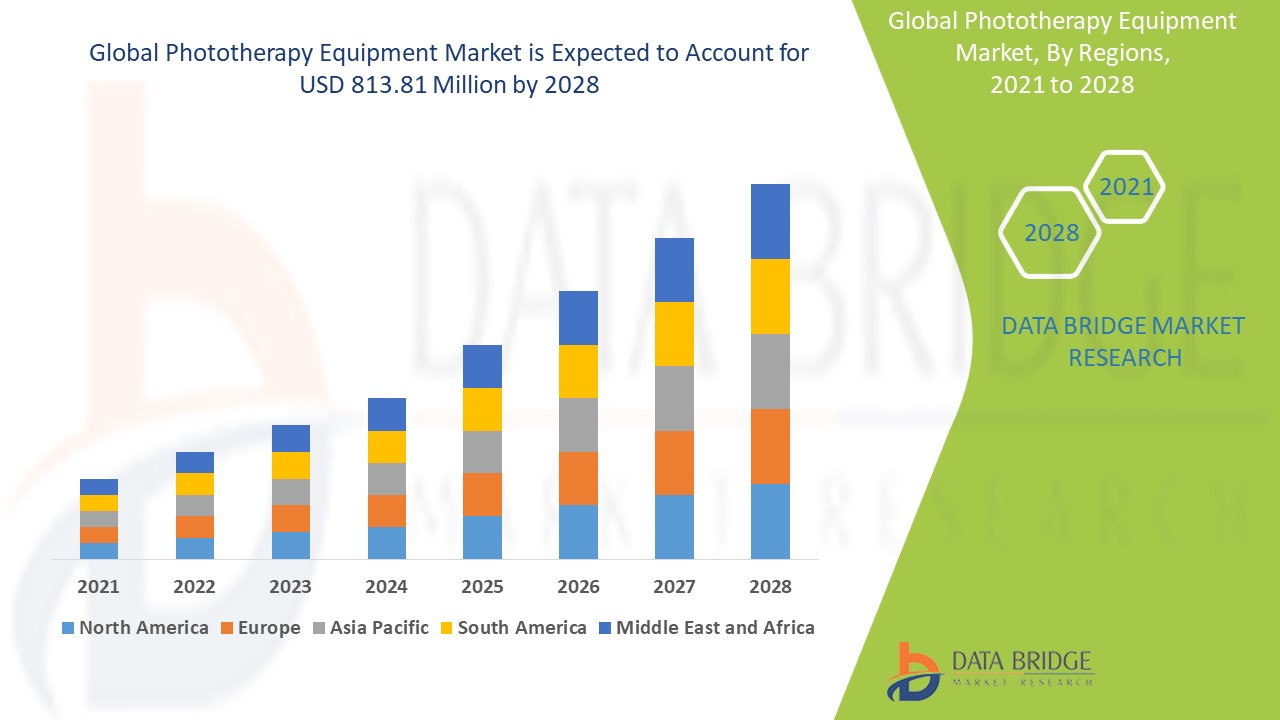
The global phototherapy equipment market size was valued at USD 672.35 Million in 2024 and is projected to reach USD 983.58 Million by 2032, with a CAGR of 4.87% during the forecast period of 2025 to 2032. In addition to the insights on market scenarios such as market value, growth rate, segmentation, geographical coverage, and major players, the market reports curated by the Data Bridge Market Research also include depth expert analysis, patient epidemiology, pipeline analysis, pricing analysis, and regulatory framework.
Phototherapy Equipment Market Trends
“Growing Preference for Led-Based Phototherapy Equipment”
The phototherapy equipment market is evolving with innovative solutions aimed at improving patient outcomes. These devices, used for treating conditions such as neonatal jaundice and skin diseases, have seen advancements in design and functionality. One notable trend is the growing preference for LED-based phototherapy equipment, offering energy efficiency, portability, and enhanced safety compared to traditional systems. Innovations in smart phototherapy devices, including remote monitoring and adjustable settings, are also gaining traction, providing healthcare professionals with greater control over treatment. This market is expanding rapidly as healthcare providers prioritize cost-effective, user-friendly, and efficient solutions. Companies such as General Electric and The Daavlin Company are at the forefront, driving progress through research and product enhancements, positioning phototherapy equipment as a key healthcare technology.
Report Scope and Phototherapy Equipment Market Segmentation
|
Attributes |
Phototherapy Equipment Key Market Insights |
|
Segments Covered |
|
|
Countries Covered |
U.S., Canada and Mexico, Germany, France, U.K., Netherlands, Switzerland, Belgium, Russia, Italy, Spain, Turkey, Rest of Europe, China, Japan, India, South Korea, Singapore, Malaysia, Australia, Thailand, Indonesia, Philippines, Rest of Asia-Pacific, Saudi Arabia, U.A.E., South Africa, Egypt, Israel, Rest of Middle East and Africa , Brazil, Argentina and Rest of South America |
|
Key Market Players |
General Electric Company (U.S.), Signify Holding (Netherlands), Natus (U.S.), Phoenix Medical Systems (India), NOVOS (Japan), Herbert Waldmann GmbH & Co. KG (Germany), nice Neotech Medical Systems Pvt. Ltd. (India), The Daavlin Company (U.S.), Lee BioSolutions (U.S.), Solarc Systems Inc. (Canada), HOSCO PRIVATE LIMITED (India), Kernel Medical Equipment Co.,LTD. (China), Olives India (India), avihealthcare (India), KRUPA MEDI SCAN (India), Narang Medical Limited (India), Hemodiaz Life Science (P) Ltd. (India), Ibis Medical (India), korrida medical systems (India) |
|
Market Opportunities |
|
|
Value Added Data Infosets |
In addition to the insights on market scenarios such as market value, growth rate, segmentation, geographical coverage, and major players, the market reports curated by the Data Bridge Market Research also include depth expert analysis, patient epidemiology, pipeline analysis, pricing analysis, and regulatory framework. |
Phototherapy Equipment Market Definition
Phototherapy equipment refers to medical devices used to treat certain conditions through exposure to light, typically ultraviolet (UV) light. These devices are commonly used for treating neonatal jaundice, skin diseases such as psoriasis, and other dermatological disorders. Phototherapy equipment includes a range of devices such as conventional phototherapy units, fiber-optic systems, and LED-based devices. These devices emit controlled light to promote healing, reduce bilirubin levels in newborns, and alleviate symptoms of various skin conditions. Phototherapy is a non-invasive treatment option that is widely used in hospitals, clinics, and increasingly in home healthcare settings due to the growing availability of portable and user-friendly models.
Phototherapy Equipment Market Dynamics
Drivers
- Rising Prevalence of Neonatal Jaundice
The increasing number of premature births and neonatal jaundice cases worldwide is a significant driver for the growth of the phototherapy equipment market. Premature infants, especially those born before 37 weeks of gestation, are more prone to developing neonatal jaundice due to their underdeveloped liver function, leading to elevated bilirubin levels. Phototherapy equipment plays a crucial role in managing this condition by using light to break down bilirubin in the baby’s blood. As the global birth rate of premature infants rises, coupled with an increase in awareness of neonatal jaundice, there is a growing demand for effective phototherapy solutions, driving market expansion.
- Growing Skin Disorders
An increase in the prevalence of skin diseases such as psoriasis, eczema, and vitiligo is significantly boosting the demand for phototherapy treatments. These chronic conditions often require long-term management, and phototherapy has proven to be an effective non-invasive treatment option. For instance, ultraviolet light therapies are widely used to reduce inflammation, promote skin healing, and manage symptoms of psoriasis and eczema. As the global population faces a rise in these dermatological conditions, the demand for phototherapy equipment continues to grow. This trend is driving the market, with more healthcare providers adopting phototherapy as a primary treatment modality for various skin disorders.
Opportunities
- Rising Trend of Home Healthcare
With the rising trend of home healthcare, portable and user-friendly phototherapy devices are becoming an attractive solution for at-home treatment, particularly for managing neonatal jaundice. These devices offer convenience, allowing parents to monitor and treat their newborns in the comfort of their homes rather than in a hospital setting. The growing preference for home-based healthcare, driven by factors such as cost-effectiveness and improved access to medical technologies, is creating new market opportunities for phototherapy equipment. As more families seek non-invasive, easy-to-use options for managing neonatal conditions, the demand for portable phototherapy devices is expected to continue expanding, driving market growth.
- Advances in Smart Phototherapy Devices
Advances in smart phototherapy devices are opening significant market opportunities. Devices equipped with features such as adjustable light intensity, remote monitoring, and integrated digital systems allow for more precise and customizable treatments. These innovations enable healthcare providers to better tailor therapies to individual patient needs, improving treatment outcomes, particularly for conditions such as neonatal jaundice and skin disorders. Remote monitoring capabilities also offer convenience for both healthcare professionals and patients, ensuring consistent treatment and early intervention if necessary. As the demand for more advanced, effective, and patient-friendly medical technologies grows, companies that invest in developing smart phototherapy devices stand to gain a competitive edge in the market.
Restraints/Challenges
- Competition from Alternative Treatments
The availability of alternative treatments, such as pharmaceutical therapies and topical treatments, poses a challenge to the adoption of phototherapy equipment. For conditions such as skin diseases, including psoriasis and eczema, patients often have multiple treatment options, including oral medications, topical creams, and biologics, which can be perceived as more convenient or effective. Similarly, neonatal jaundice can be treated with drug therapies or alternative light-based treatments. These options may discourage some healthcare providers and patients from opting for phototherapy, especially in regions with limited access to phototherapy devices or trained professionals. As a result, the competition from these alternative therapies can slow the market growth of phototherapy equipment.
- Limited Availability of Trained Professionals
A shortage of trained healthcare professionals is a significant restraint for the effective use of phototherapy equipment. Phototherapy devices, especially advanced models with features such as adjustable light intensity and remote monitoring, require skilled personnel to ensure proper usage and maximize treatment effectiveness. In regions with a limited number of trained professionals, there is a risk of improper use, which can lead to suboptimal treatment outcomes, especially in critical cases such as neonatal jaundice. This lack of skilled healthcare workers limits the adoption of advanced phototherapy technologies and hinders their full potential, particularly in developing markets where healthcare infrastructure may be less developed.
This market report provides details of new recent developments, trade regulations, import-export analysis, production analysis, value chain optimization, market share, impact of domestic and localized market players, analyses opportunities in terms of emerging revenue pockets, changes in market regulations, strategic market growth analysis, market size, category market growths, application niches and dominance, product approvals, product launches, geographic expansions, technological innovations in the market. To gain more info on the market contact Data Bridge Market Research for an Analyst Brief, our team will help you take an informed market decision to achieve market growth.
Phototherapy Equipment Market Scope
The market is segmented on the basis of type, application, and end user. The growth amongst these segments will help you analyse meagre growth segments in the industries and provide the users with a valuable market overview and market insights to help them make strategic decisions for identifying core market applications.
Type
- Conventional phototherapy equipment
- Fiber-optic phototherapy equipment
- LED-based phototherapy equipment
Application
- Skin disease treatment
- Neonatal jaundice management
End User
- Hospitals and clinics
- Home users
Phototherapy Equipment Market Regional Analysis
The market is analysed and market size insights and trends are provided by country, type, application, and end user as referenced above.
The countries covered in the market report are U.S., Canada and Mexico, Germany, France, U.K., Netherlands, Switzerland, Belgium, Russia, Italy, Spain, Turkey, rest of Europe, China, Japan, India, South Korea, Singapore, Malaysia, Australia, Thailand, Indonesia, Philippines, rest of Asia-Pacific, Saudi Arabia, U.A.E., South Africa, Egypt, Israel, rest of Middle East and Africa , Brazil, Argentina and rest of South America.
The North American region dominates the phototherapy equipment market, driven by the high adoption of advanced skincare treatment technologies.
Asia-Pacific region is projected to experience significant growth from 2025 to 2032, fueled by increasing awareness of advanced phototherapy treatments and improvements in healthcare infrastructure. The growing focus on healthcare advancements in Asia-Pacific is expected to contribute substantially to the region's market expansion.
The country section of the report also provides individual market impacting factors and changes in regulation in the market domestically that impacts the current and future trends of the market. Data points such as down-stream and upstream value chain analysis, technical trends and porter's five forces analysis, case studies are some of the pointers used to forecast the market scenario for individual countries. Also, the presence and availability of global brands and their challenges faced due to large or scarce competition from local and domestic brands, impact of domestic tariffs and trade routes are considered while providing forecast analysis of the country data.
Phototherapy Equipment Market Share
The market competitive landscape provides details by competitor. Details included are company overview, company financials, revenue generated, market potential, investment in research and development, new market initiatives, global presence, production sites and facilities, production capacities, company strengths and weaknesses, product launch, product width and breadth, application dominance. The above data points provided are only related to the companies' focus related to market.
Phototherapy Equipment Market Leaders Operating in the Market Are:
- General Electric Company (U.S.)
- Signify Holding (Netherlands)
- Natus (U.S.)
- Phoenix Medical Systems (India)
- NOVOS (Japan)
- Herbert Waldmann GmbH & Co. KG (Germany)
- nice Neotech Medical Systems Pvt. Ltd. (India)
- The Daavlin Company (U.S.)
- Lee BioSolutions (U.S.)
- Solarc Systems Inc. (Canada)
- HOSCO PRIVATE LIMITED (India)
- Kernel Medical Equipment Co.,LTD. (China)
- Olives India (India)
- avihealthcare (India)
- KRUPA MEDI SCAN (India)
- Narang Medical Limited (India)
- Hemodiaz Life Science (P) Ltd. (India)
- Ibis Medical (India)
- korrida medical systems (India)
Latest Developments in Phototherapy Equipment Market
- In February 2023, Omni Partners LLP (Omni) acquired Aesthetic Technology Ltd (ATL), the maker of the award-winning Dermalux LED systems. This acquisition strengthens Omni's position in the market for innovative light-based therapy solutions
- In April 2022, Koninklijke Philips N.V. entered into a long-term strategic partnership with Oulu University Hospital in Finland to collaborate on the development of advanced image-guided specialist care. This partnership aims to enhance operational efficiency and improve patient outcomes within the healthcare sector

- Interactive Data Analysis Dashboard
- Company Analysis Dashboard for high growth potential opportunities
- Research Analyst Access for customization & queries
- Competitor Analysis with Interactive dashboard
- Latest News, Updates & Trend analysis
- Harness the Power of Benchmark Analysis for Comprehensive Competitor Tracking
Data collection and base year analysis are done using data collection modules with large sample sizes. The stage includes obtaining market information or related data through various sources and strategies. It includes examining and planning all the data acquired from the past in advance. It likewise envelops the examination of information inconsistencies seen across different information sources. The market data is analysed and estimated using market statistical and coherent models. Also, market share analysis and key trend analysis are the major success factors in the market report. To know more, please request an analyst call or drop down your inquiry.
The key research methodology used by DBMR research team is data triangulation which involves data mining, analysis of the impact of data variables on the market and primary (industry expert) validation. Data models include Vendor Positioning Grid, Market Time Line Analysis, Market Overview and Guide, Company Positioning Grid, Patent Analysis, Pricing Analysis, Company Market Share Analysis, Standards of Measurement, Global versus Regional and Vendor Share Analysis. To know more about the research methodology, drop in an inquiry to speak to our industry experts.
Data Bridge Market Research is a leader in advanced formative research. We take pride in servicing our existing and new customers with data and analysis that match and suits their goal. The report can be customized to include price trend analysis of target brands understanding the market for additional countries (ask for the list of countries), clinical trial results data, literature review, refurbished market and product base analysis. Market analysis of target competitors can be analyzed from technology-based analysis to market portfolio strategies. We can add as many competitors that you require data about in the format and data style you are looking for. Our team of analysts can also provide you data in crude raw excel files pivot tables (Fact book) or can assist you in creating presentations from the data sets available in the report.













