


Phototherapy Market Size
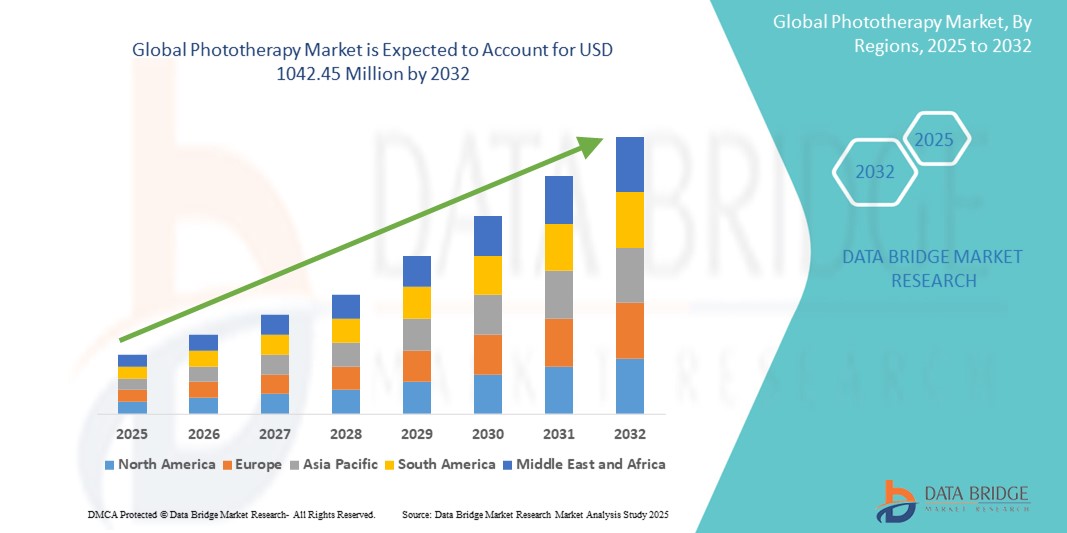
- The global phototherapy market size was valued at USD 684.43 Million in 2024 and is expected to reach USD 1,042.45 Million by 2032, at a CAGR of 5.40% during the forecast period
- The market growth is largely fueled by the increasing prevalence of neonatal jaundice, psoriasis, and other skin conditions, as well as rising awareness of non-invasive treatment options. Technological progress in light-based therapies, including advancements in LED and fiber-optic systems, is enhancing treatment precision and efficacy, thereby driving adoption across healthcare facilities
- Furthermore, growing consumer demand for safe, convenient, and home-based phototherapy solutions—particularly for conditions such as vitiligo, acne, and eczema—is establishing phototherapy as a preferred, patient-friendly therapeutic approach. These converging factors are accelerating the uptake of phototherapy devices, thereby significantly boosting the industry's growth
Phototherapy Market Analysis
- Phototherapy, a non-invasive treatment method utilizing specific light wavelengths, is increasingly vital in the management of conditions such as neonatal jaundice, psoriasis, vitiligo, and eczema. Its enhanced effectiveness, minimal side effects, and applicability in both hospital and home-care settings have made it a crucial component of modern dermatological and pediatric care
- The escalating demand for phototherapy is primarily fueled by the rising incidence of neonatal hyperbilirubinemia, increasing prevalence of chronic skin disorders, and growing awareness among patients and healthcare providers about the advantages of light-based therapies over systemic medications
- North America dominated the phototherapy market with the largest revenue share of 38.6% in 2024, driven by advanced healthcare infrastructure, favorable reimbursement policies, and the early adoption of LED-based phototherapy systems. The U.S. experienced substantial growth in both hospital and home-use phototherapy device adoption, supported by the presence of key manufacturers and increasing healthcare expenditure
- Asia-Pacific is expected to be the fastest growing region in the phototherapy market during the forecast period, with a CAGR of 8.7% from 2025 to 2032, fueled by rising birth rates, increasing urbanization, improved access to healthcare, and growing awareness of skin conditions. Countries such as India, China, and Japan are emerging as high-growth markets due to their expanding middle-class population and government initiatives to improve neonatal care
- The LED phototherapy equipment segment dominated the held the largest revenue share of 43.2% in 2024, attributed to its high efficacy, low heat emission, and energy efficiency. These devices are preferred in both NICUs and dermatology practices for their performance, safety, and longevity
Report Scope and Phototherapy Market Segmentation
|
Attributes |
Phototherapy Key Market Insights |
|
Segments Covered |
|
|
Countries Covered |
North America
Europe
Asia-Pacific
Middle East and Africa
South America
|
|
Key Market Players |
|
|
Market Opportunities |
|
|
Value Added Data Infosets |
In addition to the insights on market scenarios such as market value, growth rate, segmentation, geographical coverage, and major players, the market reports curated by the Data Bridge Market Research also include in-depth expert analysis, pricing analysis, brand share analysis, consumer survey, demography analysis, supply chain analysis, value chain analysis, raw material/consumables overview, vendor selection criteria, PESTLE Analysis, Porter Analysis, and regulatory framework. |
Phototherapy Market Trends
“Enhanced Convenience Through Technological Integration in Phototherapy”
- A significant and accelerating trend in the global phototherapy Market is the integration of advanced technologies such as automated light intensity control, smart scheduling systems, and real-time treatment monitoring. These innovations are enhancing patient convenience, treatment precision, and compliance in both clinical and home settings
- For instance, modern LED-based phototherapy devices are now equipped with programmable treatment timers, touch-screen interfaces, and mobile app connectivity, allowing users and healthcare providers to customize treatment regimens and monitor session effectiveness remotely. These features are particularly beneficial in home-use settings for chronic skin disorders such as vitiligo and psoriasis
- Smart phototherapy systems also offer automated dose adjustments based on skin response, minimizing the risk of overexposure and improving therapeutic outcomes. Some neonatal phototherapy units feature integrated bilirubin meters and thermal regulation, streamlining care for infants with jaundice in neonatal intensive care units (NICUs)
- The integration of phototherapy devices with electronic medical records (EMRs) allows clinicians to track patient progress, adjust therapy protocols more effectively, and enhance continuity of care. In some advanced healthcare systems, these technologies are linked with cloud platforms for centralized data access and analytics
- This trend toward more intelligent, connected, and user-centric phototherapy devices is fundamentally reshaping expectations in dermatology and neonatology. Companies such as GE Healthcare, Natus Medical, and Daavlin are at the forefront of developing phototherapy systems that combine efficacy with ease of use, safety, and digital integration
- The demand for smart, connected phototherapy devices is rapidly expanding across hospitals, specialty clinics, and home users, as patients and healthcare providers increasingly prioritize convenience, personalization, and real-time treatment insights
Phototherapy Market Dynamics
Driver
“Growing Need Due to Rising Incidence of Neonatal Jaundice and Skin Disorders”
- The increasing global incidence of neonatal jaundice, particularly in preterm and low birth weight infants, is a major driver for the rising demand for phototherapy treatment solutions
- For instance, in April 2024, GE HealthCare announced technological enhancements in neonatal care units with a focus on advanced phototherapy systems that offer targeted, high-intensity light exposure for more effective treatment. Such innovations by key industry players are expected to drive the phototherapy market growth during the forecast period
- In addition, phototherapy has gained significant traction for treating dermatological conditions such as psoriasis, eczema, and vitiligo, further expanding its applications beyond neonatal care
- The shift towards non-invasive treatment methods and increased awareness about the clinical benefits of phototherapy—such as reduced hospital stays and fewer side effects compared to drug therapies—are enhancing its adoption in both hospital and home care settings
- Technological advancements such as portable phototherapy units, fiber-optic blankets, and LED-based systems are improving ease of use and accessibility, thus promoting their use in rural and home healthcare setups. The growing demand for cost-effective and user-friendly phototherapy devices continues to support market expansion
Restraint/Challenge
“Concerns Regarding High Equipment Costs and Limited Access in Developing Regions”
- The relatively high cost of advanced phototherapy devices, including LED-based systems, continues to act as a barrier to adoption in low- and middle-income countries. Healthcare providers in these regions often struggle with budget constraints, limiting access to effective phototherapy solutions for newborns and dermatology patients
- For instance, in rural or under-resourced healthcare settings, hospitals may rely on outdated fluorescent lamps that are less efficient and may increase treatment duration and risk of complications
- Furthermore, a lack of trained personnel and insufficient neonatal intensive care infrastructure in certain regions hinders timely treatment, especially for critical cases of hyperbilirubinemia in infants
- Another key challenge lies in the uneven reimbursement landscape across countries, with limited insurance coverage for outpatient or home-based phototherapy treatments, leading to out-of-pocket expenditures for patients
- Addressing these issues through public-private partnerships, development of low-cost portable devices, and government-backed neonatal health programs will be critical to improving market penetration and ensuring better patient outcomes globally
Phototherapy Market Scope
The market is segmented on the basis of product, radiation, application, and end user.
• By Product
On the basis of product, the phototherapy market is segmented into conventional phototherapy equipment, LED phototherapy equipment, fiberoptic phototherapy equipment, germicidal lamps, and accessories. The LED phototherapy equipment segment held the largest revenue share of 43.2% in 2024, attributed to its high efficacy, low heat emission, and energy efficiency. These devices are preferred in both NICUs and dermatology practices for their performance, safety, and longevity.
The fiberoptic phototherapy equipment segment is expected to grow at the fastest CAGR of 7.9% from 2025 to 2032, supported by its compact design and suitability for home care, especially for neonates with jaundice.
• By Radiation
On the basis of radiation, the phototherapy market is segmented into UVA, UVB, and UVC. The UVB segment dominates the market due to its effectiveness in treating skin disorders like psoriasis and vitiligo, with minimal side effects.
Meanwhile, the UVC segment is projected to grow at the highest CAGR during the forecast period, driven by its germicidal capabilities in sterilization and disinfection applications, particularly in hospital and laboratory settings.
• By Application
On the basis of application, the phototherapy market is segmented into Skin Disease Treatment, Neonatal Jaundice Management, and Sterilization.
Neonatal Jaundice Management dominated the application segment with a revenue share of 64.3% in 2024, due to the high global prevalence of neonatal hyperbilirubinemia and increased neonatal care investments.
The Skin Disease Treatment segment is projected to grow at the highest CAGR of 8.6% during the forecast period, driven by rising cases of chronic dermatological conditions and increasing demand for drug-free, non-invasive treatment options.
• By End User
On the basis of end user, the phototherapy market is segmented into hospitals and clinics, dermatology centers, and homecare. The hospitals and clinics segment accounted for the largest share of 71.8% in 2024, owing to high adoption rates in NICUs and dermatology departments for advanced phototherapy equipment.
The homecare segment is anticipated to witness the fastest CAGR of 9.4% from 2025 to 2032, supported by the growing availability of portable phototherapy devices and a shift toward at-home treatment, particularly for dermatological conditions.
Phototherapy Market Regional Analysis
- North America dominated the phototherapy market with the largest revenue share of 38.6% in 2024, driven by the high prevalence of neonatal jaundice and chronic skin diseases such as psoriasis and vitiligo
- The region's advanced healthcare infrastructure, widespread adoption of LED-based phototherapy devices, and favorable reimbursement policies support market growth
- The growing demand for non-invasive treatments and early diagnosis, particularly in neonatal intensive care units (NICUs), further accelerates the uptake of phototherapy equipment in North America
U.S. Phototherapy Market Insight
The U.S. phototherapy market captured the largest revenue share of 83% within North America in 2024, attributed to a strong presence of neonatal care centers, widespread use of LED and fiber-optic phototherapy, and high awareness regarding skin health. Government-backed healthcare programs and private insurance coverage further facilitate access to phototherapy treatments. The increasing trend of home-based phototherapy, particularly in dermatological care, is also gaining traction across the country.
Europe Phototherapy Market Insight
The Europe phototherapy market s projected to expand at a substantial CAGR throughout the forecast period, driven by robust neonatal screening programs, rising incidence of atopic dermatitis, and technological advancements in phototherapy devices. The presence of universal healthcare systems and growing dermatological treatment demand are contributing to market expansion across key countries such as Germany, the U.K., and France.
U.K. Phototherapy Market Insight
The U.K. phototherapy market is anticipated to grow at a noteworthy CAGR during the forecast period, supported by a well-established hospital infrastructure and increasing demand for outpatient and home-based treatment options. The National Health Service (NHS) offers comprehensive neonatal jaundice screening and treatment, ensuring widespread access to phototherapy for newborns and dermatological patients asuch as.
Germany Phototherapy Market Insight
The Germany phototherapy market is expected to expand at a considerable CAGR during the forecast period. The country’s emphasis on early neonatal intervention, advanced NICUs, and dermatological care innovations fosters adoption. In addition, the strong presence of medical device manufacturers and innovation-driven policies help boost domestic phototherapy production and usage.
Asia-Pacific Phototherapy Market Insight
The Asia-Pacific phototherapy market is poised to grow at the fastest CAGR of 8.7% from 2025 to 2032. Growth is driven by high birth rates, increasing awareness of neonatal jaundice, and expanding access to healthcare in emerging economies. Countries such as China, India, and Japan are key contributors due to rising investments in neonatal care infrastructure and a growing middle-class population.
Japan Phototherapy Market Insight
The Japan phototherapy market accounted for 28.5% of the Asia-Pacific market in 2024, supported by a technologically advanced healthcare system, an aging population prone to chronic skin conditions, and strong government support for neonatal care. The rising demand for compact, efficient, and home-friendly phototherapy equipment further enhances market growth in Japan.
China Phototherapy Market Insight
The China phototherapy market led the Asia-Pacific phototherapy market with a revenue share of 36.1% in 2024, attributed to its large neonatal population, aggressive government efforts to reduce infant mortality, and domestic production of affordable LED phototherapy devices. The country's push towards rural healthcare modernization and widespread neonatal screening contributes significantly to demand.
Phototherapy Market Share
The phototherapy industry is primarily led by well-established companies, including:
- Koninklijke Philips N.V. (Netherlands)
- General Electric Company (U.S.)
- Analogic Corporation (U.S.)
- TOSHIBA CORPORATION (Japan)
- Hitachi, Ltd (Japan)
- C-RAD (Sweden)
- Elekta (Sweden)
- Accuray Incorporated (U.S.)
- Atom Medical Corp. (Japan)
- AVI Healthcare (India)
- Weyer GmbH (Germany)
- Zhengzhou Dison Instrument and Meter Co., Ltd (China)
- Natus Medical Incorporated (U.S.)
- Ibis Medical (India)
Latest Developments in Global Phototherapy Market
- In March 2024, PhotoPharmics announced the launch of the largest-ever phototherapy clinical trial for Parkinson’s disease, aiming to evaluate its innovative light-based therapy as a non-invasive treatment option. The trial represents a major milestone in the use of phototherapy beyond dermatological and neonatal applications, potentially expanding its role into neurological disease management

- Interactive Data Analysis Dashboard
- Company Analysis Dashboard for high growth potential opportunities
- Research Analyst Access for customization & queries
- Competitor Analysis with Interactive dashboard
- Latest News, Updates & Trend analysis
- Harness the Power of Benchmark Analysis for Comprehensive Competitor Tracking
Data collection and base year analysis are done using data collection modules with large sample sizes. The stage includes obtaining market information or related data through various sources and strategies. It includes examining and planning all the data acquired from the past in advance. It likewise envelops the examination of information inconsistencies seen across different information sources. The market data is analysed and estimated using market statistical and coherent models. Also, market share analysis and key trend analysis are the major success factors in the market report. To know more, please request an analyst call or drop down your inquiry.
The key research methodology used by DBMR research team is data triangulation which involves data mining, analysis of the impact of data variables on the market and primary (industry expert) validation. Data models include Vendor Positioning Grid, Market Time Line Analysis, Market Overview and Guide, Company Positioning Grid, Patent Analysis, Pricing Analysis, Company Market Share Analysis, Standards of Measurement, Global versus Regional and Vendor Share Analysis. To know more about the research methodology, drop in an inquiry to speak to our industry experts.
Data Bridge Market Research is a leader in advanced formative research. We take pride in servicing our existing and new customers with data and analysis that match and suits their goal. The report can be customized to include price trend analysis of target brands understanding the market for additional countries (ask for the list of countries), clinical trial results data, literature review, refurbished market and product base analysis. Market analysis of target competitors can be analyzed from technology-based analysis to market portfolio strategies. We can add as many competitors that you require data about in the format and data style you are looking for. Our team of analysts can also provide you data in crude raw excel files pivot tables (Fact book) or can assist you in creating presentations from the data sets available in the report.













