


What is the Physical AI Market Size and Growth Rate?
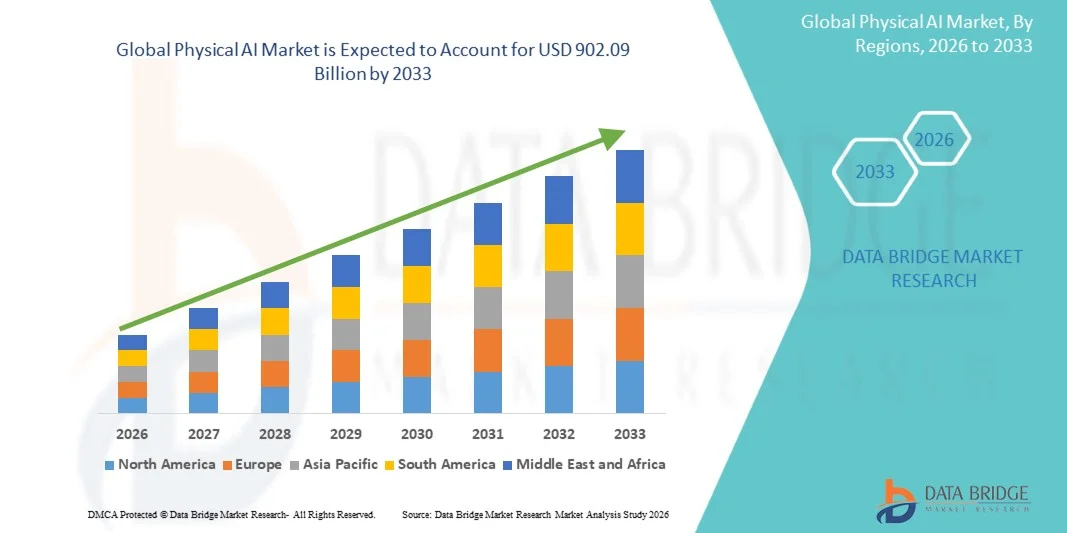
- As per Data Bridge Market Research Analysis the global physical AI market size was valued at USD 82.01 billion in 2025 and is expected to reach USD 902.09 billion by 2033, at a CAGR of 34.95% during the forecast period
- The market growth is largely fueled by the increasing adoption of robotics, automation, and AI-driven systems across industries, leading to enhanced digitalization of physical operations in sectors such as manufacturing, healthcare, and logistics
- Furthermore, rising demand for intelligent, autonomous, and adaptive systems capable of real-time decision-making and interaction with dynamic environments is establishing Physical AI as a critical technology for next-generation automation. These converging factors are accelerating the deployment of AI-enabled physical systems, thereby significantly boosting the market growth
Market Size & Forecast
Global Market Value (2025): USD 82.01 billion
Expected Market Value (2033): USD 902.09 billion
Forecast CAGR (2026–2033): 34.95%
What are the Major Takeaways of Physical AI Market?
- Physical AI refers to the integration of artificial intelligence with physical systems such as robots, machines, and autonomous devices, enabling them to perceive, learn, and act within real-world environments. These systems combine sensors, actuators, and AI algorithms to perform complex tasks with minimal human intervention across industrial and service applications
- The escalating demand for Physical AI is primarily fueled by rapid advancements in machine learning, computer vision, and edge computing, coupled with increasing focus on operational efficiency, cost reduction, and automation across industries
- North America dominated the physical AI market with a share of 41.8% in 2025, due to strong investments in robotics, AI infrastructure, and advanced automation across industries such as manufacturing, healthcare, and defense
- Asia-Pacific is expected to be the fastest growing region in the physical AI market during the forecast period due to rapid urbanization, increasing industrialization, and rising investments in AI and robotics across countries such as China, Japan, and India
- Hardware segment dominated the market with a market share of 45.5% in 2025, due to the essential role of sensors, actuators, processors, and embedded systems in enabling real-world interaction and decision-making. Physical AI systems rely heavily on advanced hardware to perceive environments, execute actions, and ensure real-time responsiveness across robotics and automation applications
Report Scope and Physical AI Market Segmentation
|
Attributes |
Physical AI Key Market Insights |
|
Segments Covered |
|
|
Countries Covered |
North America
Europe
Asia-Pacific
Middle East and Africa
South America
|
|
Key Market Players |
|
|
Market Opportunities |
|
|
Value Added Data Infosets |
In addition to the market insights such as market value, growth rate, market segments, geographical coverage, market players, and market scenario, the market report curated by the Data Bridge Market Research team includes in-depth expert analysis, import/export analysis, pricing analysis, production consumption analysis, and pestle analysis. |
What is the Key Trend in the Physical AI Market?
“Rising Integration of Physical AI with Autonomous Robotics Systems”
- A significant trend in the Physical AI market is the increasing integration of artificial intelligence into autonomous robotics systems, driven by the need for machines that can perceive, learn, and interact with real-world environments with minimal human intervention. This integration is elevating Physical AI as a foundational technology for next-generation automation across industries such as manufacturing, logistics, and healthcare
- For instance, NVIDIA introduced its Jetson Thor platform to enable real-time AI processing in humanoid robots, supporting advanced perception and decision-making capabilities. Such developments are strengthening the deployment of intelligent robots capable of performing complex physical tasks with improved efficiency and adaptability
- The adoption of Physical AI in industrial robotics is expanding rapidly as autonomous systems are increasingly used for material handling, assembly, and inspection tasks. This is positioning Physical AI as a critical enabler for smart factories aiming to enhance productivity and reduce operational errors
- The healthcare sector is integrating Physical AI into robotic-assisted surgeries, rehabilitation systems, and patient care robots where precision and real-time responsiveness are essential. This trend is accelerating innovation in medical robotics and improving patient outcomes through enhanced accuracy and reduced human intervention
- Industries focusing on logistics and warehousing are adopting AI-powered robots for sorting, picking, and last-mile delivery operations to improve speed and efficiency. This is creating a strong demand for intelligent systems capable of operating in dynamic and unstructured environments
- The market is witnessing growing adoption of humanoid and service robots equipped with advanced AI models that enable natural interaction and task execution. This increasing integration of Physical AI is reinforcing the transition toward fully autonomous systems across global industries
Physical AI Market Dynamics
Driver
“Increasing Demand for Intelligent Automation Across Industrial Sectors”
- The growing need for intelligent automation across industries such as manufacturing, logistics, and healthcare is driving the demand for Physical AI systems that enhance efficiency, accuracy, and scalability. These systems enable real-time decision-making and reduce dependency on manual labor while improving overall operational performance
- For instance, ABB deploys AI-enabled industrial robots that optimize production processes and improve precision in manufacturing environments. These solutions help organizations achieve higher throughput and reduce operational downtime, strengthening the adoption of Physical AI technologies
- The increasing complexity of industrial operations is fueling the need for autonomous systems capable of adapting to changing environments and performing multi-step tasks. Physical AI systems provide flexibility and continuous learning capabilities that support evolving industrial requirements
- The rapid expansion of e-commerce and global supply chains is accelerating the use of AI-powered robots in warehouses and distribution centers. These systems improve inventory management, order fulfillment speed, and overall logistics efficiency
- The rising focus on cost reduction, operational efficiency, and productivity enhancement continues to strengthen this driver. The demand for scalable and intelligent automation solutions is significantly contributing to the growth of the Physical AI market
Restraint/Challenge
“High Implementation Costs and Technical Complexity”
- The Physical AI market faces challenges due to the high costs associated with deploying advanced robotics systems, AI infrastructure, and specialized hardware components required for real-world applications. These investments can limit adoption, particularly among small and medium-sized enterprises
- For instance, Boston Dynamics develops highly advanced robots such as Spot and Atlas that involve significant research, engineering, and deployment costs. These high expenses make large-scale adoption challenging for organizations with limited budgets
- The integration of AI with physical systems involves complex system design, including hardware-software synchronization, real-time processing, and safety considerations. This complexity increases development time and requires specialized expertise for successful implementation
- Ensuring reliability and safety in dynamic and unpredictable environments adds further technical challenges, especially in applications such as healthcare, defense, and autonomous mobility. These requirements demand rigorous testing and validation processes
- The market continues to face constraints in achieving cost-effective scalability while maintaining high performance and safety standards. These challenges collectively impact the pace of adoption and require ongoing innovation to make Physical AI solutions more accessible and efficient
How is the Physical AI Market Segmented?
The market is segmented on the basis of component, technology, form factor, deployment, and application.
• By Component
On the basis of component, the Physical AI market is segmented into hardware, software, and services. The hardware segment dominated the largest market revenue share of 45.5% in 2025, driven by the essential role of sensors, actuators, processors, and embedded systems in enabling real-world interaction and decision-making. Physical AI systems rely heavily on advanced hardware to perceive environments, execute actions, and ensure real-time responsiveness across robotics and automation applications. Increasing investments in edge devices, robotics platforms, and AI chips further strengthen hardware demand as organizations prioritize performance, reliability, and low-latency operations. The integration of specialized AI accelerators and high-performance computing units enhances system capabilities, supporting complex physical tasks across industries. Growing deployment of robotics in manufacturing, healthcare, and logistics continues to reinforce hardware dominance as a foundational component of Physical AI systems.
The software segment is anticipated to witness the fastest growth rate from 2026 to 2033, fueled by rising demand for intelligent algorithms, real-time analytics, and adaptive learning capabilities. Software enables perception, planning, and control functions, allowing machines to interpret data and make autonomous decisions in dynamic environments. Increasing advancements in AI frameworks, simulation tools, and digital twins are accelerating software adoption across robotics and automation systems. Enterprises are focusing on scalable and upgradable software platforms to enhance flexibility and reduce operational costs over time. Continuous improvements in machine learning models and AI orchestration platforms are expected to drive rapid growth in this segment.
• By Technology
On the basis of technology, the Physical AI market is segmented into computer vision, speech/NLP, gesture/movement recognition, reinforcement learning & control systems, and others. The computer vision segment held the largest market revenue share in 2025 driven by its critical role in enabling machines to interpret visual data and interact with physical environments. Applications such as object detection, navigation, quality inspection, and surveillance rely heavily on computer vision technologies across industries. The rapid advancement of image processing algorithms and increasing availability of high-resolution sensors have significantly improved accuracy and efficiency. Widespread adoption in manufacturing automation, healthcare imaging, and autonomous systems continues to support segment dominance. Integration with edge computing further enhances real-time processing capabilities, strengthening its market position.
The reinforcement learning & control systems segment is expected to witness the fastest CAGR from 2026 to 2033, driven by the growing need for adaptive and self-learning systems in complex, dynamic environments. This technology enables machines to learn optimal actions through interaction and feedback, making it highly suitable for robotics, autonomous vehicles, and industrial automation. Increasing focus on autonomous decision-making and continuous improvement in operational efficiency is accelerating its adoption. Advancements in simulation environments and training models are enabling faster deployment and reduced development risks. The rising complexity of tasks in real-world applications is expected to further boost demand for reinforcement learning-based control systems.
• By Form Factor
On the basis of form factor, the Physical AI market is segmented into industrial robots, service robots, humanoids/social robots, cobots, exoskeletons/prosthetics, and mobile robots/drones. The industrial robots segment dominated the largest market revenue share in 2025, driven by extensive adoption in manufacturing and automotive sectors for precision, efficiency, and scalability. These robots are widely used for repetitive and high-accuracy tasks such as assembly, welding, and material handling, improving productivity and reducing operational errors. Increasing demand for automation and smart factories continues to drive the deployment of industrial robots globally. Integration of AI enhances their adaptability, enabling them to perform complex tasks with minimal human intervention. Strong investments in Industry 4.0 initiatives further reinforce the dominance of this segment.
The mobile robots/drones segment is anticipated to witness the fastest growth rate from 2026 to 2033, fueled by expanding applications in logistics, surveillance, agriculture, and last-mile delivery. These systems offer flexibility, mobility, and real-time data collection, making them suitable for dynamic and large-scale environments. Increasing adoption of autonomous navigation and AI-driven route optimization is enhancing their operational efficiency. The growing demand for contactless delivery and remote monitoring solutions is accelerating their deployment across industries. Continuous advancements in battery technology and connectivity are expected to further support rapid growth in this segment.
• By Deployment
On the basis of deployment, the Physical AI market is segmented into cloud-based AI and on-device. The cloud-based AI segment held the largest market revenue share in 2025 driven by its scalability, centralized data processing, and ability to support complex AI models. Cloud platforms enable seamless updates, large-scale data storage, and integration with multiple systems, making them suitable for enterprise-level applications. Organizations benefit from reduced infrastructure costs and enhanced computational power through cloud deployment. The growing adoption of IoT and connected devices further supports cloud integration for real-time analytics and decision-making. Continuous advancements in cloud infrastructure are strengthening its dominance in the market.
The on-device segment is expected to witness the fastest CAGR from 2026 to 2033, driven by increasing demand for low-latency processing, enhanced data privacy, and real-time responsiveness. On-device AI allows systems to process data locally without relying on external connectivity, making it ideal for critical applications such as autonomous systems and healthcare devices. Advancements in edge computing and AI chips are enabling more powerful and efficient on-device capabilities. The need for reliable performance in remote or connectivity-limited environments is accelerating adoption. Growing concerns around data security and latency are expected to further drive this segment’s growth.
• By Application
On the basis of application, the Physical AI market is segmented into healthcare, manufacturing & automotive, logistics & warehousing, retail & hospitality, defense & security, agriculture, and education & research. The manufacturing & automotive segment dominated the largest market revenue share in 2025, driven by widespread adoption of robotics and automation to enhance efficiency, precision, and cost-effectiveness. Physical AI systems are extensively used for assembly, inspection, predictive maintenance, and process optimization in industrial environments. Increasing focus on smart manufacturing and digital transformation is accelerating the integration of AI-driven systems. The need for consistent quality and reduced human intervention further strengthens segment growth. Continuous advancements in robotics and AI technologies are reinforcing its leadership position.
The healthcare segment is anticipated to witness the fastest growth rate from 2026 to 2033, fueled by increasing adoption of AI-powered robots and intelligent systems for surgery, rehabilitation, and patient care. Physical AI enhances precision, reduces human error, and improves patient outcomes in complex medical procedures. Growing demand for automation in hospitals and elderly care is driving the deployment of service robots and assistive technologies. Advancements in medical imaging, diagnostics, and wearable devices are further accelerating adoption. Rising healthcare investments and focus on improving operational efficiency are expected to support rapid growth in this segment.
Which Region Holds the Largest Share of the Physical AI Market?
- North America dominated the physical AI market with the largest revenue share of 41.8% in 2025, driven by strong investments in robotics, AI infrastructure, and advanced automation across industries such as manufacturing, healthcare, and defense
- The region benefits from a highly developed technological ecosystem, with enterprises focusing on integrating AI with physical systems to enhance productivity, precision, and operational efficiency across real-world applications
- This widespread adoption is further supported by the presence of leading technology providers, high R&D spending, and early adoption of autonomous systems, establishing Physical AI as a critical enabler of next-generation automation across sectors
U.S. Physical AI Market Insight
The U.S. Physical AI market captured the largest revenue share in 2025 within North America, fueled by rapid advancements in robotics, autonomous systems, and AI-driven industrial automation. Organizations are increasingly deploying Physical AI solutions to improve operational efficiency, reduce labor dependency, and enhance real-time decision-making capabilities. Strong investments from technology companies and government initiatives supporting AI innovation are further accelerating market growth. The increasing adoption of collaborative robots, autonomous vehicles, and AI-powered healthcare systems is significantly contributing to the expansion of the Physical AI market in the U.S.
Europe Physical AI Market Insight
The Europe Physical AI market is projected to expand at a substantial CAGR throughout the forecast period, primarily driven by strong regulatory frameworks, increasing focus on industrial automation, and rising adoption of smart manufacturing technologies. The region is witnessing growing demand for AI-enabled robotics in automotive, healthcare, and logistics sectors to improve efficiency and safety. European industries are focusing on sustainable and energy-efficient automation solutions, further supporting Physical AI adoption. The integration of AI with Industry 4.0 initiatives is playing a key role in accelerating market growth across the region.
U.K. Physical AI Market Insight
The U.K. Physical AI market is anticipated to grow at a noteworthy CAGR during the forecast period, driven by increasing investments in AI research, robotics, and automation technologies. Businesses are increasingly adopting Physical AI solutions to enhance productivity and address workforce challenges across industries. The growing focus on smart infrastructure, autonomous systems, and digital transformation is contributing to market expansion. The presence of advanced research institutions and innovation hubs is further supporting the development and deployment of Physical AI technologies in the U.K.
Germany Physical AI Market Insight
The Germany Physical AI market is expected to expand at a considerable CAGR during the forecast period, fueled by strong industrial base and leadership in manufacturing automation. Germany’s emphasis on precision engineering and Industry 4.0 initiatives is accelerating the adoption of AI-powered robotics and intelligent systems. Companies are increasingly integrating Physical AI into production processes to improve efficiency, reduce downtime, and maintain high-quality standards. The demand for advanced automation solutions in automotive and industrial sectors continues to drive market growth in Germany.
Asia-Pacific Physical AI Market Insight
The Asia-Pacific Physical AI market is poised to grow at the fastest CAGR during the forecast period of 2026 to 2033, driven by rapid urbanization, increasing industrialization, and rising investments in AI and robotics across countries such as China, Japan, and India. The region is witnessing strong adoption of automation technologies in manufacturing, logistics, and agriculture sectors. Government initiatives promoting digital transformation and smart factories are further accelerating the deployment of Physical AI solutions. The growing availability of cost-effective robotics and AI technologies is expanding adoption across a wider range of industries.
Japan Physical AI Market Insight
The Japan Physical AI market is gaining momentum due to the country’s strong technological capabilities, aging population, and increasing demand for automation. Physical AI solutions are widely adopted in robotics, healthcare, and service industries to improve efficiency and address labor shortages. The integration of AI with advanced robotics systems is driving innovation in manufacturing and service applications. Japan’s focus on developing humanoid and service robots is further contributing to the growth of the Physical AI market.
China Physical AI Market Insight
The China Physical AI market accounted for the largest market revenue share in Asia Pacific in 2025, attributed to rapid industrialization, expanding manufacturing sector, and strong government support for AI and robotics development. China is a major hub for robotics production and deployment, with increasing adoption across industrial and commercial applications. The push toward smart manufacturing and smart cities is accelerating the integration of Physical AI technologies. The presence of large-scale domestic manufacturers and growing investments in AI innovation are key factors propelling market growth in China.
What are Latest Developments in Physical AI Market?
The physical AI industry is primarily led by well-established companies, including:
- SoftBank Robotics Group (Japan)
- ABB (Switzerland)
- Toyota Motor Corporation (Japan)
- FANUC (Japan)
- KUKA AG (Germany)
- Boston Dynamics (U.S.)
- Tesla (U.S.)
- NVIDIA (U.S.)
- Google DeepMind (U.K.)
- Agility Robotics (U.S.)
- Hanson Robotics (Hong Kong)
- Universal Robots (Denmark)
- Intuitive Surgical (U.S.)
- Doosan Robotics (South Korea)
- Covariant (U.S.)
- Apptronik (U.S.)
- UBTech (China)
Latest Developments in Global Physical AI Market
- In March 2026, Tesla expanded deployment of its humanoid robot Optimus across pilot industrial environments, strengthening its positioning in real-world automation and accelerating commercialization of AI-powered robotics. This development is expected to intensify competition in the Physical AI market by pushing advancements in general-purpose robots capable of performing diverse physical tasks, thereby expanding use cases across manufacturing and logistics
- In February 2026, Boston Dynamics enhanced its AI capabilities by integrating advanced reinforcement learning into its robotic platforms such as Atlas and Spot, enabling improved autonomy and adaptability in dynamic environments. This advancement is driving the evolution of intelligent robotics systems, supporting broader adoption of Physical AI in sectors such as construction, inspection, and defense through improved efficiency and reduced human intervention
- In January 2025, NVIDIA introduced a robotics-focused compute stack including its Jetson Thor AI-chip platform designed for humanoid robots, reinforcing its role as a key infrastructure provider in the Physical AI ecosystem. This launch is accelerating innovation by enabling high-performance, energy-efficient processing for real-time decision-making, thereby supporting scalable deployment of advanced robotics across industries
- In March 2025, DeepMind launched Gemini Robotics and Gemini Robotics-ER models designed to enable robots to perform vision-language-action tasks and adapt to new environments without explicit programming. This development is significantly advancing the capabilities of Physical AI systems by improving learning efficiency and enabling more flexible, autonomous operations across complex real-world scenarios
- In August 2024, FANUC America introduced the R-50iA robot controller featuring built-in cybersecurity capabilities, enhancing the safety and reliability of industrial automation systems. This innovation is strengthening trust in connected robotics and supporting wider adoption of Physical AI solutions in manufacturing environments where secure and resilient operations are critical

- Interactive Data Analysis Dashboard
- Company Analysis Dashboard for high growth potential opportunities
- Research Analyst Access for customization & queries
- Competitor Analysis with Interactive dashboard
- Latest News, Updates & Trend analysis
- Harness the Power of Benchmark Analysis for Comprehensive Competitor Tracking
Data collection and base year analysis are done using data collection modules with large sample sizes. The stage includes obtaining market information or related data through various sources and strategies. It includes examining and planning all the data acquired from the past in advance. It likewise envelops the examination of information inconsistencies seen across different information sources. The market data is analysed and estimated using market statistical and coherent models. Also, market share analysis and key trend analysis are the major success factors in the market report. To know more, please request an analyst call or drop down your inquiry.
The key research methodology used by DBMR research team is data triangulation which involves data mining, analysis of the impact of data variables on the market and primary (industry expert) validation. Data models include Vendor Positioning Grid, Market Time Line Analysis, Market Overview and Guide, Company Positioning Grid, Patent Analysis, Pricing Analysis, Company Market Share Analysis, Standards of Measurement, Global versus Regional and Vendor Share Analysis. To know more about the research methodology, drop in an inquiry to speak to our industry experts.
Data Bridge Market Research is a leader in advanced formative research. We take pride in servicing our existing and new customers with data and analysis that match and suits their goal. The report can be customized to include price trend analysis of target brands understanding the market for additional countries (ask for the list of countries), clinical trial results data, literature review, refurbished market and product base analysis. Market analysis of target competitors can be analyzed from technology-based analysis to market portfolio strategies. We can add as many competitors that you require data about in the format and data style you are looking for. Our team of analysts can also provide you data in crude raw excel files pivot tables (Fact book) or can assist you in creating presentations from the data sets available in the report.













