


Physiotherapy Equipment Market Size
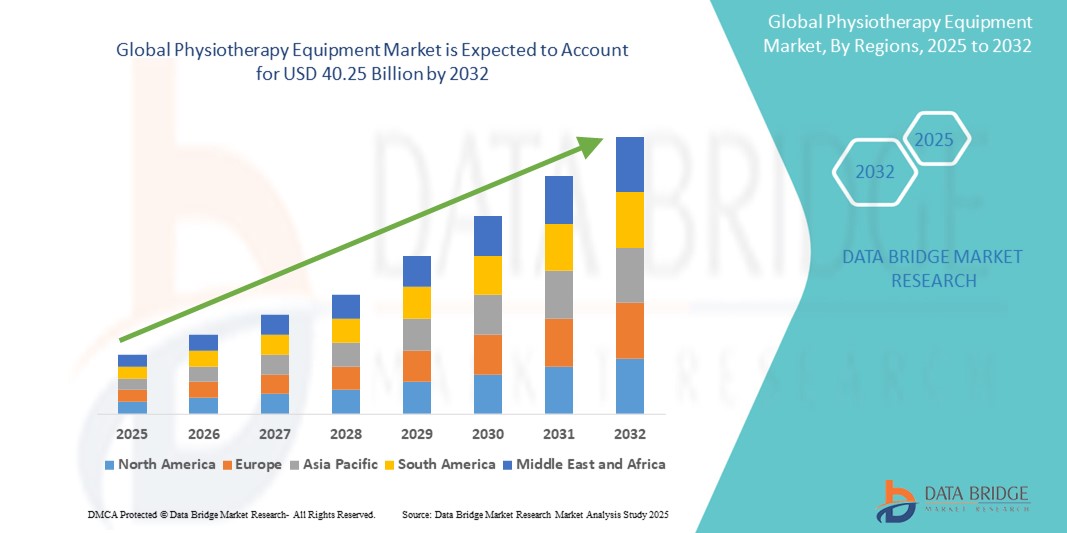
- The global physiotherapy equipment market size was valued at USD 22.24 billion in 2024 and is expected to reach USD 40.25 billion by 2032, at a CAGR of 7.70 % during the forecast period
- This growth is driven by factors such as an aging global population, which has led to a higher prevalence of musculoskeletal and neurological conditions requiring long-term physical rehabilitation.
Physiotherapy Equipment Market Analysis
- The global physiotherapy equipment market is expanding with an increasing demand for advanced rehabilitation solutions. Technological innovations, such as wearable devices and virtual reality therapies, are driving significant improvements in treatment outcomes and patient engagement
- With growing awareness of the benefits of physiotherapy, the market is seeing widespread adoption of equipment across hospitals, clinics, and home care settings. The integration of AI and smart technologies is transforming the landscape by offering more personalized and effective treatment options
- North America is expected to dominate the physiotherapy equipment market due to advanced healthcare infrastructure and high demand for innovative rehabilitation technologies
- Asia-Pacific is expected to be the fastest growing region in the physiotherapy equipment market during the forecast period due to increasing healthcare spending and expanding awareness of physiotherapy benefits
- The musculoskeletal segment is expected to dominate the physiotherapy equipment market with the largest share of 60.5% in 2025 due to its widespread use in treating common conditions such as arthritis, sports injuries, and lower back pain. The rising prevalence of musculoskeletal disorders, coupled with the increasing demand for non-invasive therapies, drives the growth of this segment
Report Scope and Physiotherapy Equipment Market Segmentation
|
Attributes |
Physiotherapy Equipment Key Market Insights |
|
Segments Covered |
|
|
Countries Covered |
North America
Europe
Asia-Pacific
Middle East and Africa
South America
|
|
Key Market Players |
|
|
Market Opportunities |
|
|
Value Added Data Infosets |
In addition to the insights on market scenarios such as market value, growth rate, segmentation, geographical coverage, and major players, the market reports curated by the Data Bridge Market Research also include depth expert analysis, patient epidemiology, pipeline analysis, pricing analysis, and regulatory framework. |
Physiotherapy Equipment Market Trends
“Increasing Adoption of Wearable Physiotherapy Devices”
- The trend of adopting wearable physiotherapy devices is gaining momentum, offering users a more personalized and convenient approach to rehabilitation
- Wearables allow for continuous monitoring of physical activity, providing real-time feedback and data for both patients and therapists
- These devices help track patient progress, ensuring that therapy is more effective and tailored to individual needs.
- For instance, smart braces that monitor joint movement can help prevent overexertion during recovery
- This trend is expected to grow as advancements in technology allow for more compact, user-friendly, and cost-effective solutions, further integrating physiotherapy into daily life. Wearables also empower patients to take a more active role in their recovery process, fostering better results
Physiotherapy Equipment Market Dynamics
Driver
“Growing Demand for Non-Invasive Treatment Methods”
- The increasing demand for non-invasive treatment methods is a significant driver in the growth of the physiotherapy equipment market, as patients and healthcare professionals seek alternatives to drugs and surgeries
- Physiotherapy has become a preferred rehabilitation and pain management option, offering effective outcomes with fewer side effects.
- For instance, electrotherapy devices are widely used to treat chronic pain without the need for medications
- Non-invasive therapies, including physiotherapy, are often linked to lower long-term healthcare costs. This makes physiotherapy an attractive option for both patients and healthcare systems seeking cost-effective treatments
- Physiotherapy equipment such as ultrasound therapy machines and therapeutic lasers plays a crucial role in recovery, reducing the reliance on invasive procedures
- For instance, therapeutic ultrasound is frequently used for soft tissue injuries, promoting faster healing without surgery
- The shift toward non-invasive therapies is expected to continue as people become more health-conscious and prefer holistic treatment options, contributing to the rising adoption of physiotherapy equipment in hospitals, outpatient clinics, and home care settings
Opportunity
“Expansion in Emerging Markets”
- The physiotherapy equipment market is witnessing significant growth opportunities in emerging markets where the demand for healthcare services is rapidly increasing due to economic development
- The growing middle class in regions such as Asia-Pacific, Latin America, and parts of Africa has increased disposable incomes, making advanced healthcare treatments, including physiotherapy, more accessible
- For instance, China and India are witnessing a rise in the availability of physiotherapy treatments as a result of this economic development
- As access to high-quality healthcare infrastructure has traditionally been limited in these regions, there is a surge in the recognition of physiotherapy’s benefits, driving demand for specialized equipment
- Governments in emerging markets are investing heavily in healthcare systems and rehabilitation services to address the growing burden of chronic conditions, further fueling the demand for physiotherapy equipment
- For instance, India has seen an increase in government funding for health programs that include physiotherapy services
- With the rise of physiotherapy clinics and rehabilitation centers, particularly in countries such as India and China, new opportunities are opening for equipment manufacturers to enter these markets and benefit from increasing adoption
Restraint/Challenge
“High Cost of Advanced Equipment”
- Despite strong growth prospects, the high cost of advanced physiotherapy equipment is a significant challenge, particularly in low-income regions where cutting-edge technologies are often out of reach for healthcare providers
- For instance, robotic rehabilitation devices, such as the ones used for stroke recovery, can cost hundreds of thousands of dollars, making them unaffordable for many hospitals in developing regions
- Sophisticated devices such as robotic rehabilitation systems, wearable sensors, and virtual reality-based equipment are priced at a premium, making them difficult for many clinics to afford. This price barrier is especially noticeable in regions with limited financial resources
- For instance, the use of virtual reality systems in physiotherapy, which, though highly effective, come with high implementation and maintenance costs
- Even in more developed markets, the high upfront investment required for purchasing and maintaining these advanced devices can deter small and mid-sized clinics from adopting them, limiting access to these technologies
- The need for specialized training to operate these advanced devices further increases the overall cost burden for healthcare providers, making it more difficult to justify the investment in physiotherapy equipment
- This financial constraint also affects the affordability of physiotherapy treatments for patients, especially in regions where insurance coverage for such services is minimal or unavailable. To address this challenge, manufacturers may need to explore more cost-effective solutions or financing options to make these technologies more accessible
Physiotherapy Equipment Market Scope
The market is segmented on the basis of equipment type, application, end user, and demographic.
|
Segmentation |
Sub-Segmentation |
|
By Equipment Type |
|
|
By Application |
|
|
By End User |
|
|
By Demographic |
|
In 2025, the musculoskeletal is projected to dominate the market with a largest share in application segment
The musculoskeletal segment is expected to dominate the physiotherapy equipment market with the largest share of 60.5% in 2025 due to its widespread use in treating common conditions such as arthritis, sports injuries, and lower back pain. The rising prevalence of musculoskeletal disorders, coupled with the increasing demand for non-invasive therapies, drives the growth of this segment.
The electro therapy equipment is expected to account for the largest share during the forecast period in equipment type market
In 2025, the electro therapy equipment segment is expected to dominate the market with the largest market share due to its effectiveness in pain management and muscle stimulation. Electrotherapy devices, such as TENS (Transcutaneous Electrical Nerve Stimulation) and EMS (Electrical Muscle Stimulation), are widely adopted for treating chronic pain, improving muscle strength, and promoting recovery after injury.
Physiotherapy Equipment Market Regional Analysis
“North America Holds the Largest Share in the Physiotherapy Equipment Market”
- North America is the dominating region in the physiotherapy equipment market, holding the largest market share of approximately 40.5%
- This dominance is driven by advanced healthcare infrastructure, high healthcare expenditure, and a strong focus on rehabilitation services
- The U.S. accounts for a significant portion of the market, driven by a high prevalence of chronic pain and musculoskeletal disorders
- Canada’s public healthcare system also contributes to growth by subsidizing physiotherapy services and increasing access to rehabilitation treatments
- The presence of established healthcare providers and the widespread adoption of innovative physiotherapy technologies further solidify North America's leadership in the market
“Asia-Pacific is Projected to Register the Highest CAGR in the Physiotherapy Equipment Market”
- Asia-Pacific region is the fastest-growing market for physiotherapy equipment market
- This rapid growth is attributed to a large and aging population, coupled with increasing healthcare expenditure and rising awareness of physiotherapy benefits
- Countries such as China and India are investing heavily in healthcare infrastructure, which is making physiotherapy services more accessible
- The growing prevalence of chronic diseases and musculoskeletal disorders in the region is driving the demand for physiotherapy equipment
- The rising adoption of advanced treatment methods, along with expanding healthcare facilities, is expected to fuel further growth in the Asia-Pacific region
Physiotherapy Equipment Market Share
The market competitive landscape provides details by competitor. Details included are company overview, company financials, revenue generated, market potential, investment in research and development, new market initiatives, global presence, production sites and facilities, production capacities, company strengths and weaknesses, product launch, product width and breadth, application dominance. The above data points provided are only related to the companies' focus related to market.
The Major Market Leaders Operating in the Market Are:
- HMS (U.S.)
- Dynatronics Corporation (U.S.)
- DJO, LLC (U.S.)
- EMS Physio Ltd. (U.K.)
- BTL (U.S.)
- Patterson Dental Supply, Inc. (U.S.)
- Whitehall Manufacturing (U.S.)
- Morris Group International (U.S.)
- Body Sport (India)
- A. Algeo Limited (U.K.)
- Danaher (U.S.)
- 3M (U.S.)
- International Electro Medical Co. (India)
- Radiance Medical Systems (Singapore)
- Accord Medical Products (India)
- Life Care Systems (India)
Latest Developments in Global Physiotherapy Equipment Market
- In November 2023, Siemens Healthineers introduced the ACUSON Maple ultrasound system, a versatile and cost-effective solution designed for high-volume clinical settings. Equipped with AI-powered applications, it enhances diagnostic efficiency and supports a broad range of imaging needs. The system's lightweight, portable design and up to 75 minutes of battery-powered scanning make it ideal for emerging markets and smaller healthcare centers. With support for 15 transducers and 25 advanced features, the ACUSON Maple streamlines workflow and improves usability. Its AI tools, such as Auto OB and eSie Measure, automate tasks, reducing measurement time and keystrokes, thereby increasing overall exam efficiency. This development positions Siemens Healthineers to better serve diverse clinical environments, particularly in regions with power supply challenges and limited resources
- In March 2023, the District Hospital in Baloda Bazar, Raipur, India, inaugurated a modern physiotherapy unit equipped with advanced therapeutic devices. The government-installed equipment includes TENS machines, IFT muscle stimulators, traction machines, shortwave diathermy (SWD), ultrasound therapy units, static bicycles, and Cordysafe chairs. These additions aim to provide comprehensive physiotherapy services for conditions such as arthritis, sciatica, post-operative limb stiffness, and neurological disorders in children. The upgraded facility enhances treatment accessibility and quality for patients in Raipur and surrounding areas, addressing a critical gap in rehabilitation services
- In January 2023, the Association of British HealthTech Industries (ABHI) and the UK Government Pavilion at Arab Health 2023 marked their most successful year to date. The event attracted a record 135,880 professionals from 183 countries and featured 3,358 exhibitors, solidifying its position as the premier platform for the global healthcare community in the Middle East. The UK Pavilion, the second largest at the event, showcased the strengths of UK healthcare innovation and celebrated collaborations between healthcare providers, clinicians, NHS Trusts, and healthcare technology companies. Over 80% of exhibitors rebooked on the spot for the 2024 exhibition, with a waiting list now in place for UK companies wishing to participate
- In February 2022, DJO, LLC, a leading global provider of medical technologies, renewed its partnership with the Professional Football Athletic Trainers Society (PFATS). This longstanding collaboration, which began in 2008, focuses on enhancing athlete safety, performance, and innovation in professional football. As part of the renewed partnership, PFATS will continue to recommend and endorse specific DJO products, including bracing and rehabilitation devices, to its members. In addition, PFATS members will serve as a sounding board for new and existing DJO devices and therapies, providing valuable feedback to drive product development. This partnership aims to promote athlete health and wellness through programs such as DJO’s preventive bracing initiative, "Join the Club," which focuses on injury prevention for high school athletes. By collaborating on evidence-based research and offering top-quality products, DJO and PFATS are committed to safeguarding athletes' health and pushing the limits of athletic performance
- In January 2022, BTL Industries (UK) expanded its physiotherapy product portfolio by integrating robotic rehabilitation devices, including the PerPedes gait training robot from Schepp MedTech. This strategic move enhances BTL's offerings in robotic rehabilitation, aligning with the growing demand for advanced therapeutic technologies. The incorporation of these devices aims to improve patient outcomes by providing precise and personalized rehabilitation therapies. This development positions BTL to better serve healthcare providers seeking innovative solutions for patient recovery and rehabilitation
- In January 2022, Zynex, Inc. (NASDAQ: ZYXI), a U.S.-based medical technology company, expanded its pain management portfolio by introducing post-operative and osteoarthritis (OA) knee braces. This strategic move aims to address the high incidence of knee injuries and OA, which are leading causes of orthopedic consultations. The new knee braces are designed to alleviate pain, enhance mobility, and potentially delay the need for surgical interventions by reducing joint wear and tear. Zynex's nationwide sales force is being trained to promote these products, which are well-recognized among orthopedic prescribers and commonly reimbursed by health insurance companies. This addition diversifies Zynex's revenue streams and strengthens its position in the orthopedic market

- Interactive Data Analysis Dashboard
- Company Analysis Dashboard for high growth potential opportunities
- Research Analyst Access for customization & queries
- Competitor Analysis with Interactive dashboard
- Latest News, Updates & Trend analysis
- Harness the Power of Benchmark Analysis for Comprehensive Competitor Tracking
Data collection and base year analysis are done using data collection modules with large sample sizes. The stage includes obtaining market information or related data through various sources and strategies. It includes examining and planning all the data acquired from the past in advance. It likewise envelops the examination of information inconsistencies seen across different information sources. The market data is analysed and estimated using market statistical and coherent models. Also, market share analysis and key trend analysis are the major success factors in the market report. To know more, please request an analyst call or drop down your inquiry.
The key research methodology used by DBMR research team is data triangulation which involves data mining, analysis of the impact of data variables on the market and primary (industry expert) validation. Data models include Vendor Positioning Grid, Market Time Line Analysis, Market Overview and Guide, Company Positioning Grid, Patent Analysis, Pricing Analysis, Company Market Share Analysis, Standards of Measurement, Global versus Regional and Vendor Share Analysis. To know more about the research methodology, drop in an inquiry to speak to our industry experts.
Data Bridge Market Research is a leader in advanced formative research. We take pride in servicing our existing and new customers with data and analysis that match and suits their goal. The report can be customized to include price trend analysis of target brands understanding the market for additional countries (ask for the list of countries), clinical trial results data, literature review, refurbished market and product base analysis. Market analysis of target competitors can be analyzed from technology-based analysis to market portfolio strategies. We can add as many competitors that you require data about in the format and data style you are looking for. Our team of analysts can also provide you data in crude raw excel files pivot tables (Fact book) or can assist you in creating presentations from the data sets available in the report.













