Global Phytogenic Aquafeed Additives Market Size
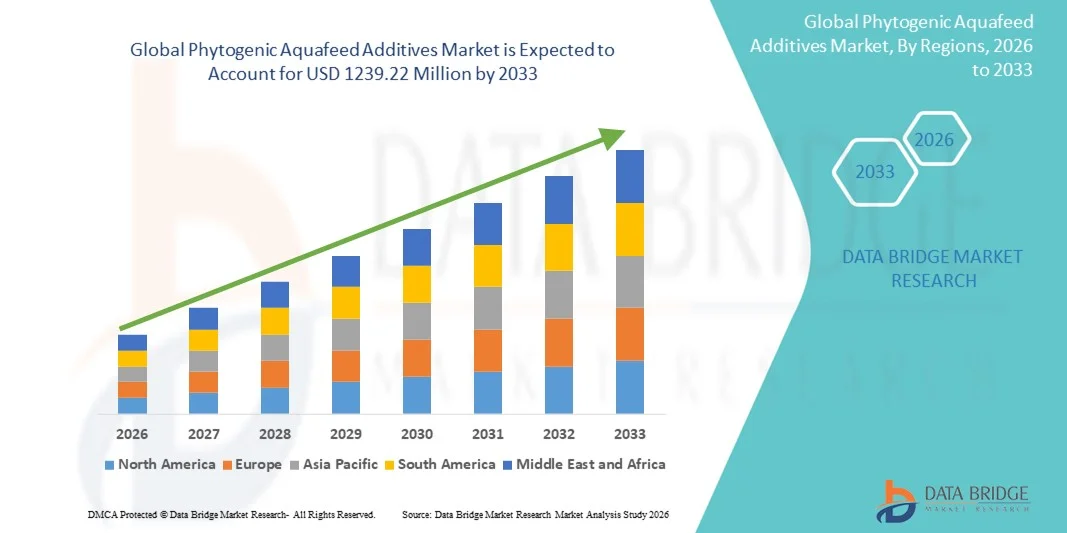
- The global Phytogenic Aquafeed Additives Market size was valued at USD 622.38 million in 2025 and is expected to reach USD 1239.22 million by 2033, at a CAGR of 8.99% during the forecast period.
- The market growth is largely driven by the increasing demand for natural and sustainable feed additives in aquaculture, along with rising awareness about the adverse effects of synthetic growth promoters on fish health and the environment.
- Furthermore, technological advancements in extraction methods and formulation of plant-based additives, coupled with supportive government regulations promoting sustainable aquaculture practices, are encouraging adoption among feed manufacturers and fish farmers, thereby significantly boosting the industry’s growth.
Global Phytogenic Aquafeed Additives Market Analysis
- Phytogenic aquafeed additives, derived from natural plant extracts such as essential oils, herbs, and spices, are increasingly vital components of modern aquaculture feed formulations due to their ability to enhance fish growth, improve gut health, and act as natural alternatives to antibiotics.
- The escalating demand for phytogenic additives is primarily fueled by the growing focus on sustainable aquaculture practices, rising consumer preference for chemical-free seafood, and increasing awareness of the negative effects of synthetic growth promoters on aquatic species and the environment.
- North America dominated the Global Phytogenic Aquafeed Additives Market with the largest revenue share of 35% in 2025, characterized by early adoption of sustainable aquaculture practices, well-established aquaculture infrastructure, and a strong presence of key industry players, with the U.S. experiencing substantial growth in the use of plant-based feed additives driven by innovations in formulation, research on gut health, and regulatory support for natural feed solutions.
- Europe is expected to be the fastest-growing region in the Global Phytogenic Aquafeed Additives Market during the forecast period due to rapid expansion of aquaculture, increasing seafood consumption, and rising investments in sustainable farming technologies.
- The essential oils segment dominated the market with the largest revenue share of 42.5% in 2025, driven by their established efficacy in enhancing feed digestibility, immunity, and growth performance across aquaculture species.
Report Scope and Global Phytogenic Aquafeed Additives Market Segmentation
|
Attributes |
Phytogenic Aquafeed Additives Key Market Insights |
|
Segments Covered |
|
|
Countries Covered |
North America
Europe
Asia-Pacific
Middle East and Africa
South America
|
|
Key Market Players |
|
|
Market Opportunities |
|
|
Value Added Data Infosets |
In addition to the insights on market scenarios such as market value, growth rate, segmentation, geographical coverage, and major players, the market reports curated by the Data Bridge Market Research also include import export analysis, production capacity overview, production consumption analysis, price trend analysis, climate change scenario, supply chain analysis, value chain analysis, raw material/consumables overview, vendor selection criteria, PESTLE Analysis, Porter Analysis, and regulatory framework. |
Global Phytogenic Aquafeed Additives Market Trends
Enhanced Performance Through Advanced Formulations and Precision Nutrition
- A significant and accelerating trend in the global Phytogenic Aquafeed Additives Market is the integration of advanced formulations and precision nutrition technologies, which optimize growth performance, gut health, and immunity in aquaculture species. This fusion of scientific innovation and natural ingredients is significantly enhancing feed efficiency and overall farm productivity.
- For instance, Biomin’s phytogenic feed additives combine essential oils, herbs, and natural extracts tailored to species-specific requirements, helping improve feed conversion ratios and disease resistance in both freshwater and marine fish. Similarly, DSM’s Activo phytogenic solutions support gut health while promoting natural growth, enabling farmers to reduce reliance on antibiotics.
- Precision formulation allows additives to target specific physiological needs of aquaculture species, enhancing nutrient absorption, immunity, and stress tolerance. For example, certain Alltech and Novus products leverage encapsulation technology to ensure active compounds are delivered effectively through the digestive tract, maximizing efficacy.
- The seamless integration of phytogenic additives with other feed technologies, such as probiotics, enzymes, and vitamins, facilitates a holistic approach to aquaculture nutrition. Through a single feed regimen, farmers can address multiple performance parameters, from growth optimization to disease prevention, creating a unified and sustainable production system.
- This trend toward more intelligent, science-backed, and multifunctional feed solutions is fundamentally reshaping expectations for aquaculture productivity and sustainability. Consequently, companies such as Cargill, Huvepharma, and Phytobiotics are developing next-generation phytogenic additives with targeted delivery, enhanced bioavailability, and synergistic blends of natural compounds.
- The demand for phytogenic feed additives that combine advanced formulations with precision nutrition is growing rapidly across global aquaculture sectors, as producers increasingly prioritize natural, effective, and sustainable solutions for fish and shrimp farming.
Global Phytogenic Aquafeed Additives Market Dynamics
Driver
Growing Need Due to Rising Demand for Sustainable and Antibiotic-Free Aquaculture
- The increasing focus on sustainable aquaculture practices, coupled with rising consumer demand for chemical-free seafood, is a significant driver for the heightened adoption of phytogenic aquafeed additives.
- For instance, in 2025, Biomin launched new phytogenic feed solutions designed to improve gut health and enhance growth performance in shrimp and fish, targeting aquaculture operations aiming to reduce antibiotic usage. Such initiatives by key companies are expected to drive market growth during the forecast period.
- As farmers become more aware of the negative effects of synthetic growth promoters on fish health and the environment, phytogenic additives offer natural alternatives that improve immunity, feed conversion ratios, and overall productivity, providing a compelling upgrade over conventional feed additives.
- Furthermore, the growing adoption of integrated aquaculture technologies and precision feeding systems is making phytogenic additives an essential component of optimized feed regimens, enabling seamless integration with probiotics, enzymes, and vitamins to support holistic aquatic nutrition.
- The effectiveness of plant-based additives in enhancing disease resistance, improving digestion, and supporting sustainable production practices are key factors propelling their adoption across global aquaculture operations. The trend toward environmentally conscious and consumer-driven aquaculture further accelerates market growth.
Restraint/Challenge
Concerns Regarding High Costs and Variability in Efficacy
- Concerns surrounding the relatively higher cost of phytogenic feed additives compared to conventional synthetic additives pose a significant challenge to broader market penetration, particularly in price-sensitive regions.
- For instance, small- and medium-scale aquaculture operations may hesitate to adopt advanced phytogenic solutions due to the upfront investment required for formulation integration and feed trials.
- Additionally, variability in efficacy due to differences in plant extract composition, species-specific responses, and environmental factors can create uncertainty among farmers. Companies such as Cargill and Huvepharma are addressing these concerns through research-backed formulations, standardized quality controls, and educational programs demonstrating consistent results.
- While prices are gradually becoming more competitive, the perception of premium cost can still hinder widespread adoption, especially for producers focused on short-term operational budgets rather than long-term health and sustainability benefits.
- Overcoming these challenges through product standardization, cost optimization, farmer training, and demonstration of tangible performance improvements will be vital for sustained market growth.
Global Phytogenic Aquafeed Additives Market Scope
Phytogenic aquafeed additives market is segmented on the basis of type, livestock, source and ingredient.
- By Type
On the basis of type, the Global Phytogenic Aquafeed Additives Market is segmented into essential oils, flavonoids, saponins, and oleoresins. The essential oils segment dominated the market with the largest revenue share of 42.5% in 2025, driven by their established efficacy in enhancing feed digestibility, immunity, and growth performance across aquaculture species. Essential oils are widely preferred due to their multifunctional properties, ease of incorporation into feed, and proven benefits in replacing synthetic growth promoters.
The saponins segment is anticipated to witness the fastest CAGR of 21.3% from 2026 to 2033, fueled by growing research on their ability to improve lipid metabolism, gut health, and disease resistance in both fish and shrimp. Increasing awareness of sustainable aquaculture practices and demand for natural feed additives are further supporting saponin adoption globally.
- By Livestock
On the basis of livestock, the Global Phytogenic Aquafeed Additives Market is segmented into poultry, swine, ruminants, and aquatic animals. The aquatic animals segment held the largest market revenue share of 45.8% in 2025, driven by the rapid expansion of aquaculture worldwide and increasing demand for high-quality seafood. Phytogenic additives are widely used in fish and shrimp feed to enhance growth, improve gut health, and reduce disease outbreaks without antibiotics.
The poultry segment is expected to witness the fastest CAGR of 20.7% from 2026 to 2033, propelled by rising global meat consumption, the need for antibiotic-free production, and growing awareness of natural feed alternatives among poultry farmers.
- By Source
On the basis of source, the Global Phytogenic Aquafeed Additives Market is segmented into herbs & spices, flowers, and fruits & vegetables. The herbs & spices segment dominated the market with a revenue share of 47.2% in 2025, attributed to their wide availability, high bioactive content, and strong efficacy in promoting feed efficiency and animal health.
Flowers are expected to witness the fastest CAGR of 22.1% from 2026 to 2033, due to increasing research on their bioactive compounds for immune support, antioxidative properties, and natural growth promotion in aquatic and terrestrial livestock species. The rising trend toward sustainable and natural feed ingredients is further accelerating the adoption of flower-based phytogenic additives.
- By Ingredient
On the basis of ingredient, the Global Phytogenic Aquafeed Additives Market is segmented into anti-parasitic, feed acidifiers, prebiotics, and palatants. The feed acidifiers segment dominated the market with a revenue share of 44.3% in 2025, driven by their proven benefits in improving gut health, nutrient absorption, and growth performance, especially in aquaculture species.
The prebiotics segment is expected to witness the fastest CAGR of 23.0% from 2026 to 2033, fueled by increasing awareness of gut microbiome management, rising demand for natural alternatives to antibiotics, and the growing focus on animal health and productivity. Innovations in combining prebiotics with other phytogenic compounds are further boosting market growth.
Global Phytogenic Aquafeed Additives Market Regional Analysis
- North America dominated the Global Phytogenic Aquafeed Additives Market with the largest revenue share of 35% in 2025, driven by the growing adoption of sustainable aquaculture practices and the increasing shift toward natural, plant-based feed additives.
- Producers in the region highly value the efficiency, health benefits, and environmental advantages offered by phytogenic additives, which enhance fish growth, improve feed utilization, and reduce dependency on synthetic antibiotics.
- This strong regional demand is further supported by advanced aquaculture infrastructure, high awareness of sustainable food production, and significant investments in research and innovation by leading feed manufacturers, establishing North America as a key hub for phytogenic aquafeed development and application.
U.S. Phytogenic Aquafeed Additives Market Insight
The U.S. phytogenic aquafeed additives market captured the largest revenue share of 81% in 2025 within North America, driven by the strong focus on sustainable aquaculture practices and the transition toward antibiotic-free feed solutions. Consumers and producers alike are increasingly prioritizing food safety, environmental sustainability, and improved aquatic health. The U.S. market benefits from robust investments in aquaculture R&D, advanced feed formulation technologies, and rising awareness of the benefits of natural plant-based additives. Moreover, leading players such as Cargill and ADM are expanding their phytogenic product portfolios, promoting innovation and accelerating adoption across fish and shrimp farming operations.
Europe Phytogenic Aquafeed Additives Market Insight
The Europe phytogenic aquafeed additives market is projected to expand at a substantial CAGR throughout the forecast period, primarily driven by stringent environmental regulations and the region’s strong commitment to sustainable aquaculture. Growing restrictions on antibiotic use and increasing consumer demand for clean-label seafood are fostering the adoption of phytogenic solutions. European aquafeed producers are focusing on enhancing feed efficiency and fish welfare using herbal extracts, essential oils, and plant-derived antioxidants. The market is witnessing steady growth across countries like Norway, Denmark, and Spain, with significant adoption in both intensive aquaculture and recirculating aquaculture systems (RAS).
U.K. Phytogenic Aquafeed Additives Market Insight
The U.K. phytogenic aquafeed additives market is anticipated to grow at a noteworthy CAGR during the forecast period, driven by the country’s expanding aquaculture industry and increasing emphasis on antibiotic reduction. Rising awareness about sustainable fish farming, coupled with the growing demand for organic and natural seafood, is propelling market growth. The adoption of herbal and essential oil-based additives is becoming increasingly common among aquafeed manufacturers aiming to improve fish health, growth rate, and feed conversion efficiency. Additionally, supportive government policies promoting eco-friendly aquaculture practices continue to strengthen market expansion.
Germany Phytogenic Aquafeed Additives Market Insight
The Germany phytogenic aquafeed additives market is expected to expand at a considerable CAGR during the forecast period, fueled by the nation’s commitment to sustainability and innovation in animal nutrition. German aquafeed producers emphasize the use of standardized, science-backed plant extracts that enhance digestion and immunity in fish and shrimp. The country’s advanced feed technology infrastructure and strong focus on R&D foster the development of highly effective phytogenic formulations. Moreover, growing demand for high-quality, antibiotic-free seafood products among German consumers supports market growth, particularly within organic aquaculture operations.
Asia-Pacific Phytogenic Aquafeed Additives Market Insight
The Asia-Pacific phytogenic aquafeed additives market is poised to grow at the fastest CAGR of 24% during the forecast period (2026–2033), driven by rapid aquaculture expansion, urbanization, and rising disposable incomes in countries such as China, India, Vietnam, and Indonesia. The region’s growing seafood consumption and government initiatives promoting sustainable aquaculture are key drivers. Additionally, APAC serves as a major production hub for aquafeed and feed additives, enhancing affordability and accessibility. Increasing awareness about disease prevention and performance improvement through natural additives further accelerates regional growth.
Japan Phytogenic Aquafeed Additives Market Insight
The Japan phytogenic aquafeed additives market is gaining momentum due to the country’s technological advancement and focus on premium-quality seafood production. Japan’s aquaculture industry increasingly integrates phytogenic additives to enhance feed utilization, reduce mortality, and improve fish welfare. The market benefits from innovation in precision nutrition and sustainable feed technology. Moreover, the aging population and rising preference for health-conscious diets are spurring demand for naturally farmed seafood, encouraging feed manufacturers to incorporate phytogenic compounds such as essential oils and flavonoids into their formulations.
China Phytogenic Aquafeed Additives Market Insight
The China phytogenic aquafeed additives market accounted for the largest market revenue share in Asia-Pacific in 2025, driven by the nation’s position as the world’s largest aquaculture producer. Rapid urbanization, a growing middle-class population, and strong government support for sustainable aquaculture are fueling demand. China’s aquafeed industry is witnessing a shift toward natural, eco-friendly ingredients as producers work to reduce antibiotic dependence and enhance productivity. The country’s robust manufacturing base and availability of domestic plant-based raw materials further contribute to cost-effective production and widespread adoption of phytogenic feed additives across fish and shrimp farming operations.
Global Phytogenic Aquafeed Additives Market Share
The Phytogenic Aquafeed Additives industry is primarily led by well-established companies, including:
• Cargill Incorporated (U.S.)
• Archer Daniels Midland Company (U.S.)
• DSM-Firmenich (Netherlands)
• Alltech Inc. (U.S.)
• Biomin GmbH (Austria)
• Adisseo Group (France)
• Kemin Industries Inc. (U.S.)
• Nutreco N.V. (Netherlands)
• Evonik Industries AG (Germany)
• Huvepharma (Bulgaria)
• Phytobiotics Futterzusatzstoffe GmbH (Germany)
• Trouw Nutrition (Netherlands)
• Novus International Inc. (U.S.)
• Biorigin (Brazil)
• AB Agri Ltd. (U.K.)
• Lallemand Animal Nutrition (Canada)
• Ridley Corporation Ltd. (Australia)
• Guangdong VTR Bio-Tech Co., Ltd. (China)
• Blue Aqua International (Singapore)
• Natural Remedies Pvt. Ltd. (India)
What are the Recent Developments in Global Phytogenic Aquafeed Additives Market?
- In April 2024, Cargill Incorporated, a global leader in animal nutrition, launched a strategic initiative in Vietnam aimed at advancing sustainable aquaculture through the introduction of its next-generation phytogenic feed additives. This initiative underscores the company’s dedication to promoting antibiotic-free aquafeeds and enhancing fish and shrimp health using natural plant-based ingredients. By leveraging its global R&D capabilities and extensive market presence, Cargill is not only addressing local sustainability challenges but also reinforcing its leadership in the rapidly expanding Global Phytogenic Aquafeed Additives Market.
- In March 2024, Biomin GmbH (part of DSM-Firmenich) introduced its new Digestarom® Aqua phytogenic additive line, specifically designed to improve gut performance and feed efficiency in tilapia and shrimp farming. This innovative formulation utilizes a proprietary blend of essential oils and herbs to boost nutrient absorption and reduce oxidative stress. The launch highlights Biomin’s commitment to science-driven, sustainable solutions that enhance aquaculture productivity while minimizing environmental impact.
- In March 2024, Alltech Inc. partnered with the Norwegian Institute of Marine Research to develop advanced plant-based feed solutions for cold-water aquaculture species such as salmon and trout. This collaboration focuses on optimizing phytogenic additive combinations to enhance growth rates, immunity, and stress tolerance in fish. The initiative emphasizes Alltech’s strategic focus on innovation and sustainability within the aquaculture feed segment.
- In February 2024, Huvepharma announced a strategic partnership with the Thailand Department of Fisheries to promote the use of natural phytogenic feed additives in shrimp and freshwater fish farming. The collaboration aims to reduce antibiotic dependence, improve water quality, and enhance disease resistance, aligning with the Thai government’s “Green Aquaculture” program. This partnership demonstrates Huvepharma’s commitment to driving responsible aquaculture through science-based phytogenic solutions.
- In January 2024, Adisseo Group, a global provider of animal nutrition solutions, unveiled its latest AquaPhy® range of phytogenic aquafeed additives at the Global Seafood Expo 2024 in Barcelona. These formulations combine essential oils, saponins, and plant extracts to improve gut health and feed conversion in shrimp and fish. The launch reflects Adisseo’s ongoing efforts to integrate sustainability, performance, and innovation in aquafeed nutrition, providing farmers with reliable, natural alternatives to synthetic additives.

- Interactive Data Analysis Dashboard
- Company Analysis Dashboard for high growth potential opportunities
- Research Analyst Access for customization & queries
- Competitor Analysis with Interactive dashboard
- Latest News, Updates & Trend analysis
- Harness the Power of Benchmark Analysis for Comprehensive Competitor Tracking
Data collection and base year analysis are done using data collection modules with large sample sizes. The stage includes obtaining market information or related data through various sources and strategies. It includes examining and planning all the data acquired from the past in advance. It likewise envelops the examination of information inconsistencies seen across different information sources. The market data is analysed and estimated using market statistical and coherent models. Also, market share analysis and key trend analysis are the major success factors in the market report. To know more, please request an analyst call or drop down your inquiry.
The key research methodology used by DBMR research team is data triangulation which involves data mining, analysis of the impact of data variables on the market and primary (industry expert) validation. Data models include Vendor Positioning Grid, Market Time Line Analysis, Market Overview and Guide, Company Positioning Grid, Patent Analysis, Pricing Analysis, Company Market Share Analysis, Standards of Measurement, Global versus Regional and Vendor Share Analysis. To know more about the research methodology, drop in an inquiry to speak to our industry experts.
Data Bridge Market Research is a leader in advanced formative research. We take pride in servicing our existing and new customers with data and analysis that match and suits their goal. The report can be customized to include price trend analysis of target brands understanding the market for additional countries (ask for the list of countries), clinical trial results data, literature review, refurbished market and product base analysis. Market analysis of target competitors can be analyzed from technology-based analysis to market portfolio strategies. We can add as many competitors that you require data about in the format and data style you are looking for. Our team of analysts can also provide you data in crude raw excel files pivot tables (Fact book) or can assist you in creating presentations from the data sets available in the report.