What is the Phytogenic Feed Additives for Swine Market Size and Growth Rate?
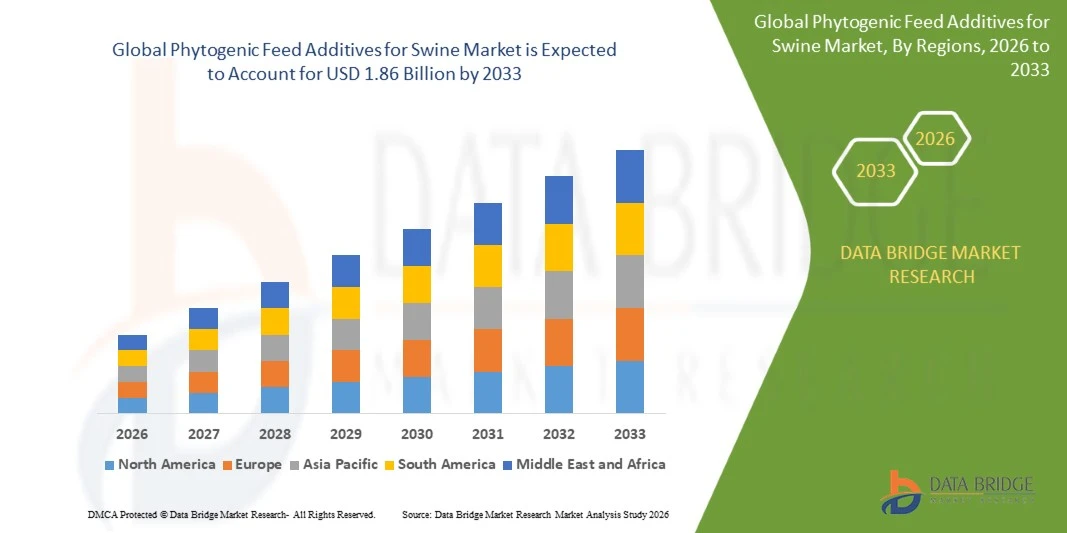
- As per Data Bridge Market Research analysis, the phytogenic feed additives for swine market was valued at USD 1.01 billion in 2025 and is projected to reach USD 1.86 billion by 2033, growing at a CAGR of 8.00% from 2026 to 2033.
- The market is experiencing consistent growth driven by increasing demand for natural and sustainable feed additives, advancements in plant-derived feed formulations, and expanding applications of essential oils, herbs, spices, and botanical extracts in swine nutrition.
- The increasing focus on reducing antibiotic use in livestock production, combined with rising demand for high-quality pork and improved animal welfare, is encouraging swine producers to adopt phytogenic feed additives. Plant-based ingredients such as essential oils, herbs, spices, and botanical extracts are increasingly used to support gut health, improve feed conversion efficiency, and strengthen immunity. These additives offer a natural approach to improving swine productivity while supporting more sustainable animal nutrition practices.
Market Size & Forecast
- Global Market Value (2025): USD 1.01 Billion
- Expected Market Value (2033): USD 1.86 Billion
- Forecast CAGR (2026–2033): 8.00%
- Leading Region in 2025: North America
- Fastest Growing Region: Asia Pacific
What are the Major Takeaways of the Phytogenic Feed Additives for Swine Market?
- North America dominated the phytogenic feed additives for swine market with the largest revenue share of 35.2% in 2025, supported by advanced livestock production practices, increasing demand for natural feed ingredients, and growing emphasis on reducing antibiotic use in swine farming.
- Asia-Pacific is expected to be the fastest-growing region at a CAGR of 8.6% from 2026 to 2033, fueled by rising pork consumption, expanding commercial pig farming, and increasing adoption of phytogenic feed additives in China, India, and other emerging markets.
- The essential oils segment led the market with a 44.6% share in 2025, driven by increasing demand for natural feed ingredients that support digestive health, feed efficiency, and animal performance.
- Oleoresins are the fastest-growing type, projected to register a CAGR of 8.5%, reflecting the surge in interest in concentrated botanical ingredients for animal nutrition.
- The herbs and spices segment dominated the source category with a 47.5% revenue share in 2025, led by the widespread use of oregano, thyme, garlic, cinnamon, and other botanical ingredients in swine nutrition.
- Performance enhancers accounted for 45.9% of the market share in 2025, preferred by increasing demand for improved weight gain, feed conversion efficiency, and production productivity
- The liquid segment is the fastest-growing form category, with a CAGR of 8.6%, driven by increasing demand for convenient feed additive delivery and growing adoption of liquid supplementation systems to support swine gut health and nutritional performance.
Report Scope and Phytogenic Feed Additives for Swine Market Segmentation
|
Attributes |
Phytogenic Feed Additives for Swine Key Market Insights |
|
Segments Covered |
|
|
Countries Covered |
North America
Europe
Asia-Pacific
Middle East and Africa
South America
|
|
Key Market Players |
|
|
Market Opportunities |
|
|
Value Added Data Infosets |
In addition to the insights on market scenarios such as market value, growth rate, segmentation, geographical coverage, and major players, the market reports curated by the Data Bridge Market Research also include import export analysis, production capacity overview, production consumption analysis, price trend analysis, climate change scenario, supply chain analysis, value chain analysis, raw material/consumables overview, vendor selection criteria, PESTLE Analysis, Porter Analysis, and regulatory framework. |
What is the Key Trend in the Phytogenic Feed Additives for Swine Market?
- Swine feed manufacturers are increasingly incorporating plant-derived essential oils, herbal extracts, and botanical compounds into feed formulations to support gut health, improve nutrient utilization, and reduce reliance on conventional antibiotic growth promoters .
- For instance, in March 2024, a study published in Frontiers in Veterinary Science evaluating coated plant essential oils in 360 weaned piglets. The study found improvements in growth performance, immune response, antioxidant activity, and fecal microbiota, highlighting the growing interest in targeted phytogenic formulations for swine nutrition
- Growing interest in microbiome-focused nutrition is encouraging manufacturers to develop targeted botanical blends for piglets, growing pigs, and finishing pigs.
- Feed producers are increasingly evaluating phytogenic combinations containing essential oils, polyphenols, and plant extracts to support digestive function and animal performance under different production conditions.
- For instance, in January 2025, a study published in Stresses examining a phytogenic feed additive containing herbs, plant extracts, and essential oils in post-weaning piglets. The findings included reduced fecal shedding of pathogenic E. coli under specific experimental conditions, reflecting continued research into botanical additives for intestinal health.
- As swine producers prioritize natural feed solutions, gut health, and sustainable livestock production, demand for scientifically evaluated phytogenic formulations is expected to increase across commercial pig farming.
What are the Key Drivers of the Phytogenic Feed Additives for Swine Market?
- The growing emphasis on reducing antibiotic use in livestock production has increased demand for phytogenic feed additives that support gut health, improve nutrient digestibility, and help maintain swine performance .
- For instance, in May 2024, a study published in the Journal of Animal Science evaluating a phytogenic feed additive in 1,380 weaned pigs. The study found that supplementation at an optimal inclusion level of 0.1% improved growth performance, including average daily gain and feed efficiency, supporting demand for effective nutritional solutions in commercial swine production.
- Commercial swine producers are increasingly seeking nutritional solutions that improve feed conversion efficiency, support animal resilience, and reduce production losses associated with digestive disorders.
- For instance, in May 2023, a study published in the Journal of Animal Science examining different ratios of phytogenic feed additives in weaned pigs challenged with pathogenic E. coli. The research assessed growth performance, nutrient digestibility, intestinal barrier integrity, and immune response, highlighting the potential of phytogenic formulations to support swine health and reduce reliance on conventional antimicrobial interventions
- With increasing attention to responsible antimicrobial use, efficient livestock production, and evidence-based animal nutrition, phytogenic feed additives are expected to remain an important component of modern swine feeding strategies.
What Factors are Challenging the Growth of the Phytogenic Feed Additives for Swine Market?
- Phytogenic feed additives can face challenges related to variable botanical composition, differences in active compound concentrations, and inconsistent performance across animal diets and production conditions .
- For instance, in April 2023, an article published in Livestock Science examining 104 studies on phytogenic feed additives in pigs. The analysis found substantial variation in outcomes due to differences in additive composition and study design, with oregano and garlic not consistently improving pig performance, highlighting uncertainty in product efficacy
- These variations can make it difficult for manufacturers to establish standardized formulations and for swine producers to achieve consistent results across different herds and feeding programs.
- The need for product standardization, reliable efficacy data, and appropriate formulation strategies can increase development costs and complicate the adoption of phytogenic additives, particularly among cost-sensitive swine producers.
- For instance, in February 2025, a study published in Stress Biology documenting conflicting findings on phytogenic additives in swine nutrition and noting that bioactive plant compounds can vary between batches. These inconsistencies and gaps in understanding effective inclusion levels create challenges for standardized formulations and reliable commercial performance.
- These formulation and validation challenges may limit widespread adoption where producers require predictable productivity improvements, consistent feed conversion results, and clear economic benefits from nutritional supplementation.
How is the Phytogenic Feed Additives for Swine Market Segmented?
The phytogenic feed additives for swine market is segmented on the basis of type, source, function, form, packaging types, and end users.
- By Source
On the basis of source, the phytogenic feed additives for swine market is segmented into herbs and spices, flowers, and fruits and vegetables. The herbs and spices segment dominated the market with an estimated 47.5% share in 2025, driven by the widespread use of oregano, thyme, garlic, cinnamon, and other botanical ingredients in swine nutrition. These plants contain bioactive compounds that may support digestive function, antioxidant activity, and intestinal health. Feed manufacturers use their extracts and active constituents to develop natural feed formulations. Growing interest in reducing reliance on conventional antibiotic growth promoters is supporting demand for botanical ingredients. Improvements in extraction, blending, and stabilization technologies are helping manufacturers achieve more consistent formulations.
The fruits and vegetables segment is projected to register the fastest growth at an estimated CAGR of 8.7% from 2026 to 2033, as manufacturers explore additional plant-derived compounds for animal nutrition. These sources can provide polyphenols, flavonoids, organic acids, and other bioactive constituents with potential antioxidant and digestive benefits. Fruit peels, vegetable extracts, and agricultural processing by-products can provide alternative raw materials for feed additive production. Their utilization may also support circular-economy initiatives by converting suitable food-processing residues into value-added ingredients. Advances in extraction and ingredient standardization are improving their potential for commercial applications.
- By Function
On the basis of function, the phytogenic feed additives for swine market is segmented into performance enhancers, antimicrobial properties, palatability enhancers, and others. The performance enhancers segment dominated the market with an estimated 45.9% share in 2025, supported by increasing demand for improved weight gain, feed conversion efficiency, and production productivity. Phytogenic compounds are incorporated into swine diets to support digestive processes and nutrient utilization. Their use is particularly relevant in commercial pig farming, where feed represents a substantial share of production costs. Producers are evaluating botanical formulations as part of broader nutritional strategies to improve animal performance. Growing interest in antibiotic-reduction programs is also supporting research into phytogenic supplementation.
The antimicrobial properties segment is projected to register the fastest growth at an estimated CAGR of 8.8% from 2026 to 2033, as livestock producers seek alternatives that help maintain intestinal health while reducing dependence on conventional antimicrobials. Certain plant-derived compounds, including thymol, carvacrol, and selected phenolics, have demonstrated antimicrobial activity under laboratory or experimental conditions. Their effects can vary according to concentration, formulation, pathogen, and conditions within the animal's digestive tract. Manufacturers are investigating combinations of botanical extracts to support gut health and improve microbial balance. Increasing attention to responsible antimicrobial use is encouraging further research in this area.
- By Form
On the basis of form, the phytogenic feed additives for swine market is segmented into dry and liquid. The dry segment dominated the market with an estimated 51.3% share in 2025, driven by convenient storage, handling, transportation, and integration into commercial feed manufacturing. Dry phytogenic products can be blended with premixes and compound feeds using established production equipment. Many formulations also offer practical advantages for bulk distribution and automated feed processing. Encapsulation and carrier technologies can help protect sensitive botanical compounds from processing conditions. Their suitability for large-scale feed production supports adoption among commercial swine producers.
The liquid segment is projected to register the fastest growth at an estimated CAGR of 8.6% from 2026 to 2033, as liquid formulations facilitate the incorporation of selected botanical extracts and essential oils into feed or drinking-water delivery systems where appropriate. These products can allow flexible dosing and uniform distribution when compatible application equipment is used. Liquid formulations may also be suitable for concentrated extracts that are difficult to disperse in dry feed without specialized carriers. Advances in emulsification and stabilization technologies are helping address challenges associated with the limited water solubility of some essential oils. Demand may increase as producers seek flexible supplementation strategies for different production stages.
- By Packaging Types
On the basis of packaging types, the phytogenic feed additives for swine market is segmented into rigid packaging, flexible packaging, and other packaging types. The flexible packaging segment is estimated to account for 48.5% of the market in 2025, supported by convenient handling, efficient transportation, and reduced storage-space requirements for dry feed additives and premixes. Multilayer bags and laminated packaging can provide barriers against moisture, oxygen, and light when appropriately designed. These properties are particularly important for protecting sensitive botanical ingredients and maintaining product quality. Flexible formats can also accommodate different package sizes for feed manufacturers and livestock producers. Their suitability for bulk distribution and routine feed-mill operations supports market adoption.
The rigid packaging segment is projected to register the fastest growth at an estimated CAGR of 8.4% from 2026 to 2033, particularly for liquid phytogenic additives, concentrated extracts, and products requiring enhanced protection during storage and transportation. Containers such as drums, canisters, and suitable plastic bottles can help prevent leakage and facilitate controlled handling. Appropriate packaging materials can protect formulations from moisture ingress, contamination, and external environmental conditions. Rigid containers are particularly useful for commercial customers purchasing concentrated products in larger quantities. Improvements in closure systems and chemical compatibility are helping manufacturers maintain formulation integrity.
- By End Users
On the basis of end users, the phytogenic feed additives for swine market is segmented into poultry shops, poultry owners, and other end users. The poultry shops segment is estimated to account for 42.5% of the market in 2025, supported by their role in distributing animal feed products and nutritional supplements through established retail channels. These outlets provide access to feed additives for livestock owners and agricultural businesses. Their local presence helps customers source nutritional products conveniently. Growing awareness of natural feed ingredients is encouraging retailers to expand their animal nutrition offerings. Product availability, affordability, and recommendations from animal nutrition professionals can influence purchasing decisions.
The poultry owners segment is projected to register the fastest growth at an estimated CAGR of 8.6% from 2026 to 2033, driven by increasing awareness of natural feed additives and growing interest in plant-based nutritional solutions. Livestock owners are increasingly exploring botanical ingredients to support animal health, digestive function, and feed utilization. Greater access to commercially formulated feed supplements is helping improve product availability. Rising awareness of antibiotic-reduction practices is also encouraging interest in phytogenic ingredients. Improved distribution networks and guidance from animal nutrition professionals may further support adoption.
Which Region Holds the Largest Share of the Phytogenic Feed Additives for Swine Market?
- North America dominated the global phytogenic feed additives for swine market with the largest revenue share of 35.2% in 2025, supported by advanced livestock production practices, increasing demand for natural feed ingredients, and growing emphasis on reducing antibiotic use in swine farming.
- The region also benefits from established animal nutrition industries, increasing adoption of plant-based feed formulations, and growing investment in research and development of essential oils and botanical extracts. Rising demand for efficient pork production and greater emphasis on animal health and feed conversion efficiency continue to strengthen North America's position in the global market.
U.S. Phytogenic Feed Additives for Swine Market Insight
The U.S. phytogenic feed additives for swine market is witnessing steady growth due to rising demand for natural animal nutrition solutions, increasing emphasis on reducing antibiotic use, and growing adoption of plant-based feed ingredients. The country’s established pork production industry, along with increasing use of essential oils, herbal extracts, and botanical compounds, is driving demand among commercial swine producers. In addition, growing focus on gut health, feed conversion efficiency, and sustainable livestock production is accelerating the adoption of phytogenic feed additives across the country.
Asia-Pacific Phytogenic Feed Additives for Swine Market Insight
The Asia-Pacific phytogenic feed additives for swine market is expected to witness rapid growth, driven by expanding pork production, rising demand for animal protein, and increasing investments in commercial livestock farming across countries such as China, Japan, and India. Growing awareness of natural feed additives, rising concerns regarding antimicrobial resistance, and increasing demand for improved animal productivity are supporting regional market expansion. Additionally, the modernization of feed manufacturing facilities and growing adoption of advanced animal nutrition practices are accelerating the use of phytogenic additives across the region.
Japan Phytogenic Feed Additives for Swine Market Insight
The Japan phytogenic feed additives for swine market is witnessing consistent growth due to increasing interest in animal health, efficient livestock production, and natural feed formulations. Swine producers and animal nutrition companies are exploring essential oils, herbal extracts, and other botanical ingredients to support digestive health and feed utilization. Moreover, the country's focus on improving livestock productivity, maintaining pork quality, and adopting sustainable animal production practices is contributing to demand for phytogenic feed additives.
China Phytogenic Feed Additives for Swine Market Insight
The China phytogenic feed additives for swine market is growing rapidly, driven by the country's large-scale pig farming industry, rising demand for pork, and continued modernization of livestock production. Increasing attention to animal health, feed efficiency, and responsible antimicrobial use is encouraging producers to explore plant-derived feed additives. In addition, investments in commercial feed manufacturing, growing adoption of specialized nutritional formulations, and increasing interest in essential oils and botanical extracts are supporting market growth. China's extensive swine production base continues to create opportunities for phytogenic feed additive suppliers.
U.K. Phytogenic Feed Additives for Swine Market Insight
The U.K. phytogenic feed additives for swine market is experiencing steady growth, supported by increasing demand for sustainable livestock production, natural feed ingredients, and improved animal health management. Feed manufacturers and swine producers are exploring botanical formulations to support gut health, feed utilization, and productivity while reducing reliance on conventional antibiotic growth promoters. Furthermore, growing interest in responsible antimicrobial use, advances in animal nutrition research, and demand for efficient pig production systems are contributing to market development across the country.
Germany Phytogenic Feed Additives for Swine Market Insight
The Germany phytogenic feed additives for swine market is expanding steadily due to the country's established animal nutrition industry, focus on livestock health, and increasing interest in plant-based feed solutions. Feed manufacturers and swine producers are evaluating essential oils, herbal extracts, and botanical compounds to support digestive function and improve feed efficiency. Continuous developments in feed formulation, increasing emphasis on responsible antimicrobial use, and growing demand for sustainable livestock production practices are further supporting market growth in Germany.
Which are the Top Companies in Phytogenic Feed Additives for Swine Market?
The phytogenic feed additives for swine industry is primarily led by well-established companies, including:
- Cargill, Incorporated (U.S.)
- Delacon Biotechnik GmbH (Austria)
- Dostofarm GmbH (Germany)
- Phytobiotics Futterzusatzstoffe GmbH (Germany)
- Adisseo (France)
- Kemin Industries, Inc. (U.S.)
- Natural Remedies Private Limited (India)
- Synthite Industries Ltd. (India)
- IGUSOL S.A. (Spain)
- NOR-FEED (France)
- Silvateam S.p.A. (Italy)
- MIAVIT GmbH (Germany)
- Phytosynthèse (France)
- Ayurvet Limited (India)
- Growell India (India)
- EW Nutrition GmbH (Germany)
- DSM-Firmenich (Switzerland)
- ABT International (U.K.)
- Truevet Animal Nutrition Pvt. Ltd. (India)
- Shreepali Livestock LLP (India)
What are Latest Developments in Phytogenic Feed Additives for Swine Market?
- In May 2025, Cargill Animal Nutrition researchers published findings on the effects of Cinergy Protect in nursery pigs. The study evaluated the phytogenic feed additive in 3,864 weaned pigs and assessed growth, feed efficiency, scouring, and mortality. Results varied across trial periods, with improvements in some later growth-performance measures and reduced scouring during one study week. The findings contribute to research into the practical use of phytogenic additives in pig production
- In May 2024, Dr. Eckel Animal Nutrition introduced a reformulated generation of Anta®Phyt. The updated phytogenic feed additive featured a higher concentration of active ingredients while maintaining the same dosage, with a broader range of activity intended to support animal health and performance. The product is designed for use in livestock, including swine, and reflects continued product development in plant-based feed solutions.
- In January 2024, researchers published a study on phytogenic feed additives and gut health in piglets. The research examined 200 pigs and investigated how a commercial blend containing essential oils, mucilages, and flavonoids affected gut microbial communities. The findings indicated changes in microbial diversity and in the abundance of certain beneficial and potentially harmful bacterial groups, adding evidence to ongoing research into phytogenic solutions for nursery pig nutrition
- In June 2022, Cargill announced an agreement to acquire Delacon, a specialist in plant-based phytogenic feed additives. The companies aimed to combine Delacon’s phytogenic expertise with Cargill’s global animal-nutrition network and animal-health technologies. The announcement highlighted the potential to expand access to plant-derived feed solutions and accelerate innovation focused on animal health, feed efficiency, and production performance.
- In January 2021, researchers published a study on oregano essential oil supplementation in sows and its effects on piglet health. The study investigated a phytogenic approach based on oregano essential oil and its relationship with piglet performance and gut microbiota. Piglets from supplemented sows were heavier at one week of age, while the study also reported reduced therapeutic treatment incidence and mortality in the supplemented litters. The research added evidence on the potential use of plant-derived compounds in sow and piglet nutrition.

- Interactive Data Analysis Dashboard
- Company Analysis Dashboard for high growth potential opportunities
- Research Analyst Access for customization & queries
- Competitor Analysis with Interactive dashboard
- Latest News, Updates & Trend analysis
- Harness the Power of Benchmark Analysis for Comprehensive Competitor Tracking
Data collection and base year analysis are done using data collection modules with large sample sizes. The stage includes obtaining market information or related data through various sources and strategies. It includes examining and planning all the data acquired from the past in advance. It likewise envelops the examination of information inconsistencies seen across different information sources. The market data is analysed and estimated using market statistical and coherent models. Also, market share analysis and key trend analysis are the major success factors in the market report. To know more, please request an analyst call or drop down your inquiry.
The key research methodology used by DBMR research team is data triangulation which involves data mining, analysis of the impact of data variables on the market and primary (industry expert) validation. Data models include Vendor Positioning Grid, Market Time Line Analysis, Market Overview and Guide, Company Positioning Grid, Patent Analysis, Pricing Analysis, Company Market Share Analysis, Standards of Measurement, Global versus Regional and Vendor Share Analysis. To know more about the research methodology, drop in an inquiry to speak to our industry experts.
Data Bridge Market Research is a leader in advanced formative research. We take pride in servicing our existing and new customers with data and analysis that match and suits their goal. The report can be customized to include price trend analysis of target brands understanding the market for additional countries (ask for the list of countries), clinical trial results data, literature review, refurbished market and product base analysis. Market analysis of target competitors can be analyzed from technology-based analysis to market portfolio strategies. We can add as many competitors that you require data about in the format and data style you are looking for. Our team of analysts can also provide you data in crude raw excel files pivot tables (Fact book) or can assist you in creating presentations from the data sets available in the report.