


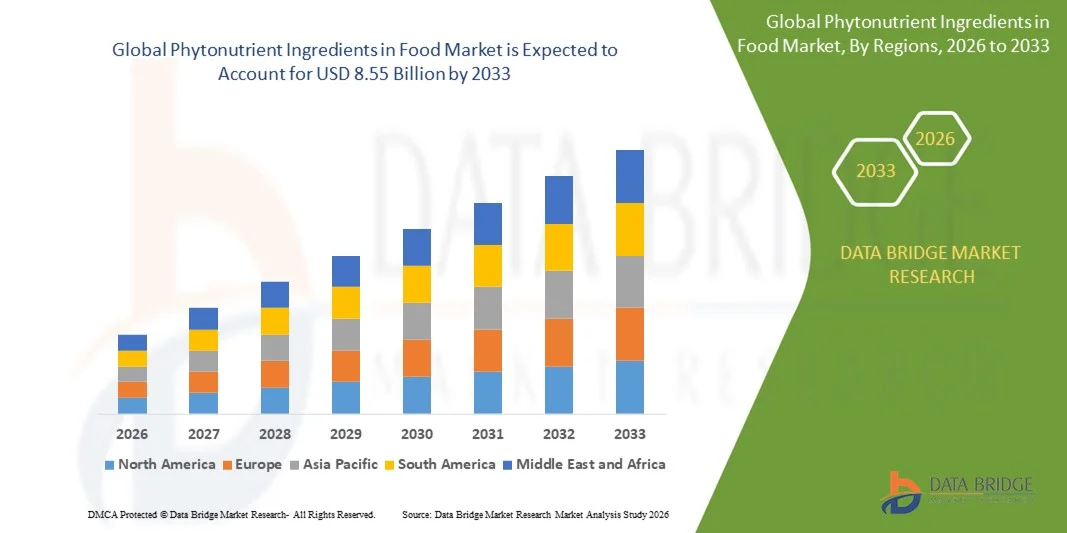
Phytonutrient Ingredients in Food Market Size
- The global phytonutrient ingredients in food market size was valued at USD 5.01 billion in 2025 and is expected to reach USD 8.55 billion by 2033, at a CAGR of 6.90% during the forecast period
- The market growth is largely fuelled by the increasing consumer focus on functional foods and natural ingredients, as well as rising awareness regarding health benefits of phytonutrients in preventing chronic diseases
- Growing demand for plant-based diets, fortified foods, and dietary supplements is accelerating the adoption of phytonutrient ingredients in both developed and emerging markets
Phytonutrient Ingredients in Food Market Analysis
- The market is driven by the rising consumer inclination towards clean-label, natural, and organic food products that promote overall health and wellness
- Increasing government and private initiatives to encourage the use of functional ingredients in food products are supporting the growth of the phytonutrient ingredients market
- North America dominated the phytonutrient ingredients in food market with the largest revenue share in 2025, driven by growing consumer demand for functional and fortified foods, as well as increasing awareness of natural health solutions
- Asia-Pacific region is expected to witness the highest growth rate in the global phytonutrient ingredients in food market, driven by increasing urbanization, rising disposable incomes, expanding health-focused consumer base, and growing penetration of functional foods and beverages
- The flavonoids segment held the largest market revenue share in 2025, driven by their strong antioxidant properties and widespread use in functional foods and beverages. Flavonoid-rich ingredients are highly valued for promoting cardiovascular health, immunity, and overall wellness, making them a preferred choice among health-conscious consumers
Report Scope and Phytonutrient Ingredients in Food Market Segmentation
|
Attributes |
Phytonutrient Ingredients in Food Key Market Insights |
|
Segments Covered |
|
|
Countries Covered |
North America
Europe
Asia-Pacific
Middle East and Africa
South America
|
|
Key Market Players |
|
|
Market Opportunities |
|
|
Value Added Data Infosets |
In addition to the insights on market scenarios such as market value, growth rate, segmentation, geographical coverage, and major players, the market reports curated by the Data Bridge Market Research also include in-depth expert analysis, pricing analysis, brand share analysis, consumer survey, demography analysis, supply chain analysis, value chain analysis, raw material/consumables overview, vendor selection criteria, PESTLE Analysis, Porter Analysis, and regulatory framework. |
Phytonutrient Ingredients in Food Market Trends
Rising Incorporation of Phytonutrient Ingredients in Functional Foods
- The growing incorporation of phytonutrient ingredients in functional and fortified foods is transforming the food industry by enhancing nutritional value, antioxidant content, and overall health benefits. These ingredients, derived from natural plant sources, are increasingly valued for promoting wellness and reducing disease risks. Their inclusion also aligns with consumer preferences for natural and clean-label products, making them a key differentiator in competitive markets
- Increasing demand for beverages, snacks, and dietary supplements enriched with phytonutrients is accelerating adoption across the nutrition and food sectors. This trend is particularly strong among health-conscious consumers seeking natural solutions for immunity, cognitive support, and heart health. Companies are leveraging this trend to develop innovative blends, personalized nutrition offerings, and premium product lines that cater to evolving dietary habits
- Manufacturers are innovating with fortified, flavored, and convenient product formats containing phytonutrients, improving product differentiation, taste, and consumer appeal. Such innovations help brands capture premium segments and expand market reach. In addition, combining multiple phytonutrient compounds in a single product is enabling synergistic health benefits, which further enhances consumer engagement and loyalty
- For instance, in 2023, several North American and European companies launched beverages and snack products fortified with polyphenols and carotenoids, leading to higher consumer adoption and enhanced retail visibility. Many of these launches included functional claims targeting immunity, gut health, and anti-aging, which contributed to strong marketing campaigns and increased shelf presence
- While the use of phytonutrient ingredients is growing rapidly, sustained expansion depends on continuous product innovation, consumer education, and cost-efficient extraction and fortification technologies. Collaboration with research institutions and investment in clinical studies are helping manufacturers validate health benefits, thereby driving trust and adoption across global markets
Phytonutrient Ingredients in Food Market Dynamics
Driver
Rising Health Awareness and Increasing Demand for Natural Functional Ingredients
- Increasing awareness of the health benefits of phytonutrients is driving demand for fortified foods and beverages that support immunity, cardiovascular health, and overall wellness. Consumers are actively seeking natural, plant-derived ingredients over synthetic alternatives. This trend is further supported by rising incidence of lifestyle-related disorders, which has heightened interest in preventive nutrition
- Growing trends toward clean-label, organic, and functional food products are encouraging manufacturers to incorporate phytonutrient-rich ingredients into their offerings. This is particularly evident in the beverage, snack, and dietary supplement categories. Companies are increasingly positioning phytonutrient-fortified products as premium and wellness-oriented, appealing to millennials and health-conscious demographics
- Expanding distribution channels, including e-commerce, supermarkets, and specialty health stores, are improving access to phytonutrient-enriched products, driving adoption in urban and semi-urban regions. The rise of online grocery platforms and direct-to-consumer sales is also helping brands reach niche health-focused audiences more effectively
- For instance, in 2023, the U.S. market reported strong growth in polyphenol and flavonoid-fortified foods, driven by consumer interest in natural antioxidants and preventive nutrition. Product launches highlighting immunity support, anti-inflammatory benefits, and cognitive health gained significant traction through influencer marketing and social media campaigns
- While demand is strong, continuous marketing, innovation in ingredient blends, and consumer awareness programs are essential to maintain long-term market growth. Partnerships with nutritionists, dieticians, and healthcare professionals are increasingly used to promote product efficacy and foster consumer trust
Restraint/Challenge
High Cost of Phytonutrient Extraction and Limited Consumer Awareness in Emerging Regions
- The extraction and stabilization of high-quality phytonutrient ingredients involve complex processes and high production costs, which may limit product affordability and accessibility in price-sensitive regions. In addition, variations in raw material quality and seasonal availability can impact consistency and supply reliability, creating operational challenges for manufacturers
- In many emerging markets, limited consumer knowledge about the health benefits of phytonutrients restricts adoption. Consumers often prefer conventional products due to familiarity and lower cost. The lack of standardized labeling and functional claims in these regions further complicates marketing and consumer education efforts
- Supply chain and storage challenges, such as maintaining ingredient potency and preventing degradation during transport, further constrain market growth, especially for perishable plant extracts. Maintaining cold-chain logistics and employing microencapsulation technologies are costly yet necessary to preserve efficacy and product quality
- For instance, in 2023, several Southeast Asian and African regions reported slow adoption of polyphenol-fortified products due to higher prices and limited educational campaigns. Retail penetration in remote or rural areas remains a key hurdle, limiting exposure to phytonutrient-enhanced offerings
- While extraction technologies and product formulations continue to improve, addressing cost, stability, and awareness challenges is crucial for the sustained growth of the global phytonutrient ingredients in food market. Strategic collaborations with local distributors, government initiatives, and targeted marketing campaigns can help overcome barriers and drive broader consumer adoption
Phytonutrient Ingredients in Food Market Scope
The global phytonutrient ingredients in food market is segmented on the basis of type and source.
- By Type
On the basis of type, the phytonutrient ingredients in food market is segmented into carotenoids, phytosterols, flavonoids, phenolic compounds, and vitamin E. The flavonoids segment held the largest market revenue share in 2025, driven by their strong antioxidant properties and widespread use in functional foods and beverages. Flavonoid-rich ingredients are highly valued for promoting cardiovascular health, immunity, and overall wellness, making them a preferred choice among health-conscious consumers.
The carotenoids segment is expected to witness the fastest growth rate from 2026 to 2033, fueled by increasing consumer awareness of their role in eye health, skin protection, and immune support. Carotenoid-enriched foods and supplements are gaining popularity due to their natural origin, vibrant colors, and functional benefits, which enhance product differentiation and appeal in the global nutrition market.
- By Source
On the basis of source, the phytonutrient ingredients in food market is segmented into herbs & trees, fruits & vegetables, cereals, and pulses & oilseeds. The fruits & vegetables segment held the largest market revenue share in 2025, owing to their high availability, consumer familiarity, and rich phytonutrient content. Ingredients derived from fruits and vegetables are widely incorporated into beverages, snacks, and dietary supplements to enhance nutritional profiles and functional benefits.
The herbs & trees segment is expected to witness the fastest growth rate from 2026 to 2033, driven by the rising use of plant extracts and herbal compounds in functional foods and beverages. These sources are valued for their concentrated phytonutrient content, natural bioactive compounds, and potential health benefits, which are increasingly leveraged in product innovation and premium formulations.
Phytonutrient Ingredients in Food Market Regional Analysis
- North America dominated the phytonutrient ingredients in food market with the largest revenue share in 2025, driven by growing consumer demand for functional and fortified foods, as well as increasing awareness of natural health solutions
- Consumers in the region highly value the nutritional benefits, antioxidant properties, and clean-label appeal offered by phytonutrient-enriched foods and beverages
- This widespread adoption is further supported by high disposable incomes, a health-conscious population, and the growing preference for preventive nutrition, establishing phytonutrient ingredients as a favored solution for functional food and beverage formulations
U.S. Phytonutrient Ingredients in Food Market Insight
The U.S. phytonutrient ingredients in food market captured the largest revenue share in 2025 within North America, fueled by rising consumer focus on immunity, cardiovascular health, and natural antioxidants. The demand for fortified snacks, beverages, and dietary supplements is increasing, with manufacturers innovating to meet evolving preferences for clean-label and organic products. Moreover, expanding retail and e-commerce channels, alongside strong R&D capabilities, are significantly contributing to market growth.
Europe Phytonutrient Ingredients in Food Market Insight
The Europe phytonutrient ingredients in food market is expected to witness the fastest growth rate from 2026 to 2033, primarily driven by regulatory support for functional foods and increasing consumer focus on wellness and preventive nutrition. Rising urbanization, combined with interest in plant-based diets and natural ingredients, is fostering adoption across multiple food categories. European consumers are particularly drawn to antioxidant-rich and polyphenol-fortified products.
U.K. Phytonutrient Ingredients in Food Market Insight
The U.K. phytonutrient ingredients in food market is expected to witness the fastest growth rate from 2026 to 2033, driven by rising health awareness, interest in clean-label products, and growing demand for functional beverages and snacks. Consumers’ focus on immunity, cognitive support, and heart health is encouraging manufacturers to incorporate carotenoids, flavonoids, and phytosterols in food formulations. The country’s well-established retail and e-commerce infrastructure further supports market expansion.
Germany Phytonutrient Ingredients in Food Market Insight
The Germany phytonutrient ingredients in food market is expected to witness the fastest growth rate from 2026 to 2033, fueled by increasing adoption of fortified and functional foods, emphasis on preventive health, and strong consumer demand for natural, plant-based ingredients. Germany’s innovation-driven food industry, coupled with consumer preference for organic and high-quality ingredients, promotes widespread usage in snacks, beverages, and dietary supplements.
Asia-Pacific Phytonutrient Ingredients in Food Market Insight
The Asia-Pacific phytonutrient ingredients in food market is expected to witness the fastest growth rate from 2026 to 2033, driven by increasing health awareness, rising disposable incomes, and rapid urbanization in countries such as China, Japan, and India. The region’s growing inclination toward natural and functional foods, supported by government initiatives promoting nutrition and wellness, is accelerating adoption. In addition, APAC’s emergence as a manufacturing hub for phytonutrient ingredients is enhancing affordability and accessibility.
Japan Phytonutrient Ingredients in Food Market Insight
The Japan phytonutrient ingredients in food market is expected to witness the fastest growth rate from 2026 to 2033 due to the country’s focus on preventive healthcare, high health-consciousness, and demand for functional foods. The market is benefiting from an increase in fortified beverages and snacks enriched with flavonoids and carotenoids. Moreover, Japan’s aging population is likely to drive demand for natural and easily digestible nutrient-dense products.
China Phytonutrient Ingredients in Food Market Insight
The China phytonutrient ingredients in food market accounted for the largest revenue share in Asia-Pacific in 2025, attributed to the country’s expanding middle class, growing health awareness, and high rates of consumption of fortified foods and beverages. China’s push toward functional nutrition, availability of affordable phytonutrient ingredients, and strong domestic manufacturing capabilities are key factors propelling market growth across beverages, snacks, and dietary supplement categories.
Phytonutrient Ingredients in Food Market Share
The Phytonutrient Ingredients in Food industry is primarily led by well-established companies, including:
• BASF SE (Germany)
• DSM (Netherlands)
• FMC Corporation (U.S.)
• Pharmachem Laboratories, Inc. (U.S.)
• Cargill, Incorporated (U.S.)
• ADM (U.S.)
• Chr. Hansen Holding A/S (Denmark)
• Cyanotech Corporation (U.S.)
• Kemin Industries, Inc. and Its Group of Companies (U.S.)
• William Reed Business Media Ltd (U.K.)
• Allied Biotech Corporation (U.S.)
• Bursa Malaysia Berhad (Malaysia)

- Interactive Data Analysis Dashboard
- Company Analysis Dashboard for high growth potential opportunities
- Research Analyst Access for customization & queries
- Competitor Analysis with Interactive dashboard
- Latest News, Updates & Trend analysis
- Harness the Power of Benchmark Analysis for Comprehensive Competitor Tracking
Global Phytonutrient Ingredients In Food Market, Supply Chain Analysis and Ecosystem Framework
To support market growth and help clients navigate the impact of geopolitical shifts, DBMR has integrated in-depth supply chain analysis into its Global Phytonutrient Ingredients In Food Market research reports. This addition empowers clients to respond effectively to global changes affecting their industries. The supply chain analysis section includes detailed insights such as Global Phytonutrient Ingredients In Food Market consumption and production by country, price trend analysis, the impact of tariffs and geopolitical developments, and import and export trends by country and HSN code. It also highlights major suppliers with data on production capacity and company profiles, as well as key importers and exporters. In addition to research, DBMR offers specialized supply chain consulting services backed by over a decade of experience, providing solutions like supplier discovery, supplier risk assessment, price trend analysis, impact evaluation of inflation and trade route changes, and comprehensive market trend analysis.
Data collection and base year analysis are done using data collection modules with large sample sizes. The stage includes obtaining market information or related data through various sources and strategies. It includes examining and planning all the data acquired from the past in advance. It likewise envelops the examination of information inconsistencies seen across different information sources. The market data is analysed and estimated using market statistical and coherent models. Also, market share analysis and key trend analysis are the major success factors in the market report. To know more, please request an analyst call or drop down your inquiry.
The key research methodology used by DBMR research team is data triangulation which involves data mining, analysis of the impact of data variables on the market and primary (industry expert) validation. Data models include Vendor Positioning Grid, Market Time Line Analysis, Market Overview and Guide, Company Positioning Grid, Patent Analysis, Pricing Analysis, Company Market Share Analysis, Standards of Measurement, Global versus Regional and Vendor Share Analysis. To know more about the research methodology, drop in an inquiry to speak to our industry experts.
Data Bridge Market Research is a leader in advanced formative research. We take pride in servicing our existing and new customers with data and analysis that match and suits their goal. The report can be customized to include price trend analysis of target brands understanding the market for additional countries (ask for the list of countries), clinical trial results data, literature review, refurbished market and product base analysis. Market analysis of target competitors can be analyzed from technology-based analysis to market portfolio strategies. We can add as many competitors that you require data about in the format and data style you are looking for. Our team of analysts can also provide you data in crude raw excel files pivot tables (Fact book) or can assist you in creating presentations from the data sets available in the report.













