


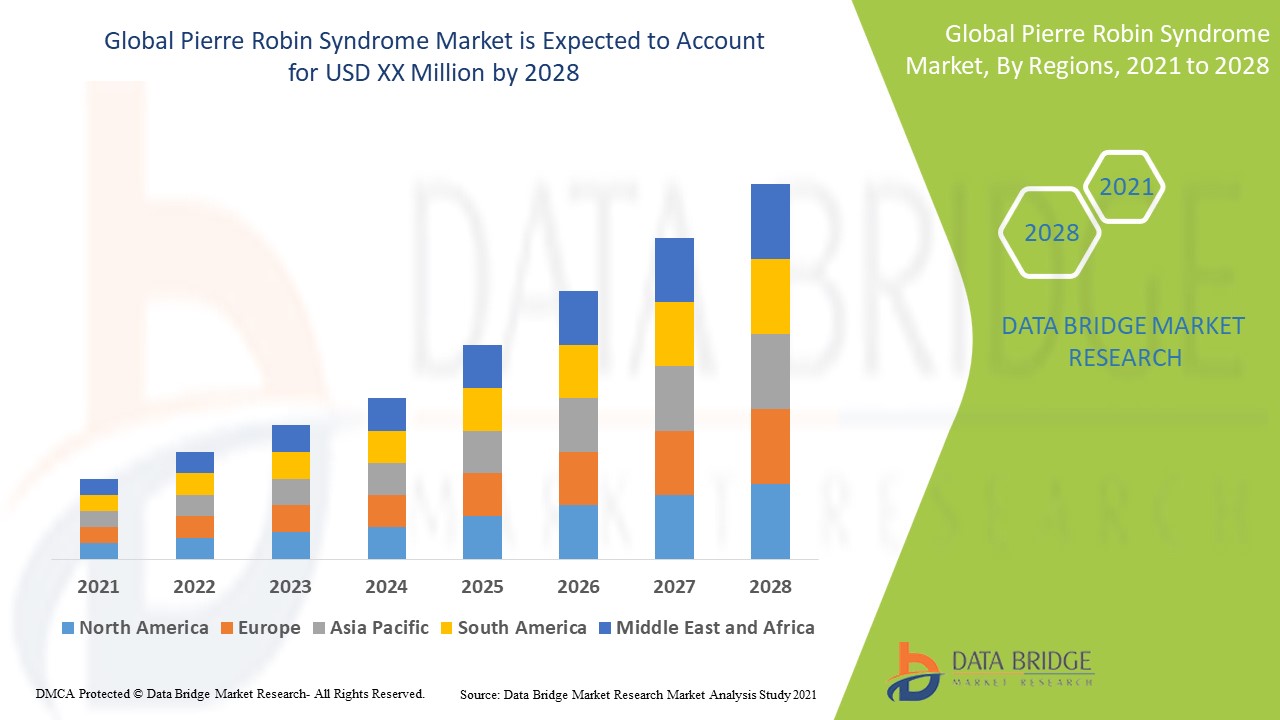
Pierre Robin Syndrome Market Analysis
The Pierre Robin Syndrome market is gaining attention due to advancements in diagnostic methods, treatment options, and a growing focus on rare congenital conditions. Pierre Robin Syndrome, characterized by micrognathia, glossoptosis, and cleft palate, requires specialized care, often involving a multidisciplinary approach. The market is driven by increasing awareness, advancements in genetic research, and improved access to healthcare in both developed and developing regions. Recent advancements in treatment include surgical innovations such as mandibular distraction osteogenesis, which addresses airway obstruction effectively, and advanced cleft palate repair techniques that improve feeding and speech outcomes. In addition, the integration of 3D imaging technologies has enhanced diagnostic accuracy, enabling early intervention. Government support and non-profit organization initiatives to improve awareness and care accessibility further bolster market growth.
North America leads the market due to its well-developed healthcare infrastructure and strong research focus. Meanwhile, the Asia-Pacific region is emerging as a significant growth area, driven by increasing awareness, healthcare investments, and an expanding population. As technologies and treatment methodologies continue to evolve, the Pierre Robin Syndrome market is poised for sustained growth, improving outcomes for affected individuals globally.
Pierre Robin Syndrome Market Size
The global pierre robin syndrome market size was valued at USD 777.64 million in 2024 and is projected to reach USD 1,184.41 million by 2032, with a CAGR of 5.40 % during the forecast period of 2025 to 2032. In addition to the insights on market scenarios such as market value, growth rate, segmentation, geographical coverage, and major players, the market reports curated by the Data Bridge Market Research also include depth expert analysis, patient epidemiology, pipeline analysis, pricing analysis, and regulatory framework.
Pierre Robin Syndrome Market Trends
“Increasing Focus on 3D Imaging and Surgical Planning Technologies”
The pierre robin syndrome market is witnessing a growing trend toward 3D imaging and surgical planning technologies, which are revolutionizing the diagnosis and treatment of this rare congenital condition. These advancements enable healthcare providers to accurately map anatomical abnormalities such as micrognathia, glossoptosis, and cleft palate, facilitating precise surgical interventions. For instance, the use of 3D-printed models has improved the success rate of procedures such as mandibular distraction osteogenesis, a technique used to address airway obstructions in infants. In addition, these technologies help reduce operative times and improve patient outcomes by allowing surgeons to simulate procedures beforehand. This trend is gaining traction in both developed markets, such as North America, with its advanced healthcare infrastructure, and emerging regions such as Asia-Pacific, where investments in medical technology are on the rise. The integration of 3D imaging represents a significant step forward in enhancing the effectiveness of Pierre Robin Syndrome treatments, positioning it as a key driver of market growth.
Report Scope and Pierre Robin Syndrome Market Segmentation
|
Attributes |
Pierre Robin Syndrome Key Market Insights |
|
Segments Covered |
|
|
Countries Covered |
U.S., Canada and Mexico in North America, Germany, France, U.K., Netherlands, Switzerland, Belgium, Russia, Italy, Spain, Turkey, Rest of Europe in Europe, China, Japan, India, South Korea, Singapore, Malaysia, Australia, Thailand, Indonesia, Philippines, Rest of Asia-Pacific (APAC) in the Asia-Pacific (APAC), Saudi Arabia, U.A.E., South Africa, Egypt, Israel, Rest of Middle East and Africa (MEA) as a part of Middle East and Africa (MEA), Brazil, Argentina and Rest of South America as part of South America |
|
Key Market Players |
Merck KGaA (Germany), Salvavidas (India), Pfizer Inc. (U.S.), AbbVie Inc. (U.S.), AstraZeneca (U.K.), CSC Pharmaceuticals International (Austria), Bristol-Myers Squibb Company (U.S.), Merck & Co., Inc. (U.S.), Teva Pharmaceutical Industries Ltd. (Israel), and Dr. Reddy’s Laboratories Ltd. (India) |
|
Market Opportunities |
|
|
Value Added Data Infosets |
In addition to the insights on market scenarios such as market value, growth rate, segmentation, geographical coverage, and major players, the market reports curated by the Data Bridge Market Research also include depth expert analysis, patient epidemiology, pipeline analysis, pricing analysis, and regulatory framework. |
Pierre Robin Syndrome Market Definition
Pierre Robin Syndrome is a rare congenital condition characterized by a combination of three primary features: micrognathia (an abnormally small lower jaw), glossoptosis (downward displacement or retraction of the tongue), and often a cleft palate (an opening in the roof of the mouth).
Pierre Robin Syndrome Market Dynamics
Drivers
- Growing Prevalence of Congenital Disorders
The growing prevalence of congenital disorders, including Pierre Robin Syndrome, is a significant driver for market growth, as it increases the demand for specialized care. According to the American Academy of Pediatrics, Pierre Robin Syndrome occurs in approximately 1 in 8,500 to 1 in 20,000 live births, with an estimated increase in diagnosis due to advancements in genetic testing and awareness. As the global population continues to grow, so does the number of children born with congenital conditions, leading to an increased need for specialized treatments such as mandibular distraction osteogenesis and cleft palate surgeries. This rising prevalence underscores the need for better access to specialized healthcare services and treatments, propelling the demand for advanced medical technologies and creating a growing market for Pierre Robin Syndrome care. The increasing recognition of rare congenital conditions and the need for early intervention drive the market's expansion, as healthcare systems seek to address these complex disorders.
- Rising Awareness and Early Diagnosis
Rising awareness and early diagnosis of Pierre Robin Syndrome are crucial drivers of market growth, as they facilitate timely interventions and improve treatment outcomes. In recent years, healthcare providers have become more attuned to the signs of this rare condition, leading to earlier detection and intervention. For instance, advancements in genetic screening and prenatal imaging techniques have allowed for the identification of Pierre Robin Syndrome in utero, enabling healthcare providers to prepare for specialized care immediately after birth. Early diagnosis ensures that infants receive necessary treatments, such as mandibular distraction osteogenesis or cleft palate repair, which can significantly improve their quality of life. Increased awareness among parents has also played a key role, with support groups and online resources helping families understand the condition and pursue appropriate medical care. As a result, the demand for advanced diagnostic tools, treatments, and specialized healthcare services is rising, making early diagnosis and awareness a pivotal market driver in the Pierre Robin Syndrome space.
Opportunities
- Rising Advancements in Treatment Techniques
Advancements in treatment techniques for Pierre Robin Syndrome, such as mandibular distraction osteogenesis and improved cleft palate repair methods, present a significant market opportunity by enhancing treatment outcomes and encouraging their widespread adoption in healthcare systems. Mandibular distraction osteogenesis, for instance, is a surgical procedure that gradually lengthens the lower jaw to improve airway function, which is crucial for infants with glossoptosis. This technique has been shown to reduce the need for tracheostomy and improve feeding and breathing functions, leading to better patient outcomes. Similarly, advancements in cleft palate repair, including the use of more refined surgical methods and tissue engineering, are improving the effectiveness of surgeries, reducing recovery time, and enhancing speech and feeding functions. These innovations are making treatments more accessible and successful, driving their adoption in both developed and emerging markets. As healthcare providers increasingly implement these advanced techniques, the demand for specialized care and related technologies in Pierre Robin Syndrome is growing, creating substantial market opportunities.
- Increasing Supportive Government Policies and Funding
Supportive government policies and funding are significantly accelerating the market development for Pierre Robin Syndrome by improving healthcare access and supporting research into rare congenital disorders. For instance, initiatives such as the Rare Disease Act in the U.S. have allocated funds for research and development of treatments for rare conditions, including Pierre Robin Syndrome. The U.S. National Institutes of Health (NIH) and the Orphan Drug Act provide financial incentives for developing medications and treatment procedures for rare diseases, leading to innovation in the treatment of congenital conditions. Similarly, non-profit organizations such as The Pierre Robin Syndrome Foundation have been instrumental in raising awareness and securing funding for specialized care, educational resources, and patient support. These policies and funding efforts are creating a more robust infrastructure for treating rare conditions, driving research, and ensuring that patients have access to cutting-edge treatments. As governments continue to prioritize rare diseases, these efforts present a significant market opportunity for healthcare providers, pharmaceutical companies, and researchers focused on advancing care for Pierre Robin Syndrome.
Restraints/Challenges
- Device-Related Complications
Device-related complications of Pierre Robin Syndromes (LCPs) remain a critical concern, posing both clinical and market challenges. Complications such as device dislodgment can lead to embolization, requiring immediate retrieval or surgical intervention. For instance, instances of device migration to the pulmonary artery have been reported, necessitating advanced retrieval techniques and specialized expertise. Similarly, the risk of cardiac perforation during implantation particularly in patients with fragile ventricular anatomy can result in life-threatening outcomes and prolonged hospital stays. These risks impact patient safety and increase procedural costs and limit the widespread adoption of LCPs. The associated complexities and potential for adverse events make healthcare providers cautious, slowing the pace of market penetration and emphasizing the need for improved device designs and robust clinical training to build confidence in this emerging technology.
- High Initial Costs of Pierre Robin Syndromes
The high initial costs of Pierre Robin Syndromes (LCPs) create a notable barrier to their broader adoption, particularly in low-resource settings and healthcare systems with limited financial flexibility. LCPs are significantly more expensive than traditional pacemakers due to their cutting-edge technology, intricate manufacturing processes, and the need for specialized implantation techniques. For instance, in some regions, hospitals may opt for conventional pacemakers because they align better with constrained budgets, whereas the cost of LCPs may make them inaccessible for many patients who must cover healthcare expenses out of pocket. This economic disparity impacts individual patients and healthcare providers, who might be reluctant to invest in LCPs despite their clinical benefits. As a market challenge, the higher costs slow the pace of adoption and highlight the need for strategies to reduce expenses, increase production efficiencies, and make the technology more universally available.
This market report provides details of new recent developments, trade regulations, import-export analysis, production analysis, value chain optimization, market share, impact of domestic and localized market players, analyses opportunities in terms of emerging revenue pockets, changes in market regulations, strategic market growth analysis, market size, category market growths, application niches and dominance, product approvals, product launches, geographic expansions, technological innovations in the market. To gain more info on the market contact Data Bridge Market Research for an Analyst Brief, our team will help you take an informed market decision to achieve market growth.
Pierre Robin Syndrome Market Scope
The market is segmented on the basis of symptoms, gender, treatment, and end user. The growth amongst these segments will help you analyse meagre growth segments in the industries and provide the users with a valuable market overview and market insights to help them make strategic decisions for identifying core market applications.
Symptoms
- Micrognathia
- Glossoptosis
- Cleft Palate
- Others
Gender
- Male
- Female
Treatment
- Surgery
- Others
End User
- Hospitals and Clinics
- Ambulatory Surgical Centers
- Others
Pierre Robin Syndrome Market Regional Analysis
The market is analysed and market size insights and trends are provided by country, symptoms, gender, treatment, and end user as referenced above.
The countries covered in the market report are U.S., Canada and Mexico in North America, Germany, France, U.K., Netherlands, Switzerland, Belgium, Russia, Italy, Spain, Turkey, Rest of Europe in Europe, China, Japan, India, South Korea, Singapore, Malaysia, Australia, Thailand, Indonesia, Philippines, Rest of Asia-Pacific (APAC) in the Asia-Pacific (APAC), Saudi Arabia, U.A.E., South Africa, Egypt, Israel, Rest of Middle East and Africa (MEA) as a part of Middle East and Africa (MEA), Brazil, Argentina and Rest of South America as part of South America.
North America dominates the Pierre Robin Syndrome market, driven by strong government support initiatives and the presence of a well-established healthcare infrastructure. Advanced diagnostic capabilities, coupled with increased funding for research and treatment programs, contribute significantly to the region's leadership in this market. In addition, the availability of specialized healthcare facilities and experienced professionals ensures better patient outcomes, further enhancing market growth. This robust infrastructure positions North America as a key region for the diagnosis and management of Pierre Robin Syndrome.
Asia-Pacific is anticipated to witness significant growth in the Pierre Robin Syndrome market during the forecast period from 2025 to 2032, primarily due to increasing awareness about the condition among the population. Efforts by healthcare organizations and governments to improve education and early diagnosis of rare disorders are driving this growth. In addition, the region’s expanding healthcare infrastructure and rising investments in pediatric care services contribute to better management and treatment options. These factors collectively position Asia-Pacific as a rapidly growing market for Pierre Robin Syndrome.
The country section of the report also provides individual market impacting factors and changes in regulation in the market domestically that impacts the current and future trends of the market. Data points such as down-stream and upstream value chain analysis, technical trends and porter's five forces analysis, case studies are some of the pointers used to forecast the market scenario for individual countries. Also, the presence and availability of global brands and their challenges faced due to large or scarce competition from local and domestic brands, impact of domestic tariffs and trade routes are considered while providing forecast analysis of the country data.
Pierre Robin Syndrome Market Share
The market competitive landscape provides details by competitor. Details included are company overview, company financials, revenue generated, market potential, investment in research and development, new market initiatives, global presence, production sites and facilities, production capacities, company strengths and weaknesses, product launch, product width and breadth, application dominance. The above data points provided are only related to the companies' focus related to market.
Pierre Robin Syndrome Market Leaders Operating in the Market Are:
- Merck KGaA (Germany)
- Salvavidas (India)
- Pfizer Inc. (U.S.)
- AbbVie Inc. (U.S.)
- AstraZeneca (U.K.)
- CSC Pharmaceuticals International (Austria)
- Bristol-Myers Squibb Company (U.S.)
- Merck & Co., Inc. (U.S.)
- Teva Pharmaceutical Industries Ltd. (Israel)
- Dr. Reddy’s Laboratories Ltd. (India)

- Interactive Data Analysis Dashboard
- Company Analysis Dashboard for high growth potential opportunities
- Research Analyst Access for customization & queries
- Competitor Analysis with Interactive dashboard
- Latest News, Updates & Trend analysis
- Harness the Power of Benchmark Analysis for Comprehensive Competitor Tracking
Data collection and base year analysis are done using data collection modules with large sample sizes. The stage includes obtaining market information or related data through various sources and strategies. It includes examining and planning all the data acquired from the past in advance. It likewise envelops the examination of information inconsistencies seen across different information sources. The market data is analysed and estimated using market statistical and coherent models. Also, market share analysis and key trend analysis are the major success factors in the market report. To know more, please request an analyst call or drop down your inquiry.
The key research methodology used by DBMR research team is data triangulation which involves data mining, analysis of the impact of data variables on the market and primary (industry expert) validation. Data models include Vendor Positioning Grid, Market Time Line Analysis, Market Overview and Guide, Company Positioning Grid, Patent Analysis, Pricing Analysis, Company Market Share Analysis, Standards of Measurement, Global versus Regional and Vendor Share Analysis. To know more about the research methodology, drop in an inquiry to speak to our industry experts.
Data Bridge Market Research is a leader in advanced formative research. We take pride in servicing our existing and new customers with data and analysis that match and suits their goal. The report can be customized to include price trend analysis of target brands understanding the market for additional countries (ask for the list of countries), clinical trial results data, literature review, refurbished market and product base analysis. Market analysis of target competitors can be analyzed from technology-based analysis to market portfolio strategies. We can add as many competitors that you require data about in the format and data style you are looking for. Our team of analysts can also provide you data in crude raw excel files pivot tables (Fact book) or can assist you in creating presentations from the data sets available in the report.












