


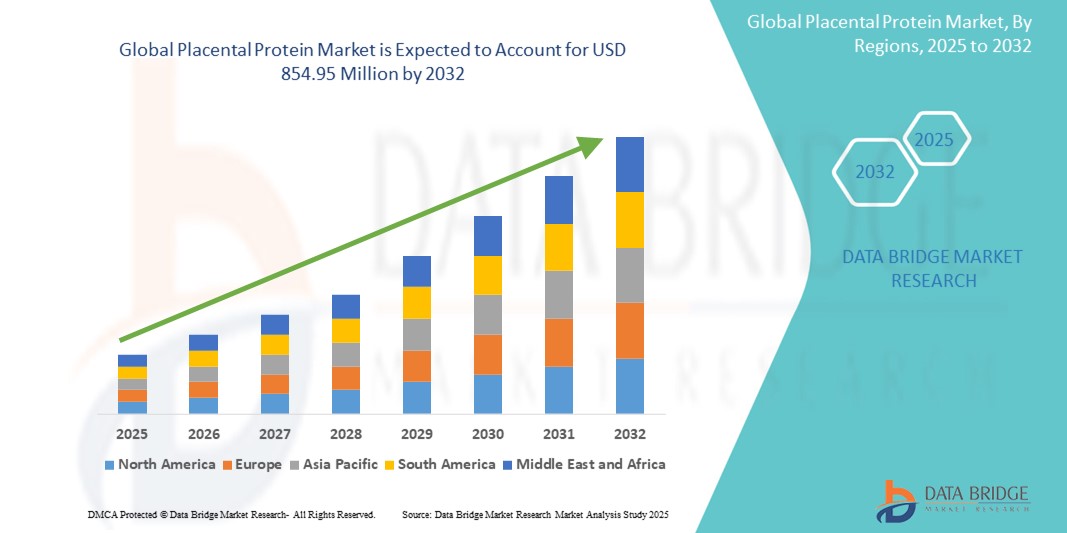
Placental Protein Market Size
- The global placental protein market size was valued at USD 560.05 Million in 2024 and is expected to reach approximately USD 854.95 Million by 2032, at a CAGR of around 5.43% during the forecast period.
- The market growth is largely fueled by the increasing demand for natural and bioactive ingredients in various industries, a rise in consumer awareness regarding the benefits of placental protein, and advancements in extraction and processing technologies.
- Moreover, rising investments in research and development for novel applications of placental protein, coupled with the expanding cosmetics and personal care industry and a growing focus on anti-aging and regenerative products, are establishing effective placental protein solutions as crucial for improving product efficacy and consumer appeal. These converging factors are accelerating the uptake of placental protein solutions, thereby significantly boosting the industry's growth.
Placental Protein Market Analysis
- Placental protein, a rich source of growth factors, amino acids, and other bioactive compounds, significantly impacts various industries, particularly in regenerative and cosmetic applications. Treatment (utilization) for placental protein is increasingly vital, offering product enhancement and improved functional outcomes for affected industries.
- The escalating demand for placental protein is primarily fueled by the increasing global interest in natural and efficacious ingredients, rising consumer awareness and scientific validation of its benefits, and continuous advancements in biotechnological processing and formulation approaches.
- Asia-Pacific is expected to hold the largest market share in the placental protein market by 2032, driven by a well-established traditional use of placental products, a rapidly expanding cosmetics and personal care industry, and a greater emphasis on natural ingredients in countries like China and South Korea.
- North America is expected to be the fastest-growing region in the placental protein market during the forecast period due to increasing consumer preference for premium and natural products, rising investments in research and development for new applications, and a strong presence of key market players.
- The cosmetics & personal care segment is expected to dominate the placental protein market with a significant market share by 2032, largely driven by its established efficacy in anti-aging, skin regeneration, and hair growth formulations, and the development of new product innovations including serums, creams, and supplements.
Report Scope and Placental Protein Market Segmentation
|
Attributes |
Placental Protein Key Market Insights |
|
Segments Covered |
|
|
Countries Covered |
North America
Europe
Asia-Pacific
Middle East and Africa
South America
|
|
Key Market Players |
|
|
Market Opportunities |
|
|
Value Added Data Infosets |
In addition to the insights on market scenarios such as market value, growth rate, segmentation, geographical coverage, and major players, the market reports curated by the Data Bridge Market Research also include in-depth expert analysis, pricing analysis, brand share analysis, consumer survey, demography analysis, supply chain analysis, value chain analysis, raw material/consumables overview, vendor selection criteria, PESTLE Analysis, Porter Analysis, and regulatory framework. |
Placental Protein Market Trends
“Expansion of Diagnostic and Therapeutic Applications Across Clinical and Research Settings”
- A major and accelerating trend in the global placental protein market is the growing integration of placental protein biomarkers into both diagnostic and therapeutic domains, especially in the fields of prenatal screening, oncology, and regenerative medicine. This expansion is significantly enhancing clinical utility and research value.
- For instance, placental growth factor (PlGF) is being increasingly incorporated into diagnostic protocols for early detection of preeclampsia, providing clinicians with critical insight to initiate timely intervention. Similarly, human chorionic gonadotropin (hCG) is widely used in tumor diagnostics, particularly for germ cell tumors and certain cancers.
- Additionally, the rising use of placental proteins in regenerative therapies and stem cell research is opening up new frontiers. Proteins like placental alkaline phosphatase and pregnancy-associated plasma protein A (PAPP-A) are being investigated for their potential roles in tissue repair, angiogenesis, and immunomodulation.
- The convergence of diagnostic testing platforms with advanced bioinformatics tools enables detailed molecular profiling of placental proteins, supporting more intelligent biomarker-based diagnostics. For example, machine learning algorithms integrated with proteomic analysis are enhancing sensitivity and specificity in early detection of pregnancy-related complications.
- This seamless integration of placental protein assays into clinical decision-support platforms facilitates real-time interpretation, risk stratification, and patient-specific therapeutic recommendations, thus promoting more personalized and proactive care models.
- This trend towards multifaceted diagnostic and therapeutic roles of placental proteins is fundamentally reshaping their value proposition in clinical and pharmaceutical settings. Consequently, companies such as Roche Diagnostics, Thermo Fisher Scientific, and Bio-Rad Laboratories are developing next-generation assays and high-throughput detection kits to harness the expanding scope of placental protein utilization.
- The demand for placental protein-based solutions is growing rapidly across hospitals, research institutes, and diagnostic labs, as clinicians and scientists increasingly prioritize molecular-level insights and targeted treatment strategies.
Placental Protein Market Dynamics
Driver
“Increased Focus on Maternal and Fetal Health and Growing Research into Protein-Based Biomarkers”
- The increasing global focus on improving maternal-fetal health outcomes, along with the growing body of research into the clinical utility of protein-based biomarkers, is a significant driver for the placental protein market’s expansion.
- For instance, the ability of placental proteins to serve as early indicators for complications such as preeclampsia, intrauterine growth restriction (IUGR), and gestational trophoblastic disease is leading to broader adoption of related diagnostic assays. A 2024 review in the Journal of Clinical Obstetrics emphasized the utility of PlGF and sFlt-1 ratio testing in routine prenatal care to improve early risk identification.
- As healthcare systems globally implement more comprehensive prenatal screening programs, and as patients become more aware of the importance of maternal health monitoring, the demand for accurate, non-invasive, and biomarker-driven diagnostic solutions continues to rise.
- Additionally, the rise in funding for biomarker research and precision medicine is making placental proteins key components in translational studies. Their roles in cell signaling, inflammation modulation, and tissue regeneration are attracting attention for their therapeutic potential in both reproductive and non-reproductive applications.
- The increasing collaboration between academic institutions and biotech firms to develop innovative assays and therapeutic formulations further accelerates market adoption. Personalized medicine approaches, powered by placental protein profiles, are increasingly becoming part of early-stage drug development pipelines.
Restraint/Challenge
“Complexity of Protein Isolation and High Analytical Costs”
- Challenges in isolating, purifying, and quantifying placental proteins, along with the high analytical costs associated with protein assays, remain significant barriers to wider market penetration. Variability in sample quality and the need for highly sensitive instrumentation can limit routine clinical adoption.
- For instance, advanced proteomic tools like mass spectrometry and multiplex immunoassays, while offering high sensitivity, require considerable capital investment and technical expertise. Reports indicate that a single placental protein biomarker panel test can cost between $100 to $300, making widespread use less feasible in low-resource settings.
- Addressing these technical and cost-related barriers through the development of simplified testing kits, automated platforms, and cost-effective reagents is critical for broader market expansion. Additionally, variability in regulatory standards for biomarker validation across regions poses a challenge for global commercialization.
- The lack of universally accepted clinical thresholds and reference values for many placental proteins complicates diagnostic interpretation and hinders physician confidence in test results, particularly in regions without standardized testing protocols.
- Overcoming these obstacles through harmonization of testing standards, technological innovations that lower costs, and increased education for healthcare providers will be key to unlocking the full market potential of placental proteins in both diagnostics and therapeutics.
Placental Protein Market Scope
The market is segmented on the basis of type, application, source, and distribution channel.
• By Type
On the basis of type, the placental protein market is segmented into hydrolyzed placental protein, placental extract, placental powder, and others. The hydrolyzed placental protein segment is expected to hold the largest market revenue share of approximately 42% by 2032, driven by its high bioavailability and growing incorporation into cosmeceutical and dermatological formulations. Hydrolyzed proteins are known for their enhanced absorption and regenerative properties, which make them widely used in skin repair and anti-aging products. The placental extract segment is anticipated to witness the fastest growth rate at a CAGR of around 8.9% from 2024 to 2032, fueled by rising demand in traditional medicine and pharmaceuticals. Placental extracts are rich in bioactive compounds and are being increasingly studied for their roles in immunomodulation, wound healing, and endocrine balance.
• By Application
On the basis of application, the placental protein market is segmented into cosmetics & personal care, pharmaceuticals, nutraceuticals, and others. The cosmetics & personal care segment is expected to hold the largest market revenue share of about 47% by 2032, driven by the increasing use of placental proteins in anti-aging, skin brightening, and rejuvenating products, particularly across Asian and European markets. These proteins are sought after for their collagen-boosting and cell renewal benefits, supporting their widespread use in premium skincare formulations. The nutraceuticals segment is expected to witness the fastest CAGR of approx 9.4% from 2024 to 2032, driven by the growing consumer shift towards functional supplements containing natural, protein-rich ingredients. Placental proteins are being incorporated into dietary supplements targeting hormonal balance, fatigue reduction, and cellular health.
• By Source
On the basis of source, the placental protein market is segmented into human placenta, animal placenta, and others. The animal placenta segment is expected to hold the largest market revenue share by 2032, driven by its abundant availability and regulatory acceptance in cosmetics and supplements, especially bovine and porcine sources. Animal placental proteins are widely utilized due to their cost-effectiveness and high protein content, making them a preferred choice for large-scale production. The human placenta segment is expected to witness the fastest CAGR from 2024 to 2032, fueled by increasing research interest in its potent regenerative and therapeutic properties. While regulatory constraints are higher, human-derived placental proteins are gaining traction in clinical research and high-end skincare due to their compatibility with human biology.
• By Distribution Channel
On the basis of distribution channel, the placental protein market is segmented into online, offline, and others. The offline segment is expected to hold the largest market revenue share by 2032, driven by the established presence of physical retail chains, pharmacies, and specialty stores that offer a range of cosmetic, pharmaceutical, and nutraceutical products. In-store consultations and brand trust are major factors driving consumer preference for offline purchases. The online segment is expected to witness the fastest CAGR from 2024 to 2032, propelled by the global shift towards e-commerce, rising digital health platforms, and the growing availability of direct-to-consumer sales channels. Online platforms offer greater product variety, competitive pricing, and convenience, significantly boosting the accessibility of placental protein-based products across geographies.
Placental Protein Market Regional Analysis
• North America
North America is expected to dominate the placental protein market with the largest revenue share of 36.8% by 2032, driven by rising demand for anti-aging solutions, strong consumer interest in health and wellness, and advanced biotechnology capabilities.
Consumers in the region highly value scientifically backed skincare, regenerative therapies, and nutraceutical innovations incorporating natural and bioactive ingredients.
Additionally, the region benefits from favorable regulatory frameworks, high R&D investment, and increasing awareness of placental-derived therapies, establishing North America as a leader in the global placental protein market.
• U.S. Placental Protein Market Insight
The U.S. placental protein market captured the largest revenue share of 81.5% within North America in 2025, driven by high consumer demand for premium skincare products, advanced nutraceuticals, and biologically active ingredients in personal care and therapeutic formulations.
The presence of leading cosmetic brands, extensive research into placental-derived compounds, and widespread access to specialty healthcare products continue to fuel market growth.
Moreover, the integration of placental proteins in regenerative medicine and anti-aging therapies, along with the rise of direct-to-consumer (DTC) wellness platforms, has significantly accelerated demand.
• Europe Placental Protein Market Insight
The Europe placental protein market is projected to expand at a steady CAGR throughout the forecast period, supported by a mature cosmetics and pharmaceutical sector, growing demand for bio-based solutions, and increasing emphasis on personalized beauty and wellness regimens.
The adoption of placental proteins in anti-aging formulations and nutraceuticals is supported by growing consumer interest in clean-label and functional products.
The region is witnessing substantial innovation in placental protein extraction, processing, and clinical research, making it a favorable market for both established and emerging players.
• U.K. Placental Protein Market Insight
The U.K. placental protein market is anticipated to grow at a notable CAGR during the forecast period, driven by rising consumer awareness about the benefits of bioactive skincare ingredients and growing demand for scientifically supported wellness products.
Innovations in placental protein-based cosmeceuticals, supported by ethical sourcing standards and evolving consumer preferences, are contributing to the segment’s growth.
Additionally, the strong presence of research institutions and progressive regulations around biotech-based cosmetic products is expected to stimulate continued market expansion.
• Germany Placental Protein Market Insight
The Germany placental protein market is projected to expand at a substantial CAGR of 5.9% during the forecast period, supported by strong biopharmaceutical R&D activity, robust consumer demand for premium anti-aging formulations, and a culture of science-backed wellness solutions.
Germany’s emphasis on high-quality manufacturing and innovation in protein processing technologies promotes wide adoption of placental protein-based applications in both healthcare and cosmetic sectors.
Academic-industry collaborations and advancements in protein extraction techniques continue to push the boundaries of product efficacy and commercial scalability.
• Asia-Pacific Placental Protein Market Insight
The Asia-Pacific placental protein market is forecast to grow at the fastest CAGR of 7.4% during the forecast period, driven by increasing consumer awareness, traditional use of placenta-derived therapies, and a booming beauty and wellness industry in countries like Japan, China, and South Korea.
The region's strong emphasis on skin health, combined with the influence of K-beauty and J-beauty trends, is driving rapid adoption of placental proteins in personal care.
Additionally, increasing investment in R&D, growing e-commerce penetration, and favorable regulatory environments are expanding the reach of placental protein-based products to wider consumer demographics.
• Japan Placental Protein Market Insight
The Japan placental protein market is gaining significant momentum due to its deep-rooted acceptance of placenta-based therapies, a strong focus on cutting-edge beauty innovations, and its leadership in cosmetic biotechnology.
Japanese consumers prioritize skin rejuvenation and holistic health, which has fueled consistent demand for placental extracts in cosmetics, injectables, and oral supplements.
Moreover, the growing elderly population and a strong premium product market are further reinforcing the role of placental proteins in age-defying and wellness solutions.
• China Placental Protein Market Insight
The China placental protein market accounted for the largest market revenue share in Asia-Pacific, attributed to its expanding middle-class population, increasing demand for functional skincare, and growth of the domestic cosmetic and nutraceutical industries.
China is witnessing a surge in placenta-based beauty and health products, supported by a mix of traditional medicine practices and modern biotechnology.
The government’s push for innovation in life sciences, combined with strong domestic manufacturing capabilities, continues to position China as a pivotal player in the regional and global placental protein market.
Placental Protein Market Share
The placental protein industry is primarily led by prominent cosmetics, pharmaceutical, and biotechnology companies focused on bioactive compounds and regenerative formulations, including:
- Japan Bio Products Co., Ltd. (Japan)
- BIOON (China)
- CJ CheilJedang Corporation (South Korea)
- Bioprogen Biotechnologies (India)
- Melsmon Pharmaceutical Co., Ltd. (Japan)
- Green Cross Corporation (South Korea)
- Shiseido Company, Limited (Japan)
- Allergan plc (Ireland)
- L'Oréal Group (France)
- Roche Holding AG (Switzerland)
- Thermo Fisher Scientific Inc. (U.S.)
- Procter & Gamble Co. (U.S.)
- Abbott Laboratories (U.S.)
- Amorepacific Corporation (South Korea)
- GlaxoSmithKline plc (U.K.)
- Nestlé Health Science (Switzerland)
- Novozymes A/S (Denmark)
- BASF SE (Germany)
- Estee Lauder Companies Inc. (U.S.)
- Johnson & Johnson (U.S.)

- Interactive Data Analysis Dashboard
- Company Analysis Dashboard for high growth potential opportunities
- Research Analyst Access for customization & queries
- Competitor Analysis with Interactive dashboard
- Latest News, Updates & Trend analysis
- Harness the Power of Benchmark Analysis for Comprehensive Competitor Tracking
Data collection and base year analysis are done using data collection modules with large sample sizes. The stage includes obtaining market information or related data through various sources and strategies. It includes examining and planning all the data acquired from the past in advance. It likewise envelops the examination of information inconsistencies seen across different information sources. The market data is analysed and estimated using market statistical and coherent models. Also, market share analysis and key trend analysis are the major success factors in the market report. To know more, please request an analyst call or drop down your inquiry.
The key research methodology used by DBMR research team is data triangulation which involves data mining, analysis of the impact of data variables on the market and primary (industry expert) validation. Data models include Vendor Positioning Grid, Market Time Line Analysis, Market Overview and Guide, Company Positioning Grid, Patent Analysis, Pricing Analysis, Company Market Share Analysis, Standards of Measurement, Global versus Regional and Vendor Share Analysis. To know more about the research methodology, drop in an inquiry to speak to our industry experts.
Data Bridge Market Research is a leader in advanced formative research. We take pride in servicing our existing and new customers with data and analysis that match and suits their goal. The report can be customized to include price trend analysis of target brands understanding the market for additional countries (ask for the list of countries), clinical trial results data, literature review, refurbished market and product base analysis. Market analysis of target competitors can be analyzed from technology-based analysis to market portfolio strategies. We can add as many competitors that you require data about in the format and data style you are looking for. Our team of analysts can also provide you data in crude raw excel files pivot tables (Fact book) or can assist you in creating presentations from the data sets available in the report.












