


What is the Plant-Based Baby Food Products Market Size and Growth Rate?
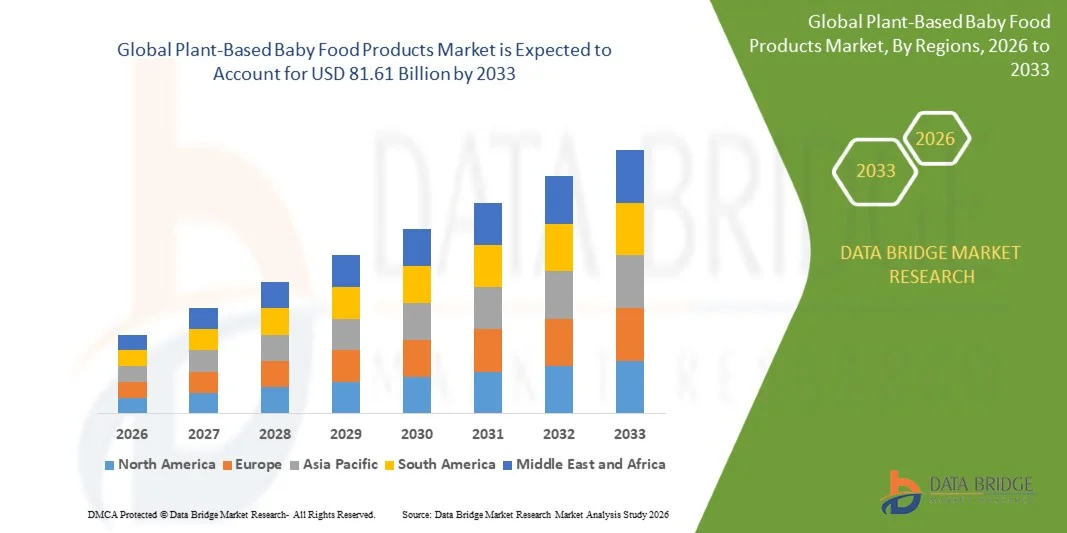
- As per Data Bridge Market Research analysis, the plant-based baby food products market was valued at USD 18.36 billion in 2025 and is projected to reach USD 81.61 billion by 2033, growing at a CAGR of 20.50% from 2026 to 2033.
- The market is experiencing rapid growth driven by rising parental demand for organic and clean-label infant nutrition, increasing adoption of vegan and flexitarian diets, and expanding availability across supermarkets, specialty stores, and online platforms.
- The increasing shift toward organic, allergen-aware, and sustainably sourced infant nutrition, combined with growing safety transparency, working-parent convenience, and premium pouch formats, is supporting market adoption. Plant-based products are being positioned across first foods, toddler meals, snacks, and dairy-free formulas, offering parents greater convenience in feeding through baby food, organic infant formula, and organic baby food.
Market Size & Forecast
- Global Market Value (2025): USD 18.36 Billion
- Expected Market Value (2033): USD 81.61 Billion
- Forecast CAGR (2026–2033): 20.50%
- Leading Region in 2025: Asia Pacific
- Fastest Growing Region: Asia Pacific
What are the Major Takeaways of the Plant-Based Baby Food Products Market?
- Asia-Pacific dominated the plant-based baby food products market with the largest revenue share of 38.60% in 2025, supported by a large infant population, rising disposable incomes, and fast-growing demand for premium and organic infant nutrition.
- Asia-Pacific is also expected to be the fastest-growing region at a CAGR of 22.40% from 2026 to 2033, fueled by urbanization, rising working-parent households, and expanding modern retail and e-commerce.
- The prepared plant-based baby food segment led the market with a 46.20% share in 2025, driven by convenience, ready-to-eat pouches, and strong brand presence.
- Plant-based infant formula is the fastest-growing product type, projected to register a CAGR of 23.80%, reflecting rising demand for dairy-free, soy-free, and allergen-aware feeding options.
- The soy segment dominated the source category with a 41.50% revenue share in 2025, led by its established protein quality and long history of use in infant nutrition.
- The dry form accounted for 52.30% of the market share in 2025, preferred for long shelf life, easy storage, and lower transportation costs.
- The online mode of sale is the fastest-growing channel, with a CAGR of 26.10%, driven by subscription models, direct-to-consumer brands, and rising comfort with digital baby product purchases.
Report Scope and Plant-Based Baby Food Products Market Segmentation
|
Attributes |
Plant-Based Baby Food Products Key Market Insights |
|
Segments Covered |
|
|
Countries Covered |
North America
Europe
Asia-Pacific
Middle East and Africa
South America
|
|
Key Market Players |
|
|
Market Opportunities |
|
|
Value Added Data Infosets |
In addition to the insights on market scenarios such as market value, growth rate, segmentation, geographical coverage, and major players, the market reports curated by the Data Bridge Market Research also include in-depth expert analysis, pricing analysis, brand share analysis, consumer survey, demography analysis, supply chain analysis, value chain analysis, raw material/consumables overview, vendor selection criteria, PESTLE Analysis, Porter Analysis, and regulatory framework. |
What is the Key Trend in the Plant-Based Baby Food Products Market?
- Plant-based baby food is increasingly shifting from a niche vegan choice to a mainstream first-foods category, combining organic ingredients, transparent safety testing, minimal processing, and convenient pouch and bowl formats.
- For instance, in January 2025, according to CNN, a California law began requiring baby food manufacturers to test finished products monthly for arsenic, cadmium, lead, and mercury and to share results through QR codes on labels, pushing brands toward ingredient transparency and cleaner plant-based sourcing
- Fresh, cold-pressed, and refrigerated formats are gaining space, as brands offer short ingredient lists made from vegetables, fruits, legumes, and whole grains that retain flavor and nutrients without artificial additives.
- Brands are expanding into plant-based proteins such as beans, lentils, and chickpeas, as parents compare products on protein quality, iron content, allergen information, and sustainability while shopping across supermarkets and online platforms.
- For instance, in March 2026, according to Once Upon a Farm’s fourth-quarter results, baby-segment sales rose 62.2% to USD 29.3 million, driven by 35.8% growth in pouches and 91.3% in snacks, showing strong demand for organic, plant-forward infant products
- As safety transparency, organic sourcing, plant-protein innovation, and e-commerce reach continue to advance, plant-based baby food is expected to expand beyond first foods into toddler meals, snacks, and dairy-free formulas.
What are the Key Drivers of the Plant-Based Baby Food Products Market?
- The growing preference for organic, vegan, and allergen-aware nutrition among parents has significantly increased demand for plant-based infant products that combine safety, quality, and sustainability.
- For instance, in November 2025, according to the National Library of Medicine (NLM), a Frontiers in Nutrition review of an ILSI Europe expert workshop evaluated the current use and future potential of plant-based proteins in infant formula, covering nutritional adequacy, allergenicity, sustainability, processing technologies, and regulatory constraints.
- Working parents, health-conscious families, and flexitarian households are adopting plant-based baby foods for convenience, ingredient transparency, and alignment with personal values, while retailers expand dedicated organic and plant-based baby aisles.
- For instance, in February 2026, according to Renaissance Capital, Once Upon a Farm priced its initial public offering at USD 18 per share, raising USD 198 million on the NYSE, reflecting strong investor confidence in organic and plant-forward children’s nutrition.
- With brands investing in innovation and distribution, and e-commerce lowering entry barriers for start-ups, plant-based baby food can gain wider visibility, trial, and repeat purchases across supermarkets, specialty stores, and direct-to-consumer platforms.
What Factors Are Challenging the Growth of the Plant-Based Baby Food Products Market?
- Plant-based baby foods face strict safety expectations, as heavy metals and contaminants in vegetables, grains, and legumes require careful sourcing, testing, and quality control.
- For instance, in January 2025, according to the U.S. Food and Drug Administration (FDA), final guidance set lead action levels of 10 parts per billion for many processed baby foods and 20 parts per billion for single-ingredient root vegetables and dry infant cereals, raising compliance expectations for plant-based producers.
- These requirements can increase testing, sourcing, and packaging costs, while premium pricing compared with conventional baby food may limit adoption among price-sensitive households and in developing markets.
- Concerns about nutritional adequacy, allergens, and limited long-term evidence for some plant proteins further restrict growth, requiring manufacturers to invest in clinical validation, fortification, and clear labeling that may increase development and regulatory costs.
- For instance, in June 2025, according to vegconomist, the CEO of Else Nutrition urged the U.S. FDA to expedite approval of a plant-based infant formula, highlighting the lengthy regulatory pathway that new plant-based formulas must navigate before reaching parents and constraining the speed of new product launches.
- The combination of contaminant testing, regulatory approvals, nutritional adequacy concerns, and premium pricing can constrain adoption among cost-sensitive consumers and smaller brands, particularly where conventional baby foods are widely trusted and affordable.
How is the Plant-Based Baby Food Products Market Segmented?
The plant-based baby food products market is segmented on the basis of product type, source, form, and mode of sale.
- By Product Type
On the basis of product type, the plant-based baby food products market is segmented into prepared plant-based baby food, dried plant-based baby food, plant-based infant formula, and others. The prepared plant-based baby food segment dominated the market with 46.20% share in 2025, supported by convenience, ready-to-eat pouches and jars, and strong brand recognition. Prepared foods let parents introduce fruits, vegetables, legumes, and grains without cooking. They are widely available through supermarkets, convenience stores, and online platforms. Organic and no-added-sugar positioning further strengthens demand among health-conscious parents. Continuous flavor innovation, stage-based nutrition, and resealable packaging are improving trial and repeat purchase.
The plant-based infant formula segment is projected to register the fastest growth at a CAGR of 23.80% from 2026 to 2033, driven by increasing demand for dairy-free, soy-free, and allergen-aware feeding options. Formulas based on pea, rice, almond, and other plant-based protein appeal to vegan families and parents of infants with cow’s milk intolerance. Research into protein quality, processing, and nutritional adequacy is improving confidence among clinicians. Regulatory approvals in selected markets are creating new opportunities for brands. Direct-to-consumer subscriptions and specialty retailers are also improving access to these premium products.
- By Source
On the basis of source, the plant-based baby food products market is segmented into soy, pea, wheat, and others. The soy segment dominated the market with 41.50% share in 2025, supported by high protein quality, established clinical evidence, and a long history of use in infant formulas and toddler foods. Soy protein provides a complete amino acid profile and is widely available at a competitive cost. The segment also benefits from broad regulatory familiarity and strong supply chains. Modern soy-based products show safe growth outcomes in healthy term infants. Its versatility across formulas, cereals, and snacks further strengthens its leadership.
The pea segment is projected to register the fastest growth at a CAGR of 24.70% from 2026 to 2033, driven by rising demand for soy-free, allergen-aware, and sustainable protein sources. Pea protein is highly soluble, digestible, and rich in iron, lysine, and branched-chain amino acids. These properties suit infant formulas, toddler drinks, and savory purees. Brands increasingly combine pea with rice or oat proteins to improve amino acid balance. Lower environmental impact compared with dairy supports sustainability claims. Improved processing is enhancing taste, texture, and nutritional quality.
- By Form
On the basis of form, the plant-based baby food products market is segmented into dry and liquid. The dry segment dominated the market with 52.30% share in 2025, driven by long shelf life, easy storage, and lower transportation costs. Powdered formulas, cereals, and instant mixes are widely used for infants and toddlers. Dry formats allow precise portioning and fortification with vitamins, iron, and probiotics. Parents value their convenience for travel and home use. Established production capacity and wide retail distribution continue to reinforce this segment's leadership.
The liquid segment is projected to register the fastest growth at a CAGR of 22.60% from 2026 to 2033, supported by demand for ready-to-feed, ready-to-eat, and cold-pressed products. Pouches, bottles, and refrigerated purees offer convenience for busy parents. Ready-to-feed plant-based formulas reduce preparation errors and mixing time. Brands use short ingredient lists and cold-chain freshness to differentiate products. Growth of refrigerated sections and delivery services is improving access.
- By Mode of Sale
On the basis of mode of sale, the plant-based baby food products market is segmented into offline and online. The offline segment dominated the market with 71.40% share in 2025, supported by strong shopper habits across supermarkets, hypermarkets, pharmacies, and specialty baby stores. Physical stores let parents check labels, compare brands, and make immediate purchases. Pharmacist and pediatrician recommendations influence choices, especially for formulas. Promotions, shelf placement, and brand trust further support sales. Established relationships with retailers continue to reinforce this channel's leadership.
The online segment is projected to register the fastest growth at a CAGR of 26.10% from 2026 to 2033, driven by growing e-commerce use, subscription purchasing, and direct-to-consumer brand expansion. Digital platforms provide access to niche organic and plant-based products not stocked in local stores. Parents value reviews, ingredient transparency, and doorstep delivery. Social media and influencer content raise awareness among younger parents. Safety testing results shared through QR codes also build trust online.
Which Region Holds the Largest Share of the Plant-Based Baby Food Products Market?
- Asia-Pacific dominated the plant-based baby food products market with the largest revenue share of 38.60% in 2025, supported by a large infant population, rising disposable incomes, and fast-growing demand for premium and organic infant nutrition.
- The region also benefits from a large and rising number of working parents, growing awareness of infant nutrition, and the presence of leading local formula and baby food manufacturers. Increasing e-commerce adoption, premiumization, and interest in organic products continue to strengthen Asia-Pacific’s position in the global market.
U.S. Plant-Based Baby Food Products Market Insight
The U.S. plant-based baby food products market is witnessing strong growth due to rising demand for organic, vegan, and allergen-aware infant nutrition, along with strong regulatory focus on food safety. The country’s mature natural food retail sector, along with growing availability of refrigerated pouches, frozen meals, and snacks in supermarkets and online platforms, is driving demand. In addition, growing investment in start-ups, heavy metal testing programs, and transparent labeling is accelerating adoption across families.
Canada Plant-Based Baby Food Products Market Insight
Canada’s plant-based baby food market is driven by rising vegan and vegetarian preferences, increasing demand for organic and clean-label ingredients, growing awareness of plant-based nutrition, demand for allergen-conscious products, sustainability concerns, eco-friendly packaging, premiumization, convenience and ready-to-eat meals, e-commerce expansion, specialty retail growth, product innovation, and improved nutritional fortification. However, higher prices, parental concerns over nutritional adequacy, and Canada’s declining birth rate may constrain market growth.
Asia-Pacific Plant-Based Baby Food Products Market Insight
The Asia-Pacific plant-based baby food products market is expected to witness rapid growth, driven by a large infant population, rising disposable incomes, and expanding modern retail across countries such as China, India, and Japan. Growing awareness of nutrition, premium imported brands, and organic foods is supporting regional market expansion. In addition, the region’s growing e-commerce platforms, rising working-parent households, and strong local manufacturers are accelerating availability and demand.
China Plant-Based Baby Food Products Market Insight
The China plant-based baby food products market is growing rapidly, driven by a large infant population, rising middle-class incomes, and strong demand for premium and organic infant nutrition. Growing online shopping among young parents is significantly boosting market demand. In addition, strong domestic formula manufacturers, cross-border e-commerce, and rising interest in plant-based and clean-label products are positioning China as a key growth market across Asia-Pacific.
Japan Plant-Based Baby Food Products Market Insight
The Japan plant-based baby food products market is witnessing consistent growth due to rising interest in natural ingredients, high safety standards, and convenient infant nutrition. Parents, retailers, and manufacturers are increasingly adopting vegetable-based and additive-free products. Moreover, strong demand for quality, easy-to-use packaging, and trusted domestic brands is further contributing to market growth in Japan.
Which are the Top Companies in Plant-Based Baby Food Products Market?
The plant-based baby food products industry is primarily led by well-established companies, including:
- Nestlé S.A. (Switzerland)
- Danone S.A. (France)
- The Kraft Heinz Company (U.S.)
- Once Upon a Farm, PBC (U.S.)
- The Hain Celestial Group, Inc. (U.S.)
- Reckitt Benckiser Group plc (U.K.)
- Abbott Laboratories (U.S.)
- China Feihe Limited (China)
- HiPP GmbH & Co. Vertrieb KG (Germany)
- Hero Group (Switzerland)
- Yili Industrial Group Co. Ltd. (China)
- Kewpie Corporation (Japan)
- Royal FrieslandCampina N.V. (Netherlands)
- Sun-Maid Growers of California (U.S.)
- Sprout Foods, Inc. (U.S.)
- Amara Organic Foods (U.S.)
- Else Nutrition Holdings Inc. (Israel)
- Little Spoon, Inc. (U.S.)
- Yumi (U.S.)
- Holle Baby Food AG (Switzerland)
What are Latest Developments in Plant-Based Baby Food Products Market?
- In February 2026, Once Upon a Farm priced its initial public offering at USD 18 per share and began trading on the NYSE under the ticker OFRM, raising about USD 198 million. The organic baby and children’s food maker plans to use the capital to expand production and distribution.
- In March 2026, Once Upon a Farm launched five new products, including Legume Blends containing plant-based protein from beans and pumpkin seeds, marking its largest portfolio expansion to date.
- In June 2025, Else Nutrition’s chief executive urged the U.S. FDA to expedite the approval of plant-based infant formula, noting the company’s focus on a soy-free and dairy-free option for babies. The call highlights growing interest in plant-based formulas and the regulatory hurdles they face.
- In May 2023, Cerebelly expanded into the Canadian market, launching through Sobeys, Safeway, Farm Boy, and Thrifty Foods, along with Amazon.ca.
- In April 2022, Nestlé’s Gerber launched Plant-tastic, its first full range of organic plant-based toddler foods, including pouches, snacks, and meals made with beans, whole grains, and vegetables. The entire range was certified carbon neutral and sold through major U.S. retailers and online channels.
- In December 2021, Yumi announced that it had raised USD 67 million to improve its distribution of plant-based baby food. The funding supported the subscription brand’s expansion in fresh, organic baby meals and increased competition among plant-forward start-ups.
- In April 2021, The Kraft Heinz Company launched a plant-based baby food line, offering vegan dishes such as Saucy Pasta Stars with beans and carrot, Potato Bake with green beans and sweet garden peas, and Risotto with chickpeas and pumpkin, to provide babies with a high-quality plant-based diet.

- Interactive Data Analysis Dashboard
- Company Analysis Dashboard for high growth potential opportunities
- Research Analyst Access for customization & queries
- Competitor Analysis with Interactive dashboard
- Latest News, Updates & Trend analysis
- Harness the Power of Benchmark Analysis for Comprehensive Competitor Tracking
Global Plant Based Baby Food Products Market, Supply Chain Analysis and Ecosystem Framework
To support market growth and help clients navigate the impact of geopolitical shifts, DBMR has integrated in-depth supply chain analysis into its Global Plant Based Baby Food Products Market research reports. This addition empowers clients to respond effectively to global changes affecting their industries. The supply chain analysis section includes detailed insights such as Global Plant Based Baby Food Products Market consumption and production by country, price trend analysis, the impact of tariffs and geopolitical developments, and import and export trends by country and HSN code. It also highlights major suppliers with data on production capacity and company profiles, as well as key importers and exporters. In addition to research, DBMR offers specialized supply chain consulting services backed by over a decade of experience, providing solutions like supplier discovery, supplier risk assessment, price trend analysis, impact evaluation of inflation and trade route changes, and comprehensive market trend analysis.
Data collection and base year analysis are done using data collection modules with large sample sizes. The stage includes obtaining market information or related data through various sources and strategies. It includes examining and planning all the data acquired from the past in advance. It likewise envelops the examination of information inconsistencies seen across different information sources. The market data is analysed and estimated using market statistical and coherent models. Also, market share analysis and key trend analysis are the major success factors in the market report. To know more, please request an analyst call or drop down your inquiry.
The key research methodology used by DBMR research team is data triangulation which involves data mining, analysis of the impact of data variables on the market and primary (industry expert) validation. Data models include Vendor Positioning Grid, Market Time Line Analysis, Market Overview and Guide, Company Positioning Grid, Patent Analysis, Pricing Analysis, Company Market Share Analysis, Standards of Measurement, Global versus Regional and Vendor Share Analysis. To know more about the research methodology, drop in an inquiry to speak to our industry experts.
Data Bridge Market Research is a leader in advanced formative research. We take pride in servicing our existing and new customers with data and analysis that match and suits their goal. The report can be customized to include price trend analysis of target brands understanding the market for additional countries (ask for the list of countries), clinical trial results data, literature review, refurbished market and product base analysis. Market analysis of target competitors can be analyzed from technology-based analysis to market portfolio strategies. We can add as many competitors that you require data about in the format and data style you are looking for. Our team of analysts can also provide you data in crude raw excel files pivot tables (Fact book) or can assist you in creating presentations from the data sets available in the report.













