


What is the Plant-Based Oils Market Size and Overview?
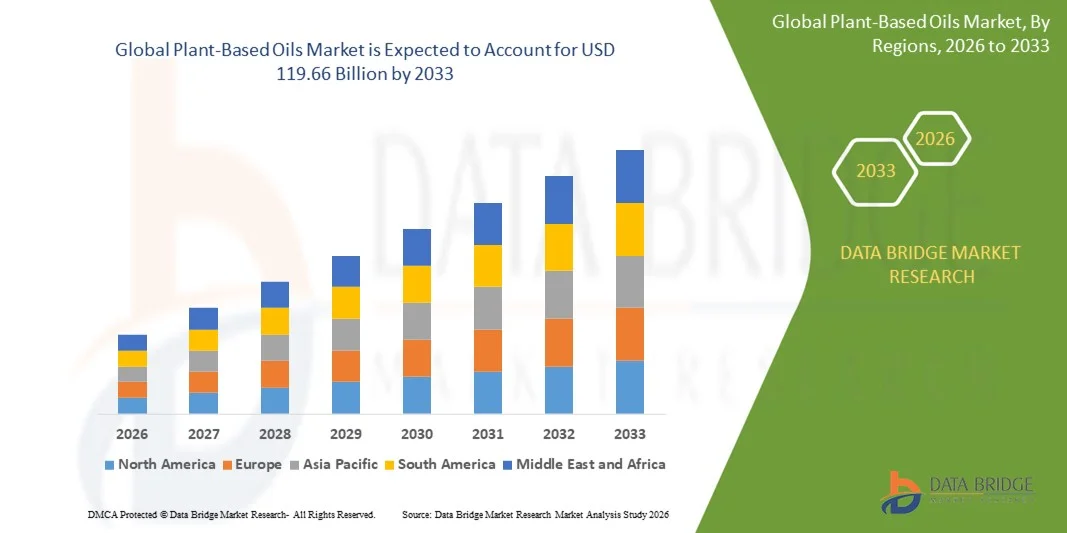
- As per Data Bridge Market Research Analysis the Global Plant-Based Oils Market size was valued at USD 79.76 billion in 2025 and is projected to reach USD 119.66 billion by 2033, expanding at a CAGR of 5.20% over the forecast period.
- Market expansion is primarily driven by rising health consciousness, increasing preference for natural and clean-label ingredients, and advancements in extraction technologies that enhance product quality and yield across food, cosmetic, and industrial applications.
- Additionally, the growing demand for sustainable, nutrient-rich, and versatile oil alternatives is positioning plant-based oils as a preferred choice among consumers and manufacturers alike, accelerating adoption and significantly contributing to overall industry growth.
Market Size & Forecast
- Global Market Value (2025): USD 79.76 Billion
- Expected Market Value (2033): USD 119.66 Billion
- Forecast CAGR (2026–2033): 5.20%
Global Plant-Based Oils Market Analysis
- Plant-based oils, derived from seeds, nuts, fruits, and other botanical sources, are becoming essential ingredients across food, cosmetic, pharmaceutical, and industrial applications due to their nutritional benefits, sustainability profile, and versatility in formulation, supporting the global shift toward natural and plant-based products.
- The rising demand for plant-based oils is primarily driven by increasing health awareness, growing preference for clean-label and minimally processed ingredients, and the expanding use of specialty oils in functional foods, personal care, and bio-based industrial solutions.
- Europe dominated the Global Plant-Based Oils Market with the largest revenue share of 32.4% in 2025, supported by strong consumer inclination toward healthy cooking oils, well-established food processing industries, and the presence of major market players, with the U.S. experiencing heightened adoption of premium and organic plant-based oils driven by lifestyle shifts and product innovation.
- Asia-Pacific is expected to be the fastest-growing region in the Global Plant-Based Oils Market during the forecast period due to rapid urbanization, rising disposable incomes, and increasing consumption of plant-derived ingredients across food, cosmetic, and wellness sectors.
- Palm oil dominated the market with the largest market revenue share of 32.4% in 2025, driven by its high extraction efficiency, cost-effectiveness, and widespread availability across major producing countries including Indonesia and Malaysia.
Report Scope and Global Plant-Based Oils Market Segmentation
|
Attributes |
Plant-Based Oils Key Market Insights |
|
Segments Covered |
|
|
Countries Covered |
North America
Europe
Asia-Pacific
Middle East and Africa
South America
|
|
Key Market Players |
|
|
Market Opportunities |
|
|
Value Added Data Infosets |
In addition to the insights on market scenarios such as market value, growth rate, segmentation, geographical coverage, and major players, the market reports curated by the Data Bridge Market Research also include in-depth expert analysis, pricing analysis, brand share analysis, consumer survey, demography analysis, supply chain analysis, value chain analysis, raw material/consumables overview, vendor selection criteria, PESTLE Analysis, Porter Analysis, and regulatory framework. |
What is the Key Trend in the Plant-Based Oils Market?
Rising Innovation in Functional and Specialty Plant-Based Oils
- A significant and rapidly accelerating trend in the Global Plant-Based Oils Market is the growing integration of advanced processing technologies—such as cold-press extraction, enzymatic processing, and molecular distillation—to enhance nutritional value, purity, and functionality in both food and non-food applications. These innovations are enabling manufacturers to deliver higher-quality oils tailored to specific consumer and industrial needs.
- For Instance, companies such as AAK and ADM are developing specialty oils optimized for plant-based meat, dairy alternatives, and bakery formulations, offering improved texture, stability, and flavor performance. Similarly, premium cold-pressed avocado and coconut oils are gaining popularity due to their rich nutrient profiles and minimal processing.
- Advanced refining and extraction techniques also enable the production of oils with enhanced bioactive compounds, such as omega-3–rich flaxseed oil and antioxidant-dense grapeseed oil. These innovations support growing demand in functional foods, nutraceuticals, and personal care products. Furthermore, cleaner and more efficient processing helps brands meet rising consumer expectations for transparency, sustainability, and natural ingredient sourcing.
- The increasing integration of plant-based oils into broader product ecosystems—spanning food manufacturing, cosmetics, pharmaceuticals, and bio-based industrial applications—is creating a more unified and technology-driven market landscape. Companies are leveraging specialized formulations to support product categories such as vegan spreads, natural skincare, and biodegradable lubricants, all of which benefit from tailored oil compositions.
- This shift toward more advanced, nutrient-dense, and application-specific oils is reshaping industry standards and elevating consumer expectations for plant-derived ingredients. Consequently, leading producers including Cargill, Wilmar, and Fuji Oil are actively expanding their portfolios to include premium, functional, and sustainably sourced oil varieties.
- Demand for these innovative plant-based oil solutions is rising across both developed and emerging markets, as consumers increasingly prioritize health, clean-label products, and environmentally responsible alternatives, driving strong growth in the global industry.
Global Plant-Based Oils Market Dynamics
Driver
Growing Need Due to Rising Health Awareness and Shift Toward Natural Ingredients
- The rising global focus on health, nutrition, and natural ingredients is a major factor driving the increasing demand for plant-based oils across food, cosmetic, and wellness applications.
- For instance, manufacturers are increasingly launching nutrient-rich and minimally processed oils—such as cold-pressed coconut, avocado, and flaxseed oils—to meet consumer preferences for healthier and cleaner alternatives. Such innovations are expected to significantly propel the plant-based oils market during the forecast period.
- As consumers become more aware of the health benefits associated with plant-derived oils—such as heart health, antioxidant properties, and essential fatty acids—these oils are increasingly replacing synthetic or animal-derived fats in daily diets and product formulations.
- Furthermore, the rising popularity of plant-based diets, clean-label food products, and natural beauty solutions is strengthening the use of plant-based oils, which integrate seamlessly into food processing, personal care, and functional wellness products.
- The convenience, versatility, and broad applicability of plant-based oils across multiple industries, along with the growing trend of home cooking and DIY beauty routines, are key factors boosting adoption globally. The rising availability of organic, sustainably sourced, and premium oil varieties further supports market expansion.
Restraint/Challenge
Price Volatility and Sustainability Concerns in Raw Material Sourcing
- Fluctuations in the availability and cost of raw materials—such as palm, soybean, and sunflower seeds—pose significant challenges to stable production and pricing in the plant-based oils market. Climate variability, supply chain disruptions, and geopolitical factors can lead to sharp price changes, limiting broader adoption in price-sensitive markets.
- For instance, global concerns regarding the environmental impact of certain oil crops, particularly palm oil, have made consumers and regulatory bodies increasingly cautious about sustainability practices in the industry.
- Addressing these concerns through certified sustainable sourcing, improved agricultural practices, and traceability systems is essential for maintaining consumer trust and meeting global sustainability standards. Major companies, including Wilmar and Cargill, are emphasizing deforestation-free supply chains and transparent sourcing to reassure buyers. Additionally, premium cold-pressed and specialty oils often come with higher production costs, making them less accessible to budget-conscious consumers, especially in developing regions.
- While affordability is gradually improving, the perception of plant-based oils as premium or specialty products can still hinder mass adoption among cost-sensitive buyers.
- Overcoming these challenges through sustainable sourcing initiatives, supply chain optimization, and the development of cost-effective oil varieties will be crucial for supporting long-term and widespread market growth.
Global Plant-Based Oils Market Scope
Plant-based oils market is segmented on the basis of source outlook, application, packaging, end user and distribution channel.
- By Source Outlook
On the basis of source, the Global Plant-Based Oils Market is segmented into Palm Oil, Soybean Oil, Sunflower Oil, Rapeseed Oil, Olive Oil, Coconut Oil, Cottonseed Oil, and Others. Palm oil dominated the market with the largest market revenue share of 32.4% in 2025, driven by its high extraction efficiency, cost-effectiveness, and widespread availability across major producing countries including Indonesia and Malaysia. Its versatility makes it a key ingredient in processed foods, baked goods, confectionery, and biofuel blends, further strengthening its market position. The segment continues to benefit from established global trade networks and extensive use in both edible and industrial applications.
The sunflower oil segment is anticipated to witness the fastest CAGR of 22.1% from 2026 to 2033, fueled by growing consumer preference for healthier oils rich in vitamin E and unsaturated fatty acids. Increased adoption of cold-pressed sunflower oil in premium food categories and rising production in Europe and Asia further contribute to its rapid growth.
- By Application
On the basis of application, the Global Plant-Based Oils Market is segmented into Food, Industrial, and Animal Feeds. The food segment accounted for the largest market revenue share of 58.7% in 2025, driven by the rising global consumption of edible oils for cooking, frying, baking, and processed food manufacturing. Increasing awareness of the health benefits of plant-based oils—such as improved heart health and antioxidant properties—continues to fuel demand across households and commercial kitchens. Specialty oils like olive, avocado, and coconut are also witnessing strong uptake in premium and functional food applications.
The industrial segment is expected to witness the fastest CAGR of 20.4% from 2026 to 2033, owing to expanding use of plant oils in cosmetics, pharmaceuticals, bio-lubricants, and environmentally friendly industrial formulations. Growing preference for bio-based raw materials and sustainable production practices is significantly boosting adoption in multiple industrial verticals.
- By Packaging
On the basis of packaging, the Global Plant-Based Oils Market is segmented into PET Bottles, HDPE Cans, Tin-Plate Containers, Tetra Packs, Flexible Plastic Pouches, and Glass Bottles. PET bottles dominated the market with the largest revenue share of 41.6% in 2025, owing to their lightweight nature, cost-effectiveness, durability, and suitability for large-scale edible oil packaging. PET bottles are widely preferred by manufacturers due to their ease of transport, compatibility with high-speed filling lines, and strong shelf appeal. They are available in various sizes, supporting household, commercial, and institutional consumption.
The flexible plastic pouches segment is expected to witness the fastest CAGR of 23.3% from 2026 to 2033, driven by increasing demand for eco-friendly and economical packaging formats. Pouches use less plastic, reduce transportation costs, and offer convenience features such as resealable openings, making them popular for both retail and refill applications in emerging and developed markets.
- By End User
On the basis of end user, the Global Plant-Based Oils Market is segmented into Food Processing Industry, Food Services Industry, Pharmaceutical Industry, Cosmetic Industry, and Others. The food processing industry dominated the market with the largest revenue share of 49.2% in 2025, supported by extensive use of plant-based oils in snacks, bakery products, confectionery, sauces, dairy alternatives, and ready-to-eat meals. Growing demand for clean-label and natural ingredients significantly strengthens the segment’s dominance. Manufacturers increasingly prefer plant-derived oils for their functional properties, stability, and nutritional benefits.
The cosmetic industry is expected to witness the fastest CAGR of 21.9% from 2026 to 2033, driven by rising consumer preference for natural, organic, and plant-based beauty formulations. Oils such as coconut, jojoba, argan, and almond are widely utilized in skincare, haircare, and personal care products due to their moisturizing, anti-inflammatory, and antioxidant properties, fueling accelerated adoption.
- By Distribution Channel
On the basis of distribution channel, the Global Plant-Based Oils Market is segmented into Online and Offline. The offline segment held the largest market revenue share of 68.3% in 2025, driven by strong consumer reliance on supermarkets, hypermarkets, grocery stores, and specialty outlets for purchasing edible and specialty oils. These retail environments offer product visibility, trusted brands, convenience, and competitive pricing, making them the primary choice for household and commercial customers. Offline channels also benefit from long-established supply networks and bulk purchase patterns in food service and industrial sectors.
The online segment is anticipated to witness the fastest CAGR of 22.8% from 2026 to 2033, attributed to rising e-commerce penetration, digital adoption, and the growing trend toward purchasing premium, organic, and international oil brands online. E-commerce platforms offer broader selection, subscription deliveries, discounts, and doorstep convenience, making them increasingly appealing to health-conscious and urban consumers.
Global Plant-Based Oils Market Regional Analysis
- Europe dominated the Global Plant-Based Oils Market with the largest revenue share of 32.4% in 2025, driven by rising demand for healthy and plant-based edible oils, growing awareness of nutritional benefits, and the presence of a mature food processing and food services industry.
- Consumers in the region increasingly prefer plant-based oils such as olive, sunflower, and canola for cooking, baking, and specialty food applications, owing to their perceived health benefits, versatility, and suitability for clean-label and organic products.
- This strong market adoption is further supported by high disposable incomes, growing health consciousness, and the expansion of retail and online distribution channels, establishing plant-based oils as a preferred choice across households, restaurants, and industrial applications in North America.
U.S. Plant-Based Oils Market Insight
The U.S. plant-based oils market captured the largest revenue share of 35% in 2025 within North America, driven by increasing consumer preference for healthy and natural cooking oils such as olive, sunflower, and canola. Rising awareness of the health benefits associated with plant-based diets, including heart health and reduced cholesterol, is fueling demand. Moreover, growth in the food processing and food service sectors, combined with the convenience of retail and online distribution channels, is further propelling market expansion. The popularity of plant-based oils in packaged foods, snacks, and bakery products also contributes significantly to market growth.
Europe Plant-Based Oils Market Insight
The Europe plant-based oils market is projected to expand at a substantial CAGR during the forecast period, primarily driven by strong demand for organic and non-GMO oils and increasing health consciousness. Countries such as Germany, France, and Italy are witnessing growing adoption of olive and rapeseed oils in both households and the food service sector. Supportive regulations on nutritional labeling and sustainability initiatives are further encouraging the use of plant-based oils in industrial and food applications.
U.K. Plant-Based Oils Market Insight
The U.K. plant-based oils market is anticipated to grow at a noteworthy CAGR, fueled by consumer demand for healthier alternatives to conventional oils. Rising awareness of cholesterol management, cardiovascular health, and plant-based diets is driving the adoption of oils like sunflower, rapeseed, and olive oils. The retail expansion of organic and specialty oils, coupled with growing e-commerce penetration, continues to support market growth.
Germany Plant-Based Oils Market Insight
The Germany plant-based oils market is expected to expand at a considerable CAGR, driven by high consumer preference for sustainable and eco-friendly oils. Olive and rapeseed oils are widely used in households and industrial food production, while increasing vegan and vegetarian diets are creating further demand. Germany’s focus on clean-label and organic food products, along with a developed retail and online sales infrastructure, reinforces the market’s growth potential.
Asia-Pacific Plant-Based Oils Market Insight
The Asia-Pacific plant-based oils market is poised to grow at the fastest CAGR of 22% during the forecast period of 2026 to 2033, driven by rising population, urbanization, and increasing disposable incomes in countries such as China, India, and Japan. Expanding demand for cooking oils in households, food processing, and packaged food sectors, combined with growing awareness of health and wellness, is boosting market adoption. Government initiatives promoting healthy nutrition and the rise of modern retail channels further accelerate growth in the region.
Japan Plant-Based Oils Market Insight
The Japan plant-based oils market is gaining momentum due to rising health consciousness and a preference for high-quality cooking oils such as olive, soybean, and canola oils. Consumers increasingly prioritize heart-healthy and cholesterol-lowering oils, while the food processing industry drives demand for standardized and refined oils. Additionally, Japan’s aging population favors easily digestible and nutrient-rich oils, supporting steady market growth.
China Plant-Based Oils Market Insight
The China plant-based oils market accounted for the largest market revenue share in Asia-Pacific in 2025, attributed to rapid urbanization, an expanding middle class, and growing adoption of healthier cooking practices. Oils such as soybean, palm, and sunflower are widely used in households, restaurants, and the food processing industry. Government initiatives promoting nutrition awareness, coupled with the rise of modern retail and e-commerce channels, are further driving consumption and market growth.
Which are the Top Companies in Plant-Based Oils Market?
The Plant-Based Oils industry is primarily led by well-established companies, including:
- Cargill, Inc. (U.S.)
- Archer Daniels Midland Company (ADM) (U.S.)
- Bunge Limited (U.S.)
- Wilmar International Ltd. (Singapore)
- Olam International (Singapore)
- IOI Corporation Berhad (Malaysia)
- Kraft Heinz Company (U.S.)
- Louis Dreyfus Company (Netherlands)
- Sime Darby Plantation (Malaysia)
- Ruchi Soya Industries Ltd. (India)
- COFCO Corporation (China)
- BASF SE (Germany)
- Haldiram’s Agro Products (India)
- Mazola / ACH Food Companies (U.S.)
- CME Group (U.S.)
- Wilmar Africa Limited (Nigeria)
- Grasim Industries Ltd. (India)
- Marico Limited (India)
- Emami Limited (India)
- Peter Cremer Holding GmbH & Co. KG (Germany)
What are the Recent Developments in Global Plant-Based Oils Market?
- In April 2024, Cargill, Inc., a global leader in agricultural and food solutions, expanded its plant-based oils production capacity in Indonesia, focusing on sustainable palm oil and soybean oil. This initiative emphasizes the company’s commitment to environmentally responsible sourcing while meeting the growing global demand for plant-based oils in food and industrial applications. By leveraging its expertise in sustainable agriculture and processing, Cargill aims to strengthen its position in the rapidly growing Global Plant-Based Oils Market.
- In March 2024, Archer Daniels Midland Company (ADM) launched a new line of high-oleic sunflower and canola oils in North America, tailored for the food processing and packaged food sectors. These oils are designed to improve nutritional value and shelf life, highlighting ADM’s focus on innovation and health-conscious product development to meet rising consumer preferences for healthier cooking and industrial applications.
- In March 2024, Bunge Limited inaugurated a state-of-the-art olive oil processing facility in Spain, aimed at boosting production efficiency and quality. The facility integrates advanced extraction and refining technologies, underscoring Bunge’s dedication to delivering high-quality plant-based oils while supporting regional agricultural development. This expansion reflects the growing significance of premium oils in both retail and industrial markets.
- In February 2024, Wilmar International Ltd. entered into a strategic partnership with local agricultural cooperatives in India to enhance the supply chain of coconut and cottonseed oils. The collaboration focuses on improving sourcing transparency and quality control, ensuring consistent supply for food processing and industrial applications. The initiative highlights Wilmar’s commitment to sustainability and operational efficiency in the plant-based oils sector.
- In January 2024, Olam International introduced an innovative line of flexible packaging for palm, soybean, and rapeseed oils, including PET and HDPE options for both retail and commercial applications. This development aims to enhance product convenience, shelf life, and sustainability, reinforcing Olam’s focus on meeting evolving consumer and industrial demands in the Global Plant-Based Oils Market.

- Interactive Data Analysis Dashboard
- Company Analysis Dashboard for high growth potential opportunities
- Research Analyst Access for customization & queries
- Competitor Analysis with Interactive dashboard
- Latest News, Updates & Trend analysis
- Harness the Power of Benchmark Analysis for Comprehensive Competitor Tracking
Global Plant Based Oils Market, Supply Chain Analysis and Ecosystem Framework
To support market growth and help clients navigate the impact of geopolitical shifts, DBMR has integrated in-depth supply chain analysis into its Global Plant Based Oils Market research reports. This addition empowers clients to respond effectively to global changes affecting their industries. The supply chain analysis section includes detailed insights such as Global Plant Based Oils Market consumption and production by country, price trend analysis, the impact of tariffs and geopolitical developments, and import and export trends by country and HSN code. It also highlights major suppliers with data on production capacity and company profiles, as well as key importers and exporters. In addition to research, DBMR offers specialized supply chain consulting services backed by over a decade of experience, providing solutions like supplier discovery, supplier risk assessment, price trend analysis, impact evaluation of inflation and trade route changes, and comprehensive market trend analysis.
Data collection and base year analysis are done using data collection modules with large sample sizes. The stage includes obtaining market information or related data through various sources and strategies. It includes examining and planning all the data acquired from the past in advance. It likewise envelops the examination of information inconsistencies seen across different information sources. The market data is analysed and estimated using market statistical and coherent models. Also, market share analysis and key trend analysis are the major success factors in the market report. To know more, please request an analyst call or drop down your inquiry.
The key research methodology used by DBMR research team is data triangulation which involves data mining, analysis of the impact of data variables on the market and primary (industry expert) validation. Data models include Vendor Positioning Grid, Market Time Line Analysis, Market Overview and Guide, Company Positioning Grid, Patent Analysis, Pricing Analysis, Company Market Share Analysis, Standards of Measurement, Global versus Regional and Vendor Share Analysis. To know more about the research methodology, drop in an inquiry to speak to our industry experts.
Data Bridge Market Research is a leader in advanced formative research. We take pride in servicing our existing and new customers with data and analysis that match and suits their goal. The report can be customized to include price trend analysis of target brands understanding the market for additional countries (ask for the list of countries), clinical trial results data, literature review, refurbished market and product base analysis. Market analysis of target competitors can be analyzed from technology-based analysis to market portfolio strategies. We can add as many competitors that you require data about in the format and data style you are looking for. Our team of analysts can also provide you data in crude raw excel files pivot tables (Fact book) or can assist you in creating presentations from the data sets available in the report.













