What is the Plant Based Organic Fertilizers Market Size and Growth Rate?
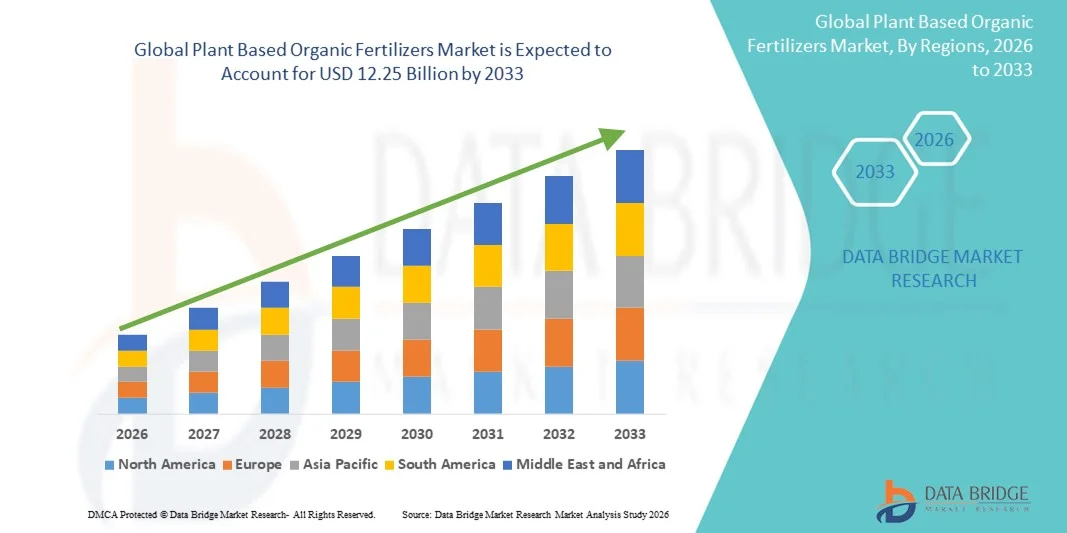
- The global plant based organic fertilizers market size was valued at USD 4.88 billion in 2025 and is expected to reach USD 12.25 billion by 2033, at a CAGR of 12.20% during the forecast period
- The market growth is largely fueled by the increasing adoption of sustainable and eco-friendly agricultural practices, coupled with technological advancements in biofertilizer production and application methods. These developments are enabling farmers to enhance soil fertility, improve crop yields, and reduce dependency on chemical fertilizers, thereby driving demand for plant-based organic fertilizers
- Furthermore, rising consumer preference for chemical-free and organic food products is establishing plant-based organic fertilizers as the preferred choice for modern agriculture. For instance, companies such as ILSA S.p.A. are offering tailored organic fertilizer solutions for high-value crops, supporting the shift toward sustainable farming practices and boosting the overall market expansion
Market Size & Forecast
- Global Market Value (2025): USD 4.88 billion
- Expected Market Value (2033): USD 12.25 billion
- Forecast CAGR (2026-2033): 12.20%
What are the Major Takeaways of Plant Based Organic Fertilizers Market?
- Plant-based organic fertilizers, derived from natural plant sources, are increasingly recognized as vital components for sustainable agriculture due to their ability to improve soil health, enhance nutrient availability, and support long-term crop productivity across cereals, fruits, vegetables, and pulses
- The escalating demand for plant-based organic fertilizers is primarily driven by government initiatives promoting organic farming, increasing awareness of environmental sustainability, and the growing adoption of precision agriculture techniques. These factors are fostering market growth and accelerating the transition from conventional chemical fertilizers to plant-based alternatives
- North America dominated the plant based organic fertilizers market in 2025, due to the increasing adoption of sustainable and eco-friendly agricultural practices, as well as heightened awareness regarding soil health and crop quality
- Asia-Pacific is expected to be the fastest growing region in the plant based organic fertilizers market during the forecast period due to increasing urbanization, rising disposable incomes, and the adoption of modern agricultural practices in countries such as China, India, and Japan
- Dry segment dominated the market with a market share of 46.5% in 2025, due to its long shelf life, ease of storage, and gradual nutrient release that supports sustained crop growth. Farmers often prefer dry fertilizers for their cost-effectiveness and ability to cover large agricultural areas efficiently. The market also sees strong demand for dry forms due to their compatibility with conventional farming equipment and the reduced risk of nutrient loss during application. The controlled-release properties of dry plant-based fertilizers further enhance soil fertility over extended periods, making them suitable for cereals and grains cultivation
Report Scope and Plant Based Organic Fertilizers Market Segmentation
|
Attributes |
Plant Based Organic Fertilizers Key Market Insights |
|
Segments Covered |
|
|
Countries Covered |
North America
Europe
Asia-Pacific
Middle East and Africa
South America
|
|
Key Market Players |
|
|
Market Opportunities |
|
|
Value Added Data Infosets |
In addition to the insights on market scenarios such as market value, growth rate, segmentation, geographical coverage, and major players, the market reports curated by the Data Bridge Market Research also include import export analysis, production capacity overview, production consumption analysis, price trend analysis, climate change scenario, supply chain analysis, value chain analysis, raw material/consumables overview, vendor selection criteria, PESTLE Analysis, Porter Analysis, and regulatory framework. |
What is the Key Trend in the Plant Based Organic Fertilizers Market?
Growing Adoption of Sustainable and Organic Farming Practices
- The global agricultural landscape is witnessing a significant shift towards sustainable and organic farming practices, driving the increased adoption of plant-based organic fertilizers as farmers aim to enhance soil health, reduce reliance on chemical inputs, and improve crop productivity over time
- For instance, ILSA S.p.A. has introduced a comprehensive range of plant-derived biofertilizers specifically formulated for high-value horticultural crops, enabling farmers to implement eco-friendly fertilization strategies while ensuring nutrient-rich soil management and enhanced crop yields
- Farmers are increasingly recognizing the long-term benefits of plant-based fertilizers, which gradually release essential nutrients, support microbial activity in the soil, and contribute to the maintenance of a balanced ecosystem that promotes sustainable agriculture practices across various crop types
- Integration of plant-based fertilizers with advanced agricultural practices such as precision farming, fertigation, and automated application systems is allowing for more efficient nutrient management, minimizing wastage, and ensuring optimized yields in cereals, fruits, vegetables, and pulses
- Growing consumer demand for organic and chemical-free food products is encouraging farmers and agribusinesses to adopt plant-based fertilizers, reinforcing the importance of eco-conscious fertilization methods in meeting both environmental standards and market expectations
- The trend towards sustainable and organic farming practices is expected to continue shaping the plant-based organic fertilizers market, as stakeholders across the value chain increasingly prioritize soil health, long-term productivity, and environmentally responsible farming solutions
Plant Based Organic Fertilizers Market Dynamics
Driver
Increasing Demand for Eco-Friendly and Soil-Enhancing Fertilizers
- Rising environmental awareness and concerns regarding the negative impacts of synthetic fertilizers on soil and water systems are significantly driving the demand for plant-based organic fertilizers, as these solutions help improve soil fertility and support sustainable agricultural practices
- For instance, Tata Chemicals Ltd. has expanded its portfolio of biofertilizers in India to cater to the growing organic farming market, providing nutrient-enriched plant-based products that enhance soil quality, increase crop yield, and contribute to sustainable farm management practices
- Farmers and commercial growers are increasingly prioritizing fertilizers that maintain soil microbial activity, enhance nutrient availability, and reduce chemical residues in crops, which further accelerates the adoption of plant-based alternatives across multiple crop segments
- Government initiatives, subsidies, and policy frameworks promoting organic agriculture are enabling wider adoption of eco-friendly fertilizers, providing farmers with financial and technical support to transition from chemical-based to plant-based nutrient solutions
- The compatibility of plant-based fertilizers with modern application methods, such as foliar feeding, fertigation, and soil broadcasting, enhances their usability across diverse farming setups, making them a preferred choice for both large-scale commercial farms and smallholder operations
Restraint/Challenge
High Production Costs and Limited Availability of Raw Plant Materials
- The production of plant-based organic fertilizers involves complex extraction and processing methods that contribute to relatively high manufacturing costs, making it challenging for companies to offer competitively priced products in cost-sensitive markets
- For instance, Coromandel International Limited faces constraints in sourcing sufficient quantities of high-quality plant-based raw materials, which can impact production volumes and slow the expansion of its organic fertilizer offerings across various regions
- Limited availability and seasonal variations of raw plant inputs can affect the consistency, nutrient concentration, and overall performance of the fertilizers, potentially reducing adoption among farmers who require reliable and standardized products
- Specialized manufacturing processes, quality assurance measures, and logistics for transporting bio-based fertilizers increase operational complexity and production timelines, posing challenges for manufacturers aiming to scale operations efficiently
- Addressing these challenges through improved sourcing strategies, investments in processing infrastructure, and supply chain optimization will be crucial for sustaining long-term growth in the plant-based organic fertilizers market while ensuring product reliability and market competitiveness
How is the Plant Based Organic Fertilizers Market Segmented?
The market is segmented on the basis of form, crop type, and application.
- By Form
On the basis of form, the plant-based organic fertilizers market is segmented into dry and liquid forms. The dry form segment dominated the market with the largest market revenue share of 46.5% in 2025, driven by its long shelf life, ease of storage, and gradual nutrient release that supports sustained crop growth. Farmers often prefer dry fertilizers for their cost-effectiveness and ability to cover large agricultural areas efficiently. The market also sees strong demand for dry forms due to their compatibility with conventional farming equipment and the reduced risk of nutrient loss during application. The controlled-release properties of dry plant-based fertilizers further enhance soil fertility over extended periods, making them suitable for cereals and grains cultivation.
The liquid form segment is anticipated to witness the fastest growth rate of 22.3% from 2026 to 2033, fueled by increasing adoption in high-value horticultural and greenhouse crops. Liquid fertilizers offer precise nutrient management and rapid absorption, allowing farmers to meet the specific nutritional needs of fruits, vegetables, and other sensitive crops. For instance, companies such as ILS Organic Fertilizers provide liquid biofertilizers designed for foliar application, enhancing crop yield and quality. The growing trend of precision farming and automated fertigation systems is expected to drive further adoption of liquid plant-based organic fertilizers.
- By Crop Type
On the basis of crop type, the plant-based organic fertilizers market is segmented into cereals & grains, oilseeds & pulses, and fruits & vegetables. The cereals & grains segment dominated the market with the largest revenue share of 44.8% in 2025, owing to the widespread cultivation of staple crops such as wheat, rice, and maize across major agricultural regions. These crops require steady nutrient supplementation over the growing season, which plant-based organic fertilizers provide through slow and consistent nutrient release. Farmers favor these fertilizers for improving soil health and ensuring sustainable yields. The cereals & grains segment also benefits from established supply chains and large-scale mechanized farming practices that facilitate efficient fertilizer application.
The fruits & vegetables segment is expected to witness the fastest CAGR of 23.1% from 2026 to 2033, driven by increasing consumer demand for high-quality, chemical-free produce. For instance, companies such as Espoma Organic promote the use of plant-based fertilizers to enhance flavor, texture, and nutrient content in fruits and vegetables. The segment is also benefiting from the expansion of greenhouse farming and organic horticulture initiatives, which emphasize rapid nutrient absorption and crop-specific formulations. Enhanced awareness among farmers regarding sustainable farming practices and premium crop pricing is further accelerating market growth in this segment.
- By Application
On the basis of application, the plant-based organic fertilizers market is segmented into broadcasting, fertigation, and foliar application. The broadcasting segment dominated the market with the largest revenue share of 42.7% in 2025, driven by its simplicity, efficiency, and suitability for large-scale farming operations. Broadcasting allows uniform distribution of fertilizers across vast fields, making it ideal for cereals, grains, and oilseed crops. Farmers also appreciate the low labor requirements and compatibility with conventional machinery, ensuring cost-effective nutrient application. The segment benefits from well-established adoption patterns and the ability to improve soil fertility over large areas consistently.
The fertigation segment is anticipated to witness the fastest growth rate of 24.5% from 2026 to 2033, fueled by precision agriculture practices and the integration of fertilizers with irrigation systems for efficient nutrient delivery. For instance, companies such as Haifa Chemicals provide fertigation-compatible plant-based organic solutions that optimize nutrient uptake while minimizing wastage. The increasing adoption of drip irrigation systems and controlled-release fertilizers in high-value crops is driving market expansion. Fertigation offers advantages such as improved crop uniformity, faster growth, and reduced environmental impact, making it highly attractive to modern farmers.
Plant Based Organic Fertilizers Market Regional Analysis
- North America dominated the plant based organic fertilizers market with the largest revenue share in 2025, driven by the increasing adoption of sustainable and eco-friendly agricultural practices, as well as heightened awareness regarding soil health and crop quality
- Farmers and agribusinesses in the region highly value the nutrient-rich, eco-conscious properties of plant-based fertilizers, which improve soil fertility and crop yields while reducing chemical dependency
- This widespread adoption is further supported by advanced farming infrastructure, government initiatives promoting organic agriculture, and the rising demand for organic food products, establishing plant-based fertilizers as a preferred solution for both large-scale farms and smallholdings
U.S. Plant-Based Organic Fertilizers Market Insight
The U.S. plant-based organic fertilizers market captured the largest revenue share in 2025 within North America, fueled by increasing awareness of sustainable farming practices and the growing trend of organic food consumption. Farmers are increasingly adopting fertilizers that enhance soil health while reducing chemical residues in crops. The rising implementation of precision agriculture, combined with technological advancements in nutrient management, further propels market growth. Moreover, government incentives and support programs promoting organic and eco-friendly farming are significantly contributing to the market’s expansion.
Europe Plant-Based Organic Fertilizers Market Insight
The Europe plant-based organic fertilizers market is projected to expand at a substantial CAGR throughout the forecast period, primarily driven by stringent environmental regulations and the rising preference for sustainable agriculture. Increasing urbanization, the growing demand for organic produce, and advanced agricultural practices are fostering the adoption of plant-based fertilizers. European farmers are also attracted to the long-term soil fertility benefits and eco-conscious advantages these fertilizers provide. The region is witnessing significant growth across cereals, fruits, vegetables, and specialty crops.
U.K. Plant-Based Organic Fertilizers Market Insight
The U.K. plant-based organic fertilizers market is anticipated to grow at a noteworthy CAGR during the forecast period, driven by the increasing emphasis on organic farming and soil preservation. In addition, consumer demand for chemical-free, high-quality produce is encouraging farmers to adopt plant-based fertilizers. The country’s well-established agricultural research infrastructure, alongside strong retail and distribution networks for organic products, is expected to continue to stimulate market growth.
Germany Plant-Based Organic Fertilizers Market Insight
The Germany plant-based organic fertilizers market is expected to expand at a considerable CAGR during the forecast period, fueled by rising awareness of environmental sustainability and the adoption of advanced agricultural techniques. Germany’s emphasis on eco-friendly farming, high-quality produce, and innovation promotes the use of plant-based fertilizers across cereals, fruits, and vegetable cultivation. Integration with precision farming technologies and a strong focus on soil health further enhances market adoption.
Asia-Pacific Plant-Based Organic Fertilizers Market Insight
The Asia-Pacific plant-based organic fertilizers market is poised to grow at the fastest CAGR during the forecast period of 2026 to 2033, driven by increasing urbanization, rising disposable incomes, and the adoption of modern agricultural practices in countries such as China, India, and Japan. The region’s growing focus on sustainable farming, government incentives for organic agriculture, and initiatives supporting soil conservation are driving market expansion. In addition, the large agricultural base, coupled with increasing awareness about food safety and organic products, is boosting demand for plant-based fertilizers.
Japan Plant-Based Organic Fertilizers Market Insight
The Japan plant-based organic fertilizers market is gaining momentum due to the country’s high-tech agricultural culture, focus on sustainability, and demand for high-quality crops. Farmers are increasingly using fertilizers that improve soil health and crop quality while minimizing chemical inputs. The adoption of greenhouse cultivation, precision farming, and IoT-based nutrient management systems is fueling market growth. Furthermore, the aging farming population is seeking easier-to-use, efficient, and eco-conscious fertilizer solutions.
China Plant-Based Organic Fertilizers Market Insight
The China plant-based organic fertilizers market accounted for the largest market revenue share in Asia-Pacific in 2025, attributed to the country’s large agricultural base, rapid urbanization, and increasing adoption of sustainable farming practices. China is a major market for both cereals and high-value crops, with plant-based fertilizers being increasingly used to enhance soil fertility and crop quality. Government support for organic agriculture, availability of cost-effective fertilizer options, and a growing domestic manufacturing base are key factors propelling the market in China.
Which are the Top Companies in Plant Based Organic Fertilizers Market?
The plant based organic fertilizers industry is primarily led by well-established companies, including:
- Tata Chemicals Ltd. (India)
- The Scotts Company LLC (U.S.)
- Coromandel International Limited (India)
- National Fertilizers Limited (India)
- KRIBHCO (India)
- Midwestern BioAg (U.S.)
- Italpollina S.p.A. (Italy)
- ILSA S.p.A. (Italy)
- Perfect Blend, LLC (U.S.)
- Suståne Natural Fertilizer, Inc. (U.S.)
- Biostar Renewables, LLC (U.S.)
- AgroCare Canada, Inc. (Canada)
- Nature Safe (U.S.)
- Fertikal N.V. (Belgium)
- MultiplexGroup (Belgium)
What are the Recent Developments in Global Plant Based Organic Fertilizers Market?
- In September 2025, ICL, a leading global provider of specialty fertilizers, entered into a long-term strategic partnership with BioPrime in India to commercialize biofertilizer solutions using BioPrime’s BioNexus platform. This collaboration highlights ICL’s commitment to promoting sustainable agriculture and enhancing soil health in one of the fastest-growing fertilizer markets. By combining ICL’s global expertise with BioPrime’s localized innovation, the partnership aims to improve nutrient efficiency and crop yields, reinforcing both companies’ positions in the expanding Indian plant-based organic fertilizers market
- In August 2025, Pivot Bio, a U.S.-based agricultural biotechnology company, formed a strategic partnership with the Soil & Water Outcomes Fund (SWOF) to deploy its PROVEN 40 and PROVEN G3 nitrogen-fixing products in Indiana and Illinois. This initiative underscores Pivot Bio’s focus on supporting sustainable farming practices and reducing synthetic nitrogen usage. By linking product adoption with environmental conservation incentives, the company is driving greater acceptance of bio-based nitrogen solutions and strengthening its presence in the North American plant-based fertilizers market
- In June 2025, Pivot Bio partnered with ag-analytics firm Taranis to streamline conservation planning and enable financial incentives for growers adopting nitrogen-efficiency practices. This collaboration highlights the company’s focus on integrating technology with sustainable agriculture, helping farmers optimize nutrient management while benefiting from eco-conscious incentives. By linking biofertilizer adoption with measurable environmental outcomes, Pivot Bio is enhancing market trust and driving growth in the plant-based fertilizers sector
- In April 2025, BSOG Energy, in collaboration with Unigrains Trading in Romania, signed an agreement to establish a combined biomethane and biofertilizer production facility with an annual capacity of over 250,000 tons. This initiative demonstrates a commitment to circular-economy solutions, converting organic waste into nutrient-rich fertilizers for sustainable agriculture. By scaling organic fertilizer production and reducing reliance on chemical inputs, BSOG Energy is strengthening its position in the European plant-based organic fertilizers market

- Interactive Data Analysis Dashboard
- Company Analysis Dashboard for high growth potential opportunities
- Research Analyst Access for customization & queries
- Competitor Analysis with Interactive dashboard
- Latest News, Updates & Trend analysis
- Harness the Power of Benchmark Analysis for Comprehensive Competitor Tracking
Data collection and base year analysis are done using data collection modules with large sample sizes. The stage includes obtaining market information or related data through various sources and strategies. It includes examining and planning all the data acquired from the past in advance. It likewise envelops the examination of information inconsistencies seen across different information sources. The market data is analysed and estimated using market statistical and coherent models. Also, market share analysis and key trend analysis are the major success factors in the market report. To know more, please request an analyst call or drop down your inquiry.
The key research methodology used by DBMR research team is data triangulation which involves data mining, analysis of the impact of data variables on the market and primary (industry expert) validation. Data models include Vendor Positioning Grid, Market Time Line Analysis, Market Overview and Guide, Company Positioning Grid, Patent Analysis, Pricing Analysis, Company Market Share Analysis, Standards of Measurement, Global versus Regional and Vendor Share Analysis. To know more about the research methodology, drop in an inquiry to speak to our industry experts.
Data Bridge Market Research is a leader in advanced formative research. We take pride in servicing our existing and new customers with data and analysis that match and suits their goal. The report can be customized to include price trend analysis of target brands understanding the market for additional countries (ask for the list of countries), clinical trial results data, literature review, refurbished market and product base analysis. Market analysis of target competitors can be analyzed from technology-based analysis to market portfolio strategies. We can add as many competitors that you require data about in the format and data style you are looking for. Our team of analysts can also provide you data in crude raw excel files pivot tables (Fact book) or can assist you in creating presentations from the data sets available in the report.