


Plant-based Wax Market Size
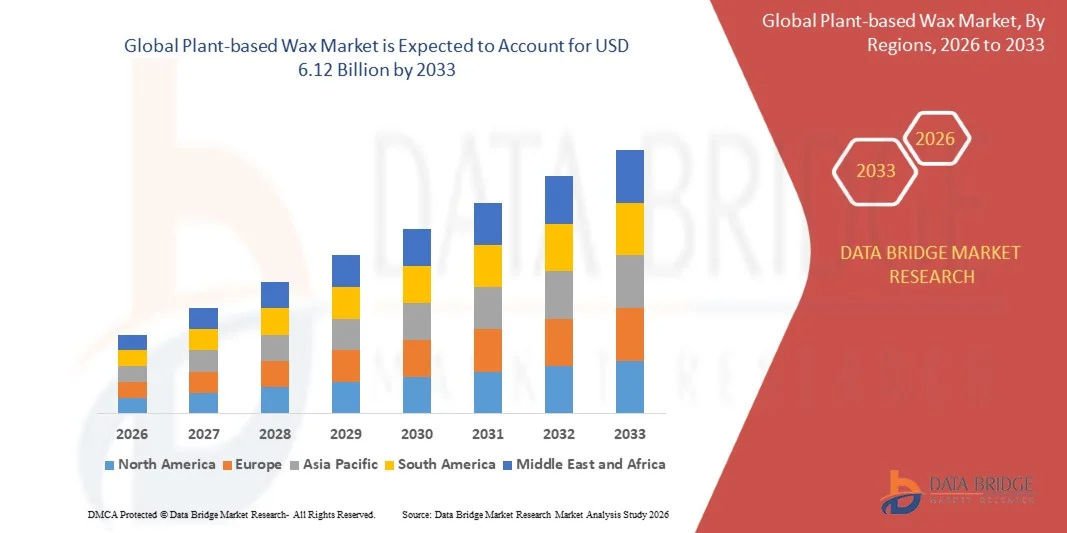
- The global Plant-based Wax market size was valued at USD 3.28 billion in 2025and is expected to reach USD 6.12 billion by 2033, at a CAGR of 8.1% during the forecast period
- The market growth is primarily driven by increasing demand for natural, sustainable, and biodegradable wax alternatives across industries such as cosmetics, candles, packaging, and food coatings, along with growing regulatory restrictions on petroleum-based waxes and paraffin products
- Rising consumer preference for eco-friendly and vegan products, expansion of clean-label trends, and increasing applications in premium candles and personal care formulations are positioning plant-based waxes as key sustainable ingredients, thereby significantly accelerating market growth
Plant-based Wax Market Analysis
- Plant-based wax, which provide properties such as hardness, gloss, water resistance, emulsification, and biodegradability, are becoming essential components across candles, cosmetics, food coatings, packaging, and pharmaceutical industries due to their eco-friendly nature and compliance with sustainability standards
- The escalating demand for plant-based wax is primarily driven by increasing regulatory restrictions on paraffin and petroleum-based waxes, rising consumer preference for natural and vegan products, and growing adoption of biodegradable materials, along with corporate commitments toward carbon neutrality and sustainable sourcing practices
- Asia-Pacific dominated the plant-based wax market with the largest revenue share of 33.5% in 2025, supported by abundant availability of raw materials such as palm and vegetable oils, strong manufacturing base, and high consumption across candles, packaging, and cosmetics industries, with countries like China, India, and Indonesia leading production and demand
- Asia-Pacific is also expected to be the fastest growing region in the plant-based wax market during the forecast period due to rapid industrialization, increasing disposable income, rising demand for natural products, and expanding production capacities across emerging economies
- The soy wax segment dominated the plant-based wax market with a market share of 30.33% in 2025, driven by high demand in candles and personal care applications due to its clean-burning properties, cost-effectiveness, and increasing shift toward non-toxic and renewable wax alternatives.
Report Scope and Plant-based Wax Market Segmentation
|
Attributes |
Plant-based Wax Key Market Insights |
|
Segments Covered |
|
|
Countries Covered |
North America · U.S. · Canada · Mexico Europe · Germany · France · U.K. · Netherlands · Switzerland · Belgium · Russia · Italy · Spain · Turkey · Rest of Europe Asia-Pacific · China · Japan · India · South Korea · Singapore · Malaysia · Australia · Thailand · Indonesia · Philippines · Rest of Asia-Pacific Middle East and Africa · Saudi Arabia · U.A.E. · South Africa · Egypt · Israel · Rest of Middle East and Africa South America · Brazil · Argentina · Rest of South America |
|
Key Market Players |
· BASF SE (Germany) · Dow Inc. (U.S.) · Evonik Industries AG (Germany) · Arkema S.A. (France) · Clariant AG (Switzerland) · LANXESS AG (Germany) · Solvay S.A. (Belgium) · LyondellBasell Industries N.V. (Netherlands) · Avient Corporation (U.S.) · Croda International Plc (U.K.) · ADEKA Corporation (Japan) · Songwon Industrial Co. Ltd. (South Korea) · Nouryon (Netherlands) · Emery Oleochemicals (Malaysia) · Cargill Incorporated (U.S.) · Corbion N.V. (Netherlands) · NatureWorks LLC (U.S.) · Braskem S.A. (Brazil) · Novamont S.p.A. (Italy) · Palsgaard A/S (Denmark) |
|
Market Opportunities |
· Rising demand for natural and vegan cosmetic products · Increasing adoption of sustainable candle materials replacing paraffin wax |
|
Value Added Data Infosets |
In addition to the insights on market scenarios such as market value, growth rate, segmentation, geographical coverage, and major players, the market reports curated by the Data Bridge Market Research also include import export analysis, production capacity overview, production consumption analysis, price trend analysis, climate change scenario, supply chain analysis, value chain analysis, raw material/consumables overview, vendor selection criteria, PESTLE Analysis, Porter Analysis, and regulatory framework. |
Plant-based Wax Market Trends
“Rising Adoption of Natural, Clean-Label, and Sustainable Wax Solutions”
- A significant and accelerating trend in the global plant-based wax market is the growing shift toward natural, biodegradable, and clean-label wax solutions that enhance product performance while reducing environmental impact across multiple end-use industries
- For instance, companies such as Cargill Incorporated and AAK AB are increasingly developing plant-based wax formulations derived from soy, palm, and vegetable oils to replace paraffin wax in candles, cosmetics, and packaging applications
- Technological advancements in formulation and processing are enabling the development of plant-based waxes with improved texture, melting stability, gloss, and compatibility across a wide range of applications, helping manufacturers maintain performance while achieving sustainability goals
- The increasing adoption of natural personal care products and eco-friendly candles is supporting the demand for plant-based waxes that enhance product safety, aesthetics, and consumer appeal
- This trend toward sustainable and high-performance wax solutions is reshaping industry expectations for regulatory compliance, product quality, and lifecycle sustainability across cosmetics, packaging, and food industries
- The demand for advanced plant-based waxes with improved functionality and reduced carbon footprint is growing rapidly across both developed and emerging economies, driven by consumer awareness and brand sustainability commitments
- Increasing adoption of biodegradable and renewable materials is gaining traction due to rising pressure to reduce reliance on petroleum-based waxes and improve environmental sustainability across global value chains.
Plant-based Wax Market Dynamics
Driver
“Rising Demand for Natural and Eco-Friendly Wax Alternatives”
- The increasing demand for natural, biodegradable, and environmentally friendly materials, coupled with growing restrictions on paraffin and petroleum-based waxes, is a major driver fueling the growth of the plant-based wax market globally
- For instance, regulatory frameworks in regions such as the European Union are encouraging the adoption of non-toxic, renewable, and sustainable ingredients in cosmetics, packaging, and food applications
- As industries focus more on reducing carbon emissions and achieving sustainability targets, plant-based waxes offer renewable sourcing, low toxicity, and improved environmental performance compared to conventional waxes
- Furthermore, the growing shift toward clean-label products and eco-friendly product formulations, supported by rising consumer awareness and corporate ESG initiatives, is increasing the adoption of plant-based wax across industries
- The versatility of these waxes across applications such as candles, cosmetics, food coatings, and packaging, along with their ability to enhance product quality and safety, is driving widespread adoption
- Expanding urbanization and rising disposable income in emerging economies are further supporting market expansion through increased consumption of premium and natural products
- Government support and sustainability-driven policies promoting bio-based materials are accelerating investments and commercialization of plant-based wax solutions
Restraint/Challenge
“High Cost and Raw Material Supply Constraints”
- Challenges related to the higher cost of plant-based wax compared to paraffin wax and performance limitations in certain applications pose significant barriers to large-scale adoption, particularly in price-sensitive markets
- For instance, plant-based wax production depends on agricultural feedstocks such as soy, palm, and other vegetable oils, which are subject to seasonal availability and price fluctuations
- Addressing these challenges through improved processing technologies, supply chain optimization, and economies of scale is critical for enhancing cost competitiveness and market penetration
- While demand for sustainable products is increasing, certain plant-based waxes may have limitations in terms of hardness, heat resistance, or consistency, restricting their use in specific industrial applications
- Overcoming these challenges through continuous innovation, blending technologies, and enhanced formulation techniques will be essential for long-term market growth, while volatility in raw material supply can impact production stability
- Stringent sustainability certifications and sourcing regulations can also increase compliance costs and complexity for manufacturers, potentially affecting product pricing and market entry timelines
Plant-based Wax Market Scope
The market is segmented on the basis of product, source, form, and application.
- By Product
On the basis of product, the global Plant-based Wax market is segmented into carnauba wax, soy wax, candelilla wax, rice bran wax, sunflower wax, and others. The soy wax segment dominated the market with the largest revenue share of 32.6% in 2025, driven by its extensive use in candles, cosmetics, and personal care products due to its clean-burning properties, smooth texture, and cost-effectiveness. Soy wax is widely preferred as a sustainable alternative to paraffin wax, supported by its renewable sourcing and compatibility with fragrances and additives used in premium candle formulations. Its increasing adoption across eco-friendly and vegan product lines, along with continuous advancements in processing techniques, is further strengthening segment dominance globally.
The carnauba wax segment is expected to witness the fastest growth during the forecast period, fueled by rising demand for high-performance natural waxes with superior hardness, gloss, and melting point across cosmetics, food coatings, and pharmaceutical applications. Increasing use in lipsticks, polishes, and confectionery coatings is driving adoption. Technological advancements in refining and processing of carnauba wax are enhancing its functional properties and expanding its application scope, further accelerating segment growth globally.
- By Source
On the basis of source, the market is segmented into soy-based, palm-based, and other vegetable oil-based waxes. The soy-based segment accounted for the largest market revenue share of 41.2% in 2025, driven by the abundant availability of soybean oil, established supply chains, and increasing demand for cost-effective and sustainable wax solutions. Soy-based waxes are widely utilized in candles and personal care applications due to their biodegradability and favorable performance characteristics. Growing consumer preference for plant-derived ingredients and increasing demand for eco-friendly products are further supporting segment dominance globally.
The palm-based segment is expected to witness the fastest growth during the forecast period, owing to its high yield efficiency, scalability, and widespread availability in tropical regions. Palm-based waxes offer desirable properties such as hardness and stability, making them suitable for candles and industrial applications. Increasing investments in sustainable palm sourcing and certifications, along with advancements in processing technologies, are further supporting the rapid growth of this segment.
- By Form
On the basis of form, the Plant-based Wax market is segmented into flakes, pellets, powder, and liquid. The flakes segment dominated the market with the largest revenue share in 2025, driven by ease of handling, storage, and usage across candle manufacturing and cosmetic formulations. Flake form allows better melting consistency and blending efficiency, making it highly preferred among manufacturers. Its compatibility with large-scale production processes further supports its widespread adoption across industries.
The liquid segment is expected to witness the fastest growth during the forecast period, fueled by increasing demand in coatings, polishes, and industrial applications where ease of application and uniform coverage are critical. Liquid plant-based waxes offer enhanced processability and efficiency, making them suitable for advanced manufacturing requirements. Technological advancements in formulation are further expanding their application scope and driving segment growth globally..
- By Application
On the basis of application, the Plant-based Wax market is segmented into candles, cosmetics & personal care, food coatings, packaging, pharmaceuticals, and others. The candles segment dominated the market with the largest revenue share of 35.4% in 2025, supported by rising demand for eco-friendly, clean-burning, and scented candles across residential and commercial applications. Increasing consumer preference for sustainable lifestyle products and premium home décor items is driving adoption. Plant-based waxes are widely used in candles due to their low soot emission and better fragrance retention, further strengthening segment dominance.
The cosmetics & personal care segment is expected to witness the fastest growth during the forecast period, driven by increasing demand for natural and organic ingredients in skincare, haircare, and makeup products. Plant-based waxes are extensively used in formulations such as lip balms, creams, and lotions due to their emollient properties and skin compatibility. Rising awareness regarding harmful effects of synthetic ingredients and growing demand for clean-label products are further accelerating segment growth globally
Plant-based Wax Market Regional Analysis
- Asia-Pacific dominated the Plant-based Wax market with the largest revenue share of ~33.5% in 2025, supported by abundant availability of raw materials such as palm, soy, and other vegetable oils, strong manufacturing base, and high consumption across candles, cosmetics, packaging, and food industries, with countries like China, India, Indonesia, and Malaysia leading production and demand
- Manufacturers and end-use industries in the region place significant emphasis on cost-effective production, scalable supply chains, and increasing adoption of natural and sustainable products, leading to widespread utilization of plant-based wax in candles, personal care, and packaging applications across both domestic and export markets
- This strong market position is further supported by expanding industrial infrastructure, increasing investments in agro-based processing industries, and rising consumer demand for eco-friendly products, along with growing government initiatives promoting bio-based materials, establishing plant-based wax as essential components in sustainable product formulations across industries
U.S. Plant-based Wax Market Insight
The U.S. Plant-based Wax market captured the largest revenue share of 78.4% in 2025 within North America, driven by strong demand for natural candles, clean-label cosmetics, and sustainable packaging solutions. Manufacturers increasingly prioritize plant-based waxes such as soy wax to meet consumer preference for eco-friendly and non-toxic products. The growing popularity of premium scented candles and organic personal care products continues to propel market growth. Moreover, the presence of key players such as Cargill Incorporated and Koster Keunen LLC significantly contributes to sustained market expansion.
Europe Plant-based Wax Market Insight
The Europe Plant-based Wax market is projected to expand at a steady CAGR throughout the forecast period, primarily driven by stringent environmental regulations and strong demand for natural and sustainable products. Increasing focus on reducing paraffin wax usage and promoting bio-based alternatives is accelerating demand across candles, cosmetics, and food applications. European industries emphasize eco-friendly product design and clean-label formulations, fostering consistent adoption across personal care and packaging sectors. Growth is supported by regulatory frameworks, sustainability initiatives, and increasing availability of certified plant-based wax products.
U.K. Plant-based Wax Market Insight
The U.K. Plant-based Wax market is anticipated to grow at a notable CAGR during the forecast period, supported by increasing demand for sustainable candles and natural personal care products. Rising awareness regarding environmental impact and strong consumer preference for vegan and cruelty-free products are driving demand across industries. The country’s well-established retail and e-commerce sectors are accelerating adoption of plant-based wax products. In addition, expanding sustainability initiatives and investments in eco-friendly materials enhance market growth across the value chain..
Germany Plant-based Wax Market Insight
The Germany Plant-based Wax market is expected to expand at a considerable CAGR during the forecast period, driven by strong demand for high-quality natural ingredients and leadership in sustainable manufacturing practices. High emphasis on environmental compliance and premium product formulations supports the adoption of plant-based wax across cosmetics, food coatings, and specialty applications. Germany’s focus on innovation and high-performance materials promotes the use of advanced wax solutions. The integration of bio-based ingredients aligns with the country’s commitment to sustainability and carbon reduction targets.
Asia-Pacific Plant-based Wax Market Insight
The Asia-Pacific Plant-based Wax market is poised to grow at the fastest CAGR during the forecast period of 2026 to 2033, driven by abundant raw material availability, expanding manufacturing base, and increasing demand for candles, cosmetics, and packaging applications. Countries such as China, India, Indonesia, and Malaysia play a key role in both production and consumption. Rising disposable income and growing preference for natural products are accelerating adoption. In addition, government initiatives promoting bio-based industries and sustainable materials further support market growth across the region.
Japan Plant-based Wax Market Insight
The Japan Plant-based Wax market is gaining momentum due to increasing focus on high-quality natural ingredients and sustainable product formulations. Strong emphasis on premium cosmetics, personal care, and specialty applications is driving adoption. The growing demand for clean-label and eco-friendly products supports long-term market growth. Integration of advanced processing technologies and innovative formulations continues to enhance product performance and expand application scope across industries.
India Plant-based Wax Market Insight
The India Plant-based Wax market accounted for a significant revenue share in Asia-Pacific in 2025, attributed to rapid urbanization, increasing disposable income, and rising demand for natural personal care and candle products. Expanding middle-class population and growing preference for eco-friendly products are driving adoption. Plant-based waxes are increasingly used across cosmetics, candles, and packaging applications due to their cost-effectiveness and availability. Government initiatives promoting sustainable materials and bio-based industries are key factors supporting sustained market expansion in India.
Plant-based Wax Market Share
The Plant-based Wax industry is primarily led by well-established companies, including:
- Cargill Incorporated (U.S.)
- AAK AB (Sweden)
- Koster Keunen LLC (U.S.)
- Strahl & Pitsch, Inc. (U.S.)
- Paramelt B.V. (Netherlands)
- Clariant AG (Switzerland)
- BASF SE (Germany)
- Evonik Industries AG (Germany)
- Arkema S.A. (France)
- Croda International Plc (U.K.)
- The International Group, Inc. (Canada)
- Sasol Limited (South Africa)
- Baerlocher GmbH (Germany)
- Sternchemie GmbH & Co. KG (Germany)
- Kerax Limited (U.K.)
- Frank B. Ross Co., Inc. (U.S.)
- Multiceras S.A. (Brazil)
- Pontes Indústria de Cera Ltda (Brazil)
- British Wax (U.K.)
- Calwax LLC (U.S.)
What are the Recent Developments in Global Plant-based Wax Market?
- In December 2025, Cargill Incorporated expanded its plant-based wax portfolio by introducing advanced soy wax solutions designed for premium candles and personal care applications, aimed at improving burn performance, texture, and sustainability while reducing reliance on paraffin-based waxes
- In October 2025, AAK AB announced the development of high-performance vegetable wax formulations derived from sustainable feedstocks, focusing on enhancing stability, consistency, and functionality in cosmetics and packaging applications
- In August 2025, Koster Keunen LLC strengthened its natural wax product line through the launch of new blends combining carnauba and candelilla wax, supporting increasing demand for clean-label and eco-friendly personal care formulations
- In June 2025, Strahl & Pitsch, Inc. expanded its plant-based candle wax offerings by introducing improved soy-based blends for better fragrance retention and clean-burning performance, targeting premium candle manufacturers and home fragrance brands
- In March 2024, Clariant AG enhanced its bio-based ingredients portfolio by developing plant-derived wax additives for coatings and industrial applications, focusing on improving surface properties, durability, and environmental performance

- Interactive Data Analysis Dashboard
- Company Analysis Dashboard for high growth potential opportunities
- Research Analyst Access for customization & queries
- Competitor Analysis with Interactive dashboard
- Latest News, Updates & Trend analysis
- Harness the Power of Benchmark Analysis for Comprehensive Competitor Tracking
Global Plant Based Wax Market, Supply Chain Analysis and Ecosystem Framework
To support market growth and help clients navigate the impact of geopolitical shifts, DBMR has integrated in-depth supply chain analysis into its Global Plant Based Wax Market research reports. This addition empowers clients to respond effectively to global changes affecting their industries. The supply chain analysis section includes detailed insights such as Global Plant Based Wax Market consumption and production by country, price trend analysis, the impact of tariffs and geopolitical developments, and import and export trends by country and HSN code. It also highlights major suppliers with data on production capacity and company profiles, as well as key importers and exporters. In addition to research, DBMR offers specialized supply chain consulting services backed by over a decade of experience, providing solutions like supplier discovery, supplier risk assessment, price trend analysis, impact evaluation of inflation and trade route changes, and comprehensive market trend analysis.
Data collection and base year analysis are done using data collection modules with large sample sizes. The stage includes obtaining market information or related data through various sources and strategies. It includes examining and planning all the data acquired from the past in advance. It likewise envelops the examination of information inconsistencies seen across different information sources. The market data is analysed and estimated using market statistical and coherent models. Also, market share analysis and key trend analysis are the major success factors in the market report. To know more, please request an analyst call or drop down your inquiry.
The key research methodology used by DBMR research team is data triangulation which involves data mining, analysis of the impact of data variables on the market and primary (industry expert) validation. Data models include Vendor Positioning Grid, Market Time Line Analysis, Market Overview and Guide, Company Positioning Grid, Patent Analysis, Pricing Analysis, Company Market Share Analysis, Standards of Measurement, Global versus Regional and Vendor Share Analysis. To know more about the research methodology, drop in an inquiry to speak to our industry experts.
Data Bridge Market Research is a leader in advanced formative research. We take pride in servicing our existing and new customers with data and analysis that match and suits their goal. The report can be customized to include price trend analysis of target brands understanding the market for additional countries (ask for the list of countries), clinical trial results data, literature review, refurbished market and product base analysis. Market analysis of target competitors can be analyzed from technology-based analysis to market portfolio strategies. We can add as many competitors that you require data about in the format and data style you are looking for. Our team of analysts can also provide you data in crude raw excel files pivot tables (Fact book) or can assist you in creating presentations from the data sets available in the report.













