Plant Breeding and CRISPR Plant Market Overview
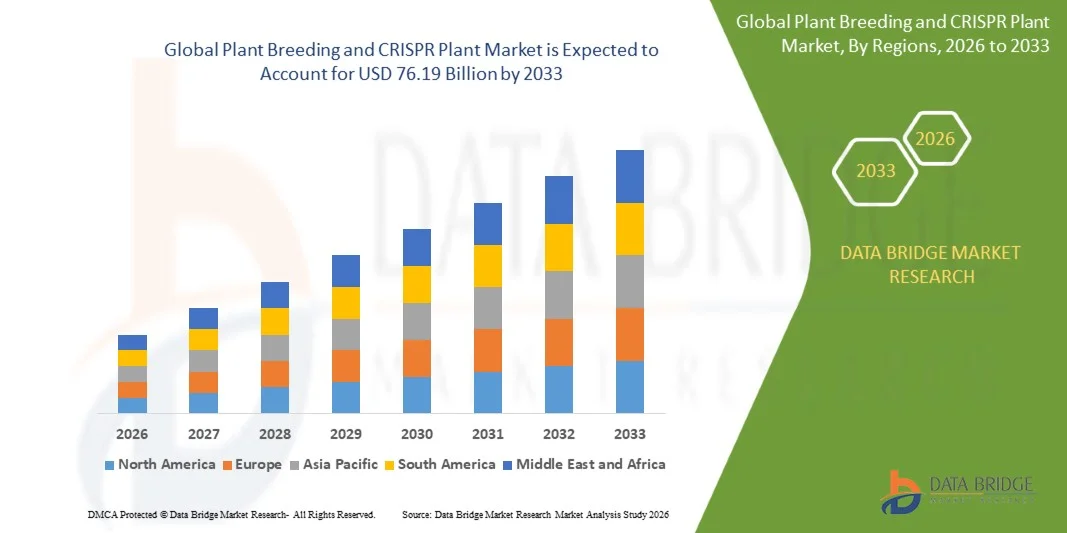
As per Data Bridge Market Research Analysis the global plant breeding and CRISPR plant market was valued at USD 21.70 billion in 2025 and is projected to reach USD 76.19 billion by 2033, growing at a CAGR of 17.00% from 2026 to 2033. The market is experiencing robust growth driven by the increasing global demand for high-yield, climate-resilient, and disease-resistant crops, alongside rapid advancements in gene-editing technologies such as CRISPR.
Rising concerns over food security, climate change, and sustainable agriculture are encouraging governments, research institutions, and agricultural biotechnology companies to invest heavily in advanced plant breeding solutions. CRISPR-based genome editing is increasingly complementing conventional breeding methods by enabling precise, faster, and cost-effective crop improvement without introducing foreign DNA in many applications. The expanding adoption of gene-edited crops, supportive regulatory developments in several countries, and growing investments in agricultural biotechnology are further accelerating market growth.
Market Size & Forecast
- Global Market Value (2025): USD 21.70 Billion
- Expected Market Value (2033): USD 76.19 Billion
- Forecast CAGR (2026–2033): 17.00%
- Leading Region in 2025: North America
- Fastest Growing Region: Asia-Pacific
Key Market Trends & Insights
- North America dominated the plant breeding and CRISPR plant market with the largest revenue share in 2025, supported by advanced agricultural biotechnology infrastructure, strong investment in crop research, and widespread adoption of improved seed technologies.
- Asia-Pacific plant breeding and CRISPR plant market is expected to witness the fastest growth rate from 2026 to 2033, supported by rising food demand, population growth, increasing agricultural productivity requirements, and expanding biotechnology capabilities across China, India, Japan, and Southeast Asia.
- The conventional method segment held the largest market revenue share in 2025, driven by its widespread use in developing improved crop varieties through selection, hybridization, and crossbreeding. Conventional breeding is preferred due to its established methodologies, broad applicability across crops, and long history of commercial adoption in seed development programs.
- The genetic engineering segment is projected to register the fastest growth at a CAGR from 2026 to 2033, driven by increasing adoption of CRISPR-based genome editing, targeted trait development, and advanced molecular breeding technologies. Rising investments in gene-edited crops with improved yield, disease resistance, and environmental tolerance are accelerating segment expansion.
- The disease resistance segment held the largest market revenue share in 2025, driven by increasing demand for crop varieties capable of reducing losses caused by pathogens and improving agricultural productivity. Disease-resistant traits are preferred due to their potential to improve crop stability, reduce dependence on crop protection inputs, and support consistent yields.
- The drought resistance segment is projected to register the fastest growth at a CAGR from 2026 to 2033, driven by increasing water scarcity, changing climatic conditions, and growing demand for climate-resilient agriculture. Rising adoption of gene editing and advanced breeding technologies to develop crops with improved water-use efficiency and drought tolerance is accelerating segment expansion.
Report Scope and Plant Breeding and CRISPR Plant Market Segmentation
|
Attributes |
Plant Breeding and CRISPR Plant Key Market Insights |
|
Segments Covered |
|
|
Countries Covered |
North America
Europe
Asia-Pacific
Middle East and Africa
South America
|
|
Key Market Players |
|
|
Market Opportunities |
|
|
Value Added Data Infosets |
In addition to the insights on market scenarios such as market value, growth rate, segmentation, geographical coverage, and major players, the market reports curated by the Data Bridge Market Research also include import export analysis, production capacity overview, production consumption analysis, price trend analysis, climate change scenario, supply chain analysis, value chain analysis, raw material/consumables overview, vendor selection criteria, PESTLE Analysis, Porter Analysis, and regulatory framework. |
Plant Breeding and CRISPR Plant Market Trends
Trend: Rising Adoption Of Precision Breeding And CRISPR-Based Crop Development
Growing demand for higher crop productivity, climate resilience, improved nutritional characteristics, and reduced agricultural inputs is accelerating the adoption of advanced plant breeding and CRISPR-based genome editing technologies. Seed developers and agricultural biotechnology companies are increasingly using genomic selection, gene editing, artificial intelligence, and precision breeding to develop crop varieties with improved yield, disease resistance, drought tolerance, nutritional quality, and other desirable traits. The ability of CRISPR technology to make targeted genetic changes more quickly and precisely than conventional breeding is further strengthening its adoption across modern crop development programs.
The rapid expansion of climate-resilient agriculture and investment in next-generation breeding technologies is creating sustained demand for precision breeding solutions across global seed markets. For instance, in May 2025, Bayer reported that its Crop Science business had more than 100,000 gene edits within its precision breeding activities and was using advanced breeding technologies, including genomics, AI, and functional genomics, to accelerate the development of new agricultural products. Bayer also reported that its pipeline produces more than 450 new products annually, highlighting the increasing scale of technology-driven crop improvement.
The growing shift toward precision agriculture and continued investment in genome editing and advanced breeding capabilities are expected to reinforce long-term demand for CRISPR plant technologies, positioning plant breeders and agricultural biotechnology companies to benefit from increasing requirements for productive, resilient, and resource-efficient crops.
Plant Breeding And CRISPR Plant Market Dynamics
Key Market Driver: Increasing Demand For High-Yielding And Climate-Resilient Crops
The agriculture industry continues to experience rising demand for crop varieties that can maintain productivity under changing environmental conditions while improving resource efficiency. Farmers and seed companies are increasingly adopting advanced breeding technologies to develop plants with improved resistance to drought, diseases, pests, and extreme weather, encouraging manufacturers and research organizations to expand their plant breeding and genome editing programs.
Major agricultural companies continue investing in precision breeding and CRISPR technologies to address evolving agricultural requirements. Bayer's genome editing program focuses on improving plant architecture, yield, quality, and disease resistance across its row-crop portfolio. The company is also exploring Short Stature Corn, which grows approximately 30% to 40% shorter than traditional hybrids while maintaining comparable yield per corn ear, using traditional breeding, biotechnology, and genome editing approaches.
As demand for productive and climate-resilient agriculture continues to expand, plant breeding and CRISPR plant technology providers are expected to benefit from sustained investment in gene editing, precision breeding, genomic technologies, and improved crop traits worldwide.
Key Restraint/Challenge: Regulatory Uncertainty And High Research And Development Costs
Plant breeding and CRISPR plant developers remain exposed to regulatory uncertainty, lengthy approval processes, intellectual property considerations, and substantial research and development costs. Differences in regulatory approaches toward gene-edited crops across countries can delay commercialization and increase compliance requirements, particularly for companies seeking to introduce new varieties across multiple international markets.
In addition, developers must manage regulatory requirements while demonstrating the safety, performance, and environmental benefits of gene-edited crops. Bayer has highlighted the importance of updated regulatory frameworks for new genomic techniques, noting that genome editing can make precise modifications to predetermined areas of plant genomes without necessarily introducing foreign genes. The company has also emphasized that appropriate regulation is important to enable these technologies to contribute to agricultural productivity and sustainability.
Despite strong technological progress, regulatory uncertainty, commercialization timelines, intellectual property considerations, and high development costs are expected to remain significant challenges, potentially slowing the widespread adoption of CRISPR-based plant breeding technologies throughout the forecast period.
Key Market Opportunity: Expansion Of Precision Breeding For Sustainable Agriculture
Agricultural companies, research organizations, and breeders are increasingly exploring precision breeding to develop crops that require fewer inputs, withstand environmental stress, and provide improved yields and nutritional characteristics. CRISPR technology offers significant opportunities due to its targeted editing capabilities, formulation flexibility across crop development programs, and potential to accelerate the creation of desirable plant traits, creating substantial long-term opportunities for agricultural biotechnology companies globally.
Leading companies are strengthening investments and collaborations in genome editing and advanced breeding technologies. For instance, Bayer and Pairwise conducted a five-year collaboration focused on gene-edited short-stature corn and other major crops, including soy, wheat, cotton, and canola. The collaboration generated 27 novel traits that were transferred into Bayer's testing programs, including edited corn phenotypes with a 20% increase in kernel row numbers and edited soy with reduced severity of Asian soybean rust.
As agricultural producers increasingly seek climate-resilient and resource-efficient crops and biotechnology companies accelerate investments in precision breeding, expanding applications of CRISPR and genome editing across corn, soybean, wheat, rice, fruits, vegetables, and other crops are expected to create substantial long-term growth opportunities for the plant breeding and CRISPR plant market.
Plant Breeding and CRISPR Plant Market Scope
The market is segmented on the basis of type, trait, and application.
- By Type
On the basis of type, the plant breeding and CRISPR plant market is segmented into conventional method, biotechnological method, and genetic engineering. The conventional method segment held the largest market revenue share in 2025, driven by its widespread use in developing improved crop varieties through selection, hybridization, and crossbreeding. Conventional breeding is preferred due to its established methodologies, broad applicability across crops, and long history of commercial adoption in seed development programs.
The genetic engineering segment is projected to register the fastest growth at a CAGR from 2026 to 2033, driven by increasing adoption of CRISPR-based genome editing, targeted trait development, and advanced molecular breeding technologies. Rising investments in gene-edited crops with improved yield, disease resistance, and environmental tolerance are accelerating segment expansion.
- By Trait
On the basis of trait, the plant breeding and CRISPR plant market is segmented into herbicide tolerance, disease resistance, yield improvement, temperature tolerance, grain size improvement, stress tolerance, drought resistance, and others. The disease resistance segment held the largest market revenue share in 2025, driven by increasing demand for crop varieties capable of reducing losses caused by pathogens and improving agricultural productivity. Disease-resistant traits are preferred due to their potential to improve crop stability, reduce dependence on crop protection inputs, and support consistent yields.
The drought resistance segment is projected to register the fastest growth at a CAGR from 2026 to 2033, driven by increasing water scarcity, changing climatic conditions, and growing demand for climate-resilient agriculture. Rising adoption of gene editing and advanced breeding technologies to develop crops with improved water-use efficiency and drought tolerance is accelerating segment expansion.
- By Application
On the basis of application, the plant breeding and CRISPR plant market is segmented into cereals and grains, oilseed and pulses, fruits and vegetables, cash crops, turf and ornamental, herbs and microgreens, medicinal crops, and others. The cereals and grains segment held the largest market revenue share in 2025, driven by extensive breeding programs focused on improving yield, disease resistance, grain quality, and environmental tolerance in major crops such as corn, wheat, rice, and barley. Cereals and grains are preferred targets for advanced breeding due to their large cultivation areas and importance to global food security.
The fruits and vegetables segment is projected to register the fastest growth at a CAGR from 2026 to 2033, driven by increasing demand for improved nutritional quality, extended shelf life, disease resistance, and climate resilience. Rising application of gene editing and biotechnology in specialty crops, together with increasing investments in precision breeding for consumer-focused traits, is accelerating segment expansion.
Plant Breeding and CRISPR Plant Market Regional Analysis
North America Plant Breeding and CRISPR Plant Market Insight
North America dominated the plant breeding and CRISPR plant market with the largest revenue share in 2025, supported by advanced agricultural biotechnology infrastructure, strong investment in crop research, and widespread adoption of improved seed technologies. The region benefits from the presence of major agricultural biotechnology companies, research institutions, and sophisticated farming systems. Growing demand for higher crop yields, disease resistance, drought tolerance, and climate-resilient varieties is further establishing North America as a major market for advanced plant breeding and CRISPR technologies.
U.S. Plant Breeding and CRISPR Plant Market Insight
U.S. plant breeding and CRISPR plant market captured the largest revenue share in 2025 within North America, fueled by strong agricultural research capabilities, substantial private-sector investment, and extensive cultivation of major crops such as corn, soybean, wheat, and cotton. Seed companies are increasingly adopting genomic selection, biotechnology, and CRISPR-based genome editing to develop improved crop traits. Moreover, growing demand for climate-resilient crops, higher productivity, and efficient agricultural inputs is significantly contributing to the market's expansion.
Europe Plant Breeding and CRISPR Plant Market Insight
Europe plant breeding and CRISPR plant market is expected to witness significant growth from 2026 to 2033, primarily driven by increasing demand for sustainable agriculture, climate-resilient crops, and improved food production efficiency. The region has strong capabilities in conventional and molecular plant breeding, supported by research institutions and established seed companies. In addition, increasing focus on reducing agricultural inputs, improving crop resilience, and developing innovative breeding technologies is fostering adoption across European agricultural markets.
U.K. Plant Breeding and CRISPR Plant Market Insight
U.K. plant breeding and CRISPR plant market is expected to witness strong growth from 2026 to 2033, driven by increasing investment in agricultural biotechnology, precision breeding, and climate-resilient crop development. The country's research capabilities and established agricultural science ecosystem support the development of improved crop varieties with enhanced yield, disease resistance, and environmental tolerance. In addition, the growing emphasis on sustainable food production and regulatory development for precision-bred crops is expected to continue stimulating market growth.
Germany Plant Breeding and CRISPR Plant Market Insight
Germany plant breeding and CRISPR plant market is expected to witness significant growth from 2026 to 2033, fueled by advanced agricultural research, strong biotechnology capabilities, and increasing demand for sustainable crop production. The country's established seed and agricultural technology industries support the development of improved varieties with enhanced disease resistance, productivity, and stress tolerance. Furthermore, increasing emphasis on resource-efficient agriculture and climate adaptation is promoting investment in advanced plant breeding technologies.
Asia-Pacific Plant Breeding and CRISPR Plant Market Insight
The Asia-Pacific plant breeding and CRISPR plant market is expected to witness the fastest growth rate from 2026 to 2033, supported by rising food demand, population growth, increasing agricultural productivity requirements, and expanding biotechnology capabilities across China, India, Japan, and Southeast Asia. The region's growing focus on improving crop yields, disease resistance, drought tolerance, and nutritional characteristics is driving adoption of advanced breeding technologies. Furthermore, increasing investments in agricultural research, seed development, and genome editing are expanding the availability of improved crop varieties across the region.
Japan Plant Breeding and CRISPR Plant Market Insight
Japan plant breeding and CRISPR plant market is expected to witness significant growth from 2026 to 2033 due to the country's advanced agricultural research capabilities, emphasis on food quality, and increasing need for climate-resilient crop varieties. Japanese research organizations and agricultural companies are utilizing genome editing and precision breeding to develop crops with improved nutritional characteristics, productivity, and environmental tolerance. Moreover, limited agricultural land and the need to improve domestic food production efficiency are supporting demand for advanced crop breeding technologies.
China Plant Breeding and CRISPR Plant Market Insight
China plant breeding and CRISPR plant market accounted for the largest market revenue share in Asia Pacific in 2025, attributed to the country's large agricultural sector, growing food demand, and substantial investments in agricultural biotechnology and crop improvement. China is increasingly focusing on developing high-yielding, disease-resistant, and climate-resilient crop varieties to strengthen agricultural productivity and food security. The expansion of agricultural research programs, development of gene-edited crops, and increasing investment in advanced seed technologies are key factors propelling the market in China.
Plant Breeding and CRISPR Plant Market Share
The plant breeding and CRISPR plant industry is primarily led by well-established companies, including:
- Bayer AG (Germany)
- Corteva, Inc. (U.S.)
- Syngenta AG (Switzerland)
- BASF SE (Germany)
- Groupe Limagrain Holding SA (France)
- KWS SAAT SE & Co. KGaA (Germany)
- Bioceres Crop Solutions Corp. (Argentina)
- DLF Seeds A/S (Denmark)
- Pairwise, Inc. (U.S.)
- Tropic Biosciences Ltd. (U.K.)
- Yield10 Bioscience, Inc. (U.S.)
- Benson Hill, Inc. (U.S.)
- Sakata Seed Corporation (Japan)
- UPL Limited (India)
- Rijk Zwaan Zaadteelt en Zaadhandel B.V. (Netherlands)
Latest Developments in Plant Breeding and CRISPR Plant Market
- In February 2025, KWS SAAT SE & Co. KGaA (Germany) introduced new combination varieties that combined the CONVISO SMART system with high Cercospora protection (CR+), strengthening its position in the sugar beet seed industry. The new varieties were launched across several European markets, with further expansion planned.
- In January 2025, Syngenta Vegetable Seeds, part of Syngenta Group (Switzerland), signed a global licensing partnership with Apricus Seeds (US), giving Syngenta exclusive access to Apricus' melon, squash, and watermelon germplasm. The agreement strengthened Syngenta's cucurbits seed portfolio.
- In November 2024, Hazera, a brand of Limagrain (France), inaugurated a high-tech tomato R&D greenhouse in Made, the Netherlands, near its headquarters. The nearly 5-hectare facility was established to accelerate research on disease-resistant and high-yield tomato varieties while supporting sustainability through advanced breeding technologies.
- In October 2023, SAKATA SEED CORPORATION (Japan) acquired Brazilian seed company Isla Sementes LTDA and its holding company Spalding for USD 12.7 million. The acquisition was aimed at expanding Sakata's presence among smallholder farmers and home gardeners in Brazil by leveraging Isla's sales network and product portfolio, with expected sales synergies of USD 3 million within five years.
- In August 2023, Pairwise (US) and Bayer AG (Germany) signed a new five-year, multi-million-dollar agreement to advance gene-edited short-stature corn for Bayer's Preceon Smart Corn System. The collaboration utilized Pairwise's Fulcrum platform to improve corn's resilience to extreme weather and increase input efficiency, building on their earlier partnership that had already generated 27 novel traits.

- Interactive Data Analysis Dashboard
- Company Analysis Dashboard for high growth potential opportunities
- Research Analyst Access for customization & queries
- Competitor Analysis with Interactive dashboard
- Latest News, Updates & Trend analysis
- Harness the Power of Benchmark Analysis for Comprehensive Competitor Tracking
Data collection and base year analysis are done using data collection modules with large sample sizes. The stage includes obtaining market information or related data through various sources and strategies. It includes examining and planning all the data acquired from the past in advance. It likewise envelops the examination of information inconsistencies seen across different information sources. The market data is analysed and estimated using market statistical and coherent models. Also, market share analysis and key trend analysis are the major success factors in the market report. To know more, please request an analyst call or drop down your inquiry.
The key research methodology used by DBMR research team is data triangulation which involves data mining, analysis of the impact of data variables on the market and primary (industry expert) validation. Data models include Vendor Positioning Grid, Market Time Line Analysis, Market Overview and Guide, Company Positioning Grid, Patent Analysis, Pricing Analysis, Company Market Share Analysis, Standards of Measurement, Global versus Regional and Vendor Share Analysis. To know more about the research methodology, drop in an inquiry to speak to our industry experts.
Data Bridge Market Research is a leader in advanced formative research. We take pride in servicing our existing and new customers with data and analysis that match and suits their goal. The report can be customized to include price trend analysis of target brands understanding the market for additional countries (ask for the list of countries), clinical trial results data, literature review, refurbished market and product base analysis. Market analysis of target competitors can be analyzed from technology-based analysis to market portfolio strategies. We can add as many competitors that you require data about in the format and data style you are looking for. Our team of analysts can also provide you data in crude raw excel files pivot tables (Fact book) or can assist you in creating presentations from the data sets available in the report.