


What is the Plant Enzymes Market Size and Growth Rate?
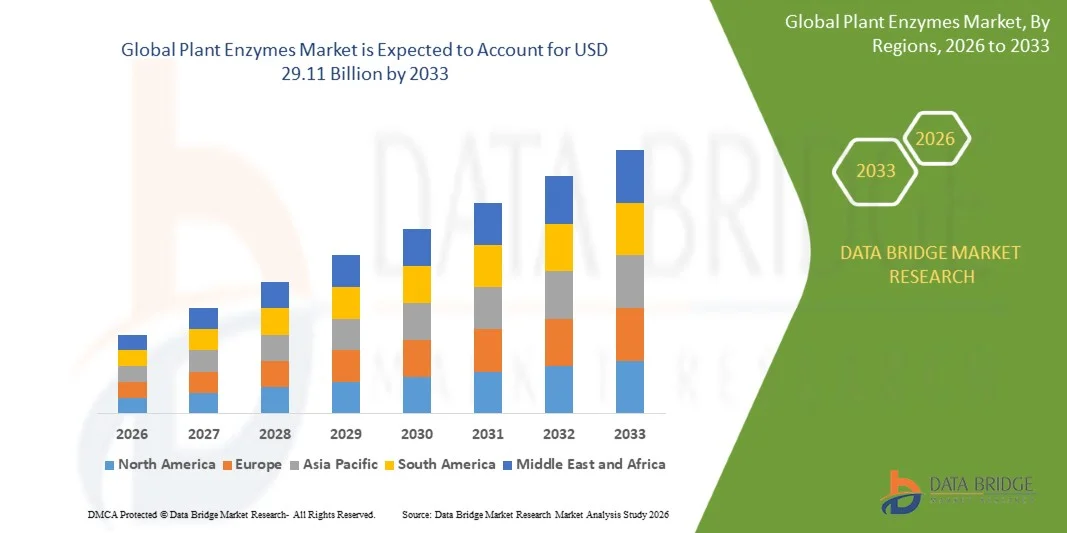
- As per Data Bridge Market Research analysis the plant enzymes market was valued at USD 15.97 billion in 2025 and is projected to reach USD 29.11 billion by 2033, growing at a CAGR of 7.80% from 2026 to 2033.
- The market is experiencing consistent growth driven by rising demand for natural and plant-based enzymes, increasing applications across food and beverages, animal feed, pharmaceuticals, and biotechnology, and growing consumer preference for clean-label and sustainable ingredients.
- The increasing adoption of enzyme-based solutions in industrial and food processing applications, combined with advancements in enzyme extraction and production technologies, is encouraging manufacturers to expand their use of plant-derived enzymes across diverse end-use industries.
Market Size & Forecast
- Market Value (2025): USD 15.97 Billion
- Expected Market Value (2033): USD 29.11 Billion
- Forecast CAGR (2026–2033): 7.80%
- Leading Region in 2025: North America
- Fastest Growing Region: Asia-Pacific
What are the Major Takeaways of the Plant Enzymes Market?
- North America held a significant position in the global plant enzymes market in 2025, supported by increasing demand for natural and clean-label ingredients across food and beverage, pharmaceutical, biotechnology, and animal feed applications.
- Asia-Pacific plant enzymes market is expected to witness the fastest growth rate from 2026 to 2033, supported by rapid expansion of food and beverage processing, rising disposable incomes, increasing health awareness, and growing demand for natural ingredients in countries such as China, India, and Japan.
- The industrial enzymes segment held the largest market revenue share in 2025, driven by its widespread use across food processing, animal feed, textiles, biofuels, and other industrial applications. Industrial enzymes are preferred due to their ability to improve processing efficiency, enhance product quality, reduce resource consumption, and support cost-effective manufacturing across diverse industries.
- The specialty enzymes segment is projected to register the fastest growth during the forecast period, driven by increasing demand for customized enzyme solutions in pharmaceuticals, diagnostics, biotechnology, and specialized food processing applications. Rising adoption of high-performance enzymes for targeted biochemical processes and advanced therapeutic applications is accelerating segment expansion.
- The carbohydrase segment held the largest market revenue share in 2025, driven by its extensive use in food and beverage processing, bakery products, brewing, and starch processing applications. Carbohydrases are widely preferred due to their ability to improve carbohydrate breakdown, enhance processing efficiency, and support improved texture and product quality.
- The proteases segment is projected to register the fastest growth during the forecast period, driven by increasing demand for protein processing, nutritional products, meat alternatives, and specialty food applications. Rising adoption of proteolytic enzymes to improve protein digestibility, functionality, and processing performance is accelerating segment expansion.
Report Scope and Plant Enzymes Market Segmentation
|
Attributes |
Plant Enzymes Key Market Insights |
|
Segments Covered |
|
|
Countries Covered |
North America
Europe
Asia-Pacific
Middle East and Africa
South America
|
|
Key Market Players |
|
|
Market Opportunities |
|
|
Value Added Data Infosets |
In addition to the insights on market scenarios such as market value, growth rate, segmentation, geographical coverage, and major players, the market reports curated by the Data Bridge Market Research also include in-depth expert analysis, pricing analysis, brand share analysis, consumer survey, demography analysis, supply chain analysis, value chain analysis, raw material/consumables overview, vendor selection criteria, PESTLE Analysis, Porter Analysis, and regulatory framework. |
What is the Key Trend in the Plant Enzymes Market?
- Food and beverage manufacturers are increasingly adopting plant-derived and enzyme-based solutions to improve the taste, texture, stability, nutritional profile, and processing efficiency of plant-based products while supporting clean-label formulations.
- For instance, in May 2025, Novonesis introduced Vertera Velvet, an enzymatic solution designed to improve foam, texture, and stability in plant-based drinks, including oat, soy, and pea-protein beverages, helping producers meet growing consumer expectations for premium plant-based products.
- The growing demand for high-protein plant-based foods is encouraging enzyme manufacturers to develop specialized solutions that improve protein functionality, solubility, texture, and sensory quality without compromising the nutritional value of finished products.
- For instance, in May 2025, Novonesis highlighted its Vertera plant-based biosolutions for high-protein plant-based yogurts, noting that 62% of global consumers consider high protein content an important purchasing factor and that 15% of new plant-based yogurt launches in late 2024 carried a high-protein claim.
- As food manufacturers increasingly prioritize clean-label ingredients, improved sensory performance, and plant-based product innovation, the adoption of specialized plant enzymes is expected to accelerate, strengthening their role in next-generation food and beverage processing.
What are the Key Drivers of the Plant Enzymes Market?
- Rising demand for processed foods, functional foods, beverages, and naturally derived ingredients is increasing the use of plant enzymes across bakery, dairy alternatives, beverages, and other food processing applications. The India food enzymes market, for instance, reached USD 447.9 million in 2024, reflecting expanding demand across these applications.
- For instance, in June 2025, Novonesis launched Optiva LS Prime, a baking enzyme that can help reduce added sugar by up to 50% while maintaining sweetness and product quality, supporting bakeries facing rising raw-material costs and consumer demand for more affordable products.
- Increasing consumer preference for clean-label and naturally derived ingredients is encouraging food manufacturers to replace conventional processing aids and additives with enzyme-based solutions that improve product quality while supporting simpler formulations.
- For instance, Novonesis reported that its enzymatic biosolutions for plant-based beverages can improve texture, flavor, protein functionality, and stability while functioning as natural processing aids, supporting manufacturers responding to consumer demand for fewer ingredients and less processed products.
- With expanding applications across plant-based foods, bakery products, beverages, and functional nutrition, combined with advancements in enzyme biotechnology and formulation, plant enzymes are expected to gain wider adoption across food and industrial processing applications.
Which Factors are Challenging the Growth of the Plant Enzymes Market?
- Plant enzymes face competition from microbial and synthetic enzyme alternatives, which can offer advantages in production scalability, consistency, cost efficiency, and broader industrial availability, limiting the adoption of plant-derived enzymes in some commercial applications.
- The production of plant-derived enzymes can also involve challenges related to raw-material availability, extraction efficiency, enzyme stability, and maintaining consistent activity across different batches, increasing manufacturing complexity and costs.
- For instance, market research identifies the availability of substitutes as a key challenge for the broader food enzymes market, where manufacturers can select enzymes from microbial, animal, or plant sources depending on application requirements and production economics.
- In addition, enzyme products require appropriate handling and controlled processing conditions, as improper workplace exposure to enzyme dust or aerosols can create occupational sensitization risks, requiring manufacturers to implement appropriate safety measures.
- These production, cost, stability, and substitution challenges can limit the broader commercialization of plant-derived enzymes, particularly in price-sensitive applications where microbial enzymes provide established large-scale production and cost advantages.
How is the Plant Enzymes Market Segmented?
The market is segmented on the basis of application, product, and type.
- By Application
On the basis of application, the plant enzymes market is segmented into industrial enzymes and specialty enzymes. The industrial enzymes segment held the largest market revenue share in 2025, driven by its widespread use across food processing, animal feed, textiles, biofuels, and other industrial applications. Industrial enzymes are preferred due to their ability to improve processing efficiency, enhance product quality, reduce resource consumption, and support cost-effective manufacturing across diverse industries.
The specialty enzymes segment is projected to register the fastest growth during the forecast period, driven by increasing demand for customized enzyme solutions in pharmaceuticals, diagnostics, biotechnology, and specialized food processing applications. Rising adoption of high-performance enzymes for targeted biochemical processes and advanced therapeutic applications is accelerating segment expansion.
- By Product
On the basis of product, the plant enzymes market is segmented into carbohydrase, proteases, and lipases. The carbohydrase segment held the largest market revenue share in 2025, driven by its extensive use in food and beverage processing, bakery products, brewing, and starch processing applications. Carbohydrases are widely preferred due to their ability to improve carbohydrate breakdown, enhance processing efficiency, and support improved texture and product quality.
The proteases segment is projected to register the fastest growth during the forecast period, driven by increasing demand for protein processing, nutritional products, meat alternatives, and specialty food applications. Rising adoption of proteolytic enzymes to improve protein digestibility, functionality, and processing performance is accelerating segment expansion.
- By Type
On the basis of type, the plant enzymes market is segmented into protease, carbohydrase, lipase, polymerase and nuclease, and other types. The protease segment held the largest market revenue share in 2025, driven by its widespread applications in food processing, pharmaceuticals, detergents, and biotechnology. Proteases are preferred due to their ability to break down proteins, improve processing efficiency, and support diverse industrial and specialty applications.
The polymerase and nuclease segment is projected to register the fastest growth during the forecast period, driven by increasing demand for molecular diagnostics, biotechnology research, genetic engineering, and advanced pharmaceutical applications. Rising adoption of nucleic acid-based technologies and enzyme-assisted molecular processes is accelerating segment expansion.
Which Region Holds the Largest Share of the Plant Enzymes Market?
- North America held a significant position in the global plant enzymes market in 2025, supported by increasing demand for natural and clean-label ingredients across food and beverage, pharmaceutical, biotechnology, and animal feed applications.
- Manufacturers in the region are increasingly adopting enzyme-based processing solutions to improve product quality, enhance production efficiency, and meet consumer preferences for minimally processed and naturally derived products. Strong research and development capabilities, advanced food processing infrastructure, and the presence of major biotechnology companies further support the adoption of plant enzymes across diverse industries.
U.S. Plant Enzymes Market Insight
U.S. plant enzymes market captured a significant revenue share in 2025 within North America, fueled by growing demand for functional foods, plant-based products, nutritional supplements, and enzyme-based processing solutions. Food manufacturers are increasingly using plant-derived enzymes to improve texture, flavor, digestibility, and processing efficiency. Moreover, the strong presence of biotechnology companies, advanced research capabilities, and increasing consumer preference for clean-label and natural ingredients are contributing significantly to the expansion of the U.S. plant enzymes market.
Europe Plant Enzymes Market Insight
Europe plant enzymes market is expected to witness steady growth from 2026 to 2033, primarily driven by increasing demand for sustainable food processing solutions and naturally derived ingredients. Stringent regulations concerning food quality and sustainability, coupled with rising consumer preference for clean-label products, are encouraging manufacturers to adopt enzyme-based processing technologies. The region is experiencing increasing applications of plant enzymes across bakery, beverages, dairy alternatives, pharmaceuticals, and biotechnology, supporting market expansion across both established and emerging applications.
U.K. Plant Enzymes Market Insight
U.K. plant enzymes market is expected to witness significant growth from 2026 to 2033, driven by rising consumer demand for clean-label, plant-based, and minimally processed food products. Increasing adoption of enzyme-based solutions in bakery, beverages, nutritional products, and specialty food applications is supporting market development. In addition, the country's growing focus on sustainable food production, biotechnology innovation, and healthier dietary choices is expected to continue stimulating demand for plant-derived enzymes.
Germany Plant Enzymes Market Insight
Germany plant enzymes market is expected to witness significant growth from 2026 to 2033, fueled by increasing demand for sustainable processing technologies, functional foods, and naturally derived ingredients. Germany's strong food processing and biotechnology industries, combined with its emphasis on resource efficiency and technological innovation, promote the adoption of plant enzymes. The growing use of enzymes in bakery, beverages, animal feed, pharmaceuticals, and industrial biotechnology applications is also contributing to market expansion.
Asia-Pacific Plant Enzymes Market Insight
The Asia-Pacific plant enzymes market is expected to witness the fastest growth rate from 2026 to 2033, supported by rapid expansion of food and beverage processing, rising disposable incomes, increasing health awareness, and growing demand for natural ingredients in countries such as China, India, and Japan. The region's expanding bakery, functional food, plant-based food, pharmaceutical, and biotechnology industries are creating new opportunities for enzyme applications. Furthermore, increasing investments in biotechnology and food processing infrastructure are improving the availability and adoption of plant enzymes across the region.
Japan Plant Enzymes Market Insight
Japan plant enzymes market is expected to witness significant growth from 2026 to 2033 due to the country's advanced biotechnology sector, strong food processing industry, and growing demand for functional and health-oriented food products. Japanese manufacturers are increasingly adopting enzyme technologies to improve food quality, processing efficiency, and nutritional characteristics. Moreover, the country's aging population and increasing interest in easily digestible and functional foods are supporting demand for specialized enzyme-based solutions across food, healthcare, and pharmaceutical applications.
China Plant Enzymes Market Insight
The China plant enzymes market accounted for a significant market revenue share in Asia Pacific in 2025, attributed to the country's expanding food processing industry, rising consumer awareness of healthy ingredients, and increasing adoption of biotechnology-based production methods. China is experiencing growing demand for plant-based foods, functional beverages, bakery products, and nutritional products, creating broader applications for plant enzymes. The expansion of domestic biotechnology capabilities, increasing investments in food technology, and growing demand for efficient and sustainable processing solutions are key factors propelling the market in China.
Which are the Top Companies in Plant Enzymes Market?
The plant enzymes industry is primarily led by well-established companies, including:
- Novonesis A/S (Denmark)
- dsm-firmenich AG (Switzerland)
- BASF SE (Germany)
- International Flavors and Fragrances Inc. (U.S.)
- Associated British Foods plc (U.K.)
- AB Enzymes GmbH (Germany)
- Amano Enzyme Inc. (Japan)
- Advanced Enzyme Technologies Limited (India)
- Kerry Group plc (Ireland)
- Dyadic International, Inc. (U.S.)
- Codexis, Inc. (U.S.)
- Lesaffre (France)
- Kemin Industries, Inc. (U.S.)
- Biocatalysts Ltd (U.K.)
- Maps Enzymes Limited (India)

- Interactive Data Analysis Dashboard
- Company Analysis Dashboard for high growth potential opportunities
- Research Analyst Access for customization & queries
- Competitor Analysis with Interactive dashboard
- Latest News, Updates & Trend analysis
- Harness the Power of Benchmark Analysis for Comprehensive Competitor Tracking
Global Plant Enzymes Market, Supply Chain Analysis and Ecosystem Framework
To support market growth and help clients navigate the impact of geopolitical shifts, DBMR has integrated in-depth supply chain analysis into its Global Plant Enzymes Market research reports. This addition empowers clients to respond effectively to global changes affecting their industries. The supply chain analysis section includes detailed insights such as Global Plant Enzymes Market consumption and production by country, price trend analysis, the impact of tariffs and geopolitical developments, and import and export trends by country and HSN code. It also highlights major suppliers with data on production capacity and company profiles, as well as key importers and exporters. In addition to research, DBMR offers specialized supply chain consulting services backed by over a decade of experience, providing solutions like supplier discovery, supplier risk assessment, price trend analysis, impact evaluation of inflation and trade route changes, and comprehensive market trend analysis.
Data collection and base year analysis are done using data collection modules with large sample sizes. The stage includes obtaining market information or related data through various sources and strategies. It includes examining and planning all the data acquired from the past in advance. It likewise envelops the examination of information inconsistencies seen across different information sources. The market data is analysed and estimated using market statistical and coherent models. Also, market share analysis and key trend analysis are the major success factors in the market report. To know more, please request an analyst call or drop down your inquiry.
The key research methodology used by DBMR research team is data triangulation which involves data mining, analysis of the impact of data variables on the market and primary (industry expert) validation. Data models include Vendor Positioning Grid, Market Time Line Analysis, Market Overview and Guide, Company Positioning Grid, Patent Analysis, Pricing Analysis, Company Market Share Analysis, Standards of Measurement, Global versus Regional and Vendor Share Analysis. To know more about the research methodology, drop in an inquiry to speak to our industry experts.
Data Bridge Market Research is a leader in advanced formative research. We take pride in servicing our existing and new customers with data and analysis that match and suits their goal. The report can be customized to include price trend analysis of target brands understanding the market for additional countries (ask for the list of countries), clinical trial results data, literature review, refurbished market and product base analysis. Market analysis of target competitors can be analyzed from technology-based analysis to market portfolio strategies. We can add as many competitors that you require data about in the format and data style you are looking for. Our team of analysts can also provide you data in crude raw excel files pivot tables (Fact book) or can assist you in creating presentations from the data sets available in the report.













