Plant Genomics for Oilseeds and Pulses Market Size
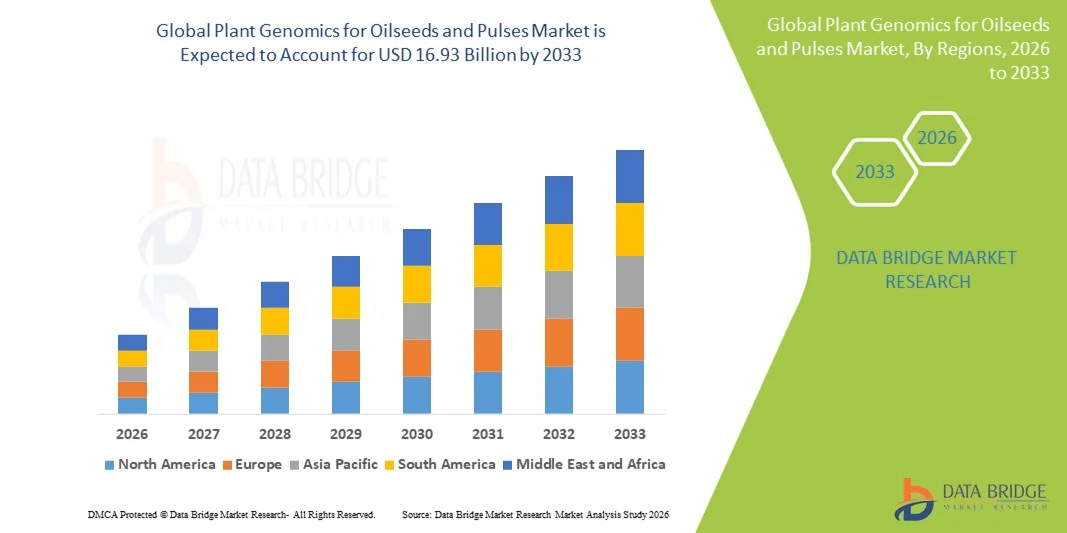
- The global plant genomics for oilseeds and pulses market size was valued at USD 9.13 billion in 2025 and is expected to reach USD 16.93 billion by 2033, at a CAGR of 8.20% during the forecast period
- The market growth is largely fuelled by the rising adoption of advanced breeding technologies to enhance crop resilience, yield potential, and oil or protein content
- Growing demand for high-performing oilseed and pulse varieties suitable for climate-adaptive farming is accelerating the use of genomic tools across seed development pipelines
Plant Genomics for Oilseeds and Pulses Market Analysis
- The market is witnessing strong momentum as seed developers and research institutions increasingly leverage genomic insights to improve disease resistance, drought tolerance, and nutrient efficiency in oilseeds and pulses
- Advancements in sequencing technologies, coupled with the integration of bioinformatics and molecular diagnostics, are enabling faster, more precise breeding outcomes that support global food security and sustainable agriculture
- North America dominated the plant genomics for oilseeds and pulses market in 2025, supported by strong adoption of advanced genomic tools and extensive R&D investments by major seed and biotechnology companies
- Asia-Pacific region is expected to witness the highest growth rate in the global plant genomics for oilseeds and pulses market, driven by expanding agricultural biotechnology investments, rapidly increasing food demand, and the growing focus on climate-resilient crop development
- Molecular engineering held the largest market revenue share in 2025 due to its extensive use in improving crop traits, enhancing yield stability, and increasing resistance to environmental stress. The approach is widely adopted by seed developers and research institutes owing to its precision and reliability in modifying plant genetic structure
Report Scope and Plant Genomics for Oilseeds and Pulses Market Segmentation
|
Attributes |
Plant Genomics for Oilseeds and Pulses Key Market Insights |
|
Segments Covered |
|
|
Countries Covered |
North America
Europe
Asia-Pacific
Middle East and Africa
South America
|
|
Key Market Players |
|
|
Market Opportunities |
|
|
Value Added Data Infosets |
In addition to the insights on market scenarios such as market value, growth rate, segmentation, geographical coverage, and major players, the market reports curated by the Data Bridge Market Research also include import export analysis, production capacity overview, production consumption analysis, price trend analysis, climate change scenario, supply chain analysis, value chain analysis, raw material/consumables overview, vendor selection criteria, PESTLE Analysis, Porter Analysis, and regulatory framework. |
Plant Genomics for Oilseeds and Pulses Market Trends
Advancements in DNA Sequencing and Trait Mapping Technologies
- The rapid evolution of genomic sequencing tools is transforming plant breeding for oilseeds and pulses by enabling precise identification of high-value traits. These technologies support faster selection of varieties with improved yield, stress tolerance, and nutritional quality, reducing the time and cost associated with traditional breeding cycles
- The growing demand for climate-resilient crops is accelerating the adoption of genomic solutions such as marker-assisted selection and genome-wide association studies. These tools help breeders develop cultivars capable of withstanding drought, heat, pests, and diseases, improving productivity in vulnerable agricultural regions
- The affordability and accessibility of next-generation sequencing systems are allowing public research institutions and seed companies to expand genomic programs. This promotes the development of region-specific hybrid varieties, supporting smallholder farmers and strengthening seed supply chains
- For instance, in 2023, several agricultural research centers reported significant improvements in disease resistance among pulse varieties after incorporating genomic trait mapping tools. These improvements enhanced field performance, reduced crop losses, and supported stable supplies for processing industries
- While genomic technologies are accelerating crop improvement, long-term success depends on integration with extension services, farmer training, and scalable seed distribution systems. Developers must focus on localized breeding strategies and sustainable deployment models to fully realize the benefits of advanced genomics
Plant Genomics for Oilseeds and Pulses Market Dynamics
Driver
Rising Demand for High-Yielding and Stress-Resistant Crop Varieties
- The increasing global pressure on food and oilseed production is driving demand for genetically enhanced varieties that offer better yield stability under unpredictable environmental conditions. Traits such as drought resilience, pest resistance, and improved nitrogen fixation are becoming essential for securing modern agricultural output
- Farmers are becoming more aware of the economic risks associated with low-performing cultivars, including reduced harvest volumes, higher input costs, and declining profitability. This awareness is encouraging adoption of genomics-driven seeds that deliver consistent performance across diverse soil and climate conditions
- Government programs and international research collaborations are expanding investment into plant genomics infrastructure such as molecular breeding labs and national seed improvement missions. These initiatives aim to strengthen food security, reduce import dependency, and enhance agricultural competitiveness
- For instance, in 2022, several national breeding programs incorporated genomic selection models to upgrade oilseed and pulse varieties, significantly improving breeding efficiency and accelerating variety release cycles
- While heightened demand and institutional support are driving market growth, challenges such as limited field-level awareness, uneven access to certified seeds, and high breeding costs require strategic interventions to ensure widespread adoption
Restraint/Challenge
High Cost of Genomic Technologies and Limited Adoption in Low-Income Regions
- Advanced genomic technologies such as whole genome sequencing, CRISPR-based editing, and high-throughput phenotyping remain costly, limiting participation among small seed companies and public breeding centers in developing economies. High investment requirements slow down adoption and restrict innovation capacity
- In many low-income agricultural regions, limited infrastructure for molecular research and inadequate availability of trained geneticists hinder effective implementation of breeding programs. These gaps result in slower development of improved varieties and reduced competitiveness of local seed markets
- Market expansion is further constrained by low farmer awareness regarding the benefits of genomics-enhanced seeds, particularly in rural zones where traditional varieties dominate. Limited distribution networks and inconsistent seed supply also affect adoption rates
- For instance, in 2023, several agricultural development agencies reported that more than half of smallholder farmers across emerging markets lacked access to improved genomic seed varieties due to infrastructural and economic barriers
- While technology costs are gradually declining, addressing affordability, capacity building, and last-mile seed distribution remains essential. Stakeholders must prioritize decentralized breeding centers, public-private partnerships, and scalable genomic platforms to unlock broader market potential
Plant Genomics for Oilseeds and Pulses Market Scope
The market is segmented on the basis of type, trait, and objectives.
- By Type
On the basis of type, the plant genomics for oilseeds and pulses market is segmented into molecular engineering, genetic engineering and genome editing, and others. Molecular engineering held the largest market revenue share in 2025 due to its extensive use in improving crop traits, enhancing yield stability, and increasing resistance to environmental stress. The approach is widely adopted by seed developers and research institutes owing to its precision and reliability in modifying plant genetic structure.
Genetic engineering and genome editing are expected to witness the fastest growth rate from 2026 to 2033, driven by rising adoption of CRISPR technologies and advanced gene-editing platforms. These tools allow targeted modification of desirable traits, making them ideal for developing high-yield, disease-resistant, and climate-resilient oilseed and pulse varieties. The segment is further supported by growing investment in next-generation breeding technologies.
- By Trait
On the basis of trait, the market is segmented into yield improvement, disease resistance, herbicide tolerance and insect resistance, and abiotic stress tolerance. Yield improvement dominated the market in 2025, supported by the global need to enhance productivity and meet rising demand for plant-based proteins and edible oils. Genomic tools enabling improved seed vigor, plant health, and optimized nutrient uptake contribute significantly to this leadership.
Abiotic stress tolerance is expected to register the fastest growth from 2026 to 2033 due to increasing climate variability and the need for crops capable of withstanding drought, heat, salinity, and flooding. Advanced genomic mapping and trait identification are enabling the development of more resilient oilseed and pulse varieties, accelerating adoption across both commercial farming and research programs.
- By Objectives
On the basis of objectives, the market is segmented into DNA extraction and purification, DNA/RNA sequencing, genotyping, gene expression profiling, marker-assisted selection, GMO-trait purity testing, hybrid purity testing, targeted resequencing, DNA parentage testing, QTL mapping, and genetic disease. DNA extraction and purification held the largest market share in 2025 due to its foundational role in downstream genomic analysis and breeding workflows. Its widespread use across laboratories and breeding facilities for sample preparation supports its dominance.
DNA/RNA sequencing is expected to grow at the fastest pace from 2026 to 2033, propelled by declining sequencing costs, increased adoption of high-throughput platforms, and the need for deeper genetic insights into oilseeds and pulses. Sequencing technologies enable rapid discovery of trait-linked markers and accelerate the development of superior crop varieties.
Plant Genomics for Oilseeds and Pulses Market Regional Analysis
- North America dominated the plant genomics for oilseeds and pulses market in 2025, supported by strong adoption of advanced genomic tools and extensive R&D investments by major seed and biotechnology companies
- Producers in the region increasingly rely on genomic-assisted breeding to enhance crop yield, improve resilience, and accelerate varietal development across key oilseed and pulse crops
- The dominance is further reinforced by a well-established agricultural infrastructure, supportive regulatory systems, and high demand for genetically improved, climate-resilient crop varieties
U.S. Plant Genomics for Oilseeds and Pulses Market Insight
The U.S. plant genomics market accounted for the largest revenue share in 2025 across North America, fuelled by rapid adoption of next-generation sequencing, marker-assisted breeding, and genome editing tools. The country’s strong biotech ecosystem enables extensive research collaborations that accelerate genetic improvements in soybeans, canola, and pulse crops. Growing emphasis on crop productivity, sustainability, and disease resistance continues to drive investment in advanced genomic solutions, strengthening the U.S. position as a leading hub for agri-genomics innovation.
Europe Plant Genomics for Oilseeds and Pulses Market Insight
Europe is expected to witness the fastest growth rate from 2026 to 2033, driven by strict quality standards, climate-resilience initiatives, and the need to reduce dependency on imports for key oilseeds and pulses. The region’s increasing focus on sustainable agriculture and precision breeding is accelerating the deployment of genomics-based crop improvement programs. Growing support from EU-funded research projects and cross-border collaborations is further enhancing the adoption of sequencing and trait-mapping technologies across major oilseed and pulse breeding centers.
U.K. Plant Genomics for Oilseeds and Pulses Market Insight
The U.K. market is expected to register the fastest CAGR from 2026 to 2033, supported by advanced genomic research capacity and strong government backing for agricultural innovation. Rising focus on developing climate-adaptive and nutrient-dense oilseed and pulse varieties is boosting reliance on molecular breeding tools. The U.K.’s expanding ecosystem of research institutes and agri-biotech firms continues to strengthen genomic development pipelines across both commercial and academic sectors.
Germany Plant Genomics for Oilseeds and Pulses Market Insight
The Germany market is expected to witness significant growth from 2026 to 2033, driven by technological advancements in genetic engineering and a strong emphasis on sustainability. Germany’s robust agricultural research network and established seed industry are encouraging widespread adoption of genomic selection and trait-profiling tools. Increasing demand for high-quality, disease-resistant oilseed varieties is further supporting the expansion of genomics-focused breeding programs in the country.
Asia-Pacific Plant Genomics for Oilseeds and Pulses Market Insight
The Asia-Pacific region is expected to experience the fastest growth rate from 2026 to 2033, supported by expanding agricultural modernization, rising crop productivity demands, and government investments in genomic research. Countries across the region are rapidly adopting sequencing platforms, phenotyping systems, and molecular breeding to enhance the resilience and yield of oilseed and pulse crops. Growing awareness of climate-adaptive and high-performance varieties is also broadening commercial adoption.
Japan Plant Genomics for Oilseeds and Pulses Market Insight
The Japan market is expected to grow rapidly from 2026 to 2033 due to the country’s strong technological expertise and advanced research infrastructure. Increasing focus on improving protein-rich pulse crops and high-value oilseeds is boosting the use of precision breeding and genome editing. Japan’s commitment to agricultural innovation, combined with a need for efficient domestic crop production, continues to accelerate genomics adoption across research institutions and commercial breeders.
China Plant Genomics for Oilseeds and Pulses Market Insight
China accounted for the largest revenue share in Asia-Pacific in 2025, driven by large-scale agricultural modernization and rapid uptake of genomic technologies. Strong government programs supporting food security and improved oilseed productivity are accelerating the use of high-throughput sequencing and hybrid purity testing. With expanding domestic demand and significant investments in seed biotechnology, China continues to strengthen its leadership in the regional plant genomics landscape.
Plant Genomics for Oilseeds and Pulses Market Share
The Plant Genomics for Oilseeds and Pulses industry is primarily led by well-established companies, including:
- Eurofins Scientific (Luxembourg)
- Illumina Inc (U.S.)
- NRGene (Israel)
- Neogen Corporation (U.S.)
- Agilent Technologies, Inc (U.S.)
- LC Sciences LLC (U.S.)
- Traitgenetics GmbH (Germany)
- Keygene N.V (Netherlands)
- Novogene Co. Ltd (China)
- GeneWiz (U.S.)
- BGI (China)
- Genotypic Technology (India)
- FLORAGENEX, INC. (U.S.)

- Interactive Data Analysis Dashboard
- Company Analysis Dashboard for high growth potential opportunities
- Research Analyst Access for customization & queries
- Competitor Analysis with Interactive dashboard
- Latest News, Updates & Trend analysis
- Harness the Power of Benchmark Analysis for Comprehensive Competitor Tracking
Data collection and base year analysis are done using data collection modules with large sample sizes. The stage includes obtaining market information or related data through various sources and strategies. It includes examining and planning all the data acquired from the past in advance. It likewise envelops the examination of information inconsistencies seen across different information sources. The market data is analysed and estimated using market statistical and coherent models. Also, market share analysis and key trend analysis are the major success factors in the market report. To know more, please request an analyst call or drop down your inquiry.
The key research methodology used by DBMR research team is data triangulation which involves data mining, analysis of the impact of data variables on the market and primary (industry expert) validation. Data models include Vendor Positioning Grid, Market Time Line Analysis, Market Overview and Guide, Company Positioning Grid, Patent Analysis, Pricing Analysis, Company Market Share Analysis, Standards of Measurement, Global versus Regional and Vendor Share Analysis. To know more about the research methodology, drop in an inquiry to speak to our industry experts.
Data Bridge Market Research is a leader in advanced formative research. We take pride in servicing our existing and new customers with data and analysis that match and suits their goal. The report can be customized to include price trend analysis of target brands understanding the market for additional countries (ask for the list of countries), clinical trial results data, literature review, refurbished market and product base analysis. Market analysis of target competitors can be analyzed from technology-based analysis to market portfolio strategies. We can add as many competitors that you require data about in the format and data style you are looking for. Our team of analysts can also provide you data in crude raw excel files pivot tables (Fact book) or can assist you in creating presentations from the data sets available in the report.