Plant Genomics Market Overview
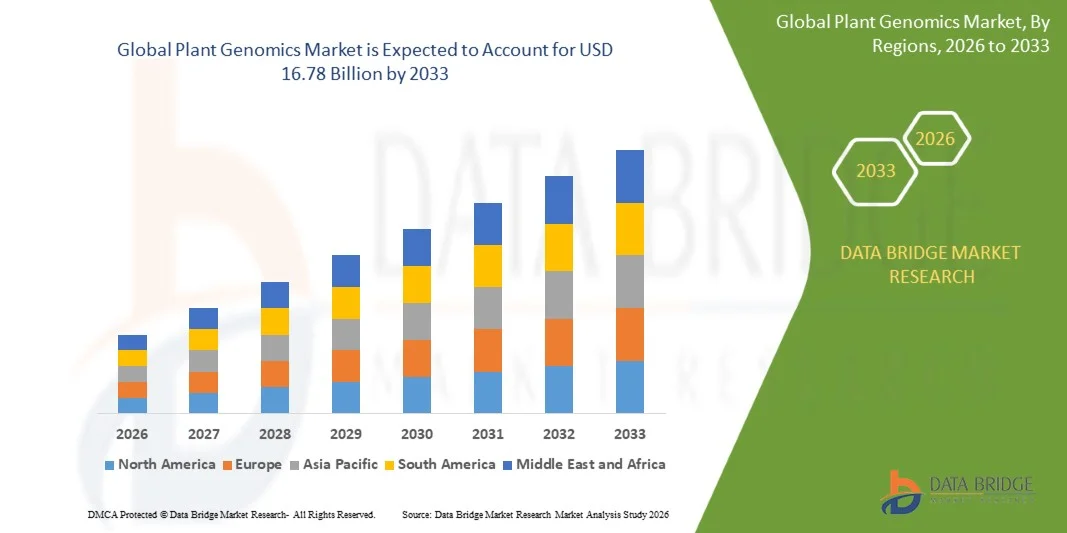
As per Data Bridge Market Research Analysis the plant genomics Market was valued at USD 9.00 billion in 2025 and is projected to reach USD 16.78 billion by 2033, growing at a CAGR of 12.30% from 2026 to 2033. Market growth is supported by falling sequencing costs, wider use of genomic selection, expansion of CRISPR-based breeding, stronger public and private agricultural research, and the urgent need to develop crops that can tolerate heat, drought, salinity, pests, and emerging diseases. Seed companies, research institutes, universities, government laboratories, and technology providers are increasingly using genomic information to shorten breeding cycles and improve the accuracy of trait selection.
Plant genomics covers the sequencing, characterization, comparison, and functional interpretation of plant genomes. The field includes DNA and RNA sequencing, genotyping, molecular markers, genome-wide association studies, genomic selection, gene editing, bioinformatics, and multi-omics analysis. DNA sequencing remains the foundation of most programs, while gene editing and AI-based genomic interpretation are expanding quickly. Commercial adoption still depends on reliable phenotype data, field validation, access to computing infrastructure, regulatory clarity, intellectual property management, and the ability to convert genomic discoveries into stable crop performance across different environments.
Market Size & Forecast
- Market Value (2025): USD 9.00 Billion
- Expected Market Value (2033): USD 16.78 Billion
- Forecast CAGR (2025-2033): 8.10%
- Leading Region: North America
- Fastest-Growing Region: Asia-Pacific
Key Market Trends & Insights
- North America dominated the plant genomics market with the largest revenue share of 40.5% in 2024, supported by advanced sequencing infrastructure, major agricultural biotechnology companies, well-funded university breeding programs, and extensive public-sector crop-genomics research. The region also benefits from established commercialization pathways for genomic selection, molecular markers, and precision-breeding technologies.
- Asia-Pacific is expected to be the fastest-growing region at a CAGR of 14.5% through 2030, fueled by food-security priorities, large crop-improvement programs, expanding domestic sequencing capacity, and rising investment in climate-resilient rice, wheat, maize, oilseeds, pulses, fruits, and vegetables across China, India, Japan, and other regional markets.
- The DNA sequencing segment led the technology category with a 45.5% market share in 2024, driven by its central role in reference-genome construction, variant discovery, pangenome development, gene identification, and marker design. Continued improvements in sequencing throughput and read accuracy are widening its use across commercial breeding and public research programs.
- The gene editing segment is the fastest-growing technology category and is projected to register a CAGR of 19.3% through 2030, reflecting the expanding use of CRISPR-based systems for precise trait improvement. Breeders are increasingly evaluating transgene-free editing to improve disease resistance, quality, stress tolerance, and productivity while shortening conventional development timelines.
- The disease resistance segment dominated the trait category with a 37.5% market share in 2024, supported by the economic importance of controlling fungal, bacterial, viral, and insect-related crop losses. Genomic markers, resistance-gene discovery, and predictive breeding models are helping developers identify durable resistance across diverse genetic backgrounds.
- The cereals and grains segment accounted for the largest crop-type share of 39.5% in 2024, driven by sustained genomics investment in rice, wheat, maize, barley, and other staple crops. Large planted areas, major public breeding programs, and the need for stable yield under climate and disease pressure continue to support segment leadership.
Report Scope and Plant Genomics Market Segmentation
|
Attributes |
Plant Genomics Key Market Insights |
|
Segments Covered |
|
|
Countries Covered |
North America
Europe
Asia-Pacific
Middle East and Africa
South America
|
|
Key Market Players |
|
|
Market Opportunities |
|
|
Value Added Data Infosets |
In addition to the insights on market scenarios such as market value, growth rate, segmentation, geographical coverage, and major players, the market reports curated by the Data Bridge Market Research also include import export analysis, production capacity overview, production consumption analysis, price trend analysis, climate change scenario, supply chain analysis, value chain analysis, raw material/consumables overview, vendor selection criteria, PESTLE Analysis, Porter Analysis, and regulatory framework. |
Plant Genomics Market Trends
Trend: Rising Integration Of AI, Pangenomics, Long-Read Sequencing, And Multi-Omics Technologies
Growing demand for faster trait discovery, improved crop performance, and climate-resilient agricultural systems is accelerating the adoption of AI-driven genomics, pangenomics, long-read sequencing, and multi-omics technologies across the global plant genomics industry. Researchers and breeding organizations are increasingly moving beyond single reference genomes toward population-scale genomic datasets that capture genetic diversity across commercial cultivars, landraces, and wild plant species. Long-read sequencing technologies, combined with transcriptomics, epigenomics, metabolomics, and phenomics, are improving the ability to identify genes and biological pathways associated with yield, disease resistance, nutritional quality, and environmental adaptability.
The rapid expansion of genomic datasets, advances in computational biology, and increasing availability of artificial intelligence tools are creating sustained demand for integrated genomics platforms. Technology providers are increasingly utilizing machine learning and foundation models to predict gene function, prioritize candidate traits, and accelerate crop-development programs. For instance, in March 2026, Living Models highlighted BOTANIC-0, the first model in its plant-biology foundation-model family, designed to learn the language of DNA and predict gene function, regulatory elements, and trait associations using a curated database of more than 1,600 plant genomes. The development reflects growing industry investment in AI-powered biological discovery platforms that support advanced crop breeding and genomic research.
The increasing integration of AI, pangenomics, long-read sequencing, and multi-omics technologies is expected to reinforce long-term demand for plant genomics solutions, positioning technology providers to benefit from rising investments in precision breeding, sustainable agriculture, and climate-resilient crop development.
Plant Genomics Market Dynamics
Key Market Driver: Growing Demand For Climate-Resilient And High-Productivity Crops
The global agricultural sector continues to face increasing pressure from climate change, water scarcity, disease outbreaks, soil degradation, and evolving pest populations. Plant genomics technologies enable researchers and breeders to identify genes, markers, and genomic regions associated with desirable agronomic traits, allowing more efficient selection of high-performing crop varieties. Genomic selection, marker-assisted breeding, sequencing technologies, and gene-editing tools are increasingly being adopted to improve crop productivity, disease resistance, drought tolerance, and resource-use efficiency.
Governments, agricultural research institutes, and commercial seed companies continue to invest in genomic innovation to strengthen food security and agricultural sustainability. For instance, in June 2024, Syngenta expanded access to selected genome-editing and breeding technologies through its Shoots by Syngenta platform, making optimized CRISPR-Cas12a and gene-editing-enabled breeding tools available to academic researchers worldwide. This initiative supports collaborative research and accelerates the development of resilient and productive crop varieties.
As global food demand continues to increase and climate-related agricultural risks intensify, plant genomics providers are expected to benefit from sustained demand driven by precision breeding initiatives, genomic selection programs, and investments in climate-smart agriculture.
Key Restraint/Challenge: Complex Data Interpretation, Validation Requirements, And Regulatory Uncertainty
Plant genomics research involves the analysis of large, highly complex, and often polyploid genomes that require advanced sequencing technologies, bioinformatics expertise, computational infrastructure, and extensive field validation. Translating genomic discoveries into commercially successful crop varieties remains challenging because genomic predictions can vary across environmental conditions, genetic backgrounds, and agricultural production systems.
In addition, regulatory frameworks governing gene-edited crops, genomic technologies, intellectual property rights, germplasm access, labeling requirements, and commercialization pathways continue to differ across countries and regions. Industry developments highlight the evolving regulatory landscape surrounding advanced plant breeding technologies. For instance, in December 2025, the European Council and European Parliament reached a provisional agreement on regulatory rules governing plants developed through new genomic techniques (NGTs), establishing requirements related to verification, authorization, traceability, patent information, and labeling of specific products.
Despite strong scientific progress, regulatory uncertainty, complex data interpretation requirements, and the need for extensive field validation are expected to remain significant challenges, potentially slowing commercialization timelines and increasing development costs throughout the forecast period.
Key Market Opportunity: Expansion Of Genomics Platforms For Specialty Crops And Emerging Agricultural Markets
Breeding programs for fruits, vegetables, plantation crops, tree nuts, pulses, and regionally important crops are increasingly adopting genomics technologies to accelerate variety development and improve disease resistance, crop quality, shelf life, nutritional value, and climate adaptability. Many specialty crops remain underserved by existing genomic resources, creating significant opportunities for providers offering chromosome-level genome assemblies, pangenomics, genomic selection tools, and transgene-free gene-editing technologies.
Technology providers are also developing cloud-based bioinformatics platforms and lower-cost sequencing solutions that make advanced genomics more accessible to smaller breeding organizations and public-sector research institutions. For instance, in March 2025, Verinomics introduced Genesis, a transgene-free gene-editing platform, and Genova, a genomic-driven breeding acceleration platform designed for seed and vegetatively propagated specialty crops. The company's platform combines chromosome-level genome assemblies, population genomics, AI-based trait discovery, genomic selection, and precision editing technologies to accelerate crop improvement programs.
As specialty crop breeding programs and emerging-market agricultural initiatives continue to expand, increasing adoption of genomic analysis, precision breeding, and gene-editing technologies is expected to create substantial long-term growth opportunities for the global plant genomics market.
Plant Genomics Market Scope
The plant genomics market is segmented on the basis of technology, trait, and crop type
- By Technology
On the basis of technology, the plant genomics market is divided into DNA sequencing, genotyping, gene editing, marker-assisted selection, bioinformatics, and other technologies. The DNA sequencing segment held the largest market revenue share of 45.5% in 2024, driven by its essential role in reference-genome construction, genome assembly, variant discovery, pangenome development, gene identification, and marker design. DNA sequencing remains the foundation for downstream genomic selection, trait mapping, and precision-breeding decisions across public and commercial crop-development programs.
The gene editing segment is projected to register the fastest growth at a CAGR of 19.3% through 2030, driven by increasing use of CRISPR-based systems for precise improvement of disease resistance, stress tolerance, quality, and productivity. Rising interest in transgene-free edits, expanding research access, and integration of genomic data with target discovery are accelerating the movement of gene-editing workflows from laboratory studies into breeding pipelines.
- By Trait
On the basis of trait, the plant genomics market is divided into disease resistance, herbicide tolerance, yield improvement, nutritional enhancement, abiotic stress tolerance, and other traits. The disease resistance segment held the largest market revenue share of 37.5% in 2024, driven by the economic importance of reducing fungal, bacterial, viral, and insect-related crop losses. Resistance-gene discovery, marker development, genomic prediction, and precision breeding are widely used to improve durable protection across cereals, oilseeds, pulses, fruits, and vegetables.
The nutritional enhancement segment is projected to register the fastest growth at a CAGR of 17.4% from 2025 to 2030, driven by rising demand for biofortified crops and improved food-quality characteristics. Breeding programs are increasingly applying genomics to enhance vitamins, minerals, protein quality, oil composition, flavor, and other nutritional attributes while maintaining yield and agronomic performance.
- By Crop Type
On the basis of crop type, the plant genomics market is divided into cereals and grains, oilseeds and pulses, fruits and vegetables, and other crops. The cereals and grains segment held the largest market revenue share of 39.5% in 2024, driven by extensive genomic investment in rice, wheat, maize, barley, and other staple crops that are central to food security. Large public research budgets, commercial seed programs, and the need for stable yield under disease and climate pressure continue to support segment leadership.
The fruits and vegetables segment is projected to register the fastest growth at a CAGR of 16.0% through 2030, driven by increasing use of genomic selection and precision editing to improve disease resistance, flavor, texture, appearance, shelf life, flowering behavior, and adaptation to protected or high-temperature production systems. High seed and crop value makes advanced genomic investment commercially attractive for specialty-crop breeding programs.
Plant Genomics Market Regional Analysis
North America Plant Genomics Market Insight
North America dominated the plant genomics market with the largest revenue share of 40.5% in 2025, supported by advanced sequencing facilities, strong agricultural universities, established biotechnology clusters, major commercial seed companies, and extensive public funding for crop genetics and breeding. Genomic tools are widely used in maize, soybean, wheat, canola, vegetables, fruits, and specialty crops, while integration with field phenotyping and predictive analytics supports translation of genomic discoveries into commercial varieties.
U.S. Plant Genomics Market Insight
The U.S. dominated the plant genomics market with the largest revenue share in 2025, supported by large-scale agricultural production, advanced sequencing companies, seed developers, federal research laboratories, and university breeding programs. Plant genomics is applied across corn, soybean, wheat, cotton, fruits, vegetables, and tree crops, with growing emphasis on pangenomes, genomic prediction, gene editing, and multi-environment field validation. Federal programs supporting plant breeding, genetic resources, genomics, and genetic improvement reinforce demand for analytical platforms and research services.
Asia-Pacific Plant Genomics Market Insight
Asia-Pacific plant genomics market is expected to witness the fastest growth rate at a CAGR of 14.5% from 2026 to 2033, primarily driven by food-security priorities, large populations, limited arable land, water stress, heat, salinity, flooding, and changing pest and disease patterns. Governments and research organizations across China, India, Japan, South Korea, Australia, and Southeast Asia are expanding sequencing facilities, crop-genome databases, biotechnology programs, and precision-breeding initiatives for rice, wheat, maize, oilseeds, pulses, fruits, and vegetables.
China Plant Genomics Market Insight
The China dominated the plant genomics market with the largest revenue share in 2025, driven by extensive agricultural research capacity, domestic sequencing infrastructure, seed-industry investment, and national focus on food and seed security. Research programs apply high-quality reference genomes, population sequencing, genomic selection, graph genomes, and precision gene editing across rice, wheat, maize, soybean, rapeseed, vegetables, and other crops. Development of local sequencing and bioinformatics capability is reducing dependence on overseas services and supporting translation of genomic research into locally adapted varieties.
Japan Plant Genomics Market Insight
Japan plant genomics market is expected to witness strong growth from 2026 to 2033, primarily driven by advanced research in rice, vegetables, fruits, flowers, and functional food crops. Japanese institutions use high-quality sequencing, molecular markers, precision breeding, and controlled-environment testing to improve quality, stress tolerance, and production efficiency. Limited agricultural land, aging farming populations, and the need for predictable performance in mechanized and protected cultivation are increasing the value of validated genomic technologies.
Europe Plant Genomics Market Insight
The Europe plant genomics market is expected to witness strong growth from 2026 to 2033, supported by publicly funded research, major breeding companies, strong agricultural universities, sequencing infrastructure, and extensive germplasm collections. Regional programs focus on cereals, oilseeds, potatoes, vegetables, fruits, forage crops, biodiversity genomics, pangenomics, and climate-resilient varieties. The evolving regulatory framework for new genomic techniques is expected to influence commercialization, traceability, intellectual-property disclosure, seed access, and investment decisions across member states.
Germany Plant Genomics Market Insight
The Germany plant genomics market is expected to witness strong growth from 2026 to 2033 due to the country’s strong plant-science institutes, agricultural universities, biotechnology capabilities, and established crop-breeding industry. Research programs combine genome sequencing, molecular markers, gene-bank resources, phenotyping, and environmental data to improve yield stability, disease resistance, and resource efficiency in wheat, barley, maize, rapeseed, sugar beet, potato, and horticultural crops. Demand remains strong for reliable sample preparation, sequencing, genotyping, and bioinformatics services.
U.K. Plant Genomics Market Insight
The U.K. plant genomics market is expected to witness strong growth from 2026 to 2033, supported by leading crop-research institutes, universities, seed companies, advanced sequencing facilities, and expertise in wheat, barley, oilseed rape, potatoes, fruits, and vegetables. Research strengths in long-read sequencing, pangenomes, disease resistance, and genomic selection are strengthening the country’s innovation base. The developing framework for precision-bred plants is also creating a clearer route for certain targeted genetic changes, although field testing and multi-season validation remain essential.
Plant Genomics Market Share
The plant genomics market is led by well established companies:
- BGI Genomics Co., Ltd. (China)
- Eurofins Scientific SE (Luxembourg)
- GENEWIZ / Azenta, Inc. (U.S.)
- Illumina, Inc. (U.S.)
- KeyGene N.V. (Netherlands)
- LC Sciences LLC (U.S.)
- Neogen Corporation (U.S.)
- Novogene Co., Ltd. (China)
- NRGene Technologies Ltd. (Israel)
- Oxford Nanopore Technologies plc (United Kingdom)
- QIAGEN N.V. (Netherlands)
- Floragenex, Inc. (U.S.)
- Thermo Fisher Scientific Inc. (U.S.)
Latest Developments in Plant Genomics Market
- In March 2026, Living Models highlighted BOTANIC-0, the first model in its plant-biology foundation-model family. The company reported that the one-billion-parameter model learns the language of DNA to predict gene function, regulatory elements, and trait associations, and stated that more than 1,600 curated plant genomes support the broader BOTANIC program. The development reflects the growing use of AI foundation models to interpret plant genomic data and prioritize candidate variants for breeding research.
- In March 2025, Verinomics introduced Genesis, a transgene-free gene-editing platform, and Genova, a genomic-driven breeding-acceleration platform for seed and vegetatively propagated specialty crops. The company stated that the platforms combine chromosome-level assemblies, population genomics, AI-based trait identification, computational biology, genomic selection, and precision editing to shorten the path from trait discovery to improved crop varieties.
- In June 2024, Syngenta opened selected genome-editing and breeding technologies to academic researchers worldwide through its Shoots by Syngenta innovation platform. The available rights included optimized CRISPR-Cas12a and gene-editing-enabled breeding tools, with the initiative intended to expand collaborative agricultural research and accelerate development of productive, resilient, and sustainable crops.

- Interactive Data Analysis Dashboard
- Company Analysis Dashboard for high growth potential opportunities
- Research Analyst Access for customization & queries
- Competitor Analysis with Interactive dashboard
- Latest News, Updates & Trend analysis
- Harness the Power of Benchmark Analysis for Comprehensive Competitor Tracking
Data collection and base year analysis are done using data collection modules with large sample sizes. The stage includes obtaining market information or related data through various sources and strategies. It includes examining and planning all the data acquired from the past in advance. It likewise envelops the examination of information inconsistencies seen across different information sources. The market data is analysed and estimated using market statistical and coherent models. Also, market share analysis and key trend analysis are the major success factors in the market report. To know more, please request an analyst call or drop down your inquiry.
The key research methodology used by DBMR research team is data triangulation which involves data mining, analysis of the impact of data variables on the market and primary (industry expert) validation. Data models include Vendor Positioning Grid, Market Time Line Analysis, Market Overview and Guide, Company Positioning Grid, Patent Analysis, Pricing Analysis, Company Market Share Analysis, Standards of Measurement, Global versus Regional and Vendor Share Analysis. To know more about the research methodology, drop in an inquiry to speak to our industry experts.
Data Bridge Market Research is a leader in advanced formative research. We take pride in servicing our existing and new customers with data and analysis that match and suits their goal. The report can be customized to include price trend analysis of target brands understanding the market for additional countries (ask for the list of countries), clinical trial results data, literature review, refurbished market and product base analysis. Market analysis of target competitors can be analyzed from technology-based analysis to market portfolio strategies. We can add as many competitors that you require data about in the format and data style you are looking for. Our team of analysts can also provide you data in crude raw excel files pivot tables (Fact book) or can assist you in creating presentations from the data sets available in the report.