




Global Plastic Antioxidant Market
Market Size in USD Billion
CAGR :
% 
 USD
3.40 Billion
USD
5.17 Billion
2025
2033
USD
3.40 Billion
USD
5.17 Billion
2025
2033
 Forecast Period Forecast Period |
2026 –2033 |
 Market Size (Base Year) Market Size (Base Year) |
USD 3.40 Billion |
 Market Size (Forecast Year) Market Size (Forecast Year) |
USD 5.17 Billion |
 CAGR CAGR |
% |
| Major Markets Players |
|
Plastic Antioxidant Market Size
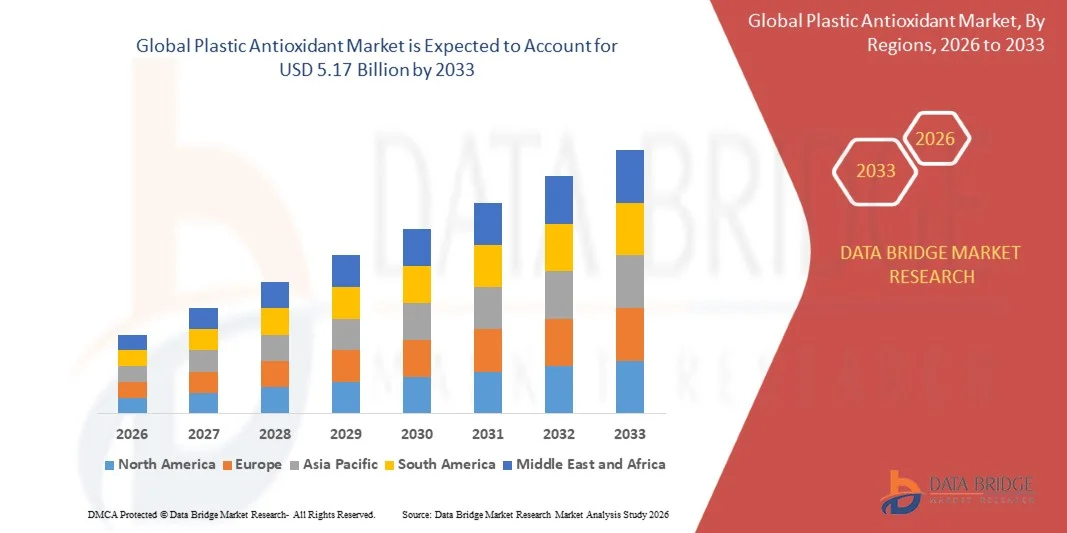
- The global plastic antioxidant market size was valued at USD 3.40 billion in 2025 and is expected to reach USD 5.17 billion by 2033, at a CAGR of 5.4% during the forecast period
- The market growth is largely fueled by the increasing demand for high-performance and durable plastics across automotive, packaging, construction, and consumer goods sectors, driving the adoption of plastic antioxidants to enhance polymer stability and longevity
- Furthermore, rising emphasis on sustainable and recyclable plastics is encouraging manufacturers to use antioxidants that prevent thermal and oxidative degradation, reduce waste, and extend product life. These converging factors are accelerating the uptake of advanced antioxidant solutions, thereby significantly boosting the industry’s growth
Plastic Antioxidant Market Analysis
- Plastic antioxidants are chemical additives used to prevent degradation of polymers caused by heat, oxygen, and UV exposure during processing and end-use applications. These additives, including phenolic antioxidants, phosphites, HALS, and antioxidant blends, maintain mechanical properties, color stability, and overall polymer performance
- The escalating demand for plastic antioxidants is primarily fueled by the widespread use of polymers in high-performance and specialty applications, growing regulatory emphasis on product durability and safety, and the rising need for long-lasting, environmentally responsible plastics
- Asia-Pacific dominated the plastic antioxidant market with a share of 35.5% in 2025, due to expanding polymer manufacturing, increasing demand for high-performance plastics, and a strong presence of chemical production hubs
- North America is expected to be the fastest growing region in the plastic antioxidant market during the forecast period due to strong demand for antioxidants in automotive, packaging, and construction plastics
- Phenolic segment dominated the market with a market share of 40.5% in 2025, due to its strong free radical scavenging ability and proven effectiveness in enhancing polymer longevity. Phenolic antioxidants are widely used in polyolefins and engineering plastics to prevent thermal degradation during processing and long-term use. Their compatibility with multiple polymer types and ability to maintain mechanical properties under high temperatures contribute to their sustained demand
Report Scope and Plastic Antioxidant Market Segmentation
|
Attributes |
Plastic Antioxidant Key Market Insights |
|
Segments Covered |
|
|
Countries Covered |
North America
Europe
Asia-Pacific
Middle East and Africa
South America
|
|
Key Market Players |
|
|
Market Opportunities |
|
|
Value Added Data Infosets |
In addition to the insights on market scenarios such as market value, growth rate, segmentation, geographical coverage, and major players, the market reports curated by the Data Bridge Market Research also include import export analysis, production capacity overview, production consumption analysis, price trend analysis, climate change scenario, supply chain analysis, value chain analysis, raw material/consumables overview, vendor selection criteria, PESTLE Analysis, Porter Analysis, and regulatory framework. |
Plastic Antioxidant Market Trends
“Increasing Adoption of Sustainable and High-Performance Polymers”
- A key trend in the plastic antioxidant market is the rising adoption of sustainable and high-performance polymers across automotive, packaging, and electronics sectors, driven by the need for materials with enhanced durability, thermal stability, and resistance to oxidative degradation. This trend is enabling manufacturers to extend product lifespans and improve efficiency in processing and end-use applications
- For instance, BASF and Songwon supply advanced antioxidants for polyolefins and engineering plastics that enhance thermal stability and mechanical properties, supporting applications in automotive parts, electronic housings, and food-grade packaging. These solutions help manufacturers meet sustainability targets while maintaining high performance under demanding conditions
- The growing focus on lightweight materials in the automotive and aerospace sectors is driving demand for polymer formulations stabilized with antioxidants, which reduce fuel consumption and emissions while preserving material integrity. This is positioning antioxidants as critical additives in next-generation high-performance plastics
- The electronics industry is increasingly incorporating antioxidant-stabilized polymers for housings, connectors, and flexible circuits, where resistance to heat and oxidative stress is essential. This integration is enhancing device longevity and reliability in consumer and industrial electronics
- Packaging manufacturers are seeking antioxidant solutions for polymers that prevent degradation from oxygen and UV exposure, thereby improving shelf life and product safety. These applications are accelerating the development of specialty antioxidants tailored for food, pharmaceutical, and cosmetic packaging
- The market is witnessing expansion in biodegradable and recyclable polymer segments where antioxidants are formulated to provide stability without compromising environmental performance. This rising demand is reinforcing the role of antioxidants in promoting sustainable material solutions across global industries
Plastic Antioxidant Market Dynamics
Driver
“Rising Demand for Durable and Heat-Resistant Plastics”
- The increasing demand for plastics that can withstand high temperatures and mechanical stress is driving growth in the plastic antioxidant market, as these additives prevent oxidative degradation and maintain material properties under extreme conditions
- For instance, Songwon and BASF provide phenolic and phosphite antioxidants that enhance the thermal and oxidative stability of polyolefins and engineering plastics used in automotive, construction, and electronics applications. These antioxidants ensure material durability while enabling manufacturers to meet performance standards
- Growth in the automotive and electrical sectors is accelerating the need for stabilized polymers that extend component lifespans, reduce maintenance, and maintain mechanical integrity under continuous use. Antioxidants play a crucial role in supporting this demand
- The rise in high-performance packaging applications requiring heat resistance and extended shelf life is further increasing reliance on antioxidants. Plastics stabilized with antioxidants maintain clarity, strength, and barrier properties during processing and storage
- Consumer demand for electronics and appliances with improved longevity is encouraging manufacturers to incorporate antioxidants into polymer housings and internal components. This trend continues to drive market expansion and innovation in antioxidant formulations
Restraint/Challenge
“Stringent Environmental and Safety Regulations”
- The plastic antioxidant market faces challenges due to increasing regulatory scrutiny on chemical additives, particularly regarding toxicity, migration, and environmental impact. Compliance with international standards requires reformulation and testing, which can slow product introduction
- For instance, BASF and Songwon must align their antioxidant products with REACH and FDA regulations, ensuring low migration and non-toxic profiles for food-contact plastics. These requirements increase development costs and extend lead times for new products
- Growing public and governmental pressure to reduce hazardous substances in polymers is compelling manufacturers to adopt safer alternatives, which may have lower stability or higher cost. This can constrain rapid adoption across certain applications
- Environmental regulations targeting plastic waste and recycling processes require antioxidants that do not interfere with recyclability, creating formulation complexities. Manufacturers must balance performance with regulatory compliance
- Stringent reporting and certification requirements are adding operational challenges, particularly for specialty antioxidants used in sensitive applications. These factors collectively create barriers for market participants to innovate while meeting safety and sustainability standards
Plastic Antioxidant Market Scope
The market is segmented on the basis of type, polymer resin, and form.
• By Type
On the basis of type, the plastic antioxidant market is segmented into phenolic, phosphite and phosphonite, antioxidant blends, and others. The phenolic segment dominated the largest market revenue share of 40.5%in 2025, driven by its strong free radical scavenging ability and proven effectiveness in enhancing polymer longevity. Phenolic antioxidants are widely used in polyolefins and engineering plastics to prevent thermal degradation during processing and long-term use. Their compatibility with multiple polymer types and ability to maintain mechanical properties under high temperatures contribute to their sustained demand. Manufacturers often prefer phenolic antioxidants for high-performance applications where durability and stability are critical. The segment also benefits from extensive industry experience and well-established supply chains, making it a preferred choice across multiple end-use industries.
The phosphite and phosphonite segment is anticipated to witness the fastest growth from 2026 to 2033, fueled by increasing use in combination with phenolic antioxidants for synergistic stabilization of polymers. Phosphite-based antioxidants offer additional protection against color changes and processing degradation, making them essential in polyolefin, PVC, and engineering plastic applications. Their growing adoption is driven by rising demand for high-performance, durable plastic products in automotive, packaging, and construction industries. The ability to enhance the thermal and oxidative stability of polymers while being compatible with eco-friendly formulations further boosts their market traction.
• By Polymer Resin
On the basis of polymer resin, the market is segmented into polypropylene (PP), polyethylene (PE), polyvinyl chloride (PVC), and other polymer resins. The polypropylene (PP) segment held the largest market revenue share in 2025 due to the widespread use of PP in packaging, automotive components, and household products. PP is particularly susceptible to thermal and oxidative degradation during processing, creating high demand for effective antioxidants. The segment benefits from extensive industrial adoption, availability of optimized antioxidant formulations, and strong demand from end-use sectors requiring lightweight and durable polymer materials. Its performance in maintaining mechanical strength and color stability under high-temperature processing conditions ensures continued preference among manufacturers.
The polyethylene (PE) segment is expected to witness the fastest CAGR from 2026 to 2033, driven by increasing demand in flexible packaging, films, and molded products. PE requires antioxidants to prevent chain scission and maintain tensile strength during extrusion and molding processes. Rising use in food packaging and consumer goods, combined with the development of enhanced antioxidant blends for PE, is accelerating market growth. In addition, the segment is supported by innovations in stabilizer combinations that extend the service life of PE products while ensuring compliance with regulatory standards for safe use.
• By Form
On the basis of form, the plastic antioxidant market is segmented into solid and liquid. The solid segment dominated the largest market revenue share in 2025, owing to its ease of handling, stable shelf life, and compatibility with masterbatch and direct polymer incorporation processes. Solid antioxidants are widely preferred in polyolefin, PVC, and engineering plastic applications for their efficient performance in both thermal and oxidative stabilization. The demand is also driven by established industrial processing protocols that favor solid antioxidants for consistent dosing and minimal handling risk.
The liquid segment is anticipated to witness the fastest growth from 2026 to 2033, fueled by rising use in continuous polymerization processes and applications requiring homogeneous dispersion. Liquid antioxidants offer enhanced solubility, faster incorporation into polymers, and improved effectiveness in stabilizing sensitive resins. Their growing adoption in high-performance engineering plastics, specialty films, and emerging polymer blends supports rapid market expansion. In addition, liquid forms facilitate formulation flexibility, enabling manufacturers to customize antioxidant levels according to specific polymer processing and end-use requirements.
Plastic Antioxidant Market Regional Analysis
- Asia-Pacific dominated the plastic antioxidant market with the largest revenue share of 35.5% in 2025, driven by expanding polymer manufacturing, increasing demand for high-performance plastics, and a strong presence of chemical production hubs
- The region’s cost-effective manufacturing landscape, rising investments in specialty additives, and growing exports of stabilized polymers are accelerating market expansion
- The availability of skilled labor, favorable government policies, and rapid industrialization across developing economies are contributing to increased consumption of plastic antioxidants in both industrial and consumer applications
China Plastic Antioxidant Market Insight
China held the largest share in the Asia-Pacific plastic antioxidant market in 2025, owing to its status as a global leader in polymer production and chemical additives manufacturing. The country's strong industrial base, government incentives for chemical sector expansion, and extensive export capabilities for stabilized polymers are major growth drivers. Demand is also bolstered by ongoing investments in specialty additives for automotive, packaging, and construction sectors.
India Plastic Antioxidant Market Insight
India is witnessing the fastest growth in the Asia-Pacific region, fueled by a rapidly expanding polymer processing sector, increasing demand for durable and high-performance plastics, and rising investments in additive production facilities. Government initiatives supporting local manufacturing and infrastructure development are strengthening demand for antioxidants. In addition, growing exports of stabilized polymers and increasing R&D in polymer additives are contributing to robust market expansion.
Europe Plastic Antioxidant Market Insight
The Europe plastic antioxidant market is expanding steadily, supported by stringent regulatory frameworks, high demand for high-quality stabilized polymers, and growing investments in sustainable and specialty additives. The region emphasizes product safety, environmental compliance, and advanced formulations, particularly in automotive, packaging, and construction plastics. The increasing use of antioxidants in engineering plastics and specialty polymer blends is further enhancing market growth.
Germany Plastic Antioxidant Market Insight
Germany’s plastic antioxidant market is driven by its leadership in high-precision polymer manufacturing, strong chemical industry heritage, and export-oriented production model. The country has well-established R&D networks and collaborations between academic institutions and chemical manufacturers, fostering continuous innovation in polymer stabilization. Demand is particularly strong for applications in automotive components, electrical appliances, and construction materials.
U.K. Plastic Antioxidant Market Insight
The U.K. market is supported by a mature polymer and chemical industry, growing efforts to localize additive supply chains, and increasing demand for specialty and sustainable plastic additives. With rising focus on R&D, academic-industry collaboration, and investments in lab-scale production of niche stabilizers, the U.K. continues to play a significant role in high-value polymer additive markets.
North America Plastic Antioxidant Market Insight
North America is projected to grow at the fastest CAGR from 2026 to 2033, driven by strong demand for antioxidants in automotive, packaging, and construction plastics. Focus on high-performance materials, advancements in polymer processing, and increasing regulatory emphasis on durability and safety are boosting demand. In addition, reshoring of polymer production and growing collaboration between additive manufacturers and polymer producers are supporting market expansion.
U.S. Plastic Antioxidant Market Insight
The U.S. accounted for the largest share in the North America market in 2025, underpinned by its expansive polymer industry, advanced R&D infrastructure, and significant investment in specialty additives. The country’s focus on innovation, regulatory compliance, and sustainability is encouraging the use of high-performance antioxidants in plastics for automotive, electronics, and packaging applications. Presence of key players and a mature distribution network further solidify the U.S.'s leading position in the region.
Plastic Antioxidant Market Share
The plastic antioxidant industry is primarily led by well-established companies, including:
- BASF SE (Germany)
- SONGWON Industrial Co., Ltd (South Korea)
- Adeka Corporation (Japan)
- Solvay S.A. (Belgium)
- SI Group, Inc. (U.S.)
- Clariant AG (Switzerland)
- Sumitomo Chemical Co., Ltd (Japan)
- 3V Sigma S.P.A (Italy)
- Dover Chemical Corporation (U.S.)
- Everspring Chemical Co., Ltd. (China)
- Ampacet Corporation (U.S.)
- LyondellBasell Industries Holdings B.V. (Netherlands)
- Astra Polymers (India)
- Evonik Industries AG (Germany)
- Lanxess AG (Germany)
- Milliken & Company (U.S.)
- OMNOVA Solutions Inc. (U.S.)
- Oxiris Chemicals S.A. (France)
- Wells Plastics (U.K.)
- Sakai Chemical Industry Co., Ltd. (Japan)
- Shandong Linyi Sunny Wealth Chemicals Co., Ltd. (China)
- Trigon Antioxidants Pvt. Ltd. (India)
Latest Developments in Global Plastic Antioxidant Market
- In October 2025, BASF introduced Tinuvin NOR 600, a next‑generation NOR hindered amine light stabilizer engineered to protect plastics from degradation caused by ultraviolet radiation. This innovation significantly improves weatherability, color retention, and mechanical durability in outdoor applications such as roofing membranes, artificial turf, and automotive exteriors. By offering enhanced performance and extended polymer lifespan, this launch addresses increasing demand for UV-resistant plastics and sustainability, enabling manufacturers to produce longer-lasting, high-performance products. The new stabilizer strengthens BASF’s portfolio, supports customer innovation, and opens opportunities in specialty applications where durability under harsh environmental conditions is critical
- In June 2025, Sabo S.p.A. restructured its global hindered amine light stabilizer (HALS) sales by transitioning to direct customer engagement, ending a longstanding distribution partnership. This strategic move aims to streamline supply chains, reduce lead times, and allow closer collaboration with end-users to tailor additive solutions for specific applications. The direct sales approach is expected to accelerate adoption of advanced stabilizer technologies in plastics used across automotive, construction, and packaging sectors, while enhancing Sabo’s market responsiveness and reinforcing its competitive position in high-performance additive markets
- In September 2023, BASF launched the industry’s first biomass balance plastic additives, including Irganox 1010 BMBcert and Irganox 1076 FD BMBcert antioxidants, certified under ISCC PLUS. Using a mass balance approach where fossil-based raw materials are replaced with renewable biomass feedstocks, these additives reduce the cradle-to-gate carbon footprint by up to 60% compared to conventional products. The launch reflects the growing focus on sustainable plastics and ESG compliance, enabling manufacturers to meet environmental targets while maintaining performance. These drop-in solutions also expand BASF’s leadership in sustainable polymer stabilization and encourage wider adoption of renewable-based additive technologies
- In June 2023, Eastman Chemical Company expanded production capacity for Hindered Amine Light Stabilizers (HALS), responding to increasing demand across global plastics markets. The expansion allows Eastman to ensure reliable supply for high-demand applications such as automotive components, flexible and rigid packaging, and specialty engineering plastics. By increasing output, Eastman strengthens its position in the HALS segment, supports market growth in UV-resistant and durable polymers, and meets the rising requirement for additives that extend product lifecycle and performance in challenging environments
- In May 2022, BASF expanded production capacity for its antioxidant Irganox 1010 at its Jurong Island, Singapore site by integrating an additional production line. This capacity enhancement addresses growing global demand for phenolic antioxidants used in polyolefins, engineering plastics, and high-performance polymer applications. The expansion improves supply reliability, supports large-scale production for high-demand markets, and reinforces BASF’s market leadership in antioxidants, enabling the company to meet both industrial and consumer requirements for long-lasting, thermally stable plastics
SKU-
Get online access to the report on the World's First Market Intelligence Cloud

- Interactive Data Analysis Dashboard
- Company Analysis Dashboard for high growth potential opportunities
- Research Analyst Access for customization & queries
- Competitor Analysis with Interactive dashboard
- Latest News, Updates & Trend analysis
- Harness the Power of Benchmark Analysis for Comprehensive Competitor Tracking
Global Plastic Antioxidant Market, Supply Chain Analysis and Ecosystem Framework
To support market growth and help clients navigate the impact of geopolitical shifts, DBMR has integrated in-depth supply chain analysis into its Global Plastic Antioxidant Market research reports. This addition empowers clients to respond effectively to global changes affecting their industries. The supply chain analysis section includes detailed insights such as Global Plastic Antioxidant Market consumption and production by country, price trend analysis, the impact of tariffs and geopolitical developments, and import and export trends by country and HSN code. It also highlights major suppliers with data on production capacity and company profiles, as well as key importers and exporters. In addition to research, DBMR offers specialized supply chain consulting services backed by over a decade of experience, providing solutions like supplier discovery, supplier risk assessment, price trend analysis, impact evaluation of inflation and trade route changes, and comprehensive market trend analysis.
Research Methodology
Data collection and base year analysis are done using data collection modules with large sample sizes. The stage includes obtaining market information or related data through various sources and strategies. It includes examining and planning all the data acquired from the past in advance. It likewise envelops the examination of information inconsistencies seen across different information sources. The market data is analysed and estimated using market statistical and coherent models. Also, market share analysis and key trend analysis are the major success factors in the market report. To know more, please request an analyst call or drop down your inquiry.
The key research methodology used by DBMR research team is data triangulation which involves data mining, analysis of the impact of data variables on the market and primary (industry expert) validation. Data models include Vendor Positioning Grid, Market Time Line Analysis, Market Overview and Guide, Company Positioning Grid, Patent Analysis, Pricing Analysis, Company Market Share Analysis, Standards of Measurement, Global versus Regional and Vendor Share Analysis. To know more about the research methodology, drop in an inquiry to speak to our industry experts.
Customization Available
Data Bridge Market Research is a leader in advanced formative research. We take pride in servicing our existing and new customers with data and analysis that match and suits their goal. The report can be customized to include price trend analysis of target brands understanding the market for additional countries (ask for the list of countries), clinical trial results data, literature review, refurbished market and product base analysis. Market analysis of target competitors can be analyzed from technology-based analysis to market portfolio strategies. We can add as many competitors that you require data about in the format and data style you are looking for. Our team of analysts can also provide you data in crude raw excel files pivot tables (Fact book) or can assist you in creating presentations from the data sets available in the report.












