


What is the Plastic-Free Household Cleaning Products Market Size and Growth Rate?
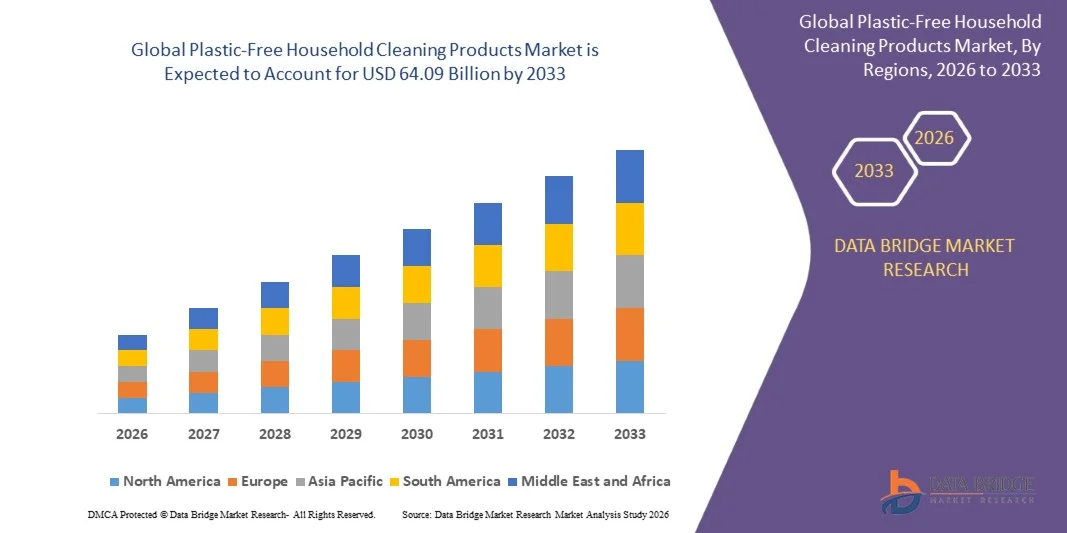
- As per Data Bridge Market Research analysis the plastic-free household cleaning products market was valued at USD 29.90 billion in 2025 and is projected to reach USD 64.09 billion by 2033, growing at a CAGR of 10.00% from 2026 to 2033.
- The market is experiencing exceptional growth driven by escalating regulatory pressure on single-use plastics, increasing consumer preference for sustainable household products, and the rapid expansion of eco-conscious retail and e-commerce channels. Manufacturers are accelerating the shift toward refill systems, paper-based packaging, concentrated formulations, and compostable materials to reduce plastic footprint while maintaining cleaning performance. The "Green Pragmatism" trend, as identified by Research and Markets, highlights that consumers prioritize products that align with their time and budget constraints while also embedding sustainability through refill systems and reduced-plastic packaging. Direct-to-consumer subscription models have further lowered switching costs, enabling innovative brands to capture market share from legacy cleaning product categories.
- The growing awareness of the environmental impact of plastic pollution, particularly in oceans and landfills, combined with heightened concerns about chemical exposure and human health, is compelling consumers to actively seek out products packaged in eco-friendly materials. Government regulations and initiatives aimed at reducing single-use plastics are pushing companies to adopt more sustainable packaging solutions, while corporate social responsibility efforts are driving the adoption of plastic-free packaging across the household cleaning industry. The market is expected to continue growing as more consumers prioritize sustainability and environmental stewardship in their purchasing decisions.
Market Size & Forecast
- Market Value (2025): USD 29.90 Billion
- Expected Market Value (2033): USD 64.09 Billion
- Forecast CAGR (2026–2033): 10.00%
- Leading Region in 2025: North America
- Fastest Growing Region: Asia-Pacific
What are the Major Takeaways of the Plastic-Free Household Cleaning Products Market?
- North America dominated the plastic-free household cleaning products market with the largest revenue share in 2025, supported by strong consumer awareness regarding plastic pollution, well-established sustainability initiatives, and increasing demand for eco-friendly home care products.
- The Asia-Pacific plastic-free household cleaning products market is expected to witness the fastest growth rate from 2026 to 2033, supported by rapid urbanization, increasing environmental awareness, and rising disposable incomes across countries such as China, Japan, South Korea, and India.
- The liquid detergents segment dominated the market in 2025, owing to their widespread consumer acceptance, superior cleaning performance, compatibility with refill and reusable packaging systems, and availability across multiple household cleaning applications.
- The tablet/solid concentrates segment is projected to register the fastest CAGR from 2026 to 2033, driven by increasing consumer preference for low-waste products, reduced transportation emissions, and convenient storage.
- The plant-based surfactants segment accounted for the largest market share in 2025 due to their effective cleaning properties, renewable sourcing, biodegradability, and increasing consumer demand for environmentally friendly alternatives to petroleum-derived chemicals.
- The enzyme-based formulations segment is anticipated to witness the fastest CAGR from 2026 to 2033, driven by rising demand for highly effective cleaning at lower temperatures, improved stain-removal performance, and reduced chemical usage.
Report Scope and Plastic-Free Household Cleaning Products Market Segmentation
|
Attributes |
Plastic-Free Household Cleaning Products Key Market Insights |
|
Segments Covered |
|
|
Countries Covered |
North America
Europe
Asia-Pacific
Middle East and Africa
South America
|
|
Key Market Players |
|
|
Market Opportunities |
|
|
Value Added Data Infosets |
In addition to the insights on market scenarios such as market value, growth rate, segmentation, geographical coverage, and major players, the market reports curated by the Data Bridge Market Research also include in-depth expert analysis, pricing analysis, brand share analysis, consumer survey, demography analysis, supply chain analysis, value chain analysis, raw material/consumables overview, vendor selection criteria, PESTLE Analysis, Porter Analysis, and regulatory framework. |
What is the Key Trend in the Plastic-Free Household Cleaning Products Market?
- The household cleaning industry is increasingly moving toward refillable, concentrated, dissolvable, and waterless product formats that reduce reliance on conventional plastic bottles while maintaining convenience and cleaning performance.
- For instance, in October 2024, Blueland expanded its presence in Target stores, increasing consumer access to plastic-free cleaning products and reusable packaging formats through mainstream retail channels.
- Manufacturers are also adopting paper-based packaging, aluminum containers, reusable bottles, and tablet-based formulations to minimize packaging waste and reduce the environmental impact associated with transporting water-heavy cleaning products.
- The increasing availability of refill and concentrated formats through both online and offline retail channels is making plastic-free alternatives more accessible, positioning low-waste packaging and waterless formulations as key trends in the household cleaning industry.
What are the Key Drivers of the Plastic-Free Household Cleaning Products Market?
- Growing consumer awareness of plastic pollution and increasing preference for sustainable, plant-based, and non-toxic household products are driving demand for plastic-free cleaning solutions.
- For instance, in June 2024, Unilever launched its Cif Infinite Clean concentrated refill system in the U.K., allowing consumers to reuse a trigger spray bottle while adding concentrated cleaning solution. The format is designed to reduce the amount of plastic used in packaging compared with conventional cleaning bottles.
- Manufacturers are increasingly developing concentrated formulations, dissolvable tablets, and refill systems that reduce packaging requirements and transportation weight while offering convenient alternatives to conventional liquid cleaning products.
- For instance, in January 2025, P&G expanded its Dawn Powerwash refill system, enabling consumers to reuse the spray bottle and purchase concentrated refills, supporting reduced packaging consumption and more efficient product transportation.
- The growing availability of refill formats, increasing sustainability initiatives by major consumer goods companies, and rising consumer preference for low-waste products are expected to support the long-term growth of the plastic-free household cleaning products market.
Which Factors are Challenging the Growth of the Plastic-Free Household Cleaning Products Market?
- Higher costs associated with alternative packaging materials, concentrated formulations, and refill systems can result in premium prices compared with conventional plastic-packaged cleaning products, limiting adoption among price-sensitive consumers.
- The limited availability of suitable refill stations, collection systems, and recycling infrastructure also creates operational challenges for companies seeking to scale plastic-free and circular packaging models.
- For instance, in February 2025, the Ellen MacArthur Foundation highlighted that businesses face challenges in scaling reusable packaging systems because of the need for investment in collection, washing, reverse logistics, and supporting infrastructure, demonstrating the operational complexity associated with replacing single-use packaging.
- In addition, differences in consumer behavior, limited awareness of refill systems, and the convenience offered by conventional packaged cleaning products can slow the transition toward plastic-free alternatives.
- The combination of higher product costs, infrastructure requirements, and consumer adoption barriers continues to challenge the widespread penetration of plastic-free household cleaning products, particularly in emerging and price-sensitive markets.
How is the Plastic-Free Household Cleaning Products Market Segmented?
- By Product Form
On the basis of product form, the plastic-free household cleaning products market is segmented into liquid detergents, powder detergents, tablet/solid concentrates, and sheets & strips. The liquid detergents segment dominated the market in 2025, owing to their widespread consumer acceptance, superior cleaning performance, compatibility with refill and reusable packaging systems, and availability across multiple household cleaning applications. Manufacturers are increasingly introducing refillable liquid formulations in aluminum bottles, glass containers, and compostable refill pouches, further strengthening the segment's leadership.
The tablet/solid concentrates segment is projected to register the fastest CAGR from 2026 to 2033, driven by increasing consumer preference for low-waste products, reduced transportation emissions, and convenient storage. The growing adoption of water-activated concentrates, coupled with innovations in dissolvable formulations and plastic-free packaging, is accelerating market growth.
- By Ingredient Type
On the basis of ingredient type, the plastic-free household cleaning products market is segmented into plant-based surfactants, enzyme-based formulations, biodegradable formulations, and non-toxic/natural ingredients. The plant-based surfactants segment accounted for the largest market share in 2025 due to their effective cleaning properties, renewable sourcing, biodegradability, and increasing consumer demand for environmentally friendly alternatives to petroleum-derived chemicals. Their broad application across laundry, dishwashing, and surface cleaning products further supports market dominance.
The enzyme-based formulations segment is anticipated to witness the fastest CAGR from 2026 to 2033, driven by rising demand for highly effective cleaning at lower temperatures, improved stain-removal performance, and reduced chemical usage. Continuous advancements in biotechnology and sustainable formulation development are further supporting rapid segment expansion.
- By End-Use
On the basis of end-use, the plastic-free household cleaning products market is segmented into residential and commercial (hospitality, healthcare, and institutional laundries). The residential segment dominated the market in 2025, supported by increasing consumer awareness regarding plastic pollution, growing adoption of sustainable household products, and rising preference for non-toxic cleaning solutions. The availability of eco-friendly products through supermarkets and online retail channels has further accelerated residential adoption.
The commercial segment is expected to register the fastest CAGR from 2026 to 2033, driven by sustainability commitments across hotels, healthcare facilities, educational institutions, and corporate organizations. Increasing regulatory pressure to reduce single-use plastics and growing implementation of green procurement policies are encouraging commercial users to adopt plastic-free cleaning products.
- By Distribution Channel
On the basis of distribution channel, the plastic-free household cleaning products market is segmented into offline (retail & supermarkets, specialty stores), online retail, and direct-to-consumer/subscription. The offline (retail & supermarkets) segment held the largest market share in 2025, owing to strong consumer preference for in-store product evaluation, extensive retail availability, and the growing presence of sustainable product sections in supermarkets and hypermarkets.
The direct-to-consumer/subscription segment is projected to witness the fastest CAGR from 2026 to 2033, driven by increasing demand for refill-based purchasing models, personalized product offerings, and recurring delivery services. Digital-first sustainable brands and growing consumer preference for convenient eco-friendly shopping experiences continue to fuel segment growth.
- By Product Category
On the basis of product category, the plastic-free household cleaning products market is segmented into laundry detergents, dish soaps, all-purpose cleaners, and specialty cleaners. The laundry detergents segment dominated the market in 2025 due to their high household consumption, increasing availability of plastic-free packaging formats such as refill tablets and detergent sheets, and growing consumer demand for sustainable laundry solutions without compromising cleaning performance.
The specialty cleaners segment is anticipated to record the fastest CAGR from 2026 to 2033, driven by increasing demand for environmentally friendly products designed for specific applications such as bathroom, glass, kitchen, and appliance cleaning. Product innovation, premium eco-friendly formulations, and expanding consumer awareness of sustainable cleaning practices are expected to accelerate growth throughout the forecast period.
Which Region Holds the Largest Share of the Plastic-Free Household Cleaning Products Market?
- North America dominated the plastic-free household cleaning products market with the largest revenue share in 2025, supported by strong consumer awareness regarding plastic pollution, well-established sustainability initiatives, and increasing demand for eco-friendly home care products.
- The region also benefits from consumers across the region are actively shifting toward refillable packaging, concentrated formulations, compostable cleaning tablets, and biodegradable ingredients. The presence of leading sustainable brands, expanding zero-waste retail channels, and supportive environmental regulations continue to strengthen the adoption of plastic-free cleaning solutions across residential and commercial applications.
U.S. Plastic-Free Household Cleaning Products Market Insight
The U.S. plastic-free household cleaning products market captured the largest revenue share in 2025 within North America, fueled by rising consumer preference for sustainable household products and increasing awareness of single-use plastic reduction. Consumers are increasingly adopting refill stations, dissolvable cleaning tablets, and fiber-based packaging as part of environmentally conscious lifestyles. The rapid expansion of e-commerce, retailer sustainability commitments, and growing availability of plant-based cleaning formulations continue to accelerate market growth across the country.
Europe Plastic-Free Household Cleaning Products Market Insight
The Europe plastic-free household cleaning products market is expected to witness the fastest growth rate from 2026 to 2033, primarily driven by stringent environmental regulations, ambitious circular economy targets, and increasing consumer demand for sustainable packaging solutions. Rising adoption of refill systems, biodegradable ingredients, and plastic-free product formats is encouraging manufacturers to innovate. Growing investments in eco-friendly household products and expanding zero-waste retail networks are further supporting market expansion across residential and institutional sectors.
U.K. Plastic-Free Household Cleaning Products Market Insight
The U.K. plastic-free household cleaning products market is expected to witness the fastest growth rate from 2026 to 2033, driven by increasing consumer awareness of plastic waste reduction and the country's strong commitment to sustainable consumption. Rising demand for refillable cleaning products, compostable packaging, and concentrated formulations is encouraging wider adoption among households. Furthermore, retailer sustainability initiatives, expanding online availability, and government policies promoting waste reduction are expected to continue stimulating market growth.
Germany Plastic-Free Household Cleaning Products Market Insight
The Germany plastic-free household cleaning products market is expected to witness the fastest growth rate from 2026 to 2033, fueled by strong environmental consciousness, robust recycling infrastructure, and growing consumer preference for eco-certified cleaning products. The country's emphasis on sustainable manufacturing and circular packaging solutions supports increasing adoption of plastic-free household cleaners. In addition, rising demand for refill systems, natural ingredients, and premium environmentally friendly products continues to strengthen market expansion across residential and commercial applications.
Asia-Pacific Plastic-Free Household Cleaning Products Market Insight
The Asia-Pacific plastic-free household cleaning products market is expected to witness the fastest growth rate from 2026 to 2033, supported by rapid urbanization, increasing environmental awareness, and rising disposable incomes across countries such as China, Japan, South Korea, and India. Government initiatives addressing plastic waste, coupled with the growing popularity of sustainable lifestyles, are accelerating demand for plastic-free cleaning products. Moreover, expanding local manufacturing capabilities and improving retail accessibility are making eco-friendly household cleaning solutions available to a broader consumer base.
Japan Plastic-Free Household Cleaning Products Market Insight
The Japan plastic-free household cleaning products market is expected to witness the fastest growth rate from 2026 to 2033 due to increasing consumer preference for high-quality sustainable products, strong waste management practices, and growing environmental awareness. Japanese consumers are increasingly adopting refill pouches, concentrated cleaners, and biodegradable formulations that reduce packaging waste. Additionally, innovation in compact product designs and the country's focus on resource efficiency are expected to drive continued market growth.
China Plastic-Free Household Cleaning Products Market Insight
The China plastic-free household cleaning products market accounted for the largest market revenue share in Asia Pacific in 2025, attributed to rapid urbanization, expanding middle-class income, and increasing government efforts to reduce plastic waste. The growing popularity of sustainable consumer goods, combined with the expansion of domestic eco-friendly brands and e-commerce platforms, is driving demand for plastic-free household cleaners. Furthermore, investments in biodegradable materials, refill packaging systems, and green manufacturing practices are significantly contributing to market growth across the country.
Which are the Top Companies in Plastic-Free Household Cleaning Products Market?
The plastic-free household cleaning products industry is primarily led by well-established companies, including:
- Meliora Cleaning Products (U.S.)
- Blueland (U.S.)
- Tru Earth Environmental Products Inc. (Canada)
- Seventh Generation, Inc. (U.S.)
- Ecover Ltd. (Belgium)
- Bio-D Company Ltd. (U.K.)
- Miniml Ltd. (U.K.)
- OceanSaver Ltd. (U.K.)
- Splosh Ltd. (U.K.)
- Clean Cult, Inc. (U.S.)
- Ethique Limited (New Zealand)
- MACK GmbH (Frosch) (Germany)
- Bower Collective Ltd. (U.K.)
- Nellie's Clean Inc. (Canada)
- Everdrop GmbH (Germany)
What are Latest Developments in Plastic-Free Household Cleaning Products Market?
In August 2024, Hindustan Unilever Limited (HUL), together with Unilever, USAID, and EY, launched the Circle Alliance to accelerate packaging circularity across India, Indonesia, Vietnam, and the Philippines. The initiative highlights that scaling reusable and recyclable packaging requires significant investment in collection systems, recycling infrastructure, and circular supply chains, underscoring the financial and operational challenges associated with reducing plastic waste.

- Interactive Data Analysis Dashboard
- Company Analysis Dashboard for high growth potential opportunities
- Research Analyst Access for customization & queries
- Competitor Analysis with Interactive dashboard
- Latest News, Updates & Trend analysis
- Harness the Power of Benchmark Analysis for Comprehensive Competitor Tracking
Data collection and base year analysis are done using data collection modules with large sample sizes. The stage includes obtaining market information or related data through various sources and strategies. It includes examining and planning all the data acquired from the past in advance. It likewise envelops the examination of information inconsistencies seen across different information sources. The market data is analysed and estimated using market statistical and coherent models. Also, market share analysis and key trend analysis are the major success factors in the market report. To know more, please request an analyst call or drop down your inquiry.
The key research methodology used by DBMR research team is data triangulation which involves data mining, analysis of the impact of data variables on the market and primary (industry expert) validation. Data models include Vendor Positioning Grid, Market Time Line Analysis, Market Overview and Guide, Company Positioning Grid, Patent Analysis, Pricing Analysis, Company Market Share Analysis, Standards of Measurement, Global versus Regional and Vendor Share Analysis. To know more about the research methodology, drop in an inquiry to speak to our industry experts.
Data Bridge Market Research is a leader in advanced formative research. We take pride in servicing our existing and new customers with data and analysis that match and suits their goal. The report can be customized to include price trend analysis of target brands understanding the market for additional countries (ask for the list of countries), clinical trial results data, literature review, refurbished market and product base analysis. Market analysis of target competitors can be analyzed from technology-based analysis to market portfolio strategies. We can add as many competitors that you require data about in the format and data style you are looking for. Our team of analysts can also provide you data in crude raw excel files pivot tables (Fact book) or can assist you in creating presentations from the data sets available in the report.













