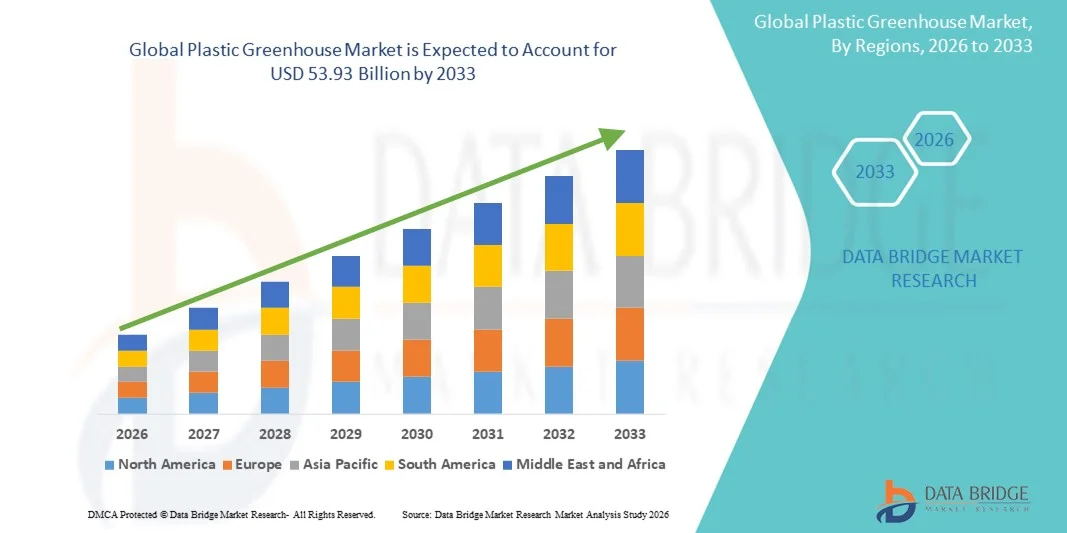
Plastic Greenhouse Market Size
- The global plastic greenhouse market size was valued at USD 23.74 billion in 2025 and is expected to reach USD 53.93 billion by 2033, at a CAGR of 10.80% during the forecast period
- The market growth is largely fuelled by the increasing demand for high-yield and off-season crop production, coupled with the need for controlled environment agriculture
- Rising adoption of advanced greenhouse technologies, including automated climate control, irrigation systems, and energy-efficient plastic films, is further supporting market expansion
Plastic Greenhouse Market Analysis
- Increasing focus on sustainable and precision agriculture is driving the adoption of plastic greenhouses across commercial and small-scale farming operations
- Technological advancements, such as UV-stabilized films, anti-drip coatings, and modular greenhouse structures, are enhancing productivity and reducing operational costs, thereby boosting market growth
- North America dominated the plastic greenhouse market with the largest revenue share of 38.52% in 2025, driven by the rising adoption of controlled environment agriculture, increasing demand for high-quality fruits and vegetables, and government support for modern farming practices
- Asia-Pacific region is expected to witness the highest growth rate in the global plastic greenhouse market, driven by rising population, increasing food demand, supportive government initiatives, and technological advancements in greenhouse cultivation
- The Cooling Systems segment accounted for the largest market revenue share in 2025, supported by the need to regulate temperature and maintain optimal growing conditions. Cooling systems help prevent heat stress in plants, reduce water consumption, and improve crop quality
Report Scope and Plastic Greenhouse Market Segmentation
|
Attributes |
Plastic Greenhouse Key Market Insights |
|
Segments Covered |
|
|
Countries Covered |
North America
Europe
Asia-Pacific
Middle East and Africa
South America
|
|
Key Market Players |
|
|
Market Opportunities |
|
|
Value Added Data Infosets |
In addition to the insights on market scenarios such as market value, growth rate, segmentation, geographical coverage, and major players, the market reports curated by the Data Bridge Market Research also include import export analysis, production capacity overview, production consumption analysis, price trend analysis, climate change scenario, supply chain analysis, value chain analysis, raw material/consumables overview, vendor selection criteria, PESTLE Analysis, Porter Analysis, and regulatory framework. |
Plastic Greenhouse Market Trends
Rise of Controlled Environment Agriculture and Smart Greenhouses
- The increasing adoption of plastic greenhouses is transforming modern agriculture by enabling controlled environment cultivation, resulting in higher crop yields, better resource utilization, and year-round production. The ability to regulate temperature, humidity, and light conditions allows farmers to optimize growth conditions and reduce losses due to pests and extreme weather. In addition, advanced sensors and automation are improving crop monitoring and precision farming, making operations more efficient and sustainable
- Growing demand for high-quality fruits, vegetables, and flowers is accelerating the adoption of advanced plastic greenhouse structures, particularly in regions with limited arable land. Farmers are increasingly relying on technology-driven solutions such as automated ventilation, irrigation, and climate control systems to enhance productivity. Integration of IoT and AI-driven monitoring is also enabling predictive maintenance and real-time adjustment of environmental conditions
- The affordability, modularity, and ease of installation of modern plastic greenhouses are encouraging wider adoption among smallholder and commercial farmers. The structures are being integrated with hydroponic, aquaponic, and vertical farming systems to maximize output per unit area. Moreover, customizable greenhouse designs allow farmers to cultivate diverse crops simultaneously, improving profitability and space utilization
- For instance, in 2023, several European and North American horticulture farms reported significant yield improvements and reduced resource consumption after implementing plastic greenhouses with automated climate control systems. Farmers noted reductions in water usage, fertilizer waste, and energy costs, demonstrating the efficiency of controlled environment agriculture. Such success stories are fostering further investment and adoption worldwide
- While plastic greenhouses are driving agricultural efficiency, their growth depends on continuous technological innovation, maintenance support, and cost-effective deployment. Manufacturers must focus on smart solutions, sustainability, and localized production to fully capitalize on this trend. Collaborative research and adoption of renewable energy solutions are also enhancing the environmental and economic benefits of greenhouse farming
Plastic Greenhouse Market Dynamics
Driver
Rising Demand for Year-Round Crop Production and Efficient Resource Utilization
- The need for consistent and high-quality crop supply is pushing farmers to adopt plastic greenhouse technology, which allows for controlled cultivation independent of seasonal variations. This ensures reliable production and improved marketability of crops. Advanced greenhouse designs also reduce vulnerability to weather-related crop failures, supporting food security initiatives
- Increased awareness of water scarcity, soil degradation, and energy efficiency is driving investments in greenhouses with automated irrigation, nutrient management, and climate control systems. These solutions reduce input costs and environmental impact while maximizing productivity. Precision agriculture technologies enable real-time adjustments, minimizing waste and improving yield quality
- Supportive government policies, subsidies, and agri-technology initiatives are further promoting the adoption of plastic greenhouses, particularly in developing countries. Farmers are incentivized to implement modern cultivation practices to ensure food security and sustainable farming. Training programs and technical assistance are also improving adoption rates and operational efficiency
- For instance, in 2022, several Asian countries, including India and China, introduced programs providing financial assistance and technical support for greenhouse adoption, boosting market penetration and technological integration. These programs helped reduce initial investment barriers and facilitated access to advanced greenhouse technologies for small and medium-scale farmers
- While demand and regulatory support are propelling growth, there is a need for reducing initial investment costs, enhancing technical knowledge, and ensuring durable materials to sustain long-term adoption. Innovations in low-cost greenhouse materials, energy-efficient systems, and modular designs are critical for expanding market reach
Restraint/Challenge
High Initial Investment and Maintenance Requirements
- The upfront cost of high-quality plastic greenhouses, including frames, films, climate control systems, and automation, limits adoption among small-scale farmers. The premium pricing remains a key barrier to widespread usage. In addition, the need for skilled labor to operate and maintain complex systems can increase operational costs
- Maintenance requirements, including replacement of films, structural repairs, and system calibration, can be challenging in remote and under-resourced areas. Lack of technical expertise and service infrastructure further restricts efficient operation. Regular upkeep is essential to ensure optimal light transmission, ventilation, and structural integrity, which directly affects crop yield and quality
- Supply chain constraints for specialized greenhouse materials and automated equipment affect timely installation and scaling of operations, particularly in developing regions. Delays in sourcing key components can disrupt planting schedules and reduce profitability. Import dependencies also make greenhouse adoption susceptible to geopolitical and logistical challenges
- For instance, in 2023, several African and South American horticulture farms faced delays in greenhouse implementation due to import restrictions and limited availability of climate control components. This led to postponed harvests, reduced crop yields, and financial losses for smallholder and commercial operators alike
- While technological advancements continue, addressing cost, maintenance, and supply chain challenges is critical. Market stakeholders must focus on affordable solutions, service networks, and scalable greenhouse designs to unlock long-term growth potential. Collaborative partnerships and local manufacturing of greenhouse components are key strategies for mitigating these challenges and ensuring sustainable expansion
Plastic Greenhouse Market Scope
The market is segmented on the basis of type, equipment type, and application.
- By Type
On the basis of type, the plastic greenhouse market is segmented into Polyethylene Plastic Greenhouse, Copolymer Plastic Greenhouse, Polyvinylchloride Plastic Greenhouse, Polycarbonate Plastic Greenhouse, and Others. The Polyethylene Plastic Greenhouse segment held the largest market revenue share in 2025, driven by its affordability, lightweight structure, and ease of installation. Polyethylene greenhouses are widely adopted for small to medium-scale farming due to their cost-effectiveness and suitability for a variety of crops.
The Polycarbonate Plastic Greenhouse segment is expected to witness the fastest growth rate from 2026 to 2033, fueled by its superior durability, UV resistance, and thermal insulation properties. Polycarbonate greenhouses are particularly favored in regions with extreme climates, as they provide enhanced protection for crops and support year-round cultivation.
- By Equipment Type
On the basis of equipment type, the market is segmented into Cooling Systems, Heating Systems, and Others. The Cooling Systems segment accounted for the largest market revenue share in 2025, supported by the need to regulate temperature and maintain optimal growing conditions. Cooling systems help prevent heat stress in plants, reduce water consumption, and improve crop quality.
The Heating Systems segment is expected to register the fastest growth from 2026 to 2033, driven by increasing adoption in colder regions and high-value crop production. Modern heating solutions ensure consistent temperature control, enabling year-round farming and reducing crop losses due to frost or low temperatures.
- By Application
On the basis of application, the market is segmented into Vegetables, Fruits, Flowers and Ornamentals, Nursery Crops, and Others. The Vegetables segment held the largest market revenue share in 2025, driven by the growing demand for high-quality and year-round vegetable supply. Plastic greenhouses provide controlled conditions that enhance yield, quality, and consistency of vegetable crops.
The Flowers and Ornamentals segment is expected to witness the fastest growth rate from 2026 to 2033, propelled by the rising demand for decorative plants, landscaping, and commercial floriculture. Controlled environment cultivation ensures vibrant colors, extended shelf life, and improved aesthetics, catering to both domestic and export markets.
Plastic Greenhouse Market Regional Analysis
- North America dominated the plastic greenhouse market with the largest revenue share of 38.52% in 2025, driven by the rising adoption of controlled environment agriculture, increasing demand for high-quality fruits and vegetables, and government support for modern farming practices
- Farmers and commercial growers in the region highly value the efficiency, year-round production capability, and resource optimization offered by plastic greenhouses, which reduce losses from extreme weather and pests
- This widespread adoption is further supported by advanced farming infrastructure, high investment capacity, and growing consumer demand for fresh and consistent produce, establishing plastic greenhouses as a preferred solution for both smallholder and commercial farms.
U.S. Plastic Greenhouse Market Insight
The U.S. plastic greenhouse market captured the largest revenue share in 2025 within North America, fueled by the expansion of horticulture, vegetable, and floriculture industries. The growing focus on smart agriculture, including automated irrigation, climate control, and hydroponics integration, is driving market growth. Moreover, increasing government subsidies, research initiatives, and sustainability programs are further promoting the adoption of modern greenhouse structures, enhancing yield efficiency and reducing operational costs.
Europe Plastic Greenhouse Market Insight
The Europe plastic greenhouse market is expected to witness the fastest growth rate from 2026 to 2033, primarily driven by technological advancements, stringent quality standards for fresh produce, and the demand for year-round crop production. The region is experiencing significant growth across vegetables, fruits, flowers, and ornamental crops, with greenhouses being incorporated into both commercial farms and urban agriculture initiatives. Consumers are increasingly favoring locally grown, high-quality products, which is fostering adoption.
U.K. Plastic Greenhouse Market Insight
The U.K. plastic greenhouse market is expected to witness the fastest growth rate from 2026 to 2033, driven by the rising emphasis on sustainable agriculture, high-value crops, and enhanced yield efficiency. In addition, increasing demand for organic vegetables and horticulture products is encouraging farmers to adopt greenhouse cultivation. The U.K.’s advanced agricultural infrastructure and well-established supply chains are expected to continue stimulating market growth.
Germany Plastic Greenhouse Market Insight
The Germany plastic greenhouse market is expected to witness the fastest growth rate from 2026 to 2033, fueled by government incentives, technological innovation, and the adoption of climate-smart agriculture. Germany’s focus on sustainable farming, energy-efficient greenhouse systems, and integration of IoT-based monitoring supports widespread adoption, particularly in commercial horticulture and floriculture. The growing preference for high-quality, locally produced crops is further driving market expansion.
Asia-Pacific Plastic Greenhouse Market Insight
The Asia-Pacific plastic greenhouse market is expected to witness the fastest growth rate from 2026 to 2033, driven by rapid urbanization, increasing disposable incomes, and the need for enhanced food security in countries such as China, India, and Japan. Government initiatives promoting modern agriculture and digital farming technologies are fostering adoption. Furthermore, APAC’s emergence as a hub for greenhouse manufacturing and low-cost materials is expanding accessibility and affordability for both commercial and smallholder farmers.
China Plastic Greenhouse Market Insight
The China plastic greenhouse market accounted for the largest market revenue share in Asia-Pacific in 2025, attributed to rapid urbanization, increasing agricultural modernization, and high domestic demand for fresh fruits, vegetables, and flowers. The country is investing heavily in smart greenhouse technologies, including climate control, automated irrigation, and integrated monitoring systems. The combination of strong manufacturing capabilities, government incentives, and a growing middle-class demand for high-quality produce is driving market expansion.
Plastic Greenhouse Market Share
The Plastic Greenhouse industry is primarily led by well-established companies, including:
- RICHEL GROUP (Canada)
- Argus Control Systems Limited (Canada)
- Certhon (Netherlands)
- LOGIQS B.V. (Netherlands)
- Agra Tech, Inc. (U.S.)
- Rough Brothers Inc. (U.S.)
- Nexus Corporation (U.S.)
- Hort Americas (U.S.)
- Heliospectra AB (Sweden)
- Top Greenhouses (Canada)
- Stuppy Greenhouse (U.S.)
- Poly-Tex, Inc. (U.S.)
- The Glasshouse Company Pty Ltd. (Australia)
- Omni Structures International (U.S.)
- Decloet Greenhouse Manufacturing Ltd. (Canada)
- Europrogress (Italy)
- Sotrafa (Spain)
- Nobutec B.V. (Netherlands)
- Ludy Greenhouse Manufacturing Corporation (U.S.)
- Apex Greenhouses (U.S.)

- Interactive Data Analysis Dashboard
- Company Analysis Dashboard for high growth potential opportunities
- Research Analyst Access for customization & queries
- Competitor Analysis with Interactive dashboard
- Latest News, Updates & Trend analysis
- Harness the Power of Benchmark Analysis for Comprehensive Competitor Tracking
Data collection and base year analysis are done using data collection modules with large sample sizes. The stage includes obtaining market information or related data through various sources and strategies. It includes examining and planning all the data acquired from the past in advance. It likewise envelops the examination of information inconsistencies seen across different information sources. The market data is analysed and estimated using market statistical and coherent models. Also, market share analysis and key trend analysis are the major success factors in the market report. To know more, please request an analyst call or drop down your inquiry.
The key research methodology used by DBMR research team is data triangulation which involves data mining, analysis of the impact of data variables on the market and primary (industry expert) validation. Data models include Vendor Positioning Grid, Market Time Line Analysis, Market Overview and Guide, Company Positioning Grid, Patent Analysis, Pricing Analysis, Company Market Share Analysis, Standards of Measurement, Global versus Regional and Vendor Share Analysis. To know more about the research methodology, drop in an inquiry to speak to our industry experts.
Data Bridge Market Research is a leader in advanced formative research. We take pride in servicing our existing and new customers with data and analysis that match and suits their goal. The report can be customized to include price trend analysis of target brands understanding the market for additional countries (ask for the list of countries), clinical trial results data, literature review, refurbished market and product base analysis. Market analysis of target competitors can be analyzed from technology-based analysis to market portfolio strategies. We can add as many competitors that you require data about in the format and data style you are looking for. Our team of analysts can also provide you data in crude raw excel files pivot tables (Fact book) or can assist you in creating presentations from the data sets available in the report.