


Plastic Optical Fiber Market Size and Growth Rate
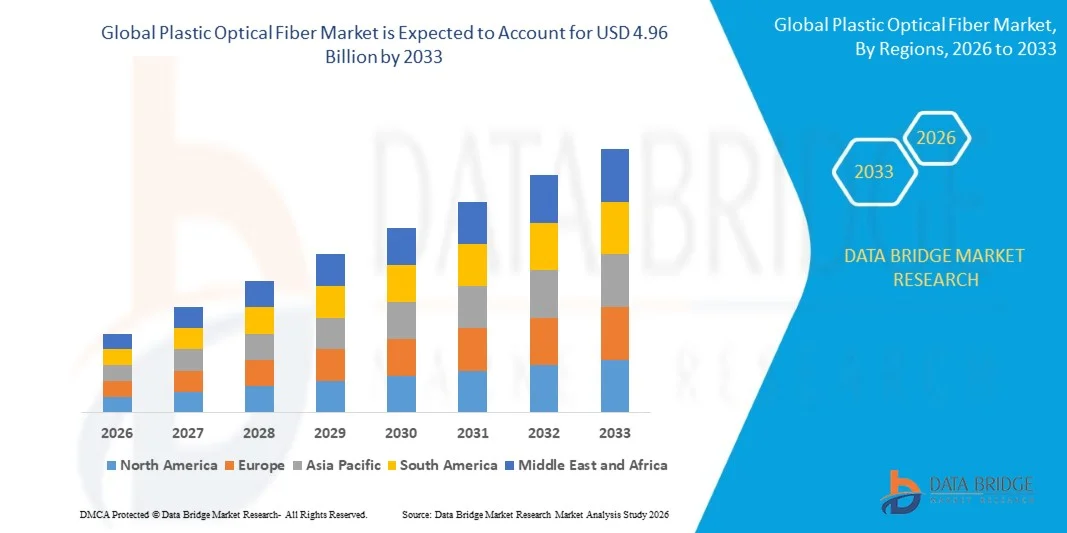
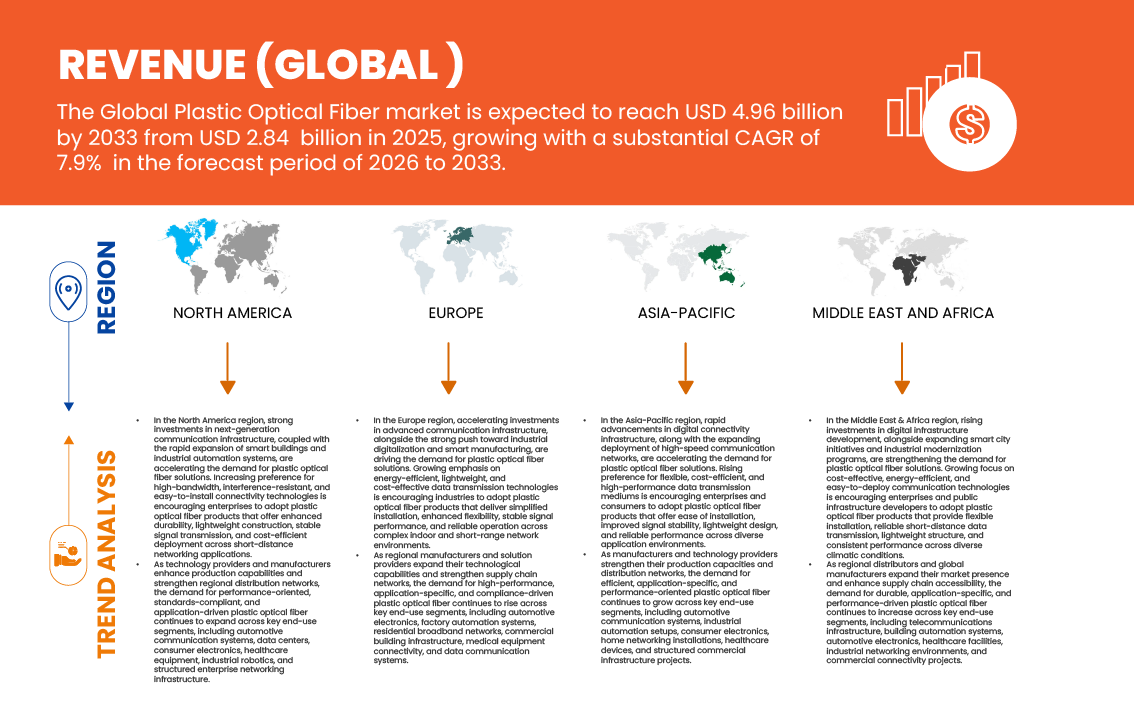
- As per Data Bridge Market Research Analysis the Global plastic optical fiber market size was valued at USD 2.84 billion in 2025 and is expected to reach USD 4.96 billion by 2033, at a CAGR of 7.9% during the forecast period of 2026 to 2033.
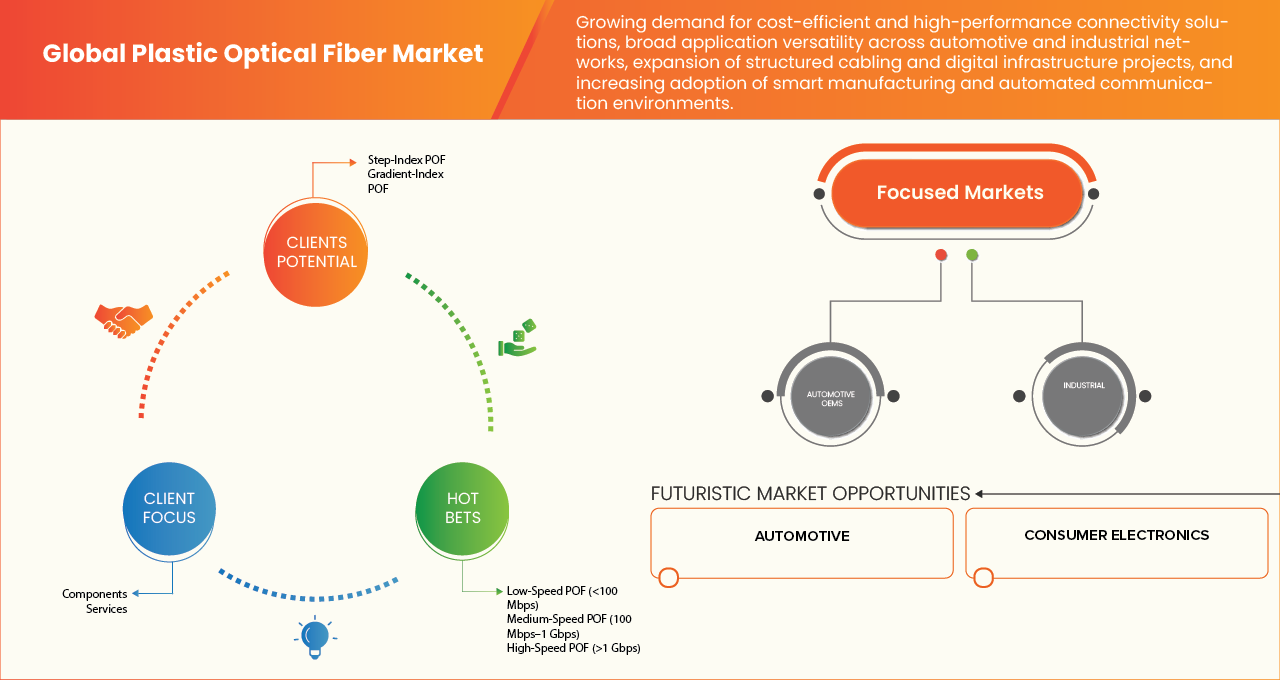
- The market growth is primarily driven by the rising demand for high-speed, cost-effective, and lightweight data transmission solutions across automotive, industrial automation, consumer electronics, and telecommunications applications. Increasing adoption of in-vehicle infotainment systems, advanced driver assistance systems (ADAS), and electric vehicle architectures is significantly boosting the need for reliable short-range optical communication networks where plastic optical fiber (POF) offers advantages in flexibility, electromagnetic interference immunity, and ease of installation. Expanding industrial automation, smart factory deployment, and Industry 4.0 integration are further accelerating investments in robust and vibration-resistant communication infrastructure. Additionally, the growing penetration of home networking, digital audio systems, and LED lighting applications is strengthening demand for large-core, easy-to-terminate fiber solutions, thereby supporting global expansion of the plastic optical fiber market.
- Increasing preference for simplified installation, cost-efficient connectivity, and integrated optical networking solutions is reinforcing the position of the global plastic optical fiber market. This shift is driven by the need for flexible cabling in space-constrained automotive and industrial environments, rising demand for high-bandwidth data transfer in consumer and commercial buildings, and the growing importance of secure, interference-free communication systems. As OEMs and system integrators prioritize lightweight materials, reduced installation complexity, and improved durability under mechanical stress, POF solutions offering plug-and-play connectivity, enhanced bending tolerance, and compatibility with optical transceivers are gaining strategic importance. Furthermore, ongoing advancements in polymer materials, improved attenuation performance, and enhanced temperature resistance are expanding application scope in aerospace, defense, and industrial robotics, thereby significantly contributing to the global growth trajectory of the plastic optical fiber market through 2033.
Market Size and Forecast:
- Market Size (2025): USD 2.84 billion
- Projected Market Size (2033): USD 4.96 billion
- CAGR (2026-2033): 7.9%
Plastic Optical Fiber Market Analysis
- Plastic Optical Fibers (POF), encompassing step-index and gradient-index fiber technologies, are becoming increasingly vital across automotive networking, industrial automation, consumer electronics, telecommunications, and illumination applications. These fibers play a critical role in enabling high-speed short-distance data transmission, secure signal integrity, and lightweight optical connectivity solutions. Their inherent advantages, including large core diameter, flexibility, vibration resistance, ease of installation, and immunity to electromagnetic interference, make them highly suitable for in-vehicle infotainment systems, factory automation networks, home broadband distribution, and digital audio systems.
- The escalating demand for Plastic Optical Fiber is primarily driven by increasing adoption in electric vehicles, advanced driver assistance systems (ADAS), smart manufacturing infrastructure, and high-bandwidth home networking solutions. Rising demand for lightweight communication materials in automotive design, expansion of Industry 4.0 deployments, and increasing need for interference-free data transmission are further accelerating market growth. Additionally, continuous advancements in polymer materials, improved attenuation performance in gradient-index fibers, and expanding applications in aerospace, robotics, and LED lighting systems are strengthening global market expansion through 2033.
- Asia-Pacific dominates the Plastic Optical Fiber market, accounting for 41.38% of the total revenue in 2025. The region’s leadership is driven by strong electronics manufacturing in China, Japan, and South Korea, expanding automotive production, rapid industrial automation in India and Southeast Asia, and high consumer electronics output. The presence of major polymer and fiber manufacturers, cost-efficient production capabilities, and rising investments in smart infrastructure further reinforce Asia-Pacific’s dominant position.
- Asia-Pacific is projected to be the fastest growing region, registering a CAGR of 8.2% during 2026–2033. Growth is supported by strong adoption in automotive electronics, aerospace systems, industrial automation, and data communication networks. Increasing investments in advanced manufacturing, robotics, and high-performance optical communication solutions are contributing to sustained demand for both step-index and gradient-index POF.
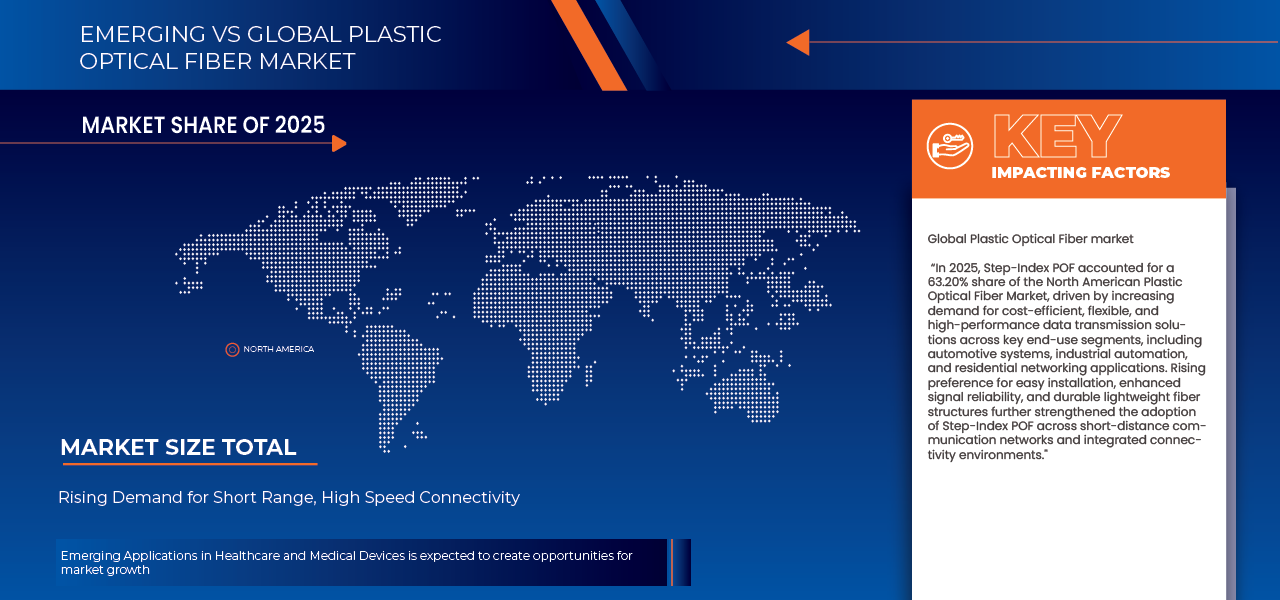
- The Step-Index POF segment continues to dominate the market, accounting for 63.20% share in 2025, owing to its cost-effectiveness, mechanical durability, and widespread adoption in short-distance data transmission, illumination systems, and consumer electronics. Although growth remains steady (CAGR 7.7%), its share gradually moderates due to increasing penetration of higher-performance gradient-index solutions.
Report Scope and Plastic Optical Fiber Market Segmentation
|
Attributes |
Plastic Optical Fiber Key Market Insights |
|
Segments Covered |
|
|
Countries Covered |
North America
Europe
Asia-Pacific
Middle East and Africa
South America
|
|
Key Market Players |
|
|
Market Opportunities |
|
|
Value Added Data Infosets |
In addition to the insights on market scenarios such as market value, growth rate, segmentation, geographical coverage, and major players, the market reports curated by the Data Bridge Market Research also include in-depth expert analysis, geographically represented company-wise production and capacity, network layouts of distributors and partners, detailed and updated price trend analysis and deficit analysis of supply chain and demand. |
Plastic Optical Fiber Market Trends
Rising Demand for High-Speed, Lightweight, and EMI-Immune Connectivity is Transforming Optical Communication Networks
- A major and fast-emerging trend in the Global Plastic Optical Fiber (POF) market is the increasing adoption of high-bandwidth optical connectivity solutions across automotive electronics, industrial automation, and smart infrastructure. As digital systems generate larger volumes of data and require faster short-distance communication, manufacturers and system integrators are increasingly deploying POF networks due to their flexibility, lightweight structure, and strong resistance to electromagnetic interference. These characteristics make POF particularly suitable for environments where traditional copper wiring faces performance limitations, thereby enabling reliable and efficient data transmission across modern digital systems.
- Leading global manufacturers—including Toray Industries, Mitsubishi Chemical Group, Asahi Kasei Corporation, and AGC Inc.—are intensifying investments in advanced polymer materials, high-performance gradient-index fibers, and improved fiber attenuation technologies. Innovations in high-bandwidth POF systems, enhanced optical transceivers, and plug-and-play connectivity solutions are enabling faster data transfer speeds and expanding the adoption of POF in automotive infotainment networks, industrial robotics, and high-performance consumer electronics systems.
- The integration of Plastic Optical Fiber within next-generation automotive communication architectures is accelerating significantly. Automotive manufacturers are increasingly utilizing POF in in-vehicle networking systems such as Media Oriented Systems Transport (MOST), Ethernet-based communication networks, and advanced infotainment platforms. As electric vehicles, advanced driver assistance systems (ADAS), and connected vehicle technologies continue to expand, demand for reliable, lightweight, and interference-free data transmission solutions is strengthening the adoption of POF-based communication systems across the automotive sector.
- Industrial automation and Industry 4.0 deployments are further accelerating POF adoption, particularly in manufacturing facilities, robotics systems, and smart factory networks. The ability of POF to withstand mechanical vibration, harsh industrial environments, and electromagnetic interference makes it a preferred solution for industrial communication networks that require consistent performance and simplified installation in complex automation infrastructures.
- Smart infrastructure development, including intelligent buildings, smart lighting systems, and home networking solutions, is increasingly incorporating plastic optical fiber technologies. POF’s large core diameter and ease of installation enable cost-efficient optical connectivity in residential broadband networks, digital audio distribution systems, and LED-based lighting applications, supporting the growing demand for high-speed data connectivity within modern smart environments.
- This global shift toward high-performance optical communication, lightweight connectivity infrastructure, and interference-resistant data transmission technologies is transforming market dynamics within the plastic optical fiber industry. As demand for high-speed digital connectivity continues to expand across automotive electronics, industrial automation, and smart infrastructure, manufacturers are accelerating investments in advanced polymer fiber technologies, scalable manufacturing capabilities, and next-generation optical networking solutions designed to support the rapidly evolving global communication ecosystem.
Plastic Optical Fiber Market Dynamics
Driver
Rising Demand for Short-Range, High Speed Connectivity
- The increasing need for high-speed data transmission in short-distance communication networks has become a major driver for the Global Plastic Optical Fiber (POF) Market, significantly influencing infrastructure development across automotive electronics, industrial automation, consumer electronics, and smart building networks.
- Unlike traditional copper wiring systems, plastic optical fibers offer advantages including lightweight structure, large core diameter, flexibility, and strong immunity to electromagnetic interference, enabling reliable high-speed connectivity in environments where electrical noise and space constraints can limit conventional cabling solutions.
- Automotive manufacturers, industrial system integrators, and electronics companies are increasingly deploying POF-based communication systems to support advanced infotainment networks, smart manufacturing platforms, robotics systems, and digital audio distribution technologies that require stable and high-bandwidth connectivity.
- This convergence of growing digital connectivity demand, rapid adoption of Industry 4.0 technologies, and expansion of connected vehicle architectures is accelerating global plastic optical fiber market growth, driving investments in advanced polymer fiber technologies, high-performance optical transceivers, and scalable manufacturing capabilities.
Restraint/Challenge
Limitations in Transmission Distance and Bandwidth
- The relatively limited transmission distance and bandwidth capacity of plastic optical fiber compared to traditional glass optical fiber represents a significant challenge for the growth of the Global Plastic Optical Fiber Market, particularly in long-distance telecommunications and high-capacity data networking applications.
- Plastic optical fibers are primarily optimized for short-range communication systems due to higher signal attenuation and bandwidth limitations, which restrict their suitability for large-scale backbone networks and long-distance data transmission infrastructure.
- In high-performance telecommunications environments, glass optical fiber technologies often remain the preferred solution because of their superior transmission distance, higher bandwidth capacity, and lower signal loss, limiting the broader deployment of POF in certain advanced networking applications.
- Although ongoing advancements in gradient-index fiber technologies and polymer materials are improving data transmission performance, these technical limitations continue to constrain adoption in large-scale communication infrastructure, thereby influencing market growth and application expansion across the global plastic optical fiber industry.

Plastic Optical Fiber Market Scope
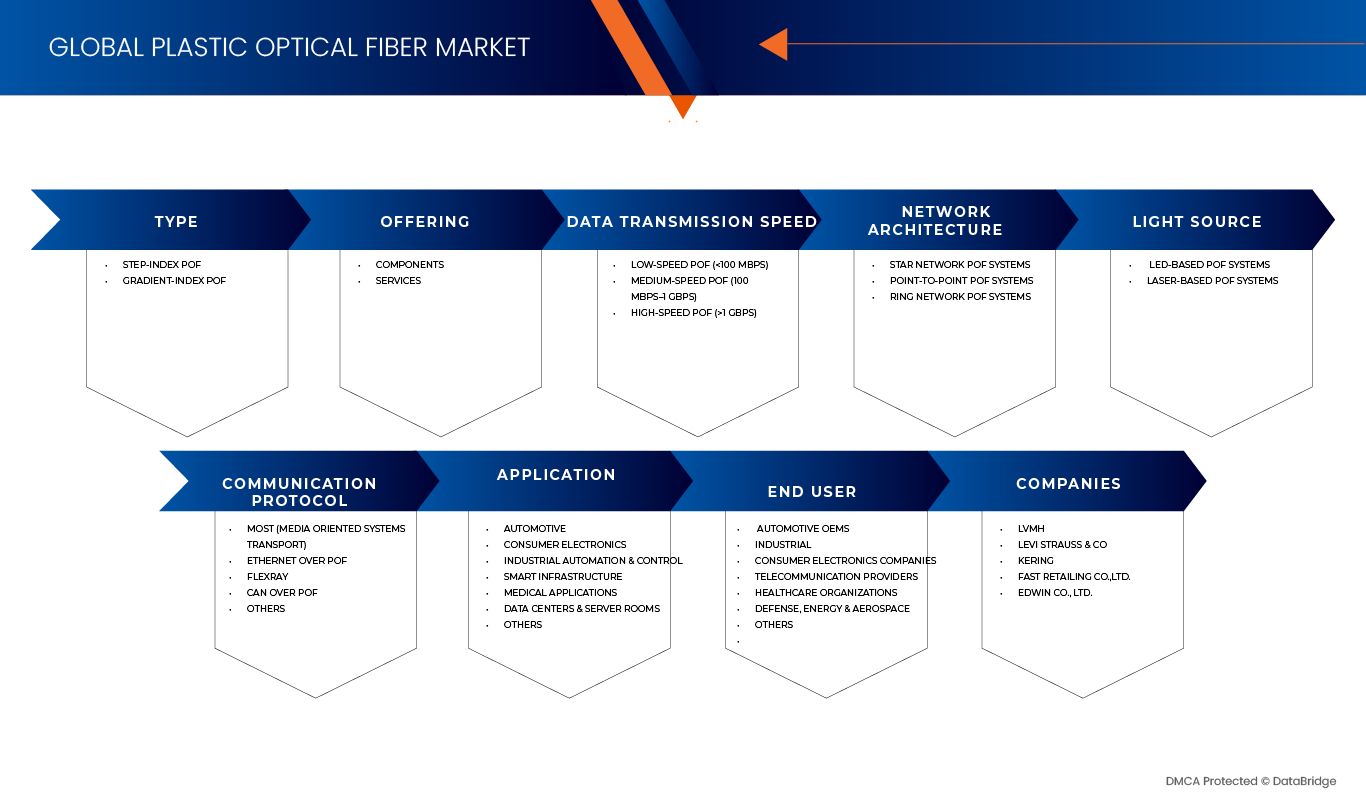
The plastic optical fiber market is segmented into eight notable segments based on the service type, class type, offering, data transmission speed, network architecture, light source, communication protocol, application, and end-use industry.
• By Type
On the basis of type, the global Plastic Optical Fiber market is segmented into Step-Index POF and Gradient-Index POF. In 2026, the Step-Index POF segment is expected to dominate with 63.07% market share due to its cost efficiency, mechanical durability, and widespread use in short-distance data transmission applications. Step-index fibers are extensively deployed in automotive infotainment networks, consumer electronics, illumination systems, and industrial communication networks where moderate bandwidth and reliable performance are required. Their simple manufacturing process and lower installation costs also make them attractive for large-scale deployments. Meanwhile, Gradient-Index POF is projected to witness faster growth due to its superior bandwidth capability and improved signal transmission performance.
The Gradient-Index POF segment is anticipated to witness the fastest CAGR of 8.3% from 2026 to 2033, fueled by its cost-effectiveness, simple manufacturing process, and strong suitability for short-distance data transmission applications. Step-index POF offers easy installation, high flexibility, and resistance to electromagnetic interference, making it highly preferred in automotive electronics, industrial automation, consumer electronics, and home networking systems. Increasing adoption of in-vehicle infotainment and lighting networks, along with the expansion of smart factories and Industry 4.0 infrastructure across the APAC region, is further accelerating demand. Additionally, growing preference for lightweight and energy-efficient communication solutions, combined with continuous improvements in polymer materials and transmission performance, is supporting wider deployment of step-index POF across commercial and industrial connectivity applications.
• By Offering
On the basis of offering, the global Plastic Optical Fiber market is segmented into components and services. In 2026, the components segment is expected to dominate with 83.49% market share owing to strong demand for optical fibers, connectors, transmitters, receivers, and integrated optical modules used across automotive electronics, industrial automation systems, and smart infrastructure networks. Increasing deployment of optical communication hardware in vehicles, robotics systems, and home networking equipment is significantly driving demand for POF components. Additionally, the rapid expansion of connected devices and smart electronics further strengthens the dominance of the components segment.
The Components segment is anticipated to witness the fastest CAGR of 8.0% from 2026 to 2033, fueled by increasing demand for essential Plastic Optical Fiber (POF) hardware such as connectors, transmitters, receivers, cables, and coupling devices required for reliable optical communication systems. Growing deployment of POF across automotive electronics, industrial automation, consumer devices, and smart building infrastructure is driving the need for high-performance and easily integrable components. Additionally, advancements in compact optical modules, improved signal transmission efficiency, and rising adoption of plug-and-play connectivity solutions are supporting segment growth. The expansion of connected devices, Industry 4.0 adoption, and increasing investments in cost-effective short-range communication networks across the APAC region are further accelerating demand for POF components.
• By Data Transmission Speed
On the basis of data transmission speed, the global Plastic Optical Fiber market is segmented into Low-Speed POF (<100 Mbps), Medium-Speed POF (100 Mbps–1 Gbps), and High-Speed POF (>1 Gbps). In 2026, the Low-Speed POF segment is expected to dominate with 45.79% market share due to its extensive use in consumer electronics, automotive infotainment systems, digital audio networks, and lighting applications. These applications typically require reliable short-range communication rather than extremely high bandwidth, making low-speed POF solutions more cost-effective and widely adopted. The growing demand for home networking and in-vehicle multimedia systems further supports the segment’s dominance.
The High-Speed POF (>1 Gbps) segment is anticipated to witness the fastest CAGR of 8.3% from 2026 to 2033, fueled by increasing demand for cost-effective and reliable short-distance communication solutions in automotive electronics, home networking, industrial control systems, and consumer devices. Low-speed POF is widely adopted for applications such as infotainment connectivity, LED lighting systems, sensors, and automation networks where moderate data transmission speeds are sufficient but durability and ease of installation are critical. Its immunity to electromagnetic interference, lightweight structure, and simplified maintenance make it an attractive alternative to copper cabling in electrically noisy environments. Additionally, growing adoption of smart home devices, factory automation, and connected infrastructure across the APAC region is accelerating deployment of low-speed POF solutions for stable and energy-efficient data communication.
• By Network Architecture
On the basis of network architecture, the global Plastic Optical Fiber market is segmented into Star Network POF Systems, Point-to-Point POF Systems, and Ring Network POF Systems. In 2026, the Star Network POF Systems segment is expected to dominate with 42.47% market share due to its scalability, simplified network management, and efficient fault isolation capabilities. Star architectures allow centralized communication management and are widely used in smart building infrastructure, automotive communication systems, and industrial networks. Their ability to support multiple devices while maintaining stable connectivity contributes significantly to their widespread adoption.
The Star Network POF Systems segment is anticipated to witness the fastest CAGR of 8.2% from 2026 to 2033, fueled by increasing demand for centralized and reliable communication architectures across automotive, industrial automation, and smart building applications. Star network topology enables efficient data transmission by connecting multiple devices to a single central hub, improving network reliability, fault isolation, and ease of maintenance compared to traditional network structures. The growing adoption of connected devices, smart lighting systems, and in-vehicle infotainment networks is accelerating the use of POF-based star configurations due to their flexibility and simplified installation. Additionally, rising deployment of home automation systems and industrial IoT networks across the APAC region is supporting demand for scalable, cost-effective, and interference-resistant star network POF solutions.
• By Light Source
On the basis of light source, the global Plastic Optical Fiber market is segmented into LED-Based POF Systems and Laser-Based POF Systems. In 2026, the LED-Based POF Systems segment is expected to dominate with 64.63% market share due to their lower cost, longer operational life, and compatibility with short-distance communication systems. LED transmitters are widely used in automotive infotainment systems, home networking devices, and consumer electronics applications where moderate data rates are sufficient. Their energy efficiency and simplified system integration further support strong market demand.
The Laser-Based POF systems segment is anticipated to witness the fastest CAGR of 8.3% from 2026 to 2033, fueled by increasing adoption of cost-efficient optical communication solutions across automotive lighting, home networking, and industrial control applications. LED-based transmitters offer advantages such as lower power consumption, longer operational life, and reduced system costs compared to laser-based alternatives, making them highly suitable for short-distance data transmission using plastic optical fibers. Growing deployment of ambient vehicle lighting, infotainment connectivity, and smart building illumination systems is further supporting demand for LED-driven POF systems. Additionally, advancements in high-brightness LEDs and improved signal stability are enhancing transmission performance, encouraging wider adoption in consumer electronics and automation networks across the APAC region.
• By Communication Protocol
On the basis of communication protocol, the global Plastic Optical Fiber market is segmented into MOST (Media Oriented Systems Transport), Ethernet over POF, FlexRay, CAN over POF, and Others. In 2026, the MOST protocol segment is expected to dominate with 36.61% market share due to its extensive adoption in automotive infotainment networks and multimedia communication systems. MOST technology enables high-speed, synchronized data transmission between entertainment systems, navigation units, and other in-vehicle electronic components, making it a preferred protocol for automotive optical networking.
The Ethernet over POF segment is anticipated to witness the fastest CAGR of 8.4% from 2026 to 2033, fueled by increasing integration of advanced infotainment and multimedia networking systems in modern vehicles. MOST technology enables high-speed, synchronized data transmission for audio, video, navigation, and communication applications through Plastic Optical Fiber (POF), ensuring reliable and interference-free connectivity within automotive environments. Growing production of connected and electric vehicles across the APAC region is driving demand for robust in-vehicle networking protocols capable of handling rising data loads from digital dashboards, entertainment systems, and driver-assistance features. Additionally, automakers’ focus on lightweight wiring architectures, improved passenger experience, and seamless multimedia communication is accelerating adoption of MOST-based POF systems in next-generation automotive platforms.
• By Application
On the basis of application, the global Plastic Optical Fiber market is segmented into Automotive, Consumer Electronics, Industrial Automation & Control, Smart Infrastructure, Medical Applications, Data Centers & Server Rooms, and Others. In 2026, the Automotive segment is expected to dominate with 28.02% market share due to the increasing integration of optical communication systems in modern vehicles. Plastic optical fibers are widely used in automotive infotainment systems, advanced driver assistance systems (ADAS), and vehicle communication networks. The growing adoption of electric vehicles, connected car technologies, and in-vehicle digital entertainment systems further drives demand for POF in the automotive sector.
The Automotive segment is anticipated to witness the fastest CAGR of 8.7% from 2026 to 2033, fueled by the rapid expansion of connected, electric, and software-defined vehicles across the APAC region. Increasing integration of advanced infotainment systems, digital instrument clusters, Advanced Driver-Assistance Systems (ADAS), and in-vehicle communication networks is driving demand for reliable and high-speed data transmission solutions. Plastic Optical Fiber (POF) is gaining strong adoption in automotive applications due to its lightweight structure, flexibility, immunity to electromagnetic interference, and ease of installation compared to traditional copper wiring. Additionally, growing vehicle electrification, rising consumer demand for enhanced in-car connectivity and entertainment, and automakers’ focus on improving energy efficiency and reducing vehicle weight are accelerating the deployment of POF-based communication systems in next-generation automotive platforms.
• By End User
On the basis of end user, the global Plastic Optical Fiber market is segmented into Automotive OEMs, Industrial, Consumer Electronics Companies, Telecommunication Providers, Healthcare Organizations, Defense, Energy & Aerospace, and Others. In 2026, the Automotive OEMs segment is expected to dominate with 27.47% market share due to increasing integration of optical communication networks in vehicles for infotainment, data transfer, and advanced electronics systems. Automotive manufacturers are increasingly adopting POF solutions due to their lightweight design, electromagnetic interference resistance, and ease of installation compared with conventional copper wiring systems. The ongoing transition toward connected vehicles and intelligent mobility solutions further strengthens the segment’s leading market position.
The Industrial segment is anticipated to witness the fastest CAGR of 8.4% from 2026 to 2033, driven by the rapid expansion of industrial automation, smart manufacturing, and Industry 4.0 initiatives across global manufacturing sectors. Industrial facilities are increasingly adopting Plastic Optical Fiber (POF) solutions to enable reliable short-range data communication between machinery, robotics systems, sensors, and control units due to their flexibility, durability, and strong resistance to electromagnetic interference.
Plastic Optical Fiber Market Regional Analysis
- Asia-Pacific dominates the Global Plastic Optical Fiber Market, accounting for 41.38% of the total share in 2025 and projected to reach 42.25% by 2033. The region’s leadership is driven by large-scale electronics manufacturing, strong automotive production, and rapid industrial automation across China, Japan, South Korea, and India. Asia-Pacific benefits from the presence of major polymer and optical fiber manufacturers, cost-efficient manufacturing ecosystems, and growing demand for high-speed data transmission in consumer electronics and automotive systems. Increasing investments in smart factories, electric vehicles, and high-performance communication infrastructure further strengthen the region’s position as the largest contributor to global plastic optical fiber demand.
- North America is the second-largest market, registering a CAGR of 8.0% during 2026–2033. Growth is supported by increasing adoption of optical communication technologies in automotive electronics, aerospace systems, and industrial automation networks. The region benefits from strong technological innovation, high adoption of Industry 4.0 solutions, and the presence of advanced electronics manufacturers. Rising investments in robotics, smart manufacturing infrastructure, and high-speed connectivity systems are further supporting regional market expansion.
North America Plastic Optical Fiber Market Insight
North America is projected to grow steadily during the forecast period, supported by the increasing integration of plastic optical fibers in automotive electronics, industrial automation systems, and smart infrastructure networks. The region is witnessing rising adoption of high-speed data communication solutions in connected vehicles, robotics systems, and advanced manufacturing environments. Additionally, strong research and development capabilities and the presence of leading technology companies are accelerating innovation in optical communication technologies, strengthening market growth across North America.
U.S. Plastic Optical Fiber Market Insight
The United States dominates the North American Plastic Optical Fiber Market and is projected to expand at a CAGR of 8.0% from 2026 to 2033. Market growth is driven by increasing deployment of plastic optical fiber solutions in automotive infotainment systems, advanced driver assistance technologies, and high-performance industrial automation networks. The country’s strong electronics manufacturing base, advanced research ecosystem, and rapid adoption of smart manufacturing technologies continue to strengthen its position as the primary revenue contributor in the regional market.
Canada Plastic Optical Fiber Market Insight
Canada is projected to grow at a CAGR of 7.7% from 2026 to 2033 within the North American Plastic Optical Fiber Market. Growth is supported by expanding industrial automation initiatives, increasing investments in smart infrastructure projects, and rising adoption of high-speed optical communication technologies across manufacturing and telecommunications sectors. Growing demand for reliable, interference-resistant communication networks in industrial facilities and commercial infrastructure further supports market expansion across Canada.
Europe Plastic Optical Fiber Market Insight
Europe is projected to grow at a CAGR of 7.7% during the forecast period. Regional growth is supported by strong automotive manufacturing in Germany, France, Italy, and Spain, along with increasing adoption of advanced optical communication technologies in industrial automation and smart infrastructure systems. The region’s focus on connected vehicles, electric mobility, and Industry 4.0 manufacturing solutions is significantly contributing to the growing deployment of plastic optical fiber networks across Europe.
Germany Plastic Optical Fiber Market Insight
Germany is projected to grow at a CAGR of 8.0% from 2026 to 2033. Market growth is driven by the country’s strong automotive manufacturing base, advanced industrial automation infrastructure, and increasing integration of optical communication technologies in vehicle electronics systems. Germany’s leadership in precision manufacturing, robotics development, and smart factory deployment continues to drive demand for reliable and high-performance communication networks, supporting increased adoption of plastic optical fiber solutions.
United Kingdom Plastic Optical Fiber Market Insight
The United Kingdom is projected to grow at a CAGR of 7.9% from 2026 to 2033. Growth is driven by increasing investments in digital infrastructure, expanding adoption of smart manufacturing technologies, and rising demand for advanced electronic communication systems. The growing deployment of automation technologies and connected infrastructure across industrial and commercial sectors is further contributing to steady market expansion in the United Kingdom.
Asia-Pacific Plastic Optical Fiber Market Insight
Asia-Pacific is projected to grow at a CAGR of 8.2%, driven by expanding electronics production, rising automotive manufacturing, and rapid industrial automation across emerging economies. Countries such as China, Japan, India, and South Korea are heavily investing in smart manufacturing technologies, electric vehicle production, and high-speed communication networks. The region’s strong semiconductor and consumer electronics manufacturing base further accelerates the adoption of plastic optical fiber communication systems.
China Plastic Optical Fiber Market Insight
China is projected to grow at a CAGR of 8.2% during the forecast period. Growth is supported by large-scale consumer electronics manufacturing, expanding automotive production, and increasing deployment of smart factory infrastructure. Government initiatives aimed at strengthening domestic technology manufacturing and increasing investments in advanced communication technologies are significantly driving demand for plastic optical fiber solutions across industrial and electronics sectors.
India Plastic Optical Fiber Market Insight
India is projected to grow highest at a CAGR of 9.1% during the forecast period. Market growth is driven by the country’s advanced automotive electronics industry, strong robotics and automation sector, and continuous technological innovation in high-performance communication systems. Japan’s emphasis on precision manufacturing and next-generation mobility solutions continues to strengthen demand for plastic optical fiber networks across automotive, industrial automation, and consumer electronics applications.
Plastic Optical Fiber Players
The Plastic Optical Fiber industry is primarily led by well-established companies, including:
- Zdea Group Co., Ltd. (China)
- Asahi Kasei Corporation (Japan)
- Mitsubishi Chemical Group Corporation. (Japan)
- TORAY INDUSTRIES, INC. (Japan)
- Industrial Fiber Optics (U.S.)
- COMOSS (Tokyo)
- AGC Inc. (Japan)
- FIBERFIN (U.S.)
- Jiangsu TX Plastic Optic fibers Co., Ltd. (China)
- Firecomms Ltd. (Ireland)
- Daishing POF Co.,Ltd (China)
- Nanoptics, Inc. (U.S.)
- Fiberoptics Technology Incorporated (U.S.)
- XiOptics LLC (U.S.)
- hyoc.com.cn (Sichuan Huiyuan Optical Plastic Optical Fiber Co. Ltd.) (China)
Latest Developments in Global Plastic Optical Fiber market
- In October 2025, Asahi Kasei has received official approval to establish new facilities at its Kawasaki Works for the production of electrolysis system components, covering both alkaline water electrolysis and chlor-alkali electrolysis. The company anticipates strong demand for alkaline water electrolysis systems as clean hydrogen production expands globally. This signals potential indirect benefits, as the company’s strengthened material expertise and production capabilities may facilitate innovations in polymer-based optical fibers, support advanced manufacturing processes, and enable the development of high-performance POF products for industrial, sensor, and data communication applications.
- In march, OFC 2025 (Optical Fiber Communication Conference) in San Francisco, AGC Inc. showcased its latest optical communications technologies, including polymer optical waveguides, glass optical waveguides, micro lens arrays, and other advanced optical materials. The demonstration highlighted AGC’s focus on high-performance optical components for data transmission, imaging, and sensing applications, reflecting its commitment to innovation in the optical communications industry. This news is directly related to plastic optical fiber, as polymer optical waveguides are a type of plastic optical fiber used for short-distance data transmission, industrial sensors, automotive networks, and consumer electronics.
- In June 2025, Firecomms Ltd. announced a strategic regional distribution partnership with Tecnomic Components to expand demand creation and strengthen customer support for its optical transceivers and fiber optic solutions across South East Asia and India, enhancing its regional market presence and service capabilities.
- In 2025, COMOSS expanding its representation of Firecomms POF products directly impacts the market by increasing the availability and reach of POF solutions in key Asian markets—Japan and South Korea. This expansion helps accelerate adoption of plastic optical fiber technology in industrial, automotive, and communication applications. By distributing Firecomms’ POF transceivers, connectors, and networking solutions, COMOSS strengthens supply chains, supports market growth, and enhances competition, which can drive innovation, price competitiveness, and broader deployment of POF systems in the region.
- In March, Jiangxi Daishing POF Co., Ltd. announced that its Innovative Plastic Optical Fiber 3.0 technology will be globally introduced, achieving dual breakthroughs in high-speed transmission and intelligent packaging, marking a new era in the field of optical fiber communication technology.

- Interactive Data Analysis Dashboard
- Company Analysis Dashboard for high growth potential opportunities
- Research Analyst Access for customization & queries
- Competitor Analysis with Interactive dashboard
- Latest News, Updates & Trend analysis
- Harness the Power of Benchmark Analysis for Comprehensive Competitor Tracking
Global Plastic Optical Fiber Market, Supply Chain Analysis and Ecosystem Framework
To support market growth and help clients navigate the impact of geopolitical shifts, DBMR has integrated in-depth supply chain analysis into its Global Plastic Optical Fiber Market research reports. This addition empowers clients to respond effectively to global changes affecting their industries. The supply chain analysis section includes detailed insights such as Global Plastic Optical Fiber Market consumption and production by country, price trend analysis, the impact of tariffs and geopolitical developments, and import and export trends by country and HSN code. It also highlights major suppliers with data on production capacity and company profiles, as well as key importers and exporters. In addition to research, DBMR offers specialized supply chain consulting services backed by over a decade of experience, providing solutions like supplier discovery, supplier risk assessment, price trend analysis, impact evaluation of inflation and trade route changes, and comprehensive market trend analysis.
Data collection and base year analysis are done using data collection modules with large sample sizes. The stage includes obtaining market information or related data through various sources and strategies. It includes examining and planning all the data acquired from the past in advance. It likewise envelops the examination of information inconsistencies seen across different information sources. The market data is analysed and estimated using market statistical and coherent models. Also, market share analysis and key trend analysis are the major success factors in the market report. To know more, please request an analyst call or drop down your inquiry.
The key research methodology used by DBMR research team is data triangulation which involves data mining, analysis of the impact of data variables on the market and primary (industry expert) validation. Data models include Vendor Positioning Grid, Market Time Line Analysis, Market Overview and Guide, Company Positioning Grid, Patent Analysis, Pricing Analysis, Company Market Share Analysis, Standards of Measurement, Global versus Regional and Vendor Share Analysis. To know more about the research methodology, drop in an inquiry to speak to our industry experts.
Data Bridge Market Research is a leader in advanced formative research. We take pride in servicing our existing and new customers with data and analysis that match and suits their goal. The report can be customized to include price trend analysis of target brands understanding the market for additional countries (ask for the list of countries), clinical trial results data, literature review, refurbished market and product base analysis. Market analysis of target competitors can be analyzed from technology-based analysis to market portfolio strategies. We can add as many competitors that you require data about in the format and data style you are looking for. Our team of analysts can also provide you data in crude raw excel files pivot tables (Fact book) or can assist you in creating presentations from the data sets available in the report.













