


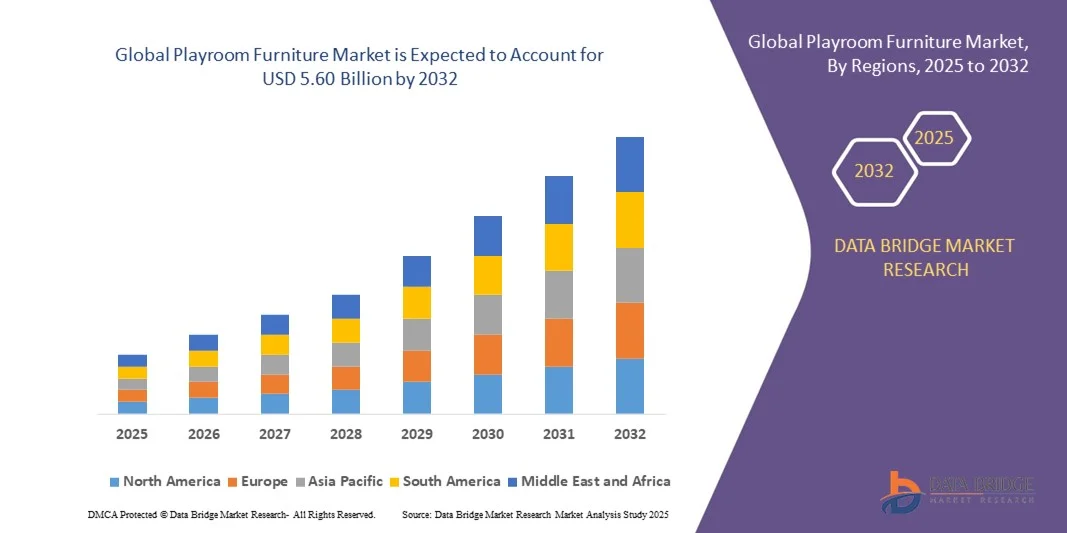
Playroom Furniture Market Size
- The global playroom furniture market size was valued at USD 3.73 billion in 2024 and is expected to reach USD 5.60 billion by 2032, at a CAGR of 5.20% during the forecast period
- The market growth is largely fuelled by the increasing demand for multifunctional, safe, and ergonomic furniture designed for children’s play and learning environments
- Rising parental focus on creating interactive and creative spaces for children, coupled with the growing influence of early childhood education, is further driving the market expansion
Playroom Furniture Market Analysis
- The global playroom furniture market is witnessing steady growth, supported by the rising number of childcare centers, preschools, and play-based learning environments emphasizing comfort, safety, and engagement
- Manufacturers are increasingly focusing on producing eco-friendly, modular, and customizable furniture made from sustainable materials to meet the growing consumer preference for environmentally responsible products
- North America dominated the playroom furniture market with the largest revenue share of 39.82% in 2024, driven by increasing demand for ergonomic, safe, and sustainable furniture solutions in residential and institutional spaces
- Asia-Pacific region is expected to witness the highest growth rate in the global playroom furniture market, driven by expanding retail networks, rising awareness of ergonomic and child-safe designs, and growing demand for affordable, high-quality furniture solutions for children
Report Scope and Playroom Furniture Market Segmentation
|
Attributes |
Playroom Furniture Key Market Insights |
|
Segments Covered |
|
|
Countries Covered |
North America
Europe
Asia-Pacific
Middle East and Africa
South America
|
|
Key Market Players |
|
|
Market Opportunities |
|
|
Value Added Data Infosets |
In addition to the insights on market scenarios such as market value, growth rate, segmentation, geographical coverage, and major players, the market reports curated by the Data Bridge Market Research also include in-depth expert analysis, pricing analysis, brand share analysis, consumer survey, demography analysis, supply chain analysis, value chain analysis, raw material/consumables overview, vendor selection criteria, PESTLE Analysis, Porter Analysis, and regulatory framework. |
Playroom Furniture Market Trends
Rising Popularity Of Sustainable And Child-Safe Furniture Designs
- The growing emphasis on eco-friendly and child-safe materials is transforming the playroom furniture market, as parents increasingly prioritize products made from non-toxic, sustainable, and durable resources. Manufacturers are adopting certified wood, recycled plastics, and water-based finishes to meet rising consumer awareness regarding health and environmental impact. This shift is enhancing both the safety and sustainability profile of modern playroom furniture, with brands also emphasizing transparency in sourcing and production practices to build consumer trust
- The demand for furniture that promotes sustainability while maintaining visual appeal is driving innovation across product lines. Companies are introducing biodegradable, recyclable, and modular furniture options that align with eco-conscious lifestyles. These developments are particularly popular among millennial parents who value ethical consumption and environmental stewardship, encouraging brands to incorporate minimalist aesthetics and long-lasting materials into their product offerings
- The trend toward sustainability is also reinforced by government regulations promoting the use of eco-certified materials and low-emission manufacturing processes. Educational institutions and childcare centers are increasingly adopting furniture that meets safety and environmental standards to create healthier indoor environments for children. Moreover, subsidies and green certifications are motivating manufacturers to innovate further and achieve a competitive edge through compliance with eco-friendly policies
- For instance, in 2023, several leading European furniture brands introduced new lines of FSC-certified playroom furniture crafted from reclaimed wood and organic fabrics. These collections combine safety, durability, and aesthetics while supporting circular economy initiatives. The move also positioned these brands as leaders in sustainable design, boosting their reputation and expanding their customer base in both residential and institutional markets
- While sustainable designs are gaining traction, broader adoption depends on balancing affordability and material availability. Continuous innovation in eco-material technology and large-scale manufacturing will be essential to maintain cost efficiency and accessibility for a wider consumer base. The development of hybrid materials and digital design tools is expected to further streamline production and help scale sustainable furniture manufacturing globally
Playroom Furniture Market Dynamics
Driver
Increasing Focus On Early Childhood Development And Functional Play Spaces
- The growing awareness of early childhood development and the importance of interactive learning environments are major factors driving demand for specialized playroom furniture. Parents and educators are investing in ergonomic and multi-functional furniture that fosters creativity, motor skills, and social interaction among children. The market is increasingly witnessing the integration of educational features such as color recognition, sensory play, and STEM-based elements into modern designs
- Furniture designed for educational playrooms, such as activity tables, sensory stations, and modular seating, is gaining popularity for its ability to enhance both learning and comfort. This trend is particularly strong in preschools and daycare centers that emphasize experiential learning through structured play areas. The demand is also supported by government funding for early education infrastructure upgrades and classroom modernization programs across several developed economies
- The rise in disposable incomes and the increasing number of dual-income households are further boosting spending on premium and customized playroom furniture. Parents are seeking aesthetically pleasing yet functional designs that maximize space and support various stages of child growth. As a result, modular and convertible furniture solutions that evolve with the child’s age are becoming increasingly popular in both residential and institutional settings
- For instance, in 2023, several childcare centers across the U.S. and U.K. upgraded their classrooms with adaptive play furniture that can be rearranged to accommodate different activities, promoting flexibility and cognitive development. This growing adoption highlights the shift toward versatile furniture that encourages interactive learning, creative thinking, and collaboration among children
- Although the demand for developmental furniture is rising, manufacturers must continue to focus on design innovation, material safety, and ergonomic standards to cater to evolving consumer preferences and educational requirements. Future growth will also depend on how effectively brands integrate digital learning aids, inclusive designs, and sustainable production to appeal to modern childcare and parenting trends
Restraint/Challenge
High Cost Of Premium And Customized Playroom Furniture
- Despite rising interest, the high cost of premium playroom furniture remains a significant barrier to market expansion. Furniture made from sustainable materials, ergonomic designs, or modular features often carries higher production and retail costs, limiting accessibility for price-sensitive consumers. The costs are further amplified by strict safety testing standards, certifications, and global logistics challenges that increase final product prices
- Small-scale manufacturers and households with limited budgets often opt for low-cost, mass-produced alternatives that may compromise on quality and durability. This price disparity creates a market divide between high-end, sustainable products and affordable but short-lived furniture. Consequently, many emerging-market consumers remain underserved, highlighting the need for cost-effective yet compliant product innovations
- The lack of standardized safety certifications and compliance awareness among small manufacturers also poses challenges, as inconsistencies in product quality may undermine consumer trust. Maintaining affordability while ensuring compliance with child safety standards remains a complex issue, as testing, material sourcing, and quality assurance processes are often expensive and time-consuming
- For instance, in 2023, several small furniture retailers in Asia-Pacific reported declining margins due to the rising cost of sustainable raw materials and logistics, which hindered their ability to compete with large global brands. This has led to consolidation trends, with smaller players collaborating with established manufacturers to access cost efficiencies and advanced technology
- While the premium segment continues to grow, the industry must focus on scalable manufacturing, cost optimization, and increased awareness about the long-term value of quality playroom furniture to sustain overall market growth. Expansion into developing markets and adoption of lean production technologies could play a pivotal role in bridging the affordability gap and ensuring equitable access to safe and durable products
Playroom Furniture Market Scope
The market is segmented on the basis of product type, price, distribution channel, material type, and end user.
- By Product Type
On the basis of product type, the playroom furniture market is segmented into storage cabinets, table and chair sets, play furniture sets, couches, and other product types. The table and chair sets segment held the largest market revenue share in 2024, driven by their widespread use in both residential and institutional play areas. These sets offer multifunctionality, combining learning and play activities while optimizing space utilization.
The play furniture sets segment is expected to witness the fastest growth rate from 2025 to 2032, driven by increasing demand for interactive, themed, and modular designs that promote creativity and physical engagement. Their rising adoption in preschools, daycare centers, and home playrooms highlights a growing preference for flexible and imaginative furniture setups.
- By Price
On the basis of price, the playroom furniture market is segmented into low, medium, and premium. The medium price segment held the largest market revenue share in 2024, attributed to the balance it offers between quality, design, and affordability. Consumers in this category often seek durable yet stylish furniture suited for long-term household use.
The premium segment is expected to witness the fastest growth rate from 2025 to 2032, driven by rising disposable incomes and increasing consumer preference for sustainable, ergonomic, and customized playroom furniture. Enhanced design aesthetics, material innovation, and child-safety certifications are further boosting the appeal of premium offerings.
- By Distribution Channel
On the basis of distribution channel, the playroom furniture market is segmented into direct sales, chained stores, specialty stores, modern trade, department stores, online retailers, and other sales channels. The specialty stores segment held the largest market revenue share in 2024, supported by their ability to offer curated collections and personalized shopping experiences for parents and institutions.
The online retailers segment is expected to witness the fastest growth rate from 2025 to 2032, fuelled by the rapid expansion of e-commerce platforms and digital purchasing behavior. The convenience of home delivery, virtual product visualization, and access to a wide range of options are major factors accelerating online sales.
- By Material Type
On the basis of material type, the playroom furniture market is segmented into wood, plastic, fabric, metal, and other material types. The wood segment held the largest market revenue share in 2024, driven by its durability, aesthetic appeal, and use of sustainable and non-toxic finishes. Wooden furniture is also highly preferred in premium households and educational institutions due to its long lifespan.
The plastic segment is expected to witness the fastest growth rate from 2025 to 2032, attributed to its lightweight design, affordability, and versatility in colorful, child-safe furniture. Its increasing adoption in preschools and daycare facilities is supported by easy maintenance and high adaptability to playful design themes.
- By End User
On the basis of end user, the playroom furniture market is segmented into residential, school and institutions, and other end users. The residential segment held the largest market revenue share in 2024, supported by growing urbanization, increasing disposable incomes, and the rising trend of dedicated play spaces within homes.
The school and institutions segment is expected to witness the fastest growth rate from 2025 to 2032, driven by growing investments in early childhood education infrastructure and the need for ergonomically designed furniture to support learning and development. The expansion of daycare centers and preschools globally further amplifies this segment’s growth potential.
Playroom Furniture Market Regional Analysis
- North America dominated the playroom furniture market with the largest revenue share of 39.82% in 2024, driven by increasing demand for ergonomic, safe, and sustainable furniture solutions in residential and institutional spaces
- Consumers in the region are highly inclined toward multifunctional and aesthetically appealing furniture that supports early learning and creative play environments for children
- The market growth is further supported by high disposable incomes, growing investments in preschool infrastructure, and strong demand for eco-friendly materials, positioning North America as a key hub for innovative children’s furniture design
U.S. Playroom Furniture Market Insight
The U.S. playroom furniture market captured the largest revenue share in 2024 within North America, driven by rising parental focus on early childhood development and home-based learning setups. Consumers are increasingly seeking durable, modular, and customizable furniture that promotes both play and learning. Moreover, the growing popularity of sustainable materials and locally manufactured products is enhancing market growth. The country’s strong retail presence, both online and offline, further contributes to the easy availability and adoption of premium playroom furniture.
Europe Playroom Furniture Market Insight
The Europe playroom furniture market is expected to witness the fastest growth rate from 2025 to 2032, primarily supported by stringent safety regulations and growing environmental consciousness among consumers. European manufacturers are focusing on producing furniture with non-toxic finishes and certified sustainable materials to meet evolving standards. The trend toward Montessori-style furniture that promotes independent learning is gaining significant traction, especially in schools and daycare centers. The region’s focus on sustainability and functionality continues to drive innovation and adoption.
U.K. Playroom Furniture Market Insight
The U.K. playroom furniture market is projected to witness rapid growth from 2025 to 2032, fuelled by rising awareness about safe and educational furniture designs for children. Increasing demand from urban households and educational institutions is driving market expansion. Moreover, the growing preference for locally produced and eco-certified furniture supports domestic manufacturers. The U.K.’s robust e-commerce landscape and focus on compact, space-efficient designs are further enhancing product accessibility and popularity.
Germany Playroom Furniture Market Insight
The Germany playroom furniture market is expected to register significant growth from 2025 to 2032, driven by the country’s emphasis on product quality, safety, and environmental standards. Parents and institutions are investing in ergonomically designed furniture that supports posture, creativity, and sensory development among children. Additionally, German manufacturers are leading in developing modular and customizable solutions that align with both residential and educational settings. The country’s focus on sustainability continues to shape innovation and consumer preferences in the market.
Asia-Pacific Playroom Furniture Market Insight
The Asia-Pacific playroom furniture market is anticipated to witness the fastest growth rate from 2025 to 2032, fuelled by rapid urbanization, rising disposable incomes, and a growing emphasis on child development. Increasing investments in early education infrastructure and expanding middle-class populations in countries such as China, India, and Japan are accelerating product demand. Moreover, the availability of affordable, durable, and visually appealing furniture through online platforms is broadening market reach across the region.
Japan Playroom Furniture Market Insight
The Japan playroom furniture market is expected to witness steady growth from 2025 to 2032, driven by the country’s focus on compact, multifunctional, and minimalist furniture designs suitable for smaller living spaces. Parents are increasingly opting for products that combine safety, functionality, and aesthetics. The trend toward sustainable materials and locally crafted products is gaining momentum. Additionally, Japan’s advanced design innovation and emphasis on child well-being continue to strengthen its market position in the region.
China Playroom Furniture Market Insight
The China playroom furniture market accounted for the largest revenue share in the Asia-Pacific region in 2024, supported by strong manufacturing capabilities and growing consumer awareness regarding child safety and developmental needs. The expanding middle-class population and rapid urbanization have led to increased spending on children’s furniture. Moreover, the rise of domestic brands offering affordable and customized solutions is boosting adoption across residential and institutional segments. Government support for early education infrastructure further drives market expansion in the country.
Playroom Furniture Market Share
The Playroom Furniture industry is primarily led by well-established companies, including:
• Inter IKEA Systems B.V. (Netherlands)
• Ashley HomeStore (U.S.)
• ETHAN ALLEN GLOBAL INC. (U.S.)
• KidKraft (U.S.)
• Williams-Sonoma Inc. (U.S.)
• Nebraska Furniture Mart (U.S.)
• Toys“R”Us (Canada) Ltd. (Canada)
• Crate and Barrel (U.S.)
• FLEXA4DREAMS A/S (Denmark)
• P'kolino (U.S.)
• Bajaj Electricals Ltd. (India)
• American Signature, Inc. (U.S.)
• Herman Miller, Inc. (U.S.)
• Kids Furniture World Factory Outlet (U.K.)
• Kids Zone Furniture (U.S.)
• Rooms To Go (U.S.)
• Steelcase Inc. (U.S.)
• The TJX Companies, Inc. (U.S.)
• Dream On Me (U.S.)
• Sorelle Furniture (U.S.)
Latest Developments in Global Playroom Furniture Market
- In January 2024, Williams-Sonoma, Inc., through its brand Pottery Barn Kids, announced a strategic collaboration with luxury lifestyle brand AERIN. This partnership marked AERIN’s first entry into the children’s home furnishing market, introducing an exclusive collection that blends timeless design with premium craftsmanship. The collaboration aims to enhance Pottery Barn Kids’ luxury product portfolio while appealing to style-conscious parents seeking high-quality and elegant playroom furniture. This development is expected to strengthen Williams-Sonoma’s market position in the premium children’s furniture segment and drive brand differentiation through designer partnerships

- Interactive Data Analysis Dashboard
- Company Analysis Dashboard for high growth potential opportunities
- Research Analyst Access for customization & queries
- Competitor Analysis with Interactive dashboard
- Latest News, Updates & Trend analysis
- Harness the Power of Benchmark Analysis for Comprehensive Competitor Tracking
Data collection and base year analysis are done using data collection modules with large sample sizes. The stage includes obtaining market information or related data through various sources and strategies. It includes examining and planning all the data acquired from the past in advance. It likewise envelops the examination of information inconsistencies seen across different information sources. The market data is analysed and estimated using market statistical and coherent models. Also, market share analysis and key trend analysis are the major success factors in the market report. To know more, please request an analyst call or drop down your inquiry.
The key research methodology used by DBMR research team is data triangulation which involves data mining, analysis of the impact of data variables on the market and primary (industry expert) validation. Data models include Vendor Positioning Grid, Market Time Line Analysis, Market Overview and Guide, Company Positioning Grid, Patent Analysis, Pricing Analysis, Company Market Share Analysis, Standards of Measurement, Global versus Regional and Vendor Share Analysis. To know more about the research methodology, drop in an inquiry to speak to our industry experts.
Data Bridge Market Research is a leader in advanced formative research. We take pride in servicing our existing and new customers with data and analysis that match and suits their goal. The report can be customized to include price trend analysis of target brands understanding the market for additional countries (ask for the list of countries), clinical trial results data, literature review, refurbished market and product base analysis. Market analysis of target competitors can be analyzed from technology-based analysis to market portfolio strategies. We can add as many competitors that you require data about in the format and data style you are looking for. Our team of analysts can also provide you data in crude raw excel files pivot tables (Fact book) or can assist you in creating presentations from the data sets available in the report.













