


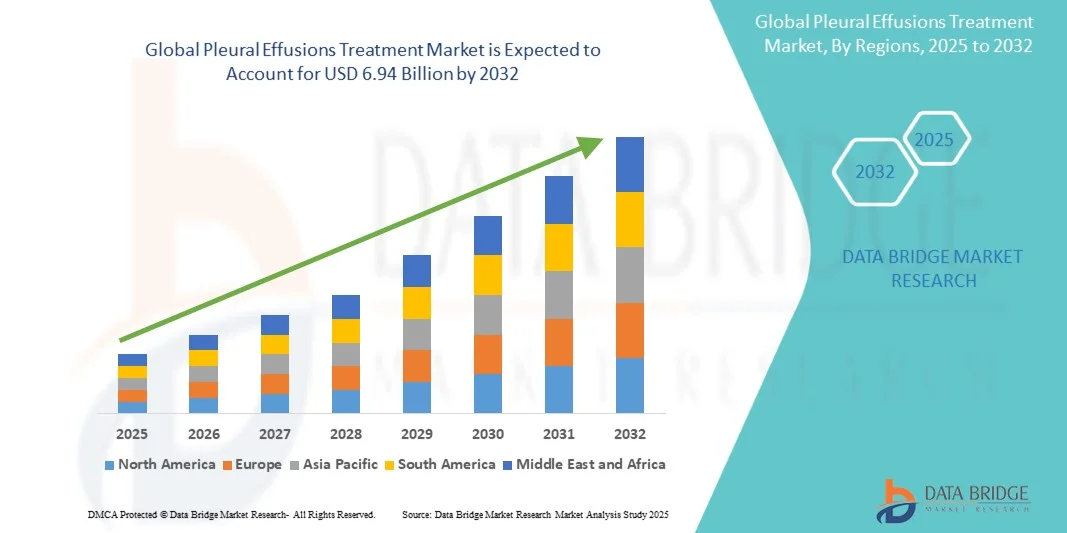
Pleural Effusions Treatment Market Size
- The global pleural effusions treatment market size was valued at USD 4.70 billion in 2024 and is expected to reach USD 6.94 billion by 2032, at a CAGR of 5.00% during the forecast period
- The market growth is largely fueled by increasing prevalence of pulmonary and cardiovascular disorders, along with advancements in diagnostic and therapeutic technologies, leading to improved detection and management of pleural effusions in clinical settings
- Furthermore, rising patient demand for effective, safe, and minimally invasive treatment options—ranging from pharmacological therapies to thoracentesis and other medical procedures—is establishing innovative pleural effusions solutions as the preferred choice for clinicians. These converging factors are accelerating the uptake of Pleural Effusions treatment solutions, thereby significantly boosting the industry's growth
Pleural Effusions Treatment Market Analysis
- Pleural Effusions Treatment, encompassing therapeutic interventions for fluid accumulation in the pleural cavity, is increasingly crucial in modern healthcare due to its role in preventing complications, improving respiratory function, and enhancing patient outcomes
- The escalating demand for pleural effusions treatment is primarily fueled by the rising prevalence of cardiovascular and pulmonary disorders, increasing geriatric population, and growing awareness of early diagnosis and treatment options
- North America dominated the pleural effusions treatment market with the largest revenue share of 47% in 2024, characterized by advanced healthcare infrastructure, high healthcare spending, and the presence of key hospitals and specialized pulmonary care centers. The U.S. experienced substantial growth in Pleural Effusions Treatment adoption, particularly in urban hospitals and tertiary care centers, driven by innovations from established pharmaceutical companies and medical device manufacturers focusing on minimally invasive drainage techniques and advanced therapeutics
- Asia-Pacific is expected to be the fastest growing region in the pleural effusions treatment market during the forecast period due to increasing healthcare awareness, rising disposable incomes, expanding hospital networks, and growing access to specialized pulmonary care in countries such as India, China, and Japan. Improved healthcare infrastructure, government initiatives, and growing patient awareness are further driving treatment adoption
- The Malignant Pleural Effusions segment dominated the pleural effusions treatment market with a 57% revenue share in 2024, owing to the high incidence of lung, breast, and ovarian cancers causing pleural involvement
Report Scope and Pleural Effusions Treatment Market Segmentation
|
Attributes |
Pleural Effusions Treatment Key Market Insights |
|
Segments Covered |
|
|
Countries Covered |
North America
Europe
Asia-Pacific
Middle East and Africa
South America
|
|
Key Market Players |
|
|
Market Opportunities |
|
|
Value Added Data Infosets |
In addition to the insights on market scenarios such as market value, growth rate, segmentation, geographical coverage, and major players, the market reports curated by the Data Bridge Market Research also include in-depth expert analysis, pricing analysis, brand share analysis, consumer survey, demography analysis, supply chain analysis, value chain analysis, raw material/consumables overview, vendor selection criteria, PESTLE Analysis, Porter Analysis, and regulatory framework. |
Pleural Effusions Treatment Market Trends
“Emerging Minimally Invasive and Targeted Therapies”
- A prominent trend in the global pleural effusions treatment market is the increasing adoption of minimally invasive procedures and targeted therapies. These approaches aim to reduce patient discomfort, shorten hospital stays, and improve recovery outcomes
- For instance, in May 2023, Becton Dickinson (BD) introduced an advanced indwelling pleural catheter system designed for outpatient management of recurrent malignant pleural effusions, allowing patients to manage fluid accumulation at home under physician supervision
- Targeted pharmacological interventions, such as intrapleural fibrinolytics for complicated pleural effusions, are also gaining traction, with clinical studies reporting improved therapeutic outcomes and fewer complications compared to conventional methods
- Healthcare providers are increasingly combining procedural interventions with pharmacological management to achieve more personalized care
- The trend toward outpatient management and home-based treatment options is expanding patient access and convenience while reducing healthcare costs
- Ongoing R&D activities are focused on novel drainage systems, safer thoracentesis techniques, and advanced pleurodesis agents to improve patient comfort and treatment efficiency
Pleural Effusions Treatment Market Dynamics
Driver
“Rising Prevalence of Pulmonary Disorders and Aging Population”
- The growth of the Pleural Effusions Treatment market is strongly propelled by the increasing prevalence of pulmonary and systemic disorders that lead to pleural fluid accumulation. Conditions such as heart failure, liver cirrhosis, pneumonia, tuberculosis, and malignancies are contributing significantly to the rising patient pool worldwide
- For instance, in June 2023, The Lancet Respiratory Medicine reported a 12% rise in hospitalizations due to pleural effusions across developed regions over the past five years, highlighting the growing clinical demand for effective management
- The aging global population is another critical factor driving market expansion. Older adults are more susceptible to chronic illnesses, including congestive heart failure and liver disease, which often result in recurrent pleural effusions. For example, a WHO report in March 2024 projected a 20% increase in the elderly population in North America and Europe by 2030, directly influencing treatment demand
- Healthcare providers are increasingly adopting minimally invasive procedures and indwelling catheter systems, which enhance patient comfort and enable outpatient management. For instance, in May 2023, Becton Dickinson launched an advanced indwelling pleural catheter system for home-based management of recurrent effusions, demonstrating the trend toward patient-centric care
- Rising awareness among patients and healthcare professionals about early diagnosis and effective therapeutic interventions is further fueling market growth. Educational initiatives, coupled with advancements in imaging and diagnostic techniques, are facilitating timely treatment and improved patient outcomes
- Overall, the convergence of increasing disease incidence, geriatric population growth, and technological innovations in treatment methods is creating strong momentum for the Pleural Effusions Treatment market
Restraint/Challenge
“High Treatment Costs and Limited Accessibility in Emerging Markets”
- Despite the growing demand, the pleural effusions treatment market faces challenges due to high costs associated with hospitalization, procedural interventions, and advanced therapeutic devices. Such costs can be prohibitive for patients in low- and middle-income countries, limiting access to standard care
- For instance, in August 2022, the American Thoracic Society reported that managing malignant pleural effusions in the U.S. could exceed USD 15,000 per patient annually, highlighting the financial burden associated with treatment
- Infrastructure and accessibility barriers further restrict market penetration in emerging regions. Many hospitals lack specialized pulmonology units, skilled physicians, or advanced equipment necessary for effective pleural effusion management. For example, a study in India in September 2023 revealed that fewer than 40% of hospitals capable of performing pleural interventions had dedicated pulmonology or thoracic care units
- Patient apprehension toward invasive procedures, fear of complications, and limited knowledge about minimally invasive options also hinder treatment adoption
- Regulatory complexities and reimbursement challenges in various regions can delay the launch of advanced therapeutic devices, impacting market growth
- Addressing these restraints requires strategies such as development of cost-effective treatments, expansion of specialized healthcare infrastructure, patient education programs, and collaborative efforts between healthcare providers, pharmaceutical companies, and governments to improve affordability and accessibility
Pleural Effusions Treatment Market Scope
The market is segmented on the basis of type, treatment, disease application, distribution channel, and end user.
By Type
On the basis of type, the pleural effusions treatment market is segmented into transudative pleural effusions and exudative pleural effusions. The transudative pleural effusions segment dominated the market with a 52% revenue share in 2024, owing to its higher prevalence in patients with conditions such as heart failure, liver cirrhosis, and nephrotic syndrome. These cases are generally easier to manage using standardized therapeutic approaches, making transudative effusions more commonly treated in hospitals and specialty clinics. Established clinical guidelines, high treatment success rates, and reimbursement support also enhance adoption. The segment benefits from early detection through routine diagnostics and frequent monitoring by pulmonologists. Increasing awareness among healthcare providers about early intervention and the predictable nature of transudative effusions further solidify its dominant position. Large hospital networks and tertiary care centers also contribute to its widespread treatment adoption.
The exudative pleural effusions segment is expected to witness the fastest CAGR of 7.8% from 2025 to 2032, driven by increasing incidences of infections, malignancies, and inflammatory diseases that lead to complex pleural effusions. Advanced diagnostic techniques, such as thoracentesis with fluid analysis, have improved early detection. Minimally invasive procedures like pleurodesis and indwelling catheters facilitate effective management. Expanding access to specialized pulmonary care and rising patient awareness about complications associated with exudative effusions support rapid growth. Hospitals and specialty clinics are increasingly equipped to treat such cases. Government initiatives promoting early diagnosis and treatment of pulmonary conditions are boosting adoption. The segment also benefits from technological advancements in drainage and monitoring, ensuring efficient patient care.
By Treatment
On the basis of treatment, the pleural effusions treatment market is segmented into Thoracentesis, Tube Thoracostomy, Pleural Drain, Pleurodesis, Pleural Decortication, and Others. The Thoracentesis segment dominated the market with a 45.6% revenue share in 2024, as it is considered the first-line treatment for both diagnosis and management of pleural effusions. Its minimally invasive nature, high safety profile, and cost-effectiveness make it widely preferred in hospitals and specialty clinics. Use of imaging guidance, such as ultrasound, improves procedural accuracy and reduces complications. Thoracentesis is also suitable for recurrent effusions, allowing repeated interventions without major risk. Its acceptance among pulmonologists, along with standardized clinical protocols, contributes to consistent usage. Hospital procurement policies and training programs further strengthen its market position. In addition, it is frequently used in both acute and chronic cases, enhancing its dominance.
The Pleural Drain segment is expected to witness the fastest CAGR of 8.5% from 2025 to 2032, driven by the increasing need for long-term management of complex or recurrent effusions, particularly in malignant cases. Portable drainage systems enable home-based management, reducing hospital stays. Growth is also supported by rising incidences of cancer-related effusions and post-surgical complications. Improved patient comfort, ease of monitoring, and integration with telemedicine services encourage adoption. Expansion of homecare and outpatient services further boosts demand. Availability of advanced catheters and minimally invasive devices supports faster adoption. Training programs for healthcare providers and patient education contribute to the rapid growth trajectory.
By Disease Application
On the basis of disease application, the pleural effusions treatment market is segmented into Malignant Pleural Effusions (MPE) and Paramalignant Pleural Effusions (PMPE). The Malignant Pleural Effusions segment dominated the market with a 57% revenue share in 2024, owing to the high incidence of lung, breast, and ovarian cancers causing pleural involvement. Hospitals prioritize MPE management due to its significant impact on patient morbidity and quality of life. Advanced procedures like pleurodesis and indwelling pleural catheters increase adoption. Oncology centers and tertiary care hospitals frequently implement treatment protocols, contributing to its dominance. Availability of specialized healthcare infrastructure and skilled pulmonologists further supports growth. Rising awareness of supportive care and palliative treatments in cancer management also fuels demand. Insurance coverage and clinical guideline adherence enhance segment adoption.
The Paramalignant Pleural Effusions segment is expected to witness the fastest CAGR of 8.2% from 2025 to 2032, driven by increasing prevalence of systemic conditions like pulmonary embolism, post-surgical complications, and autoimmune disorders. Advancements in imaging and diagnostics enable early detection. Homecare solutions and minimally invasive treatments promote faster adoption. Specialty clinics and urban hospitals increasingly manage these cases. Patient awareness campaigns and government initiatives improve treatment uptake. The segment benefits from expanding access to healthcare facilities and training programs. Telemedicine-supported monitoring and improved patient outcomes further contribute to rapid growth.
By Distribution Channel
On the basis of distribution channel, the pleural effusions treatment market is segmented into Hospital Pharmacies, Retail Pharmacies, and Online Pharmacies. The Hospital Pharmacies segment dominated the market with a 62% revenue share in 2024, as hospitals directly procure medications and devices for inpatient and outpatient pleural effusion management. Centralized hospital systems and structured supply chains ensure availability and accessibility. Hospitals also drive adoption through routine procedures, training, and integration with pulmonary care units. Government and private healthcare funding support procurement, enhancing dominance. Tertiary care centers, specialty hospitals, and teaching institutions favor hospital pharmacies due to efficiency, reliability, and adherence to clinical guidelines.
The Online Pharmacies segment is expected to witness the fastest CAGR of 12% from 2025 to 2032, fueled by increasing patient preference for home delivery and telehealth consultations. Growing digital literacy, secure online platforms, and convenience contribute to rapid adoption. Patients in semi-urban and rural areas benefit from timely access to medicines and devices. Expansion of e-pharmacy regulations and payment gateways facilitates adoption. Increasing awareness of chronic and recurrent pleural effusion management supports segment growth. Rising online healthcare services integration with prescription verification also enhances the trend.
End User
On the basis of end user, the pleural effusions treatment market is segmented into Hospitals, Homecare, Specialty Clinics, and Others. The Hospitals segment dominated the market with a 68% revenue share in 2024, owing to the availability of advanced pulmonary units, specialized diagnostic equipment, and trained healthcare personnel. Hospitals remain the primary sites for moderate-to-severe pleural effusions, providing inpatient and outpatient care. Large-scale healthcare infrastructure and established clinical workflows ensure widespread adoption. Multidisciplinary teams and tertiary care centers strengthen dominance. Routine procedural adoption, insurance coverage, and protocol-driven management contribute to growth.
The Homecare segment is expected to witness the fastest CAGR of 10.8% from 2025 to 2032, driven by rising patient preference for treatment at home using minimally invasive drainage techniques. Portable pleural drainage systems and telemedicine support enable remote monitoring and reduce hospital visits. Expansion of homecare service providers and increasing awareness among patients and caregivers fuel adoption. Insurance coverage for home-based care and government initiatives promoting outpatient management enhance growth. Improved patient comfort, cost-effectiveness, and convenience drive rapid growth of this segment.
Pleural Effusions Treatment Market Regional Analysis
- North America dominated the pleural effusions treatment market with the largest revenue share of 47% in 2024, driven by advanced healthcare infrastructure, high healthcare spending, and the presence of key hospitals and specialized pulmonary care centers
- The market witnessed substantial growth in treatment adoption, particularly in urban hospitals and tertiary care centers, fueled by innovations from established pharmaceutical companies and medical device manufacturers focusing on minimally invasive drainage techniques, pleurodesis, and targeted therapeutics for recurrent pleural effusions
- The increasing prevalence of comorbidities such as congestive heart failure, liver cirrhosis, and malignancies further contributed to the rising demand for effective management of pleural effusions
U.S. Pleural Effusions Treatment Market Insight
The U.S. pleural effusions treatment market captured the largest revenue share in North America in 2024, supported by widespread availability of specialized pulmonary care units and access to cutting-edge diagnostic tools such as thoracic ultrasound and CT-guided interventions. Hospitals and outpatient centers are increasingly adopting minimally invasive treatment options like tunneled pleural catheters and endoscopic pleurodesis, improving patient outcomes and reducing hospital stays. Moreover, collaborations between pharmaceutical companies and research institutions have led to the development of advanced therapeutic protocols, further strengthening market growth.
Europe Pleural Effusions Treatment Market Insight
The Europe pleural effusions treatment market is projected to grow at a substantial CAGR during the forecast period, primarily driven by increasing prevalence of chronic respiratory diseases, aging populations, and government initiatives aimed at improving pulmonary healthcare services. Countries such as Germany, France, and Italy are witnessing growing adoption of minimally invasive drainage procedures, as well as targeted therapies for malignant pleural effusions. The region is also seeing increased incorporation of standardized treatment protocols in tertiary hospitals and cancer care centers, supporting consistent clinical outcomes and driving market expansion.
U.K. Pleural Effusions Treatment Market Insight
The U.K. pleural effusions treatment market is expected to grow at a noteworthy CAGR over the forecast period, driven by increasing incidence of pleural effusions linked to chronic conditions such as heart failure and lung cancer. Hospitals and specialized pulmonary care units are investing in advanced drainage systems, image-guided interventions, and outpatient management strategies to improve patient comfort and reduce hospitalization duration. Public awareness campaigns and initiatives to promote early diagnosis are also contributing to market growth.
Germany Pleural Effusions Treatment Market Insight
The Germany pleural effusions treatment market is anticipated to expand at a significant CAGR, fueled by the country’s strong focus on healthcare innovation and advanced hospital infrastructure. The adoption of minimally invasive pleural drainage techniques, along with targeted therapies for malignant and recurrent effusions, is increasing rapidly. Growing prevalence of chronic respiratory diseases, coupled with government support for improved hospital facilities and patient access to specialized care, is driving sustained demand in both urban and semi-urban healthcare centers.
Asia-Pacific Pleural Effusions Treatment Market Insight
The Asia-Pacific pleural effusions treatment market is poised to grow at the fastest CAGR during the forecast period (2025–2032), driven by rising healthcare awareness, expanding hospital networks, and increasing access to specialized pulmonary care in countries such as India, China, and Japan. Improved healthcare infrastructure, government initiatives promoting early detection, and growing patient awareness about treatment options are significantly boosting adoption. In addition, advancements in minimally invasive drainage techniques and the availability of modern therapeutic interventions in tertiary hospitals are contributing to the rapid growth of the market in the region.
Japan Pleural Effusions Treatment Market Insight
The Japan pleural effusions treatment market is gaining momentum due to rising prevalence of chronic respiratory conditions, increasing geriatric population, and high patient awareness regarding early intervention. Adoption of advanced therapeutic procedures, including indwelling pleural catheters and endoscopic pleurodesis, is expanding across hospitals and outpatient centers. Moreover, Japan’s focus on healthcare innovation and specialized pulmonary care is supporting the growth of effective and patient-friendly treatment options.
China Pleural Effusions Treatment Market Insight
The China pleural effusions treatment market accounted for the largest revenue share in Asia-Pacific in 2024, attributed to expanding healthcare awareness, rapid urbanization, and increasing access to specialized pulmonary care centers. The availability of modern diagnostic and therapeutic interventions, along with growing government initiatives for improving respiratory healthcare, has significantly driven market adoption. Rising prevalence of chronic diseases and malignancies that contribute to pleural effusions is further fueling demand for effective treatment solutions across both urban and semi-urban regions.
Pleural Effusions Treatment Market Share
The Pleural Effusions Treatment industry is primarily led by well-established companies, including:
- Clover Biopharmaceuticals, Ltd. (China)
- HEYER Medical AG (Germany)
- AstraZeneca (U.K.)
- Boehringer Ingelheim International GmbH (Germany)
- GSK plc (U.K.)
- Sumitomo Dainippon Pharma Co., Ltd (Japan)
- Teva Pharmaceutical Industries Ltd (Israel)
- Merck & Co., Inc. (U.S.)
- Abbott (U.S.)
- F. Hoffmann-La Roche Ltd (Switzerland)
- Pfizer Inc. (U.S.)
- Novartis AG (Switzerland)
- Chiesi Farmaceutici S.p.A (Italy)
Latest Developments in Pleural Effusions Treatment Market
- In September 2025, Memorial Healthcare System announced the successful conclusion of a clinical trial for an innovative pleural effusion treatment device. The trial, which concluded on March 25, 2025, received FDA approval, and the device is expected to reach the general market soon after. This advancement aims to enhance patient care and transform lives by providing more effective treatment options for pleural effusion patients
- In August 2025, a study introduced the Dual-Branch Interactive Fusion Attention model (DBIF-AUNet), a semantic segmentation algorithm designed for pleural effusion based on CT imaging. This model achieved Intersection over Union (IoU) and Dice scores of 80.1% and 89.0%, respectively, outperforming existing models like U-Net++ and Swin-UNet. The DBIF-AUNet model enhances the accuracy and timeliness of clinical diagnosis and treatment by precisely identifying disease severity and lesion areas

- Interactive Data Analysis Dashboard
- Company Analysis Dashboard for high growth potential opportunities
- Research Analyst Access for customization & queries
- Competitor Analysis with Interactive dashboard
- Latest News, Updates & Trend analysis
- Harness the Power of Benchmark Analysis for Comprehensive Competitor Tracking
Data collection and base year analysis are done using data collection modules with large sample sizes. The stage includes obtaining market information or related data through various sources and strategies. It includes examining and planning all the data acquired from the past in advance. It likewise envelops the examination of information inconsistencies seen across different information sources. The market data is analysed and estimated using market statistical and coherent models. Also, market share analysis and key trend analysis are the major success factors in the market report. To know more, please request an analyst call or drop down your inquiry.
The key research methodology used by DBMR research team is data triangulation which involves data mining, analysis of the impact of data variables on the market and primary (industry expert) validation. Data models include Vendor Positioning Grid, Market Time Line Analysis, Market Overview and Guide, Company Positioning Grid, Patent Analysis, Pricing Analysis, Company Market Share Analysis, Standards of Measurement, Global versus Regional and Vendor Share Analysis. To know more about the research methodology, drop in an inquiry to speak to our industry experts.
Data Bridge Market Research is a leader in advanced formative research. We take pride in servicing our existing and new customers with data and analysis that match and suits their goal. The report can be customized to include price trend analysis of target brands understanding the market for additional countries (ask for the list of countries), clinical trial results data, literature review, refurbished market and product base analysis. Market analysis of target competitors can be analyzed from technology-based analysis to market portfolio strategies. We can add as many competitors that you require data about in the format and data style you are looking for. Our team of analysts can also provide you data in crude raw excel files pivot tables (Fact book) or can assist you in creating presentations from the data sets available in the report.












