


Point-to-Point (P2P) Antennas Market Size
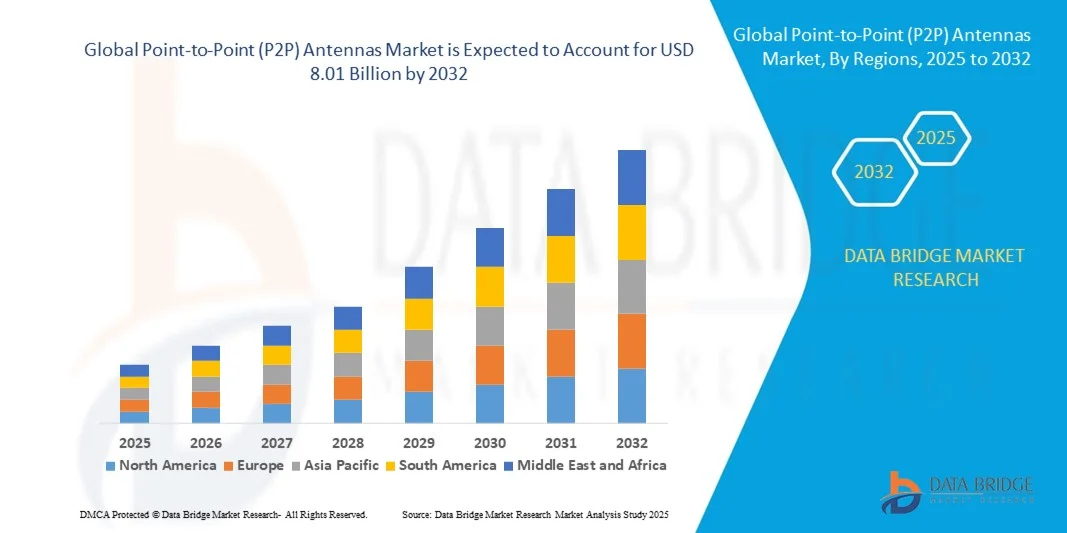
- The global point-to-point (P2P) antennas market size was valued at USD 4.84 billion in 2024 and is expected to reach USD 8.01 billion by 2032, at a CAGR of 6.50% during the forecast period
- The market growth is largely fueled by the increasing deployment of high-speed broadband and 5G networks, driving the demand for reliable backhaul and long-distance communication infrastructure supported by Point-to-Point (P2P) antennas. These antennas enable high-capacity data transmission with minimal latency, making them critical for expanding telecom and enterprise connectivity. The growing reliance on wireless communication technologies across industries continues to propel market expansion
- Furthermore, rapid technological advancements in antenna design, including higher frequency operations and improved signal directivity, are enhancing network efficiency and coverage capabilities. These innovations are accelerating the adoption of P2P antennas across telecommunication, defense, and industrial sectors, supporting seamless communication in both urban and remote locations, and significantly strengthening the market’s growth trajectory
Point-to-Point (P2P) Antennas Market Analysis
- Point-to-Point (P2P) antennas, designed to transmit data directly between two fixed locations, serve as a core component in wireless backhaul, broadband delivery, and private network connectivity. Their high-gain, directional performance ensures reliable data transmission over long distances, making them indispensable in modern telecommunication networks, especially for supporting 5G and IoT infrastructure
- The rising demand for P2P antennas is primarily driven by increasing global data traffic, expanding broadband coverage initiatives, and the growing need for cost-effective alternatives to fiber networks. The ongoing integration of advanced wireless communication technologies, along with the need for flexible and scalable connectivity solutions, is further amplifying market growth across both developed and emerging regions
- North America dominated the point-to-point (P2P) antennas market with a share of 41.5% in 2024, due to the rapid expansion of high-speed broadband infrastructure and the growing adoption of 5G networks
- Asia-Pacific is expected to be the fastest growing region in the point-to-point (P2P) antennas market during the forecast period due to the booming telecommunication sector and widespread adoption of 5G across countries such as China, Japan, and India
- Dual-polarized antenna segment dominated the market with a market share of 52.6% in 2024, due to its ability to transmit and receive signals in both vertical and horizontal polarizations simultaneously, improving spectral efficiency and link reliability. These antennas are ideal for environments with high data demand and are increasingly deployed in cellular base stations and backhaul systems. Their enhanced resistance to multipath interference and superior data throughput make them essential for broadband communication and high-capacity wireless links
Report Scope and Point-to-Point (P2P) Antennas Market Segmentation
|
Attributes |
Point-to-Point (P2P) Antennas Key Market Insights |
|
Segments Covered |
|
|
Countries Covered |
North America
Europe
Asia-Pacific
Middle East and Africa
South America
|
|
Key Market Players |
|
|
Market Opportunities |
|
|
Value Added Data Infosets |
In addition to the insights on market scenarios such as market value, growth rate, segmentation, geographical coverage, and major players, the market reports curated by the Data Bridge Market Research also include in-depth expert analysis, geographically represented company-wise production and capacity, network layouts of distributors and partners, detailed and updated price trend analysis and deficit analysis of supply chain and demand. |
Point-to-Point (P2P) Antennas Market Trends
Rising Adoption of 5G Network Infrastructure
- The point-to-point (P2P) antennas market is witnessing rapid growth due to the global rollout of 5G network infrastructure, which requires high-performance backhaul systems capable of delivering low-latency, high-capacity connections. P2P antennas play a vital role in transmitting data between cell towers and core networks, enabling continuous, reliable communication essential for 5G performance standards
- For instance, Huawei Technologies has been deploying high-frequency P2P antennas, including E-band and millimeter-wave models, to strengthen 5G backhaul capabilities across urban and suburban areas. These solutions are critical for managing the massive data volumes associated with 5G-enabled applications such as autonomous vehicles and smart city networks
- The shift toward 5G is accelerating demand for high-frequency P2P antennas that support data transmission rates exceeding 10 Gbps. Such antennas provide stable connectivity over medium and long distances, making them indispensable for mobile operators managing dense network deployments in challenging environments
- Manufacturers are integrating advanced materials and precision design technologies to enhance antenna performance and reduce signal losses. The development of compact, energy-efficient antenna systems is helping telecom providers reduce operational power consumption while extending service coverage to remote areas
- Major telecom equipment providers are collaborating with network operators to develop flexible backhaul solutions customized for 5G architecture. For instance, Ericsson and Nokia are advancing next-generation P2P antenna designs that support dual-band and adaptive modulation technologies to improve performance consistency across varying weather conditions and terrains
- The adoption of 5G infrastructure is fundamentally transforming the P2P antennas landscape by requiring greater transmission efficiency, capacity, and network flexibility. As global telecom networks continue to scale 5G deployments, this trend will propel sustained demand for advanced P2P antenna solutions across mobile, enterprise, and public communication sectors
Point-to-Point (P2P) Antennas Market Dynamics
Driver
Increasing Demand for High-Capacity Wireless Backhaul Solutions
- The growing need for high-speed and high-capacity wireless connectivity is driving demand for P2P antennas as critical components in backhaul network architecture. Operators are expanding wireless infrastructure to handle escalating data traffic generated by cloud services, video streaming, IoT networks, and enterprise communications
- For instance, in 2024, Cambium Networks launched a new line of 60 GHz cnWave P2P antennas designed to deliver multi-gigabit throughput for urban broadband providers. These advanced systems help service operators achieve superior network reliability and latency performance compared to traditional microwave or fiber-based solutions
- Telecom operators are relying increasingly on wireless backhaul as an alternative to fiber, especially in areas where fiber installation is impractical or cost-prohibitive. P2P antennas deliver adaptable and efficient connectivity for both fixed and mobile broadband applications, supporting network expansion in developing and rural regions
- The proliferation of data-intensive technologies and edge computing infrastructure is also amplifying the need for reliable high-capacity backhaul. Advanced P2P antennas help manage network traffic efficiently by linking distributed access points directly to data centers and cloud hubs without compromising speed or service quality
- As digital transformation accelerates, the strategic integration of P2P antenna systems within expanding wireless networks will remain a central driver for telecommunications and enterprise connectivity. Their role in sustaining bandwidth growth and reducing network congestion ensures continued market development across the global backhaul ecosystem
Restraint/Challenge
Signal Interference and Line-of-Sight Limitations
- One of the primary challenges faced by the P2P antennas market is signal interference and the need for clear line-of-sight communication between transmission points. As these antennas primarily operate at higher frequencies such as millimeter-wave bands, they are highly susceptible to obstructions, atmospheric conditions, and multipath interference that affect signal quality and stability
- For instance, during 2023 infrastructure trials, several network providers, including Ubiquiti Inc., reported performance disruptions in dense urban environments caused by physical obstacles and electromagnetic interference from nearby devices. Such conditions highlight the critical importance of accurate site planning and antenna alignment for maintaining optimal coverage
- Environmental factors such as heavy rainfall, fog, and humidity can cause significant attenuation of millimeter-wave signals, impacting long-distance data transmission. These conditions increase the complexity of system design and necessitate advanced error correction or redundancy protocols to sustain consistent network performance
- The limited line-of-sight range also restricts deployment flexibility in areas with challenging topography, where towers or buildings block direct signal paths. Network operators often need to invest in additional relay stations or base infrastructure to ensure seamless connectivity, increasing overall project costs
- To address these challenges, manufacturers are developing adaptive beamforming, intelligent frequency management, and high-gain antenna technologies to mitigate interference and enhance signal stability. Effective management of environmental and topographical constraints will be essential for the reliable deployment of P2P antennas in future high-density 5G and beyond-5G network architectures
Point-to-Point (P2P) Antennas Market Scope
The market is segmented on the basis of type, polarization, diameter, frequency range, and applications.
- By Type
On the basis of type, the Point-to-Point (P2P) Antennas market is segmented into parabolic antenna, flat panel antenna, and Yagi antenna. The parabolic antenna segment dominated the market with the largest market revenue share in 2024 due to its high directional gain, long-distance signal transmission capability, and superior performance in minimizing interference. These antennas are extensively adopted in backhaul connectivity for telecom networks and satellite communication systems where precision and signal strength are critical. Their ability to support higher frequencies and wide bandwidth further enhances their suitability for remote and high-capacity communication networks, making them a preferred choice for telecom operators and broadcasters.
The flat panel antenna segment is projected to witness the fastest growth rate from 2025 to 2032, driven by the growing demand for compact, lightweight, and cost-effective antenna solutions. These antennas are gaining traction across urban areas and enterprise applications due to their ease of installation and aesthetic design compatibility with building structures. The flat panel antenna’s adaptability to emerging 5G and IoT networks supports seamless high-speed data transmission, fueling its adoption in modern telecommunication and commercial environments.
- By Polarization
On the basis of polarization, the market is segmented into single-polarized antenna and dual-polarized antenna. The dual-polarized antenna segment dominated the market with a share of 52.6% in 2024, supported by its ability to transmit and receive signals in both vertical and horizontal polarizations simultaneously, improving spectral efficiency and link reliability. These antennas are ideal for environments with high data demand and are increasingly deployed in cellular base stations and backhaul systems. Their enhanced resistance to multipath interference and superior data throughput make them essential for broadband communication and high-capacity wireless links.
The single-polarized antenna segment is anticipated to register the fastest growth rate from 2025 to 2032, driven by its simpler design, lower cost, and suitability for applications requiring limited bandwidth. These antennas are particularly utilized in short-range point-to-point systems and niche industrial or defense operations where minimal interference is expected. The growing preference among small-scale service providers for efficient, low-maintenance communication systems further contributes to this segment’s expansion.
- By Diameter
On the basis of diameter, the market is categorized into 0.2m to 0.9m, 1.0m to 3.0m, and 3.1m to 4.6m. The 1.0m to 3.0m diameter segment dominated the market in 2024, attributed to its balanced performance between range, gain, and portability. These antennas are commonly deployed in long-distance microwave links and satellite communication systems, offering optimal coverage and stable transmission even in adverse weather conditions. The segment’s widespread use in telecom infrastructure and defense networks further strengthens its market position.
The 0.2m to 0.9m diameter segment is expected to grow at the fastest rate during 2025–2032, primarily due to its compact size and suitability for portable and small-cell communication systems. The expansion of 5G and IoT networks across urban and remote areas has accelerated the demand for smaller antennas that can be easily installed on rooftops or mobile platforms. The segment’s growing relevance in commercial and industrial wireless connectivity applications also supports its rapid growth trajectory.
- By Frequency Range
On the basis of frequency range, the market is segmented into 1.0 GHz to 9.9 GHz, 10.0 GHz to 29.9 GHz, and 30.0 GHz to 86.0 GHz. The 10.0 GHz to 29.9 GHz segment dominated the market in 2024 owing to its high data transmission capabilities and suitability for broadband communication and satellite backhaul applications. This range supports efficient long-distance connectivity with minimal signal degradation, making it vital for telecommunication, broadcasting, and defense communications. The increasing demand for high-capacity data networks continues to sustain the dominance of this frequency range.
The 30.0 GHz to 86.0 GHz segment is projected to witness the fastest growth from 2025 to 2032, fueled by its rising adoption in 5G millimeter-wave communication and next-generation satellite systems. Antennas operating within this range provide ultra-high bandwidth and low-latency transmission, crucial for advanced network architectures. The segment benefits from ongoing technological advancements aimed at enhancing spectrum efficiency and supporting dense urban network deployments.
- By Applications
On the basis of applications, the market is segmented into telecommunication, commercial/industrial, military and defense, satellite, and others. The telecommunication segment dominated the market in 2024, driven by the surge in broadband data traffic, 5G infrastructure expansion, and the growing need for reliable wireless backhaul. P2P antennas play a pivotal role in ensuring high-capacity, long-range connections between cell towers and network nodes. The increasing emphasis on enhancing connectivity in rural and remote regions further reinforces this segment’s market share.
The satellite segment is anticipated to record the fastest growth rate from 2025 to 2032, supported by the proliferation of low Earth orbit (LEO) satellite constellations and growing investment in global broadband initiatives. P2P antennas are essential in ground station communication and inter-satellite links, providing high-precision, low-latency data transmission. The rise in demand for satellite-based communication in navigation, surveillance, and remote sensing further drives this segment’s accelerated growth.
Point-to-Point (P2P) Antennas Market Regional Analysis
- North America dominated the point-to-point (P2P) antennas market with the largest revenue share of 41.5% in 2024, driven by the rapid expansion of high-speed broadband infrastructure and the growing adoption of 5G networks
- The region’s increasing data consumption and emphasis on low-latency communication for enterprise and defense applications are key contributors to market growth
- Furthermore, strong investments by telecom operators in upgrading network backhaul systems and the widespread use of wireless connectivity for rural and remote areas continue to reinforce market dominance
U.S. Point-to-Point (P2P) Antennas Market Insight
The U.S. captured the largest revenue share within North America in 2024, fueled by extensive deployment of advanced wireless communication systems and rising demand for high-capacity data transmission. The country’s robust telecom infrastructure, coupled with the growing trend of smart city projects and industrial IoT integration, accelerates the need for P2P antennas. The ongoing expansion of 5G and private LTE networks, along with government initiatives supporting broadband access in underserved regions, further strengthens the market outlook.
Europe Point-to-Point (P2P) Antennas Market Insight
The Europe Point-to-Point (P2P) Antennas market is projected to register steady growth throughout the forecast period, driven by increased investment in broadband expansion and the modernization of telecommunication infrastructure. European nations are focusing on reducing connectivity gaps across urban and rural areas through the adoption of high-frequency wireless systems. The region’s strong emphasis on industrial automation, IoT adoption, and digital transformation within enterprises further supports the use of P2P antennas for high-speed data backhaul.
U.K. Point-to-Point (P2P) Antennas Market Insight
The U.K. market is anticipated to grow at a significant CAGR during the forecast period, supported by the government’s push for nationwide 5G coverage and smart infrastructure initiatives. The rising use of fixed wireless access for broadband delivery in remote regions and growing reliance on cloud-based enterprise communication are major drivers. Moreover, the presence of leading network equipment providers and telecom service operators enhances the deployment of advanced P2P antenna systems.
Germany Point-to-Point (P2P) Antennas Market Insight
The Germany market is expected to witness considerable growth, propelled by the rapid industrial digitalization and adoption of Industry 4.0 technologies. The country’s well-developed manufacturing and automotive sectors increasingly utilize P2P antennas for machine-to-machine communication and data transmission across connected facilities. Furthermore, government-backed initiatives for enhancing rural broadband connectivity and smart city expansion are fostering demand for reliable wireless infrastructure.
Asia-Pacific Point-to-Point (P2P) Antennas Market Insight
The Asia-Pacific region is poised to grow at the fastest CAGR from 2025 to 2032, attributed to the booming telecommunication sector and widespread adoption of 5G across countries such as China, Japan, and India. The region’s increasing investments in smart city development, along with the rising need for robust network connectivity in industrial and defense applications, are key growth enablers. Furthermore, the presence of numerous antenna manufacturers and the availability of cost-effective communication equipment make APAC a dominant production and consumption hub.
China Point-to-Point (P2P) Antennas Market Insight
China accounted for the largest revenue share within Asia-Pacific in 2024, driven by strong government support for 5G deployment and large-scale broadband expansion projects. The country’s extensive adoption of high-capacity antennas across telecommunication, military, and commercial applications underpins its market dominance. In addition, domestic production capabilities and strategic investments by major telecom operators in rural network enhancement continue to fuel growth.
Japan Point-to-Point (P2P) Antennas Market Insight
Japan’s market is gaining momentum owing to its advanced communication infrastructure and emphasis on high-speed, low-latency connectivity. The integration of P2P antennas within 5G networks and industrial automation systems is driving adoption across both public and private sectors. The country’s strong focus on innovation, coupled with increasing demand for reliable data transmission in urban environments, supports sustained market expansion.
Point-to-Point (P2P) Antennas Market Share
The point-to-point (P2P) antennas industry is primarily led by well-established companies, including:
- Comba Telecom Systems Holdings Ltd. (China)
- Amphenol Corporation (U.S.)
- Cambium Networks, Ltd. (U.S.)
- Laird (U.K.)
- Radio Frequency Systems (Germany)
- Mobi Antenna Technology (Shenzhen) Co. (China)
- CommScope (U.S.)
- Telefonaktiebolaget LM Ericsson (Sweden)
- Rosenberger (Germany)
- Guangdong Shenglu Telecommunication Tech. Co., Ltd. (China)
- Infinite Electronics International, Inc. (U.S.)
- Trango Networks LLC (U.S.)
- mWAVE Industries LLC (U.S.)
- Kavveri Telecoms (India)
- XI’AN Putian Antenna (China)
- LEAX Arkivator Telecom AB (Sweden)
- CableFree (U.K.)
- PC-Tel (U.S.)
Latest Developments in Global Point-to-Point (P2P) Antennas Market
- In November 2023, Cisco introduced the Catalyst 9166D1, a Wi-Fi 6E-certified access point engineered to deliver robust 6 GHz Wi-Fi performance in areas such as large halls, high-ceiling buildings, and extended corridors. Capable of achieving nearly 8 Gbps data rates and enhancing signal strength up to 8 dBi with integrated directional antennas, this innovation represents a significant leap in wireless infrastructure. By enabling seamless, high-capacity connectivity, Cisco has strengthened its position in the Point-to-Point (P2P) Antennas market, catering to growing demands for high-speed enterprise and industrial communication systems. This development underscores Cisco’s continued investment in next-generation wireless solutions that enhance efficiency, range, and reliability across diverse network environments
- In September 2023, Ubiquiti Inc. launched the airFiber 60 LR, a long-range millimeter-wave radio designed to deliver ultra-fast, low-latency connectivity across distances exceeding 12 km in the 60 GHz spectrum. Featuring advanced alignment tools and compact design, the device provides a cost-effective, high-performance alternative to traditional fiber networks. This launch significantly impacts the P2P Antennas market by broadening wireless backhaul accessibility for telecom providers and enterprises seeking scalable and affordable connectivity solutions. Ubiquiti’s innovation further reinforces its market leadership by driving the adoption of next-generation, high-frequency communication systems optimized for 5G and IoT applications
- In July 2023, Cambium Networks unveiled its 28 GHz cnWave V3000 module, specifically designed for high-capacity urban and industrial backhaul networks. The module supports multi-gigabit throughput and mesh networking capabilities that ensure seamless scalability and reliability across dense deployment environments. This advancement has substantially boosted the company’s standing in the high-frequency antenna market, enabling telecom operators and enterprises to meet growing bandwidth and low-latency demands. By supporting 5G rollout and industrial digitalization, Cambium Networks’ innovation exemplifies its commitment to delivering efficient, flexible, and next-generation P2P connectivity solutions
- In May 2023, Ericsson announced an upgrade to its MINI-LINK 6000 series, integrating improved spectral efficiency, higher data capacity, and enhanced performance for 5G backhaul operations. This upgrade enables mobile operators to accommodate surging data traffic while minimizing latency and operational costs. The enhancement plays a pivotal role in expanding Ericsson’s influence in the microwave and P2P antenna domain, offering advanced solutions for 5G and broadband network expansion. Through this development, Ericsson continues to advance network transformation globally, ensuring faster, more reliable wireless communication infrastructure
- In February 2023, Huawei introduced its AirPON-based P2P antenna system, focusing on extending high-speed broadband access to suburban and rural regions. The system integrates simplified installation, intelligent automation, and superior signal coverage, making it ideal for large-scale connectivity initiatives. This product launch has significantly impacted the P2P Antennas market by enhancing Huawei’s leadership in cost-efficient wireless deployment and supporting digital inclusion efforts. By bridging connectivity gaps and enabling scalable network expansion, Huawei reinforces its commitment to advancing smart connectivity infrastructure across emerging and underserved markets

- Interactive Data Analysis Dashboard
- Company Analysis Dashboard for high growth potential opportunities
- Research Analyst Access for customization & queries
- Competitor Analysis with Interactive dashboard
- Latest News, Updates & Trend analysis
- Harness the Power of Benchmark Analysis for Comprehensive Competitor Tracking
Global Point To Point Antenna Market, Supply Chain Analysis and Ecosystem Framework
To support market growth and help clients navigate the impact of geopolitical shifts, DBMR has integrated in-depth supply chain analysis into its Global Point To Point Antenna Market research reports. This addition empowers clients to respond effectively to global changes affecting their industries. The supply chain analysis section includes detailed insights such as Global Point To Point Antenna Market consumption and production by country, price trend analysis, the impact of tariffs and geopolitical developments, and import and export trends by country and HSN code. It also highlights major suppliers with data on production capacity and company profiles, as well as key importers and exporters. In addition to research, DBMR offers specialized supply chain consulting services backed by over a decade of experience, providing solutions like supplier discovery, supplier risk assessment, price trend analysis, impact evaluation of inflation and trade route changes, and comprehensive market trend analysis.
Data collection and base year analysis are done using data collection modules with large sample sizes. The stage includes obtaining market information or related data through various sources and strategies. It includes examining and planning all the data acquired from the past in advance. It likewise envelops the examination of information inconsistencies seen across different information sources. The market data is analysed and estimated using market statistical and coherent models. Also, market share analysis and key trend analysis are the major success factors in the market report. To know more, please request an analyst call or drop down your inquiry.
The key research methodology used by DBMR research team is data triangulation which involves data mining, analysis of the impact of data variables on the market and primary (industry expert) validation. Data models include Vendor Positioning Grid, Market Time Line Analysis, Market Overview and Guide, Company Positioning Grid, Patent Analysis, Pricing Analysis, Company Market Share Analysis, Standards of Measurement, Global versus Regional and Vendor Share Analysis. To know more about the research methodology, drop in an inquiry to speak to our industry experts.
Data Bridge Market Research is a leader in advanced formative research. We take pride in servicing our existing and new customers with data and analysis that match and suits their goal. The report can be customized to include price trend analysis of target brands understanding the market for additional countries (ask for the list of countries), clinical trial results data, literature review, refurbished market and product base analysis. Market analysis of target competitors can be analyzed from technology-based analysis to market portfolio strategies. We can add as many competitors that you require data about in the format and data style you are looking for. Our team of analysts can also provide you data in crude raw excel files pivot tables (Fact book) or can assist you in creating presentations from the data sets available in the report.













