


Polyalkylene Glycol Market Overview
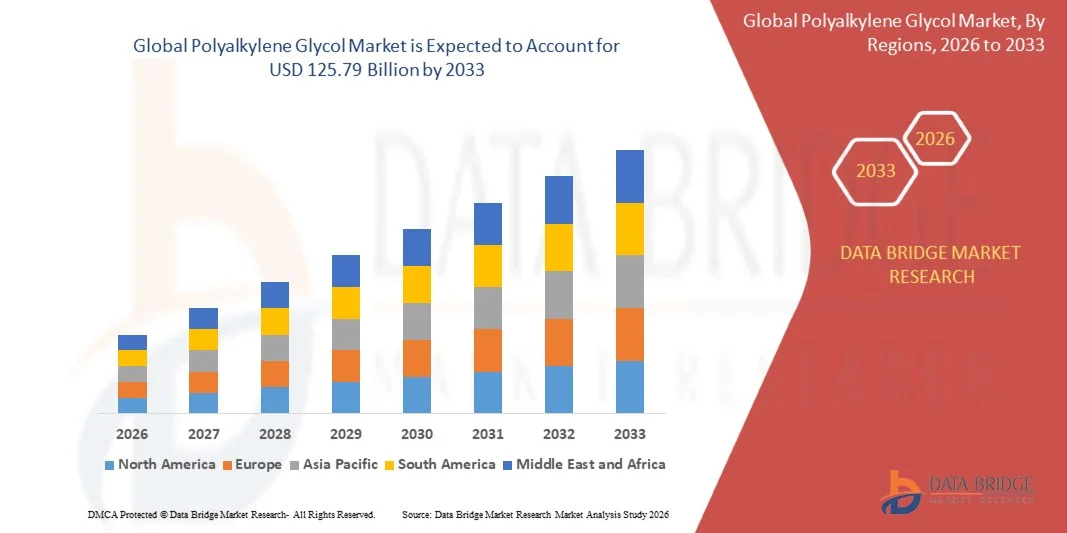
The Polyalkylene Glycol Market was valued at USD 53.03 Billion in 2025 and is projected to reach USD 125.79 Billion by 2033, growing at a CAGR of 11.40% from 2026 to 2033. The market is experiencing consistent growth driven by rising demand for high-performance synthetic lubricants, expanding applications in pharmaceuticals and personal care products, and increasing adoption of functional fluids across automotive and industrial sectors. Growing preference for energy-efficient, low-toxicity, and biodegradable chemical solutions is further supporting market expansion across global end-use industries.
The increasing shift toward advanced industrial automation, stricter environmental regulations on conventional lubricants, and rising demand for specialty chemical formulations are significantly driving the adoption of Polyalkylene Glycol. Its superior properties such as thermal stability, water solubility, and excellent lubricity make it highly suitable for applications in lubricants, surfactants, and polyurethane production. Expanding R&D activities focused on sustainable polymer-based solutions and continuous innovation in synthetic fluid technologies are further strengthening long-term market growth.
Key Market Trends & Insights
- Asia-Pacific dominated the Polyalkylene Glycol Market with the largest revenue share of 49.4% in 2025, supported by strong chemical manufacturing capacity, expanding industrial base, and high consumption across lubricants, automotive fluids, pharmaceuticals, and personal care applications
- The water soluble polyalkylene glycol segment led the market with a 44.1% share in 2025, driven by its widespread use in pharmaceuticals, personal care products, and industrial formulations requiring easy dispersion and compatibility with aqueous systems
- North America is expected to be the fastest-growing region at a CAGR of 10.07% from 2026 to 2033, fueled by strong demand for advanced industrial lubricants, automotive fluids, and pharmaceutical-grade polyalkylene glycol
- Functional fluids are the fastest-growing application type, projected to register a CAGR of 9% from 2026 to 2033, supported by increasing deployment in hydraulic systems, heat transfer fluids, and specialty processing applications
- The polyethylene glycol segment dominated the type category with a 41.8% revenue share in 2025, led by its extensive utilization in pharmaceuticals, personal care formulations, and industrial processing applications
- Lubricants accounted for 36.5% of the market in 2025, preferred by widespread usage in industrial machinery, automotive systems, and compressor applications requiring high thermal and oxidative stability
- The oil soluble polyalkylene glycol segment is the fastest-growing solubility category, with a CAGR of 8% from 2026 to 2033, driven by increasing adoption in industrial lubrication systems and high performance machinery applications
Market Size & Forecast
- Global Market Value (2025): USD 53.03 Billion
- Expected Market Value (2033): USD 125.79 Billion
- Forecast CAGR (2026–2033): 11.40%
- Leading Region in 2025: Asia-Pacific
- Fastest Growing Region: North America
Report Scope and Polyalkylene Glycol Market Segmentation
|
Attributes |
Polyalkylene Glycol Key Market Insights |
|
Segments Covered |
|
|
Countries Covered |
North America · U.S. · Canada · Mexico Europe · Germany · France · U.K. · Netherlands · Switzerland · Belgium · Russia · Italy · Spain · Turkey · Rest of Europe Asia-Pacific · China · Japan · India · South Korea · Singapore · Malaysia · Australia · Thailand · Indonesia · Philippines · Rest of Asia-Pacific Middle East and Africa · Saudi Arabia · U.A.E. · South Africa · Egypt · Israel · Rest of Middle East and Africa South America · Brazil · Argentina · Rest of South America |
|
Key Market Players |
· BASF SE (Germany) · Dow (U.S.) · INEOS (Switzerland) · SABIC (Saudi Arabia) · LyondellBasell Industries Holdings B.V. (Netherlands) · DuPont (U.S.) · Shell plc (Netherlands) · Bayer AG (Germany) · Clariant (Switzerland) · Huntsman International LLC (U.S.) · Eastman Chemical Company (U.S.) · ExxonMobil Chemical (U.S.) · Croda International Plc (U.K.) · Evonik Industries AG (Germany) · Arkema (France) · Mitsui Chemicals, Inc. (Japan) · LG Chem (South Korea) · Reliance Industries Limited (India) |
|
Market Opportunities |
· EV Thermal Management Fluids Expansion · Pharmaceutical and Personal Care Applications Growth · Specialty Surfactants and Polyurethane Demand Rise |
|
Value Added Data Infosets |
In addition to the insights on market scenarios such as market value, growth rate, segmentation, geographical coverage, and major players, the market reports curated by the Data Bridge Market Research also include in-depth expert analysis, geographically represented company-wise production and capacity, network layouts of distributors and partners, detailed and updated price trend analysis and deficit analysis of supply chain and demand. |
Polyalkylene Glycol Market Trends
Trend: Growth in High-Performance Synthetic Lubricants Adoption
The Polyalkylene Glycol market is witnessing strong growth in demand for high-performance synthetic lubricants driven by industrial automation, energy efficiency requirements, and extended equipment life cycles. PAG-based lubricants are increasingly replacing mineral oils due to superior thermal stability, oxidation resistance, and low volatility across automotive, compressor, and industrial machinery applications. The automotive sector, particularly electric vehicle systems, is accelerating adoption due to compatibility with advanced thermal management systems.
Companies such as Dow are actively expanding their UCON PAG lubricant portfolio to support electric vehicle compressors and high-efficiency industrial lubrication systems, strengthening the shift toward advanced synthetic lubricant technologies.
Polyalkylene Glycol Market Dynamics
Key Market Driver: Rising Demand for Energy-Efficient and Biodegradable Chemicals
The increasing demand for energy-efficient and environmentally sustainable chemical solutions is significantly driving the Polyalkylene Glycol market. Industries are shifting toward biodegradable and low-toxicity alternatives to conventional petrochemical-based fluids to comply with strict environmental regulations and sustainability targets. PAG’s water solubility, low environmental impact, and high performance characteristics make it widely preferred in lubricants, surfactants, and pharmaceutical applications.
Companies such as BASF SE are expanding their specialty glycol and polymer portfolios to support sustainable industrial solutions, reinforcing the transition toward eco-friendly chemical formulations across global manufacturing sectors.
Key Restraint/Challenge: Strict Environmental Regulations on Conventional Lubricants
Stringent environmental regulations on conventional petroleum-based lubricants and chemical fluids are creating compliance challenges for manufacturers operating in the Polyalkylene Glycol market. Regulatory frameworks in Europe and North America are pushing industries to reformulate products with lower emissions, reduced toxicity, and improved biodegradability, increasing R&D and production costs. Transitioning from legacy systems to advanced synthetic alternatives also requires significant process modifications across industrial users.
Companies such as Shell plc are adapting their lubricant and chemical product lines to meet evolving regulatory standards while maintaining performance efficiency in industrial and automotive applications.
Key Market Opportunity: Specialty Surfactants and Polyurethane Demand Rise
The rising demand for specialty surfactants and polyurethane-based materials is creating significant growth opportunities for the Polyalkylene Glycol market. PAG is increasingly used as a key intermediate in surfactant formulations, coatings, and polyurethane foam production due to its flexibility, emulsification properties, and chemical stability. Growth in construction, automotive interiors, and personal care products is further expanding application scope.
Companies such as Covestro AG are increasingly utilizing polyol-based chemistries, including PAG derivatives, in polyurethane systems to support high-performance foam and coating applications across industrial and consumer markets.
Polyalkylene Glycol Market Scope
The polyalkylene glycol market is segmented on the basis of type, application, end user, and solubility.
- By Type
On the basis of type, the Polyalkylene Glycol Market is segmented into Polyethylene Glycol, Polypropylene Glycol, Higher Polyols-Adducts, and Others. The Polyethylene Glycol segment dominated the market with the largest share of 41.8% in 2025, driven by its extensive utilization in pharmaceuticals, personal care formulations, and industrial processing applications. Its strong compatibility with water soluble systems and high stability across temperature ranges strengthens its adoption across multiple end use industries. Expanding demand for drug delivery formulations and functional excipients further supports steady consumption growth. Established large scale production capacity across global chemical manufacturers reinforces its leading position in the market.
The Higher Polyols-Adducts segment is projected to register the fastest growth at a CAGR of 8% from 2026 to 2033, driven by increasing demand for advanced performance based lubrication and specialty chemical formulations. These compounds offer enhanced thermal stability, improved viscosity control, and superior load bearing properties, making them suitable for next generation industrial systems. Rising adoption in customized polyurethane and engineered lubricant solutions is accelerating market penetration. Continuous innovation in polymer chemistry and formulation technologies is expanding application scope across high performance industrial environments. Growing shift toward tailored synthetic fluid solutions further supports strong growth momentum.
- By Application
On the basis of application, the Polyalkylene Glycol Market is segmented into lubricants, functional fluids, surfactants, intermediates, and polyurethane foam. The Lubricants segment dominated the market with a share of 36.5% in 2025, supported by widespread usage in industrial machinery, automotive systems, and compressor applications requiring high thermal and oxidative stability. Polyalkylene glycol based lubricants reduce friction and improve energy efficiency in demanding operating conditions, strengthening their industrial adoption. Expanding use in environmentally friendly synthetic lubricants further reinforces demand across manufacturing sectors. Strong replacement of conventional mineral oils with advanced synthetic alternatives supports long term dominance.
The Functional Fluids segment is projected to register the fastest growth at a CAGR of 9% from 2026 to 2033, driven by increasing deployment in hydraulic systems, heat transfer fluids, and specialty processing applications. These fluids offer excellent lubricity, thermal conductivity, and low volatility, making them suitable for high efficiency industrial systems. Rising demand for energy efficient equipment across automotive and manufacturing industries is accelerating adoption. Continuous advancements in fluid engineering and formulation technologies are expanding performance capabilities. Increasing focus on operational efficiency and equipment longevity further strengthens growth potential.
- By End User
On the basis of end user, the Polyalkylene Glycol Market is segmented into personal care products, pharmaceuticals, surface active agents, military, automotive, and aerospace industry. The Automotive segment dominated the market with a share of 33.2% in 2025, driven by extensive use of polyalkylene glycol based lubricants and functional fluids in engines, transmissions, and braking systems. Rising demand for high performance synthetic fluids that enhance fuel efficiency and reduce emissions supports strong adoption across vehicle manufacturing. Increasing integration of advanced thermal management systems further strengthens usage in modern automotive platforms. Continuous expansion of global vehicle production reinforces its leading position.
The Aerospace Industry segment is projected to register the fastest growth at a CAGR of 9% from 2026 to 2033, driven by increasing requirement for high performance lubricants and hydraulic fluids in aircraft systems. Polyalkylene glycol based formulations offer exceptional stability under extreme temperature and pressure conditions, making them suitable for aerospace applications. Growing investments in commercial aviation expansion and defense modernization programs are accelerating demand. Advancements in lightweight and energy efficient aircraft systems further enhance adoption. Rising focus on operational safety and reliability strengthens long term market growth.
- By Solubility
On the basis of solubility, the Polyalkylene Glycol Market is segmented into oil soluble polyalkylene glycol, mineral oil soluble polyalkylene glycol, and water soluble polyalkylene glycol. The Water Soluble Polyalkylene Glycol segment dominated the market with a share of 44.1% in 2025, driven by its widespread use in pharmaceuticals, personal care products, and industrial formulations requiring easy dispersion and compatibility with aqueous systems. Its strong biodegradability and low toxicity enhance adoption in environmentally sensitive applications. Expanding demand in drug formulation and surfactant production further strengthens its dominance. Broad industrial applicability across multiple end use sectors supports sustained market leadership.
The Oil Soluble Polyalkylene Glycol segment is projected to register the fastest growth at a CAGR of 8% from 2026 to 2033, driven by increasing adoption in industrial lubrication systems and high performance machinery applications. These fluids provide excellent lubricity and thermal stability under heavy load conditions, making them suitable for advanced mechanical systems. Rising demand for energy efficient industrial operations is accelerating usage in specialized lubrication environments. Continuous innovation in synthetic base oil formulations is expanding application areas. Growing preference for high performance, low friction lubricants further supports strong growth trajectory.
Polyalkylene Glycol Market Regional Analysis
Asia-Pacific dominated the polyalkylene glycol market and accounted for the largest revenue share of 49.4% in 2025, supported by strong chemical manufacturing capacity, expanding industrial base, and high consumption across lubricants, automotive fluids, pharmaceuticals, and personal care applications. The region benefits from cost-efficient production infrastructure, availability of raw materials, and rapid expansion of end-use industries such as automotive, construction, and healthcare. Increasing demand for high-performance synthetic lubricants and functional fluids is further strengthening regional growth. In addition, rising investments in specialty chemicals and industrial automation are accelerating adoption of polyalkylene glycol across key economies.
China Polyalkylene Glycol Market Insight
China held the largest share in the Asia-Pacific Polyalkylene Glycol market in 2025, driven by its strong position as a global chemical manufacturing hub and extensive production of industrial lubricants, surfactants, and polyurethane intermediates. The country’s large-scale petrochemical infrastructure supports continuous supply to automotive, machinery, and pharmaceutical industries. Growing demand for energy-efficient industrial systems and high-performance synthetic fluids is further boosting consumption. In addition, expanding exports of specialty chemicals and increasing investments in advanced polymer production technologies are reinforcing China’s leadership in the global market.
India Polyalkylene Glycol Market Insight
India is witnessing the fastest growth in the Asia-Pacific region, driven by rapid industrialization, expansion of the automotive sector, and rising demand for pharmaceuticals and personal care products. Increasing use of polyalkylene glycol in industrial lubricants, surfactants, and functional fluids is significantly supporting market expansion. The country is also benefiting from growing investments in manufacturing infrastructure and chemical production capacity under industrial development initiatives. In addition, rising demand for cost-effective synthetic alternatives and increasing adoption in domestic pharmaceutical formulations are accelerating long-term growth.
Europe Polyalkylene Glycol Market Insight
The Europe Polyalkylene Glycol market is expanding steadily, supported by strong demand for eco-friendly lubricants, high-performance functional fluids, and advanced polyurethane applications. The region’s strict environmental regulations are driving adoption of low-toxicity and biodegradable synthetic chemicals across industries. Increasing focus on energy efficiency in automotive and industrial machinery is further supporting market growth. In addition, strong demand from aerospace, pharmaceuticals, and specialty chemical sectors is reinforcing regional expansion.
Germany Polyalkylene Glycol Market Insight
Germany accounted for the largest share in the Europe Polyalkylene Glycol market in 2025, driven by its advanced automotive manufacturing base, strong industrial machinery sector, and high demand for synthetic lubricants. The country’s well-established chemical industry supports large-scale production and innovation in high-performance polymer-based fluids. Rising focus on energy-efficient industrial operations and sustainable manufacturing practices is further strengthening adoption. In addition, increasing use of polyalkylene glycol in engineering applications and specialty chemical formulations is reinforcing Germany’s dominant position.
U.K. Polyalkylene Glycol Market Insight
The U.K. market is supported by growing demand for high-performance lubricants, pharmaceutical excipients, and specialty surfactants across industrial and healthcare sectors. Increasing focus on sustainable chemical alternatives and regulatory compliance is driving adoption of biodegradable synthetic fluids. The country is also witnessing rising utilization of polyalkylene glycol in aerospace and advanced engineering applications. In addition, expansion of pharmaceutical manufacturing and increasing imports of specialty chemicals are further supporting steady market growth.
North America Polyalkylene Glycol Market Insight
North America is projected to grow at the fastest CAGR of 10.07% from 2026 to 2033, driven by strong demand for advanced industrial lubricants, automotive fluids, and pharmaceutical-grade polyalkylene glycol. Rising focus on energy efficiency, emission reduction, and high-performance synthetic materials is significantly supporting market expansion. Increasing adoption in aerospace, automotive, and healthcare industries is further accelerating growth across the region. In addition, strong R&D investments in specialty chemicals and expanding production of eco-friendly industrial fluids are boosting regional demand.
U.S. Polyalkylene Glycol Market Insight
The U.S. accounted for the largest share in the North America Polyalkylene Glycol market in 2025, supported by strong demand from automotive, aerospace, pharmaceuticals, and industrial manufacturing sectors. The country benefits from advanced chemical production capabilities and widespread adoption of high-performance synthetic lubricants and functional fluids. Growing emphasis on sustainable and energy-efficient industrial operations is further strengthening market growth. In addition, increasing utilization in drug formulations, personal care products, and specialty surfactants is reinforcing the U.S. leadership position in the regional market.
Polyalkylene Glycol Market Share
The polyalkylene glycol industry is primarily led by well-established companies, including:
- BASF SE (Germany)
- Dow (U.S.)
- INEOS (Switzerland)
- SABIC (Saudi Arabia)
- LyondellBasell Industries Holdings B.V. (Netherlands)
- DuPont (U.S.)
- Shell plc (Netherlands)
- Bayer AG (Germany)
- Clariant (Switzerland)
- Huntsman International LLC (U.S.)
- Eastman Chemical Company (U.S.)
- ExxonMobil Chemical (U.S.)
- Croda International Plc (U.K.)
- Evonik Industries AG (Germany)
- Arkema (France)
- Mitsui Chemicals, Inc. (Japan)
- LG Chem (South Korea)
- Reliance Industries Limited (India)
Latest Developments in Polyalkylene Glycol Market
- In May 2025, BASF introduced Pluriol A 2400 I reactive polyethylene glycol, strengthening its position in the construction chemicals segment of the Polyalkylene Glycol market by enhancing high-performance superplasticizer formulations used in cement and infrastructure applications. This development improves dispersion efficiency and durability in advanced construction materials, supporting rising demand for high-strength and sustainable building solutions. It also reinforces BASF’s ability to cater to large-scale infrastructure growth and specialty chemical requirements across global markets
- In March 2025, BASF expanded its methyl glycols production facility in Zhanjiang, China, positively impacting the Polyalkylene Glycol value chain by improving regional supply stability for glycol derivatives used in automotive fluids and industrial applications. This expansion strengthens feedstock integration and enhances availability of downstream PAG-related products in Asia-Pacific. It also supports rising demand from automotive and industrial sectors requiring high-performance thermal and braking fluid solutions, while improving BASF’s competitive manufacturing footprint in the region
- In September 2024, Dow launched advanced UCON polyalkylene glycol grades tailored for electric vehicle compressor systems, significantly influencing the Polyalkylene Glycol market by addressing the growing need for high-efficiency synthetic lubricants in EV thermal management. This innovation enhances compatibility with next-generation refrigerants and improves energy efficiency in electric mobility systems. It further strengthens Dow’s positioning in the rapidly expanding EV ecosystem, where demand for low-viscosity, high-stability lubricants is accelerating
- In July 2024, INEOS completed the acquisition of LyondellBasell’s ethylene oxide and derivatives business, strengthening its upstream control in the Polyalkylene Glycol supply chain by securing critical raw material integration for glycol and PAG production. This acquisition improves feedstock security and cost efficiency while enhancing production scalability for downstream industrial and lubricant applications. It also reinforces INEOS’s competitiveness in global petrochemical and specialty chemical markets by expanding its ethylene oxide-based product portfolio
- In April 2024, Clariant expanded its pharmaceutical excipients portfolio including PEG-based high-purity materials, positively impacting the Polyalkylene Glycol market by addressing rising demand for pharmaceutical-grade excipients used in injectable and sensitive drug formulations. This expansion strengthens Clariant’s presence in regulated healthcare applications where purity, safety, and consistency are critical. It also supports growing global demand for advanced drug delivery systems and high-performance biomedical materials

- Interactive Data Analysis Dashboard
- Company Analysis Dashboard for high growth potential opportunities
- Research Analyst Access for customization & queries
- Competitor Analysis with Interactive dashboard
- Latest News, Updates & Trend analysis
- Harness the Power of Benchmark Analysis for Comprehensive Competitor Tracking
Global Polyalkylene Glycol Market, Supply Chain Analysis and Ecosystem Framework
To support market growth and help clients navigate the impact of geopolitical shifts, DBMR has integrated in-depth supply chain analysis into its Global Polyalkylene Glycol Market research reports. This addition empowers clients to respond effectively to global changes affecting their industries. The supply chain analysis section includes detailed insights such as Global Polyalkylene Glycol Market consumption and production by country, price trend analysis, the impact of tariffs and geopolitical developments, and import and export trends by country and HSN code. It also highlights major suppliers with data on production capacity and company profiles, as well as key importers and exporters. In addition to research, DBMR offers specialized supply chain consulting services backed by over a decade of experience, providing solutions like supplier discovery, supplier risk assessment, price trend analysis, impact evaluation of inflation and trade route changes, and comprehensive market trend analysis.
Data collection and base year analysis are done using data collection modules with large sample sizes. The stage includes obtaining market information or related data through various sources and strategies. It includes examining and planning all the data acquired from the past in advance. It likewise envelops the examination of information inconsistencies seen across different information sources. The market data is analysed and estimated using market statistical and coherent models. Also, market share analysis and key trend analysis are the major success factors in the market report. To know more, please request an analyst call or drop down your inquiry.
The key research methodology used by DBMR research team is data triangulation which involves data mining, analysis of the impact of data variables on the market and primary (industry expert) validation. Data models include Vendor Positioning Grid, Market Time Line Analysis, Market Overview and Guide, Company Positioning Grid, Patent Analysis, Pricing Analysis, Company Market Share Analysis, Standards of Measurement, Global versus Regional and Vendor Share Analysis. To know more about the research methodology, drop in an inquiry to speak to our industry experts.
Data Bridge Market Research is a leader in advanced formative research. We take pride in servicing our existing and new customers with data and analysis that match and suits their goal. The report can be customized to include price trend analysis of target brands understanding the market for additional countries (ask for the list of countries), clinical trial results data, literature review, refurbished market and product base analysis. Market analysis of target competitors can be analyzed from technology-based analysis to market portfolio strategies. We can add as many competitors that you require data about in the format and data style you are looking for. Our team of analysts can also provide you data in crude raw excel files pivot tables (Fact book) or can assist you in creating presentations from the data sets available in the report.













