


Polyamide Powder Market for 3D Printing Size
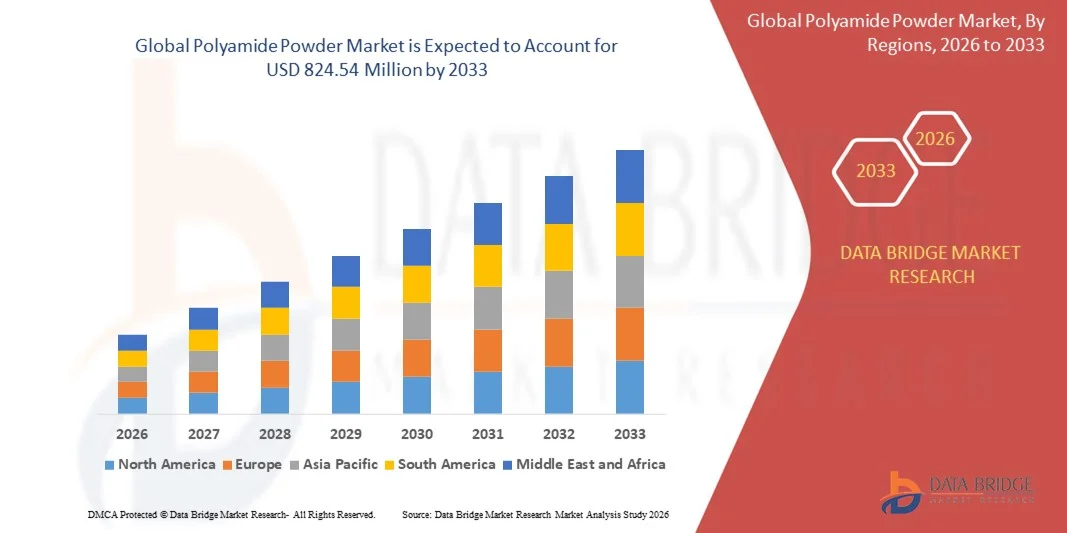
- The global polyamide powder market for 3D printing size was valued at USD 243 million in 2025 and is expected to reach USD 824.54 million by 2033, at a CAGR of 16.50% during the forecast period
- The market growth is largely fueled by the expanding adoption of additive manufacturing across aerospace, automotive, medical, and consumer goods sectors, where polyamide powders are extensively preferred for producing lightweight, durable, and high-precision components. The rising shift toward cost-efficient prototyping and small-batch production is further accelerating demand for PA powders, as industries increasingly replace traditional manufacturing with powder-bed fusion technologies such as SLS and MJF
- Furthermore, continuous advancements in polyamide powder formulations, including reinforced, bio-based, and high-performance grades, are enabling manufacturers to achieve superior mechanical strength, thermal stability, and design flexibility. These innovations are strengthening the suitability of PA powders for end-use parts and expanding their application scope across demanding industrial environments, thereby significantly boosting the market’s growth
Polyamide Powder Market for 3D Printing Analysis
- Polyamide powders, used primarily in selective laser sintering and multi-jet fusion technologies, have become essential materials in 3D printing due to their excellent mechanical properties, durability, and ability to produce complex geometries without support structures. Their versatility allows industries to manufacture functional prototypes, end-use components, and customized products across aerospace, automotive, medical, and consumer applications
- The escalating demand for polyamide powders is driven by the growing industrial transition toward lightweight materials, reduced production time, and enhanced design freedom enabled by additive manufacturing. As companies prioritize high-strength polymers that offer excellent dimensional stability and environmental resistance, polyamide powders continue to gain prominence as the preferred material choice for production-grade 3D-printed parts
- North America dominated the polyamide powder market for 3D printing with a share of 41.7% in 2025, due to strong adoption of additive manufacturing across aerospace, automotive, medical, and defense sectors
- Asia-Pacific is expected to be the fastest growing region in the polyamide powder market for 3D printing during the forecast period due to rapid industrial expansion, rising disposable incomes, and accelerating adoption of 3D printing across China, Japan, India, and South Korea
- Selective laser sintering segment dominated the market with a market share of 64.8% in 2025, due to its long-standing adoption across industrial 3D printing environments and its proven ability to deliver highly durable, functional prototypes. Manufacturers prefer SLS for its excellent mechanical strength, precision, and suitability for low-volume production runs. The technology supports a wide range of polyamide powders, enabling flexible application development in aerospace, automotive, and medical sectors. Its compatibility with high-performance PA11 and PA12 materials reinforces its competitive edge. The absence of support structures during printing further improves production efficiency and cost performance, strengthening its continued leadership
Report Scope and Polyamide Powder Market for 3D Printing Segmentation
|
Attributes |
Polyamide Powder Market for 3D Printing Key Market Insights |
|
Segments Covered |
|
|
Countries Covered |
North America
Europe
Asia-Pacific
Middle East and Africa
South America
|
|
Key Market Players |
|
|
Market Opportunities |
|
|
Value Added Data Infosets |
In addition to the insights on market scenarios such as market value, growth rate, segmentation, geographical coverage, and major players, the market reports curated by the Data Bridge Market Research also include import export analysis, production capacity overview, production consumption analysis, price trend analysis, climate change scenario, supply chain analysis, value chain analysis, raw material/consumables overview, vendor selection criteria, PESTLE Analysis, Porter Analysis, and regulatory framework. |
Polyamide Powder Market for 3D Printing Trends
Rising Adoption of High-Performance and Sustainable Polyamide Powders
- A major trend is the surging adoption of high-performance polyamide powders that deliver strong mechanical stability and heat resistance, supporting advanced 3D printed components across sectors such as aerospace, automotive, and healthcare. This trend is reshaping material selection as industries demand reliability and precision in functional applications
- For instance, EOS GmbH is witnessing growing preference for its PA 1101 and PA 2200 powders, which offer high rigidity and bio-based composition. This reflects a broader shift toward materials that combine durability with environmentally conscious production
- Sustainable polyamide powders produced from renewable feedstocks such as castor oil are gaining traction, as manufacturers prioritize eco-friendly alternatives that help reduce carbon impact. This supports long-term material innovation aligned with global sustainability goals
- Demand for materials that support mass customization is increasing, as PA11 and PA12 powders enable accurate detailing, flexibility, and consistent part geometry. Industries are adopting these materials to produce specialized components with enhanced repeatability
- Compatibility with advanced printing technologies such as SLS and MJF is reinforcing market interest, as these systems require powders that deliver stable flow, uniform melting, and high surface quality. This compatibility ensures reliable production outcomes across varied applications
- The trend is strengthening as industries emphasize lightweighting, sustainability, and performance optimization, establishing polyamide powders as essential materials for next-generation additive manufacturing
Polyamide Powder Market for 3D Printing Dynamics
Driver
Increasing Use of Additive Manufacturing for Lightweight Functional Components
- A key driver is the expanding role of additive manufacturing in producing lightweight yet durable components for industrial applications. Polyamide powders support this shift by offering an optimal balance of strength, flexibility, and reduced weight
- For instance, BMW Group uses PA12 powders for producing lightweight functional automotive parts, enabling rapid prototyping and improved design efficiency. This adoption highlights how polyamide powders enhance performance while supporting material reduction
- Industries such as aerospace and transportation are relying on polyamide powders to replace metal parts in selected applications, enabling lower fuel consumption and improved operational efficiency. This reinforces the value of lightweight polymer engineering
- Growing acceptance of end-use 3D printed parts is accelerating demand for PA11 and PA12 powders because they offer durability, fatigue resistance, and stable performance under continuous use. These capabilities improve the feasibility of polymer-based functional components
- As companies prioritize material efficiency and structural optimization, polyamide powders are becoming integral to modern component design. This driver continues to shape additive manufacturing strategies across multiple sectors
Restraint/Challenge
High Material and Production Costs
- High material costs associated with premium polyamide powders remain a major challenge for manufacturers pursuing large-scale additive production. These powders require specialized processing, which further elevates operational expenses
- For instance, companies such as Arkema offer high-performance PA11 and PA12 powders that come at elevated prices, limiting adoption among cost-sensitive users. This cost barrier affects expansion in smaller enterprises and emerging regions
- Production workflows for polyamide powders require controlled environments, advanced 3D printers, and skilled operators, all of which contribute to high setup and running costs. These requirements raise the financial threshold for new adopters
- Post-processing effort, powder handling, and waste management add significant time and cost to manufacturing cycles, reducing overall cost-efficiency. These factors hinder scalability for high-volume production
- Addressing cost-related challenges through improved material efficiency, optimized printing processes, and better recycling practices will be essential for broadening market accessibility and ensuring sustained growth within the polyamide powder segment
Polyamide Powder Market for 3D Printing Scope
The market is segmented on the basis of technology, material, and end-use industry.
- By Technology
On the basis of technology, the polyamide powder market for 3D printing is segmented into Selective Laser Sintering and Multi Jet Fusion. The Selective Laser Sintering segment dominated the market with the largest revenue share of 64.8% in 2025 due to its long-standing adoption across industrial 3D printing environments and its proven ability to deliver highly durable, functional prototypes. Manufacturers prefer SLS for its excellent mechanical strength, precision, and suitability for low-volume production runs. The technology supports a wide range of polyamide powders, enabling flexible application development in aerospace, automotive, and medical sectors. Its compatibility with high-performance PA11 and PA12 materials reinforces its competitive edge. The absence of support structures during printing further improves production efficiency and cost performance, strengthening its continued leadership.
The Multi Jet Fusion segment is anticipated to witness the fastest growth rate from 2026 to 2033, driven by rapid advancements in printing speeds, surface finish improvements, and strong adoption among service bureaus. MJF technology provides superior productivity benefits that reduce lead times across prototyping and small-batch manufacturing. Businesses in automotive and consumer goods sectors are increasingly choosing MJF for its ability to deliver high dimensional accuracy and fine detailing. The technology’s compatibility with advanced polyamide grades supports the production of durable, end-use parts. Enhanced process control ensures material uniformity and optimized mechanical properties. Rising preference for economical batch production positions MJF as a transformative growth engine in the market.
- By Material
On the basis of material, the market is segmented into Polyamide 11, Polyamide 12, Polyamide 2200, Polyamide 6, Polyamide 11 CF & GF, Polyamide 12 CF & GF, and Others. The Polyamide 12 segment dominated the market with the largest revenue share in 2025 due to its exceptional balance of toughness, chemical resistance, and printability across diverse 3D printing platforms. PA12 is widely preferred for its superior moisture resistance and dimensional stability, making it suitable for rigorous industrial applications. Its extensive certification compatibility strengthens adoption in aerospace and automotive production workflows. The material enables consistent surface quality and low shrinkage, supporting the creation of high-end functional components. Growing usage of PA12 in medical device housings and customized parts further consolidates its leadership position.
The Polyamide 11 CF & GF segment is expected to witness the fastest CAGR from 2026 to 2033, propelled by rising demand for high-strength, lightweight composite-based powders. PA11 reinforced with carbon fiber or glass fiber enables superior stiffness, heat resistance, and mechanical durability required in demanding engineering environments. Industries such as defense, aerospace, and high-performance automotive increasingly depend on these materials for load-bearing structural components. Advancements in composite powder formulation are enabling improved recyclability and process consistency, enhancing market attractiveness. The segment benefits from the expansion of high-speed additive manufacturing systems optimized for reinforced polyamide grades. Upgrading of production lines for fiber-reinforced feedstock is accelerating adoption, resulting in strong long-term growth prospects.
- By End-Use Industry
On the basis of end-use industry, the market is segmented into aerospace, automotive, medical, defense, consumer goods, and others. The aerospace segment dominated the market with the largest revenue share in 2025 due to stringent performance requirements that favor lightweight, durable polyamide-based 3D-printed components. Polyamide powders enable the production of complex geometries with excellent fatigue resistance, which is essential for interior cabin parts, brackets, and UAV components. Leading aerospace OEMs rely on PA11 and PA12 for certified production workflows supporting customized, small-batch components. The material’s high chemical stability and temperature tolerance facilitate its use in challenging operational environments. Rising investments in additive manufacturing qualification programs continue to reinforce the segment’s dominance across global aerospace supply chains.
The medical segment is projected to record the fastest growth from 2026 to 2033, driven by increasing adoption of patient-specific implants, surgical guides, and customized prosthetics. Polyamide powders, especially medical-grade PA11 and PA12, support biocompatibility and high design flexibility required in advanced medical applications. Healthcare facilities are embracing 3D printing for faster production of tailored components that reduce surgical time and enhance patient outcomes. Growth is supported by expanding regulatory approvals for polymer-based additive manufacturing materials. Hospitals and specialized 3D printing labs are integrating high-precision SLS and MJF systems to scale personalized medical device production. Continuous progress in material purity and clinical validation is strengthening the healthcare sector’s transition toward polyamide-based 3D printing.
Polyamide Powder Market for 3D Printing Regional Analysis
- North America dominated the polyamide powder market for 3D printing with the largest revenue share of 41.7% in 2025, driven by strong adoption of additive manufacturing across aerospace, automotive, medical, and defense sectors
- The region benefits from an advanced industrial ecosystem where leading OEMs and service bureaus rely on polyamide-based powders for high-performance prototyping and production
- Demand continues to rise as companies increasingly shift toward lightweight functional components requiring superior mechanical strength and thermal stability. High R&D investment, robust government initiatives supporting digital manufacturing, and the presence of leading 3D printer manufacturers reinforce North America’s leadership in the regional landscape
U.S. Polyamide Powder Market for 3D Printing Insight
The U.S. captured the largest revenue share within North America in 2025, supported by the rapid expansion of additive manufacturing in aerospace, healthcare, and automotive domains. Companies in the U.S. are adopting polyamide powders for applications involving durable, lightweight, and complex structures, especially in aerospace interiors, orthopedic devices, and automotive prototypes. Growth is strengthened by strong federal funding for 3D printing innovation and the increasing integration of SLS and MJF technologies across production lines. The presence of key material suppliers and advanced manufacturing hubs further accelerates market penetration.
Europe Polyamide Powder Market for 3D Printing Insight
Europe is expected to expand at a substantial CAGR during the forecast period, driven by stringent quality standards and the rising adoption of sustainable, high-performance materials. Countries with advanced industrial bases are increasingly utilizing PA powders for automotive lightweighting, medical device manufacturing, and electric mobility applications. The region demonstrates strong preference for precision-engineered components produced using SLS and MJF technologies due to their consistency and mechanical reliability. Government initiatives promoting additive manufacturing, coupled with the rise of Industry 4.0 adoption, continue to strengthen Europe’s growth momentum across industrial and commercial applications.
U.K. Polyamide Powder Market for 3D Printing Insight
The U.K. market is projected to grow at a notable CAGR, supported by increasing investments in digital manufacturing and advancements in aerospace and healthcare sectors. Polyamide powders are gaining preference for producing lightweight, durable parts required for aircraft interiors, medical devices, and industrial tooling. The growing presence of 3D printing service providers, paired with ongoing R&D in advanced polymers and composites, enhances adoption. Rising use of additive manufacturing in renovation projects and small-batch customized production further strengthens market demand.
Germany Polyamide Powder Market for 3D Printing Insight
Germany is anticipated to witness strong growth, driven by its leadership in engineering, automotive manufacturing, and industrial automation. The country's emphasis on high-precision components and sustainable materials supports increased usage of PA powders in additive manufacturing workflows. German manufacturers extensively deploy SLS and MJF technologies to produce durable parts for EVs, machinery, and medical applications. The nation’s strong innovation ecosystem, growing focus on performance-driven materials, and integration of digital factories solidify Germany’s position as a key contributor to the European market.
Asia-Pacific Polyamide Powder Market for 3D Printing Insight
Asia-Pacific is poised to record the fastest CAGR during 2026 to 2033, supported by rapid industrial expansion, rising disposable incomes, and accelerating adoption of 3D printing across China, Japan, India, and South Korea. The region benefits from strong government initiatives promoting digital manufacturing, expanding industrial automation, and increasing demand for cost-effective production of lightweight components. Growing manufacturing capacity for PA powders and the emergence of domestic 3D printing companies are boosting accessibility and affordability. APAC’s growing role as a global 3D printing hub reinforces its position as the fastest-growing region.
Japan Polyamide Powder Market for 3D Printing Insight
Japan is experiencing strong momentum, driven by its advanced technological ecosystem, preference for precision-engineered components, and growing adoption of IoT-enabled manufacturing. Polyamide powders are increasingly utilized for medical devices, robotics, automotive parts, and consumer electronics due to their high durability and fine-detail capability. The aging population is influencing demand for customized orthopedic devices and medical implants, supporting market expansion. Japan's commitment to innovation and material quality continues to elevate its position in the regional market.
China Polyamide Powder Market for 3D Printing Insight
China held the largest revenue share in the Asia-Pacific region in 2025, supported by its rapidly growing industrial base, strong domestic production of 3D printers, and increasing consumption of PA powders across automotive, consumer electronics, and healthcare. The nation’s aggressive smart manufacturing initiatives and widespread integration of SLS and MJF technologies across factories strengthen market presence. A large pool of cost-competitive material manufacturers expands availability and drives down production costs. China’s expanding middle class and robust commercial adoption of additive manufacturing reinforce its leadership within APAC.
Polyamide Powder Market for 3D Printing Share
The polyamide powder market for 3D printing industry is primarily led by well-established companies, including:
- 3D Systems, Inc (U.S.)
- Arkema (France)
- EnvisionTEC (U.S.)
- SABIC (Saudi Arabia)
- Materialise (Belgium)
- EOS (Germany)
- PolyOne Corporation / Avient Corporation (U.S.)
- Dow (U.S.)
- BASF SE (Germany)
- DSM / dsm-firmenich (Netherlands)
- Sandvik AB (Sweden)
- Evonik Industries (Germany)
- GKN Sinter Metals Engineering GmbH (U.K.)
- Sandvik AB (Sweden)
Latest Developments in Global Polyamide Powder Market for 3D Printing
- In November 2025, Arkema showcased its high-recyclability Orgasol PA12 powder at Formnext 2025, a development that strengthens the company’s position in sustainable additive manufacturing. The introduction of a PA12 powder engineered for enhanced recyclability, improved surface finish, and cost-efficient material reuse is expected to accelerate industry adoption across automotive, consumer goods, and industrial production. This innovation aligns with the market’s shift toward eco-friendly materials and supports broader transition toward circular manufacturing in 3D printing
- In March 2025, Evonik expanded its presence in the North American market through a strategic distribution partnership with 3DChimera, enabling wider availability of INFINAM SLS PA12 powders. This collaboration is expected to enhance supply chain accessibility, improve technical support for end users, and strengthen Evonik’s competitive foothold in a rapidly expanding regional landscape. The partnership reinforces the growing demand for high-performance PA materials across industrial 3D printing applications and accelerates adoption in small- and mid-scale manufacturing environments
- In November 2024, Evonik introduced flame-retardant PA12 FR powder and carbon-black-embedded core-shell PA materials, marking a significant advancement in safety-driven and durability-focused 3D printing solutions. These materials broaden the application scope of polyamide powders in sectors requiring thermal stability, electrical protection, and UV resistance. The launch supports market expansion into aerospace interiors, electronics housings, industrial equipment, and consumer devices, reinforcing the need for specialized PA formulations with enhanced environmental performance
- In October 2023, Evonik released INFINAM eCO PA12, the first PA12 powder made from fully bio-circular raw materials derived from waste cooking oil, representing a major step toward decarbonizing additive manufacturing. This material delivers comparable mechanical performance to standard PA12 while reducing carbon emissions by nearly three-quarters, setting a new benchmark for sustainability in polymer powders. Its introduction is expected to influence material procurement strategies across aerospace, automotive, and consumer goods industries seeking lower-carbon manufacturing pathways
- In October 2023, Evonik launched INFINAM TPA 4006 P, a PA12-based elastomer powder offering rubber-like flexibility, high impact strength, and strong recyclability for SLS systems. This innovation expands the material versatility of polyamide powders and opens new opportunities in footwear, sports equipment, medical devices, and flexible industrial components. The availability of an elastomeric PA solution with reliable performance and favorable reuse ratios supports the broader shift toward functional, production-grade polymers in additive manufacturing

- Interactive Data Analysis Dashboard
- Company Analysis Dashboard for high growth potential opportunities
- Research Analyst Access for customization & queries
- Competitor Analysis with Interactive dashboard
- Latest News, Updates & Trend analysis
- Harness the Power of Benchmark Analysis for Comprehensive Competitor Tracking
Global Polyamide Powder Market, Supply Chain Analysis and Ecosystem Framework
To support market growth and help clients navigate the impact of geopolitical shifts, DBMR has integrated in-depth supply chain analysis into its Global Polyamide Powder Market research reports. This addition empowers clients to respond effectively to global changes affecting their industries. The supply chain analysis section includes detailed insights such as Global Polyamide Powder Market consumption and production by country, price trend analysis, the impact of tariffs and geopolitical developments, and import and export trends by country and HSN code. It also highlights major suppliers with data on production capacity and company profiles, as well as key importers and exporters. In addition to research, DBMR offers specialized supply chain consulting services backed by over a decade of experience, providing solutions like supplier discovery, supplier risk assessment, price trend analysis, impact evaluation of inflation and trade route changes, and comprehensive market trend analysis.
Data collection and base year analysis are done using data collection modules with large sample sizes. The stage includes obtaining market information or related data through various sources and strategies. It includes examining and planning all the data acquired from the past in advance. It likewise envelops the examination of information inconsistencies seen across different information sources. The market data is analysed and estimated using market statistical and coherent models. Also, market share analysis and key trend analysis are the major success factors in the market report. To know more, please request an analyst call or drop down your inquiry.
The key research methodology used by DBMR research team is data triangulation which involves data mining, analysis of the impact of data variables on the market and primary (industry expert) validation. Data models include Vendor Positioning Grid, Market Time Line Analysis, Market Overview and Guide, Company Positioning Grid, Patent Analysis, Pricing Analysis, Company Market Share Analysis, Standards of Measurement, Global versus Regional and Vendor Share Analysis. To know more about the research methodology, drop in an inquiry to speak to our industry experts.
Data Bridge Market Research is a leader in advanced formative research. We take pride in servicing our existing and new customers with data and analysis that match and suits their goal. The report can be customized to include price trend analysis of target brands understanding the market for additional countries (ask for the list of countries), clinical trial results data, literature review, refurbished market and product base analysis. Market analysis of target competitors can be analyzed from technology-based analysis to market portfolio strategies. We can add as many competitors that you require data about in the format and data style you are looking for. Our team of analysts can also provide you data in crude raw excel files pivot tables (Fact book) or can assist you in creating presentations from the data sets available in the report.













