


Polybutylene Adipate Terephthalate (PBAT) Market Overview
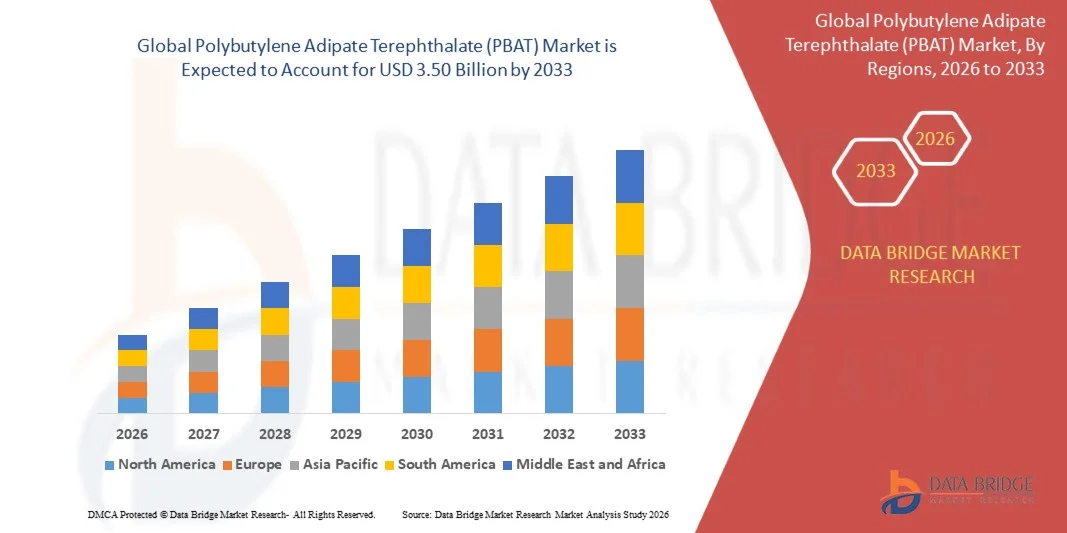
As per Data Bridge Market Research analysis, the polybutylene adipate terephthalate (PBAT) market was valued at USD 1.71 billion in 2025 and is projected to reach USD 3.50 billion by 2033, growing at a CAGR of 9.40% from 2026 to 2033. The market is experiencing consistent growth driven by increasing demand for biodegradable and compostable plastics, stringent regulations restricting single-use plastics, and expanding adoption across packaging, agriculture, and consumer goods industries.
The growing emphasis on sustainable packaging solutions, coupled with government initiatives promoting biodegradable materials and rising consumer preference for environmentally friendly products, is accelerating PBAT adoption worldwide. PBAT is increasingly replacing conventional petroleum-based plastics in compostable bags, agricultural mulch films, food packaging, and disposable products owing to its flexibility, biodegradability, and compatibility with existing plastic processing infrastructure. Continuous advancements in biodegradable polymer formulations and increasing investments in circular economy initiatives are further supporting market expansion.
Market Size & Forecast
- Global Market Value (2025): USD 1.71 Billion
- Expected Market Value (2033): USD 3.50 Billion
- Forecast CAGR (2026–2033): 9.40%
- Leading Region in 2025: Asia-Pacific
- Fastest Growing Region: Europe
Key Market Trends & Insights
- Asia-Pacific dominated the polybutylene adipate terephthalate (PBAT) market with an estimated revenue share of 52.4% in 2025, supported by large-scale production capacity expansions in China, favorable biodegradable plastics policies, and strong demand from packaging and agricultural applications
- The compostable segment led the market with a 58.7% share in 2025, driven by increasing regulatory support for certified compostable plastics and growing adoption in flexible packaging applications
- Europe is expected to be the fastest-growing regional market, registering a CAGR of 16.9% from 2026 to 2033, fueled by stringent environmental regulations, circular economy initiatives, and growing investments in compostable packaging materials
- Biodegradable are the fastest-growing product type, projected to register a CAGR of 18.4%, reflecting the surge in demand for environmentally friendly alternatives to conventional plastics
- The plasticizers segment dominated the additives category with a 42.3% revenue share in 2025, led by its critical role in enhancing flexibility, softness, and processability of PBAT-based products
- Composite bags accounted for 36.8% of the market, preferred by widespread adoption of compostable shopping bags, retail carry bags, and waste collection bags
- The medical clothing segment is the fastest-growing application category, with a CAGR of 19.3%, driven by increasing interest in sustainable healthcare materials
Report Scope and Polybutylene Adipate Terephthalate (PBAT) Market Segmentation
|
Attributes |
Polybutylene Adipate Terephthalate (PBAT) Key Market Insights |
|
Segments Covered |
|
|
Countries Covered |
North America
Europe
Asia-Pacific
Middle East and Africa
South America
|
|
Key Market Players |
|
|
Market Opportunities |
|
|
Value Added Data Infosets |
In addition to the insights on market scenarios such as market value, growth rate, segmentation, geographical coverage, and major players, the market reports curated by the Data Bridge Market Research also include import export analysis, production capacity overview, production consumption analysis, price trend analysis, climate change scenario, supply chain analysis, value chain analysis, raw material/consumables overview, vendor selection criteria, PESTLE Analysis, Porter Analysis, and regulatory framework. |
Polybutylene Adipate Terephthalate (PBAT) Market Trends
Trend: Accelerating Adoption of Compostable Flexible Packaging
Brand owners, retailers, and packaging manufacturers are increasingly adopting PBAT-based materials to meet sustainability commitments and comply with tightening regulations on single-use plastics. PBAT offers flexibility, toughness, and compostability, making it suitable for shopping bags, food packaging films, organic waste bags, and other flexible packaging applications where conventional biodegradable polymers may have performance limitations. The growing emphasis on circular economy initiatives and sustainable packaging solutions is further driving investments in PBAT production capacity, while advancements in PBAT blending technologies are improving material properties and expanding end-use applications across consumer goods and industrial packaging sectors. For instance, in June 2024, BASF introduced biomass-balanced ecoflex (PBAT), expanding its certified compostable biopolymer portfolio for the packaging industry. The new PBAT grade replaces fossil feedstocks with renewable waste-based raw materials, offering a 60% lower product carbon footprint while maintaining identical processing and performance characteristics, supporting broader adoption of compostable packaging solutions
Growing regulatory pressure and corporate sustainability targets are accelerating PBAT demand in compostable flexible packaging applications.
Polybutylene Adipate Terephthalate (PBAT) Market Dynamics
Key Market Driver: Rising Government Restrictions on Conventional Single-Use Plastics
The increasing implementation of regulations restricting conventional plastic products has created substantial demand for biodegradable alternatives such as PBAT. Governments worldwide are introducing bans, taxes, and extended producer responsibility frameworks aimed at reducing plastic pollution and encouraging compostable materials. PBAT has emerged as a preferred material due to its biodegradability, processability, and compatibility with existing film manufacturing infrastructure. Packaging producers, retailers, and consumer goods companies are therefore expanding the use of PBAT-based products to comply with evolving environmental regulations while maintaining product performance and operational efficiency. For instance, in July 2021, the European Union began applying the Single-Use Plastics (SUP) Directive, prohibiting the placement of certain single-use plastic products on the EU market and accelerating investment in compostable and biodegradable materials, including PBAT, for packaging applications.
Expanding regulatory action against conventional plastics remains one of the strongest long-term growth drivers for the PBAT market.
Key Restraint/Challenge: Higher Production Costs Compared with Conventional Plastics
A significant challenge in the PBAT market is the relatively higher production cost compared with traditional petroleum-based plastics. PBAT manufacturing requires specialized raw materials and production processes, while compostable polymer supply chains remain less mature than conventional plastics infrastructure. In addition, fluctuations in feedstock prices and limited economies of scale in some regions continue to impact overall product competitiveness. These cost factors can restrict adoption among price-sensitive packaging manufacturers and end users, particularly in developing economies where cost remains a primary purchasing criterion. For instance, in July 2024, a study published in Frontiers in Bioengineering and Biotechnology identified high production costs, immature value chains, feedstock availability, and limited end-of-life infrastructure as key barriers to the large-scale commercialization of biodegradable polymers, including PBAT, despite increasing regulatory support and sustainability initiatives.
Cost competitiveness remains a critical challenge that must be addressed through scale expansion, technological innovation, and supply-chain optimization.
Key Market Opportunity: Expansion of Biodegradable Agricultural Mulch Film Applications
The increasing adoption of biodegradable mulch films presents a significant growth opportunity for PBAT manufacturers. Conventional polyethylene mulch films generate substantial agricultural plastic waste and require costly collection and disposal processes after harvest. PBAT-based biodegradable mulch films can degrade under suitable environmental conditions, reducing labor requirements and minimizing soil contamination concerns. Growing investments in sustainable agriculture, combined with government support for environmentally friendly farming practices, are creating new commercial opportunities for PBAT suppliers across major agricultural regions. For instance, in July 2024, a study published in Science of The Total Environment reported that PBAT-based biodegradable mulch films can help address residual plastic pollution in agricultural soils while supporting agricultural performance, reinforcing their growing adoption as sustainable alternatives to conventional polyethylene mulch films.
Expanding use of biodegradable mulch films is expected to create a substantial long-term growth avenue for PBAT producers.
Polybutylene Adipate Terephthalate (PBAT) Market Scope
The polybutylene adipate terephthalate (PBAT) market is segmented on the basis of product type, additives, application, and end-use.
- By Product Type
On the basis of product type, the polybutylene adipate terephthalate (PBAT) market is segmented into biodegradable, compostable, and non-biodegradable. The compostable segment dominated the market with an estimated 58.7% share in 2025, due to increasing regulatory support for certified compostable plastics and growing adoption in flexible packaging applications. Compostable PBAT products are extensively used in shopping bags, food packaging films, organic waste bags, and agricultural applications where end-of-life sustainability is critical. Governments across Europe, North America, and Asia-Pacific are encouraging the transition toward compostable materials to reduce plastic pollution. PBAT’s excellent flexibility and processability make it one of the preferred materials for industrial composting applications. Manufacturers are also developing advanced PBAT blends to improve compostability performance while maintaining mechanical strength. Strong demand from the packaging industry continues to support the segment’s leadership position.
The biodegradable segment is expected to witness the fastest growth at a CAGR of 18.4% from 2026 to 2033, driven by increasing demand for environmentally friendly alternatives to conventional plastics. Growing awareness regarding plastic waste management and sustainability is encouraging industries to adopt biodegradable polymer solutions. PBAT-based biodegradable materials are increasingly being used in agriculture, packaging, and consumer goods applications. Continuous advancements in polymer technology are improving degradation performance under various environmental conditions. Expanding investments in biodegradable materials research and development are further supporting market growth. Rising government incentives and sustainability commitments from major brands are expected to accelerate adoption globally.
- By Additives
On the basis of additives, the polybutylene adipate terephthalate (PBAT) market is segmented into antioxidants, UV stabilizers, flame retardants, and plasticizers. The plasticizers segment dominated the market with an estimated 42.3% share in 2025 due to its critical role in enhancing flexibility, softness, and processability of PBAT-based products. Plasticizers help improve film-forming properties and mechanical performance, making them highly suitable for packaging films, compostable bags, and agricultural applications. Manufacturers increasingly utilize plasticizers to optimize processing efficiency and product durability. The growing demand for flexible biodegradable packaging solutions continues to drive consumption. Plasticizers also enable better compatibility when PBAT is blended with other biodegradable polymers such as PLA and starch. Their importance in maintaining performance characteristics across diverse end-use applications supports their dominant market position.
The UV stabilizers segment is projected to register the fastest growth at a CAGR of 18.9% from 2026 to 2033 owing to increasing use of PBAT products in outdoor applications. Agricultural mulch films and outdoor packaging materials require protection against ultraviolet radiation to maintain performance throughout their service life. UV stabilizers significantly improve weather resistance and product longevity. Rising adoption of biodegradable agricultural films is creating strong demand for advanced stabilization technologies. Manufacturers are investing in specialty additive formulations to improve outdoor durability while maintaining biodegradability. Increasing agricultural modernization initiatives are expected to further support segment expansion.
- By Application
On the basis of application, the polybutylene adipate terephthalate (PBAT) market is segmented into composite bags, cling films, bin bags, and medical clothing. The composite bags segment held the largest market share of 36.8% in 2025, driven by widespread adoption of compostable shopping bags, retail carry bags, and waste collection bags. Governments worldwide are implementing restrictions on conventional plastic bags, encouraging the use of PBAT-based alternatives. Composite bags offer excellent flexibility, tear resistance, and compostability characteristics. Retailers and consumer brands are increasingly adopting sustainable packaging materials to meet environmental targets. The segment also benefits from strong demand from municipal waste management programs utilizing compostable collection bags. Continued regulatory support is expected to maintain the segment’s leading position.
The medical clothing segment is anticipated to witness the fastest growth at a CAGR of 19.3% from 2026 to 2033 due to increasing interest in sustainable healthcare materials. Hospitals and healthcare institutions are seeking environmentally responsible alternatives for disposable protective apparel and medical textiles. PBAT-based materials provide flexibility, comfort, and potential biodegradability advantages compared to conventional plastics. Growing concerns regarding medical waste generation are encouraging research into biodegradable healthcare products. Continuous innovation in polymer processing technologies is expanding application possibilities within the medical sector. Increasing sustainability initiatives in healthcare systems are expected to drive long-term demand.
- By End-Use
On the basis of end-use, the polybutylene adipate terephthalate (PBAT) market is segmented into packaging, agriculture, fishery, consumer goods, and coatings. The packaging segment dominated the market with a 61.8% revenue share in 2025 due to extensive utilization of PBAT in compostable bags, food packaging films, and flexible packaging solutions. Packaging remains the primary application area for biodegradable polymers because of increasing environmental regulations and consumer demand for sustainable products. PBAT offers an attractive combination of flexibility, toughness, and compostability, making it highly suitable for packaging applications. Major brand owners are actively transitioning toward biodegradable packaging materials to achieve sustainability goals. Growing investments in circular economy initiatives continue to strengthen demand. The segment remains the largest contributor to overall PBAT consumption globally.
The agriculture segment is expected to register the fastest growth at a CAGR of 18.7% from 2026 to 2033, supported by rising adoption of biodegradable mulch films and agricultural coverings. Conventional plastic films often create significant disposal challenges and contribute to soil contamination. PBAT-based agricultural films provide an environmentally friendly alternative by reducing residual plastic accumulation in farmland. Increasing government support for sustainable agricultural practices is encouraging adoption across major farming regions. Farmers are increasingly recognizing the operational benefits associated with biodegradable films, including reduced collection and disposal costs. Continued focus on sustainable agriculture and soil health management is expected to accelerate segment growth over the coming years.
Polybutylene Adipate Terephthalate (PBAT) Market Regional Analysis
Asia-Pacific dominated the polybutylene adipate terephthalate (PBAT) market with an estimated revenue share of 52.4% in 2025, supported by large-scale production capacity expansions in China, favorable biodegradable plastics policies, and strong demand from packaging and agricultural applications. The region also benefits from increasing adoption of compostable packaging, rapid expansion of food delivery and e-commerce industries, and growing investments in biodegradable polymer production facilities. Rising regulatory restrictions on conventional plastics, coupled with increasing demand for environmentally friendly packaging solutions, are accelerating market development. Continuous capacity expansions, technological advancements in biopolymer processing, and growing focus on circular economy objectives continue to strengthen Asia-Pacific's leadership position in the PBAT market.
U.S. Polybutylene Adipate Terephthalate (PBAT) Market Insight
The U.S. polybutylene adipate terephthalate (PBAT) market is witnessing strong growth due to rising demand for compostable packaging materials, increasing corporate sustainability commitments, and expanding regulatory focus on reducing plastic waste. The country's well-established packaging industry, combined with growing investments in biodegradable polymer innovation, is driving PBAT adoption across food packaging, retail bags, and organic waste collection applications. In addition, increasing consumer preference for environmentally responsible products is accelerating market penetration. California's SB 54 Plastic Pollution Prevention and Packaging Producer Responsibility Act, enacted in 2022, requires a 25% reduction in single-use plastic packaging by 2032 and is accelerating demand for compostable materials.
Europe Polybutylene Adipate Terephthalate (PBAT) Market Insight
The Europe polybutylene adipate terephthalate (PBAT) market remains a major contributor to global revenue, driven by stringent environmental regulations, strong circular economy initiatives, and widespread adoption of biodegradable packaging solutions. The region's leadership in sustainable materials development and compostable plastics innovation is supporting continued market expansion. Increasing investments in biodegradable polymer production capacity, coupled with growing consumer awareness regarding plastic pollution, continue to enhance PBAT adoption throughout Europe. European Union’s Single-Use Plastics (SUP) Directive (Directive (EU) 2019/904) became applicable, introducing restrictions on certain single-use plastic products and accelerating the adoption of sustainable alternatives, including biodegradable and compostable materials, across packaging applications.
U.K. Polybutylene Adipate Terephthalate (PBAT) Market Insight
The U.K. polybutylene adipate terephthalate (PBAT) market is experiencing steady growth, supported by increasing adoption of sustainable packaging solutions, government efforts to reduce plastic waste, and rising demand for compostable materials. Packaging manufacturers and consumer goods companies are increasingly exploring biodegradable alternatives to comply with sustainability targets and environmental regulations. Furthermore, ongoing innovation in biodegradable polymer technologies is improving product performance and expanding commercial applications. In April 2022, the U.K. Plastic Packaging Tax came into effect, applying a tax on plastic packaging manufactured in or imported into the U.K. that contains less than 30% recycled plastic, encouraging manufacturers and businesses to increase the use of recycled, sustainable, and alternative packaging materials.
Germany Polybutylene Adipate Terephthalate (PBAT) Market Insight
The Germany polybutylene adipate terephthalate (PBAT) market is expanding steadily due to the country's advanced packaging industry, strong sustainability initiatives, and increasing adoption of biodegradable materials. Manufacturers are actively investing in innovative compostable packaging solutions to align with national and European environmental objectives. Continuous advancements in biopolymer processing technologies and growing demand from food packaging and consumer goods sectors are further supporting market growth. Germany remains Europe's largest market for bioplastics consumption and is a leading adopter of compostable packaging solutions, supported by extensive recycling and circular economy infrastructure
Japan Polybutylene Adipate Terephthalate (PBAT) Market Insight
The Japan polybutylene adipate terephthalate (PBAT) market is witnessing consistent growth due to increasing investments in sustainable materials, rising demand for environmentally friendly packaging solutions, and strong corporate commitments toward carbon neutrality. Packaging manufacturers and consumer goods companies are increasingly adopting biodegradable materials to reduce environmental impact and meet evolving consumer expectations. Moreover, ongoing research and development activities in advanced biopolymers are further contributing to market growth. In April 2022, Japan’s Act on Promotion of Resource Circulation for Plastics (Plastic Resource Circulation Act) came into force, promoting plastic reduction, recycling, resource circulation, and the adoption of sustainable material alternatives across product and packaging applications.
China Polybutylene Adipate Terephthalate (PBAT) Market Insight
The China polybutylene adipate terephthalate (PBAT) market is growing rapidly, driven by extensive production capacity expansions, strong government support for biodegradable plastics, and increasing demand from packaging and agricultural sectors. The country has emerged as the world's largest producer and consumer of PBAT, supported by large-scale investments in biodegradable polymer manufacturing facilities. In addition, rising environmental awareness, growing restrictions on conventional plastics, and expanding compostable packaging applications are significantly boosting market demand. China accounts for the majority of global PBAT production capacity, with multiple large-scale capacity expansion projects announced by leading manufacturers in recent years to meet rising domestic and international demand.
Polybutylene Adipate Terephthalate (PBAT) Market Share
The polybutylene adipate terephthalate (PBAT) industry is primarily led by well-established companies, including:
- BASF (Germany)
- Novamont S.p.A. (Italy)
- Mitsubishi Chemical Group Corporation (Japan)
- SK chemicals Co., Ltd. (South Korea)
- Kingfa Sci. & Tech. Co., Ltd. (China)
- WILLEAP (China)
- XINJIANG BLUE RIDGE TUNHE POLYESTER CO. LTD. (China)
- Jiangsu Youcheng CNC Technology Co.,Ltd (China)
- Ruixing Group Co., Ltd. (China)
- Hangzhou Bioking Biochemical Engineering Co.,Ltd. (China)
- Zhejiang Hisun Biomaterials Co., Ltd (China)
- Danimer Scientific (U.S.)
- Biome Bioplastics Limited (U.K.)
- NatureWorks LLC (U.S.)
- Futerro S.A. (Belgium)
- TotalEnergies Corbion (Thailand)
Latest Developments in Polybutylene Adipate Terephthalate (PBAT) Market
- In June 2024, BASF launched biomass-balanced ecoflex F Blend C1200 BMB, a new PBAT (Polybutylene Adipate Terephthalate) grade designed for sustainable packaging applications. The product replaces fossil-based feedstocks with renewable waste-based feedstocks through a certified biomass balance approach and delivers a 60% lower product carbon footprint compared with the standard ecoflex grade
- In September 2023, BASF highlighted the expanded application potential of ecovio, a certified compostable biopolymer compound based on ecoflex PBAT, for sustainable packaging and organic waste collection solutions. The material is designed to combine PBAT’s flexibility and toughness with renewable raw materials, supporting applications such as compostable bags, food packaging films, and agricultural products. The development supports manufacturers seeking alternatives to conventional plastics while maintaining existing processing capabilities
- In October 2023, BASF marked the 25th anniversary of ecoflex, its PBAT-based biodegradable and certified compostable biopolymer introduced commercially in 1998. The company highlighted continued advancements in ecoflex applications, including its use as a base polymer for ecovio compostable compounds used in packaging, organic waste collection, and agricultural applications. The milestone reflected BASF’s long-term development of PBAT technology and its role in enabling compostable plastic solutions for circular economy applications
- In March 2023, Novamont announced the development of new circular material solutions through its Mater-Bi biodegradable and compostable bioplastics portfolio, expanding applications of sustainable polymers into consumer and industrial products. The company’s biodegradable materials are designed for applications including packaging, agriculture, and organic waste management, supporting the transition from conventional plastics toward compostable alternatives
- In August 2022, TGP Bioplastics announced the commercialization of its compostable plastic material developed as an alternative to conventional single-use plastics. The company received financial support from India’s Technology Development Board (TDB) under the Department of Science and Technology to scale up manufacturing and commercialization of its compostable plastic solution. The development supported the expansion of sustainable plastic alternatives for applications affected by single-use plastic restrictions and highlighted increasing investments in compostable polymer technologies across emerging markets

- Interactive Data Analysis Dashboard
- Company Analysis Dashboard for high growth potential opportunities
- Research Analyst Access for customization & queries
- Competitor Analysis with Interactive dashboard
- Latest News, Updates & Trend analysis
- Harness the Power of Benchmark Analysis for Comprehensive Competitor Tracking
Global Polybutylene Adipate Terephthalate Pbat Market, Supply Chain Analysis and Ecosystem Framework
To support market growth and help clients navigate the impact of geopolitical shifts, DBMR has integrated in-depth supply chain analysis into its Global Polybutylene Adipate Terephthalate Pbat Market research reports. This addition empowers clients to respond effectively to global changes affecting their industries. The supply chain analysis section includes detailed insights such as Global Polybutylene Adipate Terephthalate Pbat Market consumption and production by country, price trend analysis, the impact of tariffs and geopolitical developments, and import and export trends by country and HSN code. It also highlights major suppliers with data on production capacity and company profiles, as well as key importers and exporters. In addition to research, DBMR offers specialized supply chain consulting services backed by over a decade of experience, providing solutions like supplier discovery, supplier risk assessment, price trend analysis, impact evaluation of inflation and trade route changes, and comprehensive market trend analysis.
Data collection and base year analysis are done using data collection modules with large sample sizes. The stage includes obtaining market information or related data through various sources and strategies. It includes examining and planning all the data acquired from the past in advance. It likewise envelops the examination of information inconsistencies seen across different information sources. The market data is analysed and estimated using market statistical and coherent models. Also, market share analysis and key trend analysis are the major success factors in the market report. To know more, please request an analyst call or drop down your inquiry.
The key research methodology used by DBMR research team is data triangulation which involves data mining, analysis of the impact of data variables on the market and primary (industry expert) validation. Data models include Vendor Positioning Grid, Market Time Line Analysis, Market Overview and Guide, Company Positioning Grid, Patent Analysis, Pricing Analysis, Company Market Share Analysis, Standards of Measurement, Global versus Regional and Vendor Share Analysis. To know more about the research methodology, drop in an inquiry to speak to our industry experts.
Data Bridge Market Research is a leader in advanced formative research. We take pride in servicing our existing and new customers with data and analysis that match and suits their goal. The report can be customized to include price trend analysis of target brands understanding the market for additional countries (ask for the list of countries), clinical trial results data, literature review, refurbished market and product base analysis. Market analysis of target competitors can be analyzed from technology-based analysis to market portfolio strategies. We can add as many competitors that you require data about in the format and data style you are looking for. Our team of analysts can also provide you data in crude raw excel files pivot tables (Fact book) or can assist you in creating presentations from the data sets available in the report.













