


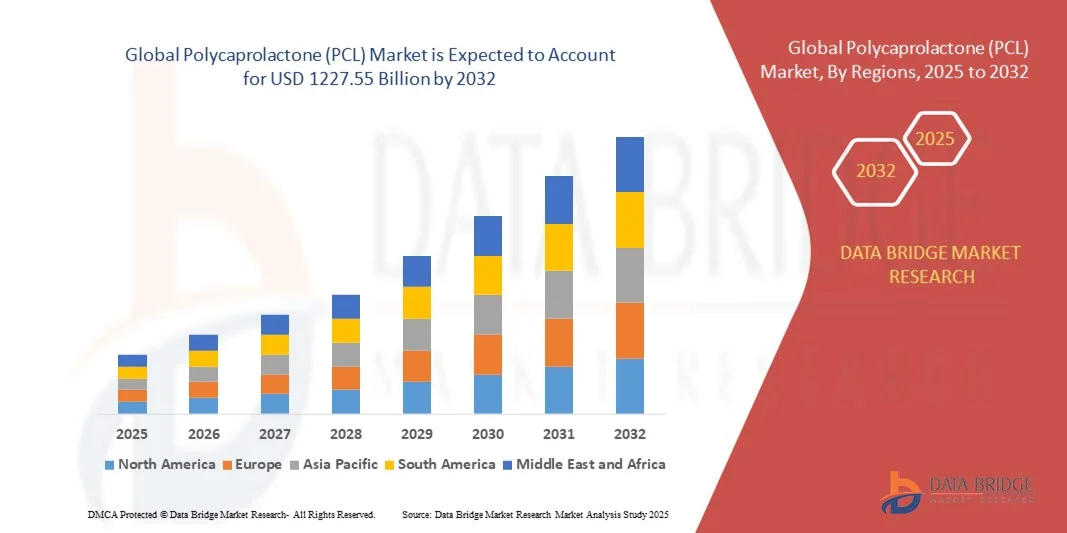
Global Polycaprolactone (PCL) Market Size
- The global polycaprolactone (PCL) market size was valued at USD 552.25 billion in 2024 and is expected to reach USD 1227.55 billion by 2032, growing at a CAGR of 10.50% during the forecast period
- Market expansion is primarily driven by increasing demand for biodegradable polymers across medical, packaging, and agricultural industries, owing to rising environmental concerns and regulatory support for sustainable alternatives
- Additionally, advancements in drug delivery systems and tissue engineering applications are propelling the use of polycaprolactone in healthcare, further accelerating market growth through the forecast period
Global Polycaprolactone (PCL) Market Analysis
- Polycaprolactone (PCL), a biodegradable polyester, is becoming increasingly critical in applications such as medical devices, drug delivery systems, packaging, and 3D printing due to its biocompatibility, ease of processing, and controlled degradation profile
- The rising demand for sustainable and eco-friendly materials is a major factor fueling PCL adoption, supported by regulatory pressure to reduce plastic waste and growing preference for green alternatives across multiple end-use industries
- North America dominated the global polycaprolactone (PCL) market with the largest revenue share of 39.7% in 2024, driven by stringent environmental regulations, a well-established biomedical industry, and strong investments in research and development of biodegradable polymers
- Asia-Pacific is projected to be the fastest-growing region during the forecast period, supported by rapid industrialization, increasing healthcare expenditure, and expanding packaging and agricultural sectors in countries like China and India
- The pellets segment dominated the market with the largest revenue share of 61.4% in 2024, primarily due to its widespread use in industrial applications such as thermoplastic polyurethanes (TPU), 3D printing filaments, and biodegradable packaging
Report Scope and Global Polycaprolactone (PCL) Market Segmentation
|
Attributes |
Polycaprolactone (PCL) Key Market Insights |
|
Segments Covered |
|
|
Countries Covered |
North America
Europe
Asia-Pacific
Middle East and Africa
South America
|
|
Key Market Players |
|
|
Market Opportunities |
|
|
Value Added Data Infosets |
In addition to the insights on market scenarios such as market value, growth rate, segmentation, geographical coverage, and major players, the market reports curated by the Data Bridge Market Research also include import export analysis, production capacity overview, production consumption analysis, price trend analysis, climate change scenario, supply chain analysis, value chain analysis, raw material/consumables overview, vendor selection criteria, PESTLE Analysis, Porter Analysis, and regulatory framework. |
Global Polycaprolactone (PCL) Market Trends
Advanced Functionality Through Material Innovation and Smart Manufacturing
- A significant and accelerating trend in the global Polycaprolactone (PCL) Market is the integration of advanced material science with smart manufacturing technologies such as AI-driven formulation, precision 3D printing, and automated production systems. This synergy is enhancing the performance, customization, and scalability of PCL-based products across industries.
- For instance, in the biomedical field, AI-assisted modeling is being used to design patient-specific implants and drug delivery systems using PCL, optimizing degradation rates and mechanical properties based on individual health data. Companies are also leveraging additive manufacturing to produce complex PCL scaffolds with high precision for tissue engineering applications.
- Smart manufacturing processes allow for tighter control over molecular weight and composition, resulting in more consistent product quality and enabling tailored solutions for applications such as biodegradable packaging, controlled drug release, and agricultural films. These innovations reduce waste and energy consumption, aligning with sustainability goals.
- The combination of material innovation and intelligent manufacturing enables seamless adaptation of PCL to emerging market needs. For example, smart extrusion systems are being used to produce PCL composites that meet specific regulatory and environmental standards for compostability and safety.
- This shift toward more intelligent, customizable, and environmentally conscious production is reshaping industry standards. Companies like Corbion and Perstorp are actively investing in R&D to develop next-generation PCL materials with enhanced thermal stability, faster degradation profiles, and compatibility with digital manufacturing workflows.
- The rising demand for high-performance, sustainable, and application-specific biodegradable polymers is driving rapid growth in the PCL market across medical, packaging, and industrial sectors, as stakeholders increasingly prioritize material efficiency, innovation, and circular economy principles.
Global Polycaprolactone (PCL) Market Dynamics
Driver
Growing Demand Driven by Sustainability Goals and Biodegradable Material Adoption
-
The increasing global emphasis on sustainability, environmental regulations, and the urgent need to reduce plastic waste are major drivers propelling the demand for polycaprolactone (PCL) across various sectors, particularly in packaging, agriculture, and biomedical applications
- For instance, in February 2024, Corbion announced a strategic investment to expand its biodegradable polymer production capacity in Europe, aiming to meet the surging demand for eco-friendly alternatives in the medical and packaging industries. Such moves by key players are expected to accelerate market expansion
- As industries seek to replace conventional, non-degradable plastics with more sustainable options, PCL offers a compelling solution due to its excellent biodegradability, low toxicity, and compatibility with other biopolymers. These properties make it ideal for use in compostable packaging, controlled-release fertilizers, and bioresorbable medical implants
- Additionally, the growing adoption of PCL in 3D printing and tissue engineering is fueled by its ease of processing, thermal stability, and ability to form porous structures. The customization potential in medical applications, such as drug delivery systems and wound dressings, further drives its uptake
- The demand for bioplastics in consumer goods, combined with global policy shifts promoting circular economies and banning single-use plastics, is positioning PCL as a key material in the transition to greener product solutions. As a result, both established manufacturers and startups are investing in the R&D and commercialization of new PCL-based products
Restraint/Challenge
High Production Costs and Limited Commercial Availability
- Despite its promising applications, the high production cost of polycaprolactone compared to traditional plastics and other biopolymers presents a significant barrier to widespread market adoption. Complex synthesis processes and the reliance on specific monomers contribute to elevated manufacturing expenses
- For instance, small and medium enterprises, especially in cost-sensitive regions, may find it difficult to justify the shift to PCL-based materials without strong policy support or subsidies. This cost challenge can deter adoption in price-competitive sectors such as mass packaging or agriculture
- Moreover, the limited number of large-scale producers and constrained global supply of high-purity PCL restrict availability, particularly for industries requiring medical-grade or food-safe variants. Supply chain limitations can lead to longer lead times and higher procurement costs
- Addressing this issue through technological innovation in production methods—such as enzymatic synthesis or low-energy processes—along with scaling up global manufacturing capacity, will be crucial to making PCL more commercially viable. Companies like Perstorp and Daicel are exploring such advancements to reduce costs and expand access
- Broader adoption will also depend on increasing consumer awareness, incentivizing industrial users to invest in biodegradable alternatives, and implementing supportive regulations that level the playing field for sustainable materials against cheaper, petroleum-based plastics
Global Polycaprolactone (PCL) Market Scope
The polycaprolactone (PCL) market is segmented into three notable segments based on form, production method, and application.
- By Form
On the basis of form, the Global Polycaprolactone Market is segmented into pellets, nanosphere, and microsphere. The pellets segment dominated the market with the largest revenue share of 61.4% in 2024, primarily due to its widespread use in industrial applications such as thermoplastic polyurethanes (TPU), 3D printing filaments, and biodegradable packaging. Pellets are favored for their ease of storage, transport, and processing using conventional plastic manufacturing equipment. Their consistency in quality and compatibility with compounding processes makes them a preferred choice across various sectors.
The nanosphere segment is anticipated to witness the fastest CAGR of 22.1% from 2025 to 2032, fueled by its growing application in targeted drug delivery and regenerative medicine. Due to their ability to encapsulate and release active pharmaceutical ingredients in a controlled manner, nanosphere-form PCLs are gaining traction in advanced healthcare solutions and are a key focus for biomedical research.
- By Production Method
Based on production method, the Global Polycaprolactone Market is segmented into ring-opening polymerization and polycondensation of carboxylic acid. The ring-opening polymerization (ROP) method held the largest market share of 78.5% in 2024, driven by its efficiency in producing high molecular weight PCL with controlled properties suitable for medical, industrial, and commercial applications. ROP is widely adopted due to its scalability, purity of output, and lower reaction temperatures, making it the dominant method in current commercial production.
The polycondensation of carboxylic acid segment is expected to witness the fastest growth rate of 20.4% from 2025 to 2032, as new technological advancements aim to improve its cost-effectiveness and environmental sustainability. Though currently limited due to challenges in achieving high polymer quality, increased research on green chemistry and bio-based alternatives is opening new possibilities for this method, particularly among emerging manufacturers targeting eco-friendly markets.
- By Application
On the basis of application, the Global Polycaprolactone Market is segmented into thermoplastic polyurethane (TPU) and healthcare. The thermoplastic polyurethane segment held the largest market share of 54.8% in 2024, owing to PCL's ability to enhance TPU flexibility, biodegradability, and resistance to wear. These properties make PCL-based TPU highly desirable for applications in footwear, adhesives, coatings, and various consumer goods. The rising demand for sustainable, high-performance materials across these industries continues to drive this segment’s dominance.
The healthcare segment is projected to record the fastest CAGR of 23.2% from 2025 to 2032, driven by the increasing use of PCL in biomedical applications such as drug delivery systems, wound healing, sutures, and tissue scaffolding. PCL's biocompatibility and slow degradation rate make it ideal for long-term medical implants and regenerative therapies. The rising global healthcare expenditure and focus on bioresorbable materials are expected to significantly boost demand in this segment.
Global Polycaprolactone (PCL) Market Regional Analysis
- North America dominated the Global Polycaprolactone Market with the largest revenue share of 39.7% in 2024, driven by stringent environmental regulations, strong demand for biodegradable materials, and a well-established biomedical sector
- The region's industries are actively adopting polycaprolactone for applications in sustainable packaging, agriculture, and medical devices, supported by government policies promoting circular economy practices and the reduction of single-use plastics
- High investment in R&D, the presence of leading biopolymer manufacturers, and increasing awareness among consumers and industries about eco-friendly alternatives are key contributors to market growth. Additionally, the healthcare sector in countries like Germany, France, and the Netherlands is leveraging PCL for advanced drug delivery and tissue engineering solutions, further reinforcing Europe’s leadership in the market
U.S. Polycaprolactone (PCL) Market Insight
The U.S. polycaprolactone (PCL) market captured the largest revenue share of 74% in North America in 2024, driven by strong demand across healthcare, packaging, and 3D printing sectors. The country's robust biomedical research infrastructure and FDA support for biocompatible materials are accelerating the use of PCL in drug delivery systems, sutures, and tissue scaffolds. Furthermore, growing interest in sustainable and biodegradable plastics is fostering increased adoption in packaging and industrial applications. The rise in additive manufacturing and the customization potential of PCL for medical and prototyping uses also contribute significantly to the market’s expansion.
Europe Polycaprolactone (PCL) Market Insight
The Europe polycaprolactone market is projected to grow at a substantial CAGR during the forecast period, led by stringent environmental policies, high demand for compostable plastics, and a mature healthcare sector. Regulatory frameworks such as the European Green Deal and bans on single-use plastics are encouraging the shift towards biodegradable polymers like PCL. The region's leadership in pharmaceutical innovation and sustainable packaging solutions further supports market growth. Additionally, industries in Germany, France, and the Netherlands are integrating PCL into circular economy initiatives and advanced biomedical applications.
U.K. Polycaprolactone (PCL) Market Insight
The U.K. polycaprolactone market is expected to grow at a notable CAGR during the forecast period, fueled by the country’s increasing investment in bioplastics and advanced healthcare technologies. Rising concerns over environmental sustainability and strong academic-industry collaboration in medical research are boosting the use of PCL in drug delivery and regenerative medicine. Furthermore, the demand for innovative, eco-conscious materials in packaging and consumer goods aligns with the U.K.'s sustainability goals, promoting broader application of PCL in commercial sectors.
Germany Polycaprolactone (PCL) Market Insight
The Germany polycaprolactone market is anticipated to expand at a considerable CAGR during the forecast period, driven by the country's leadership in engineering, material science, and sustainable industrial practices. Germany's high R&D investment and strong medical device industry are propelling the adoption of PCL in bioresorbable products. Moreover, increasing demand for high-performance biodegradable polymers in automotive components, coatings, and electronics is supporting industrial applications. The country’s progressive environmental regulations are also encouraging PCL usage in eco-friendly packaging and agricultural films.
Asia-Pacific Polycaprolactone (PCL) Market Insight
The Asia-Pacific polycaprolactone market is projected to grow at the fastest CAGR of 24.3% from 2025 to 2032, propelled by rapid industrialization, urbanization, and rising healthcare expenditures in key countries such as China, Japan, and India. Growing demand for sustainable materials, combined with government-backed initiatives for environmental protection and digital health, is driving the adoption of PCL. The region's expanding manufacturing capacity and lower production costs are also making PCL more accessible across industries, from pharmaceuticals to agriculture and packaging.
Japan Polycaprolactone (PCL) Market Insight
The Japan polycaprolactone market is gaining momentum due to its advanced medical technology sector and high focus on precision healthcare. PCL is increasingly used in tissue engineering, wound care, and drug delivery systems due to its high biocompatibility and controlled degradation rate. Japan’s commitment to sustainable manufacturing and innovation in biodegradable plastics is also boosting demand in packaging and electronics. Additionally, strong academic-industry partnerships are accelerating the development of next-generation PCL-based medical applications.
China Polycaprolactone (PCL) Market Insight
The China polycaprolactone market accounted for the largest revenue share in Asia-Pacific in 2024, supported by the country’s massive manufacturing base, growing focus on eco-friendly materials, and significant investment in biotechnology. China’s rising middle class and expanding healthcare infrastructure are increasing demand for PCL in medical and pharmaceutical applications. Simultaneously, the shift towards biodegradable packaging solutions is fueling adoption in consumer goods. Strong domestic production capabilities and government support for green technologies further reinforce China’s dominant position in the regional PCL market.
Global Polycaprolactone (PCL) Market Share
The polycaprolactone (PCL) industry is primarily led by well-established companies, including:
- LyondellBasell Industries Holdings BV (Netherlands)
- Momentive (U.S.)
- Huntsman International L.L.C. (U.S.)
- LANXESS (Germany)
- Dow (U.S.)
- Perstorp (Sweden)
- Daicel Corporation (Japan)
- Shenzhen Esun Industrial Co. Ltd (China)
- Corbion (Netherlands)
- Merck KGaA (Germany)
- Polysciences Inc. (U.S.)
- Haihang Group (China)
- Durect Corporation (U.S.)
What are the Recent Developments in Global Polycaprolactone (PCL) Market?
- In April 2023, Corbion, a global leader in biochemicals and sustainable materials, launched a strategic initiative in South Africa aimed at expanding the availability of polycaprolactone (PCL)-based biodegradable products for agricultural and packaging applications. This move highlights Corbion’s commitment to addressing environmental challenges through innovative, eco-friendly materials tailored to regional needs. By leveraging its global expertise and advanced polymer technologies, Corbion is strengthening its position in the rapidly growing global polycaprolactone market.
- In March 2023, LyondellBasell Industries Holdings BV, a global chemical manufacturing leader, introduced a new high-performance polycaprolactone grade designed specifically for medical device manufacturers and tissue engineering applications. This innovation emphasizes LyondellBasell’s dedication to advancing biocompatible polymer solutions that meet stringent healthcare standards, driving safer and more effective biomedical products.
- In March 2023, Daicel Corporation successfully collaborated on a major project to integrate polycaprolactone-based materials into the development of next-generation biodegradable packaging solutions for urban markets in Japan. This initiative underscores Daicel’s commitment to sustainability and innovation in plastic alternatives, supporting the growth of eco-conscious consumer goods.
- In February 2023, LANXESS, a specialty chemicals company, announced a strategic partnership with leading pharmaceutical companies to supply high-purity polycaprolactone polymers for controlled drug delivery systems. This collaboration is designed to enhance the efficiency and safety of therapeutic treatments, demonstrating LANXESS’s role in advancing biomedical polymer applications.
- In January 2023, Huntsman International L.L.C. unveiled a new polycaprolactone-based thermoplastic polyurethane (TPU) formulation at the international polymer conference, offering improved biodegradability and mechanical properties for industrial applications. This launch reflects Huntsman’s commitment to integrating sustainability with high-performance materials, broadening the commercial scope of PCL in various industries.

- Interactive Data Analysis Dashboard
- Company Analysis Dashboard for high growth potential opportunities
- Research Analyst Access for customization & queries
- Competitor Analysis with Interactive dashboard
- Latest News, Updates & Trend analysis
- Harness the Power of Benchmark Analysis for Comprehensive Competitor Tracking
Global Polycaprolactone Market, Supply Chain Analysis and Ecosystem Framework
To support market growth and help clients navigate the impact of geopolitical shifts, DBMR has integrated in-depth supply chain analysis into its Global Polycaprolactone Market research reports. This addition empowers clients to respond effectively to global changes affecting their industries. The supply chain analysis section includes detailed insights such as Global Polycaprolactone Market consumption and production by country, price trend analysis, the impact of tariffs and geopolitical developments, and import and export trends by country and HSN code. It also highlights major suppliers with data on production capacity and company profiles, as well as key importers and exporters. In addition to research, DBMR offers specialized supply chain consulting services backed by over a decade of experience, providing solutions like supplier discovery, supplier risk assessment, price trend analysis, impact evaluation of inflation and trade route changes, and comprehensive market trend analysis.
Data collection and base year analysis are done using data collection modules with large sample sizes. The stage includes obtaining market information or related data through various sources and strategies. It includes examining and planning all the data acquired from the past in advance. It likewise envelops the examination of information inconsistencies seen across different information sources. The market data is analysed and estimated using market statistical and coherent models. Also, market share analysis and key trend analysis are the major success factors in the market report. To know more, please request an analyst call or drop down your inquiry.
The key research methodology used by DBMR research team is data triangulation which involves data mining, analysis of the impact of data variables on the market and primary (industry expert) validation. Data models include Vendor Positioning Grid, Market Time Line Analysis, Market Overview and Guide, Company Positioning Grid, Patent Analysis, Pricing Analysis, Company Market Share Analysis, Standards of Measurement, Global versus Regional and Vendor Share Analysis. To know more about the research methodology, drop in an inquiry to speak to our industry experts.
Data Bridge Market Research is a leader in advanced formative research. We take pride in servicing our existing and new customers with data and analysis that match and suits their goal. The report can be customized to include price trend analysis of target brands understanding the market for additional countries (ask for the list of countries), clinical trial results data, literature review, refurbished market and product base analysis. Market analysis of target competitors can be analyzed from technology-based analysis to market portfolio strategies. We can add as many competitors that you require data about in the format and data style you are looking for. Our team of analysts can also provide you data in crude raw excel files pivot tables (Fact book) or can assist you in creating presentations from the data sets available in the report.













