


Polyether Polyols Market Size
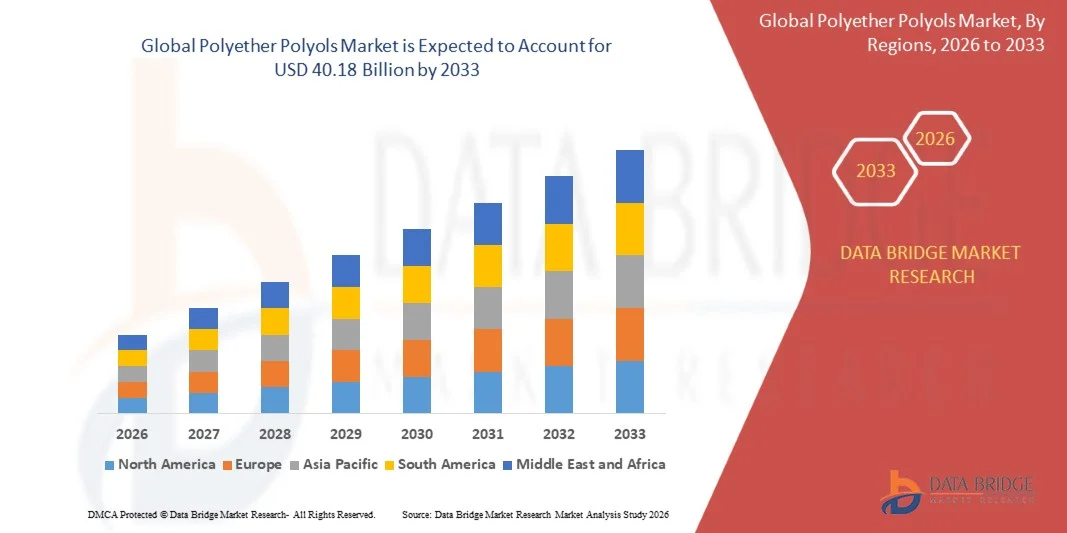
- The global polyether polyols market size was valued at USD 28.74 billion in 2025and is expected to reach USD 40.18 billion by 2033, at a CAGR of 4.28% during the forecast period
- The market growth is largely fueled by the growing adoption and technological progress within polyurethane foam manufacturing and specialty elastomer applications, leading to increased utilization of polyether polyols in both residential and commercial end-use sectors
- In addition, rising demand for high-performance flexible foam, rigid insulation systems, and advanced CASE polyurethane applications is establishing polyether polyols as the modern polyol of choice for diverse polyurethane polymer synthesis and formulation applications. These converging factors are accelerating the uptake of polyether polyols solutions, thereby significantly boosting the industry's growth
Polyether Polyols Market Analysis
- Polyether polyols, offering versatile hydroxyl-terminated polyether backbone functionality for a broad spectrum of polyurethane foam, elastomer, coating, adhesive, and sealant applications, are increasingly vital components of modern furniture, construction, and automotive industries in both developed and emerging markets due to their enhanced hydrolytic stability, low viscosity processing performance, and seamless integration with isocyanate-based polyurethane polymer manufacturing platforms
- The escalating demand for polyether polyols is primarily fueled by the widespread growth of the polyurethane foam sector for flexible furniture and mattress applications, rising demand for rigid polyurethane insulation in building and construction markets, and a growing preference for polyether-based CASE polyols in coating, adhesive, and elastomer formulations
- North America dominated the polyether polyols market with the largest revenue share of 37.4% in 2025, characterized by early adoption of advanced polyurethane systems, high manufacturing capabilities, and a strong presence of key industry players, with the U.S. experiencing substantial growth in polyether polyol consumption, particularly in flexible foam and specialty CASE applications, driven by innovations from both established chemical companies and specialty polyurethane formulators
- Asia-Pacific is expected to be the fastest growing region in the polyether polyols market during the forecast period due to increasing industrialization, rising construction activity, and rapidly growing demand for polyurethane foam products in furniture, automotive, and building applications
- The Flexible Foam Polyols segment dominated the largest market revenue share of 47.6% in 2025, driven by the massive global scale of flexible polyurethane foam production for furniture, bedding, and automotive seating applications
Report Scope and Polyether Polyols Market Segmentation
|
Attributes |
Polyether Polyols Key Market Insights |
|
Segments Covered |
|
|
Countries Covered |
North America · U.S. · Canada · Mexico Europe · Germany · France · U.K. · Netherlands · Switzerland · Belgium · Russia · Italy · Spain · Turkey · Rest of Europe Asia-Pacific · China · Japan · India · South Korea · Singapore · Malaysia · Australia · Thailand · Indonesia · Philippines · Rest of Asia-Pacific Middle East and Africa · Saudi Arabia · U.A.E. · South Africa · Egypt · Israel · Rest of Middle East and Africa South America · Brazil · Argentina · Rest of South America |
|
Key Market Players |
· BASF SE (Germany) · Dow Chemical Company (U.S.) · Covestro AG (Germany) · Huntsman Corporation (U.S.) · Shell Chemicals (Netherlands) · Wanhua Chemical Group Co., Ltd. (China) · Repsol S.A. (Spain) · Stepan Company (U.S.) · Carpenter Co. (U.S.) · Lanxess AG (Germany) · Mitsui Chemicals, Inc. (Japan) · Solvay S.A. (Belgium) · Evonik Industries AG (Germany) · Tosoh Corporation (Japan) · Sumitomo Chemical Co., Ltd. (Japan) · PCC Rokita SA (Poland) · Oltchim S.A. (Romania) · Sinopec Group (China) · KPX Chemical (South Korea) · Nanjing Hongbaoli Co., Ltd. (China) |
|
Market Opportunities |
· Expanding Use in Rigid Insulation Foam and Sustainable Bio-Based Polyol Applications · Rising Demand in Emerging Markets |
|
Value Added Data Infosets |
In addition to the insights on market scenarios such as market value, growth rate, segmentation, geographical coverage, and major players, the market reports curated by the Data Bridge Market Research also include import export analysis, production capacity overview, production consumption analysis, price trend analysis, climate change scenario, supply chain analysis, value chain analysis, raw material/consumables overview, vendor selection criteria, PESTLE Analysis, Porter Analysis, and regulatory framework. |
Polyether Polyols Market Trends
“Enhanced Sustainability Through Bio-Based Polyol Development and Energy-Efficient Insulation Systems”
- A significant and accelerating trend in the global polyether polyols market is the deepening integration with bio-based raw material platforms and growing investment in sustainable polyurethane foam and insulation system development. This fusion of renewable chemistry and high-performance polyurethane technology is significantly reshaping the sustainability profile and competitive positioning of polyether polyol producers and downstream polyurethane formulators
- For instance, BASF SE has developed its Sovermol line of bio-based polyols derived from natural oils as renewable alternatives to conventional petrochemical polyether polyols for rigid coating and adhesive applications. Similarly, Covestro has advanced its cardyon polyols program, incorporating carbon dioxide as a co-monomer in polyol synthesis to reduce fossil feedstock dependency and carbon footprint
- Bio-based and low-carbon polyol developments enable features such as reduced dependence on propylene oxide petrochemical feedstocks, improved sustainability credentials for downstream polyurethane product marketing, and enhanced regulatory compliance with evolving global sustainability reporting requirements. For instance, Huntsman Corporation's TEROL bio-based polyol line enables formulators to achieve up to 50% renewable carbon content in rigid coating and adhesive polyurethane applications. In addition, advanced rigid foam polyol formulations incorporating next-generation blowing agent systems offer manufacturers the opportunity to achieve superior thermal insulation lambda values in building and construction applications, meeting increasingly stringent global energy efficiency building code requirements
- The seamless integration of next-generation polyether polyols with MDI and TDI isocyanate systems, along with compatible additive and processing aid platforms, facilitates broader adoption across the full spectrum of flexible foam, rigid insulation, and specialty CASE polyurethane applications. Through advanced polyol molecular architecture design, formulators can engineer polyurethane systems with precisely tailored mechanical performance, foam cell structure, and thermal insulation properties across diverse application requirements
- This trend towards more sustainable, performance-optimized, and application-tailored polyether polyol chemistries is fundamentally reshaping formulator expectations for polyurethane raw material procurement. Consequently, companies such as Wanhua Chemical are developing next-generation bio-content polyether polyol grades with enhanced renewable feedstock credentials and improved flexible foam performance profiles for next-generation furniture and bedding markets
- The demand for polyether polyols that offer seamless integration with bio-based and energy-efficient polyurethane system platforms is growing rapidly across both construction and consumer goods sectors, as manufacturers increasingly prioritize sustainability and comprehensive polyurethane performance
Polyether Polyols Market Dynamics
Driver
“Growing Need Due to Rising Construction Activity and Polyurethane Foam Adoption”
- The increasing prevalence of energy efficiency requirements in building construction and the accelerating adoption of high-performance polyurethane insulation and flexible foam systems are significant drivers for the heightened demand for polyether polyols
- For instance, in April 2025, Covestro AG announced a strategic capacity expansion of its polyether polyols production in Asia, aimed at meeting the rapidly growing demand from the region's expanding furniture, building insulation, and automotive seating sectors. Such strategies by key companies are expected to drive the polyether polyols industry growth in the forecast period
- As building and construction contractors increasingly deploy rigid polyurethane insulation systems to meet tightening energy efficiency standards, polyether polyols offer advanced formulation flexibility including tunable reactivity profiles, compatibility with a broad range of blowing agent systems, and the ability to achieve superior thermal insulation performance, providing a compelling advantage over alternative insulation material chemistries
- In addition, the growing consumer preference for high-comfort flexible polyurethane foam in furniture and bedding applications and the desire for advanced seating and noise reduction performance in automotive polyurethane systems are making polyether polyols an integral component of these high-value polyurethane material platforms, offering seamless integration with MDI, TDI, and specialty isocyanate systems
- The functionality of polyether polyols in CASE polyurethane applications for protective coating performance, elastomeric sealant durability, structural adhesive bonding, and thermoplastic polyurethane elastomer flexibility are key factors propelling their adoption in both industrial and consumer-facing polyurethane material sectors. The trend towards performance-driven polyurethane formulations and the increasing availability of application-specific polyether polyol grades further contribute to market growth
Restraint/Challenge
“Concerns Regarding Propylene Oxide Feedstock Volatility and Environmental Regulations on Isocyanate Systems”
- Concerns surrounding the volatility of propylene oxide feedstock costs underlying polyether polyol production, as well as increasing environmental and health regulatory scrutiny of isocyanate-based polyurethane systems, pose significant challenges to supply chain stability and market growth
- For instance, major disruptions in propylene oxide supply chains driven by petrochemical facility outages and logistics constraints have historically triggered significant polyether polyol price volatility, creating procurement planning challenges for downstream furniture, construction, and automotive polyurethane manufacturers
- Addressing these supply security concerns through strategic propylene oxide inventory management, long-term feedstock supply agreements, and investment in alternative synthesis routes such as hydrogen peroxide-based propylene oxide production is crucial for building customer confidence. Companies such as BASF and Dow Chemical emphasize their backward integration into propylene oxide production and their diversified feedstock procurement strategies as key supply security differentiators. In addition, tightening regulatory frameworks around isocyanate occupational exposure limits in North America and Europe are increasing the engineering control and worker protection investment requirements for polyurethane system manufacturers utilizing polyether polyols. While modern enclosed spray foam and rigid foam manufacturing processes have significantly improved worker protection profiles, residual regulatory compliance costs remain a factor for smaller polyurethane system manufacturers
- While production technologies and supply chain resilience are continuously improving, the price sensitivity of polyether polyols to upstream propylene oxide and ethylene oxide market movements can still create procurement uncertainty, especially for smaller polyurethane manufacturers operating on tight margin structures
- Overcoming these challenges through enhanced feedstock diversification, consumer education on safe polyurethane handling practices, and the development of more sustainable and lower-hazard polyol and polyurethane system formulations will be vital for sustained market growth
Polyether Polyols Market Scope
The market is segmented on the basis of type, application, and end user.
- By Type
On the basis of type, the polyether polyols market is segmented into Flexible Foam Polyols, Rigid Foam Polyols, CASE Polyols, and Others. The Flexible Foam Polyols segment dominated the largest market revenue share of 47.6% in 2025, driven by the massive global scale of flexible polyurethane foam production for furniture, bedding, and automotive seating applications. Polyurethane foam formulators rely on flexible foam polyols for their ability to provide the controlled reactivity profile, cell structure, and mechanical elongation performance required by comfort and cushioning applications. The market also sees strong demand for flexible foam polyol grades due to their broad commercial availability, competitive pricing, and well-established regulatory acceptance across global foam manufacturing markets.
The CASE Polyols segment is anticipated to witness the fastest growth rate of 11.2% from 2026 to 2033, fueled by increasing adoption in high-performance polyurethane coatings, adhesives, sealants, and elastomer formulations across construction, automotive, and industrial maintenance sectors. CASE polyether polyols provide superior hydrolytic stability, low-temperature flexibility, and broad chemical compatibility in demanding outdoor and industrial polyurethane applications, making them the preferred polyol choice for specialty coating, sealant, and adhesive markets.
- By Application
On the basis of application, the polyether polyols market is segmented into Flexible Foam, Rigid Foam, Coatings, Adhesives, Sealants & Elastomers, and Others. The Flexible Foam segment held the largest market revenue share of 30% in 2025, driven by the dominant position of polyether-based flexible polyurethane foam in global furniture, bedding, and automotive seating markets. The well-established performance advantages and cost-competitive manufacturing profile of polyether-based flexible foam systems continue to reinforce their dominant position in the global polyol demand structure.
The Rigid Foam segment is expected to witness the fastest CAGR from 2026 to 2033, driven by growing demand for high-performance polyurethane thermal insulation in building and construction, cold chain logistics, and energy-efficient appliance applications. Increasingly stringent global building energy efficiency regulations and the strong thermal insulation performance advantage of polyurethane rigid foam systems over competing mineral and organic insulation materials are supporting the strong growth trajectory of polyether polyol demand in rigid foam applications.
- By End User
On the basis of end user, the polyether polyols market is segmented into Furniture & Bedding, Building & Construction, Automotive, Electronics, Footwear, and Others. The Furniture & Bedding segment accounted for the largest market revenue share of 22% in 2025, driven by the massive global scale of flexible polyurethane foam production for residential and commercial furniture seating and mattress applications. Rising global middle-class consumer spending on quality furniture and premium sleep products in developing markets is reinforcing strong and sustained demand growth for flexible polyurethane foam in the furniture and bedding end-use sector.
The Building & Construction segment is expected to witness the fastest CAGR from 2026 to 2033, driven by the growing deployment of rigid polyurethane insulation boards, spray foam insulation systems, and structural polyurethane adhesive and sealant applications across global residential and commercial construction markets. Continuously tightening building energy efficiency codes and government-mandated carbon reduction targets across North America, Europe, and Asia are driving accelerating adoption of polyurethane rigid foam insulation and significantly expanding the polyether polyol demand contribution from the building and construction sector.
Polyether Polyols Market Regional Analysis
- North America dominated the polyether polyols market with the largest revenue share of 37.4% in 2025, driven by strong demand for flexible foam intermediates and specialty CASE polyurethane applications, as well as significant production capacity and technology investments by leading chemical manufacturers
- Manufacturers in the region highly value the broad formulation versatility, well-established performance track record, and mature supply chain infrastructure of polyether polyols across multiple high-value polyurethane end-use sectors including furniture, construction insulation, and automotive seating
- This widespread adoption is further supported by high industrial chemical consumption, a technologically advanced polyurethane manufacturing base, and the growing preference for sustainable and energy-efficient polyether polyol platforms, establishing polyether polyols as the preferred building block for both residential and industrial polyurethane applications
U.S. Polyether Polyols Market Insight
The U.S. polyether polyols market captured the largest revenue share within North America in 2025, fueled by the strong domestic flexible polyurethane foam manufacturing base and the expanding deployment of polyether-based rigid insulation systems across the commercial and residential construction sectors. Polyurethane formulators are increasingly prioritizing the development of high-performance polyether polyol grades optimized for energy-efficient building insulation and advanced automotive interior applications. The growing preference for sustainable polyurethane materials, combined with robust demand from furniture, bedding, and CASE polyurethane manufacturers, further propels the polyether polyols industry.
Europe Polyether Polyols Market Insight
The Europe polyether polyols market is projected to expand at a substantial CAGR throughout the forecast period, primarily driven by stringent EU building energy efficiency directives promoting the deployment of high-performance rigid polyurethane insulation systems and the escalating demand for sustainable and bio-based polyol alternatives across furniture, automotive, and CASE polyurethane applications. The growth in green polyurethane chemistry adoption, coupled with demand for carbon-reduced polyol grades, is fostering significant innovation across European polyurethane raw material and formulation industries.
U.K. Polyether Polyols Market Insight
The U.K. polyether polyols market is anticipated to grow at a noteworthy CAGR during the forecast period, driven by the escalating demand for high-performance rigid polyurethane insulation in residential and commercial building retrofit and new construction applications. In addition, growing regulatory pressure to improve national building stock energy efficiency is encouraging both large-scale construction companies and specialty insulation contractors to accelerate the deployment of polyurethane rigid foam insulation systems. The U.K.'s emphasis on building decarbonization, alongside its well-developed specialty chemical and polyurethane manufacturing infrastructure, is expected to continue to stimulate market growth.
Germany Polyether Polyols Market Insight
The Germany polyether polyols market is expected to expand at a considerable CAGR during the forecast period, fueled by increasing demand for high-performance polyurethane flexible foam, rigid insulation, and CASE polyurethane systems across the country's well-developed furniture, automotive manufacturing, and industrial construction sectors. Germany's advanced chemical industry infrastructure, combined with its strong emphasis on technological innovation, process efficiency, and sustainability compliance, promotes the adoption of next-generation polyether polyol grades across all major polyurethane application platforms.
Asia-Pacific Polyether Polyols Market Insight
The Asia-Pacific polyether polyols market is poised to grow at the fastest CAGR of 12.1% during the forecast period of 2026 to 2033, driven by rapidly expanding construction activity, rising furniture and bedding production output, and high-growth automotive manufacturing sectors in countries such as China, India, and South Korea. The region's strong orientation toward domestic polyurethane raw material and systems manufacturing capacity growth, supported by government industrial development initiatives and foreign direct investment in polyurethane production, is driving strong adoption of polyether polyols across all major application segments.
Japan Polyether Polyols Market Insight
The Japan polyether polyols market is gaining momentum due to the country's advanced polyurethane chemistry and materials technology manufacturing capabilities, continued investment in high-performance automotive and electronic material applications, and demand for application-optimized specialty polyether polyol grades. The Japanese market places a significant emphasis on polyurethane material precision and quality, and the adoption of specialty polyether polyol grades is driven by the increasing sophistication of domestic automotive interior, electronic component encapsulation, and specialty CASE polyurethane manufacturing industries.
China Polyether Polyols Market Insight
The China polyether polyols market accounted for the largest market revenue share in Asia-Pacific in 2025, attributed to the country's massive expansion of domestic polyether polyol production capacity, rapidly growing flexible foam and rigid insulation manufacturing sectors, and high-growth automotive and appliance polyurethane application markets. China stands as the world's largest producer and consumer of polyether polyols, and continued strong domestic demand across furniture foam, building insulation, and automotive seating segments is supported by an increasingly competitive and technology-advanced local manufacturing base.
Polyether Polyols Market Share
The Polyether Polyols industry is primarily led by well-established companies, including:
- BASF SE (Germany)
- Dow Chemical Company (U.S.)
- Covestro AG (Germany)
- Huntsman Corporation (U.S.)
- Shell Chemicals (Netherlands)
- Wanhua Chemical Group Co., Ltd. (China)
- Repsol S.A. (Spain)
- Stepan Company (U.S.)
- Carpenter Co. (U.S.)
- Lanxess AG (Germany)
- Mitsui Chemicals, Inc. (Japan)
- Solvay S.A. (Belgium)
- Evonik Industries AG (Germany)
- Tosoh Corporation (Japan)
- Sumitomo Chemical Co., Ltd. (Japan)
- PCC Rokita SA (Poland)
- Oltchim S.A. (Romania)
- Sinopec Group (China)
- KPX Chemical (South Korea)
- Nanjing Hongbaoli Co., Ltd. (China)
Latest Developments in Global Polyether Polyols Market
- In April 2023, Covestro AG announced a strategic capacity expansion initiative at its Shanghai, China polyether polyols production facility, aimed at strengthening supply reliability for its growing Asia-Pacific furniture foam, rigid insulation, and automotive seating customer base, underscoring the company's commitment to delivering competitive polyether polyol supply solutions in the world's fastest growing polyurethane market
- In March 2023, BASF SE introduced its next-generation Sovermol bio-based polyol platform extensions for rigid coating and adhesive polyurethane applications, specifically developed to enable formulators to achieve higher renewable carbon content in CASE polyurethane systems with maintained performance profiles, highlighting the company's commitment to advancing sustainable polyurethane raw material chemistry
- In March 2023, Wanhua Chemical Group announced the successful commissioning of a major new polyether polyols production complex in China, representing one of the world's largest single-site polyol capacity expansions and aimed at supporting the growing domestic and export demand for flexible foam, rigid foam, and CASE polyether polyol grades
- In February 2023, Huntsman Corporation announced a strategic commercial partnership with a leading building construction products manufacturer to co-develop next-generation polyether polyol-based rigid spray foam insulation systems, specifically engineered to meet the thermal performance and dimensional stability requirements of modern zero-energy building construction applications
- In January 2023, Stepan Company unveiled an enhanced bio-based polyol product line derived from natural oil polyols, specifically designed for flexible foam and CASE polyurethane applications requiring renewable feedstock content credentials, enabling users to achieve sustainability targets while maintaining high polyurethane performance standards

- Interactive Data Analysis Dashboard
- Company Analysis Dashboard for high growth potential opportunities
- Research Analyst Access for customization & queries
- Competitor Analysis with Interactive dashboard
- Latest News, Updates & Trend analysis
- Harness the Power of Benchmark Analysis for Comprehensive Competitor Tracking
Global Polyether Polyols Market, Supply Chain Analysis and Ecosystem Framework
To support market growth and help clients navigate the impact of geopolitical shifts, DBMR has integrated in-depth supply chain analysis into its Global Polyether Polyols Market research reports. This addition empowers clients to respond effectively to global changes affecting their industries. The supply chain analysis section includes detailed insights such as Global Polyether Polyols Market consumption and production by country, price trend analysis, the impact of tariffs and geopolitical developments, and import and export trends by country and HSN code. It also highlights major suppliers with data on production capacity and company profiles, as well as key importers and exporters. In addition to research, DBMR offers specialized supply chain consulting services backed by over a decade of experience, providing solutions like supplier discovery, supplier risk assessment, price trend analysis, impact evaluation of inflation and trade route changes, and comprehensive market trend analysis.
Data collection and base year analysis are done using data collection modules with large sample sizes. The stage includes obtaining market information or related data through various sources and strategies. It includes examining and planning all the data acquired from the past in advance. It likewise envelops the examination of information inconsistencies seen across different information sources. The market data is analysed and estimated using market statistical and coherent models. Also, market share analysis and key trend analysis are the major success factors in the market report. To know more, please request an analyst call or drop down your inquiry.
The key research methodology used by DBMR research team is data triangulation which involves data mining, analysis of the impact of data variables on the market and primary (industry expert) validation. Data models include Vendor Positioning Grid, Market Time Line Analysis, Market Overview and Guide, Company Positioning Grid, Patent Analysis, Pricing Analysis, Company Market Share Analysis, Standards of Measurement, Global versus Regional and Vendor Share Analysis. To know more about the research methodology, drop in an inquiry to speak to our industry experts.
Data Bridge Market Research is a leader in advanced formative research. We take pride in servicing our existing and new customers with data and analysis that match and suits their goal. The report can be customized to include price trend analysis of target brands understanding the market for additional countries (ask for the list of countries), clinical trial results data, literature review, refurbished market and product base analysis. Market analysis of target competitors can be analyzed from technology-based analysis to market portfolio strategies. We can add as many competitors that you require data about in the format and data style you are looking for. Our team of analysts can also provide you data in crude raw excel files pivot tables (Fact book) or can assist you in creating presentations from the data sets available in the report.













