


Polylactic Acid (PLA) Disposable Containers Market Analysis
The polylactic acid (PLA) disposable containers market is experiencing significant growth due to the rising demand for eco-friendly and biodegradable packaging solutions. PLA, derived from renewable resources such as corn starch or sugarcane, offers a sustainable alternative to conventional plastic. These containers are increasingly adopted in the food and beverage, personal care, and retail sectors due to their biodegradability and reduced carbon footprint. Key drivers include stringent government regulations promoting sustainable packaging and growing consumer preference for environmentally friendly products. Recent developments in the market include advancements in PLA manufacturing processes to enhance durability and cost efficiency, alongside collaborations between manufacturers and retail chains to expand product reach. However, challenges such as high production costs and limited heat resistance persist. The market is poised for growth as innovation continues, driven by the increasing focus on sustainability across industries.
Polylactic Acid (PLA) Disposable Containers Market Size
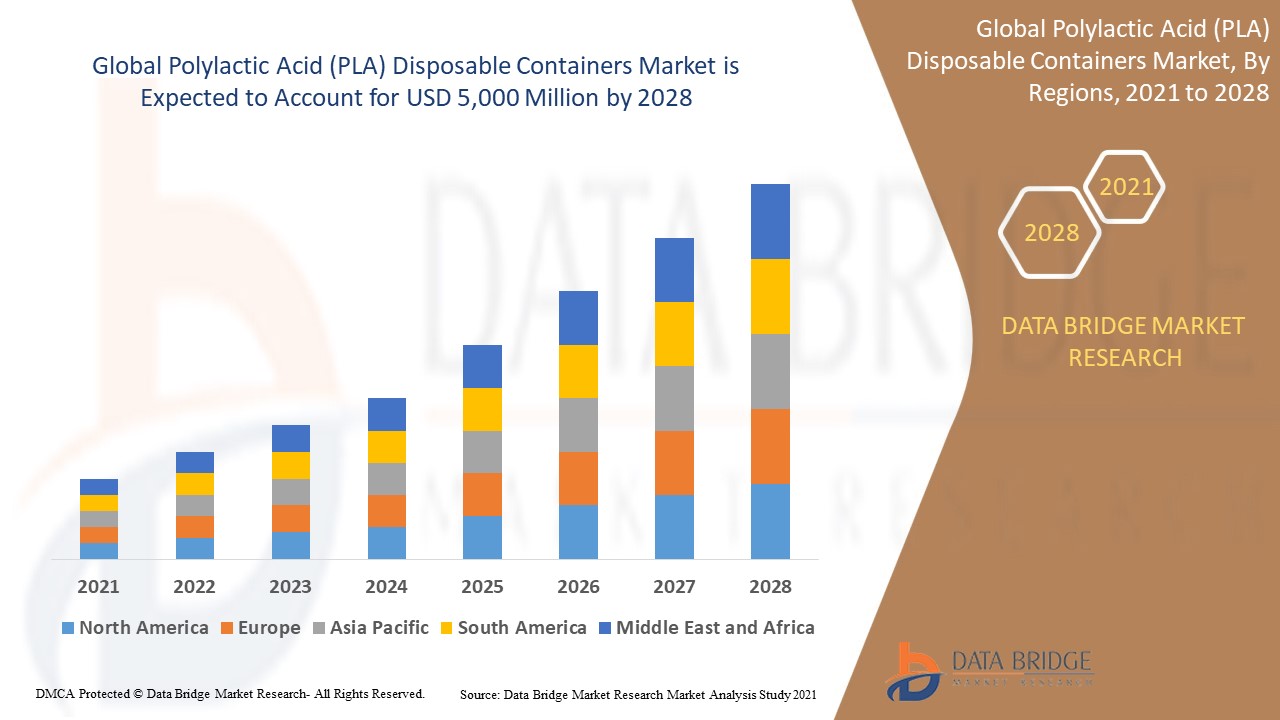
The polylactic acid (PLA) disposable containers market size was valued at USD 3.81 billion in 2024 and is projected to reach USD 6.55 billion by 2032, with a CAGR of 7.00% during the forecast period of 2025 to 2032. In addition to the insights on market scenarios such as market value, growth rate, segmentation, geographical coverage, and major players, the market reports curated by the Data Bridge Market Research also include import export analysis, production capacity overview, production consumption analysis, price trend analysis, climate change scenario, supply chain analysis, value chain analysis, raw material/consumables overview, vendor selection criteria, PESTLE Analysis, Porter Analysis, and regulatory framework.
Polylactic Acid (PLA) Disposable Containers Market Trends
“Food Safety Certification”
The growing emphasis on food-grade certifications is emerging as a significant trend in the polylactic acid (PLA) disposable containers market. These certifications ensure that PLA containers meet stringent safety and quality standards for use in food and beverage applications. With increasing consumer awareness about health and safety, certified PLA containers are gaining trust and acceptance, particularly in sectors such as food delivery, packaging, and retail. Certifications such as FDA and EU food safety approvals provide assurance that the containers are free from harmful substances, enhancing their usability in direct food contact. This trend is driving manufacturers to prioritize compliance, making certified PLA containers a preferred choice for businesses aiming to meet both safety standards and sustainability goals.
Report Scope and Polylactic Acid (PLA) Disposable Containers Market Segmentation
|
Attributes |
Polylactic Acid (PLA) Disposable Containers Key Market Insights |
|
Segments Covered |
|
|
Countries Covered |
U.S., Canada and Mexico in North America, Germany, France, U.K., Netherlands, Switzerland, Belgium, Russia, Italy, Spain, Turkey, Rest of Europe in Europe, China, Japan, India, South Korea, Singapore, Malaysia, Australia, Thailand, Indonesia, Philippines, Rest of Asia-Pacific (APAC) in the Asia-Pacific (APAC), Saudi Arabia, U.A.E, South Africa, Egypt, Israel, Rest of Middle East and Africa (MEA) as a part of Middle East and Africa (MEA), Brazil, Argentina and Rest of South America as part of South America |
|
Key Market Players |
Amcor plc (Switzerland), Bemis Manufacturing Company (U.S.), The Tetra Laval Group (Switzerland), Mondi (U.K.), WestRock Company (U.S.), BASF (Germany), Sonoco Products Company (U.S.), Smurfit Kappa (Ireland), Sealed Air (U.S.), Huhtamaki (Finland), Gerresheimer AG (Germany), Ball Corporation (U.S.), Ardagh Group S.A. (Luxembourg), Crown (U.S.), DS Smith Plc (U.K.), International Paper (U.S.), Berry Global Inc. (U.S.), Genpak (U.S.), DuPont (U.S.), UFlex Limited (India), Pactiv Evergreen Inc. (U.S.) |
|
Market Opportunities |
|
|
Value Added Data Infosets |
In addition to the insights on market scenarios such as market value, growth rate, segmentation, geographical coverage, and major players, the market reports curated by the Data Bridge Market Research also include import export analysis, production capacity overview, production consumption analysis, price trend analysis, climate change scenario, supply chain analysis, value chain analysis, raw material/consumables overview, vendor selection criteria, PESTLE Analysis, Porter Analysis, and regulatory framework. |
Polylactic Acid (PLA) Disposable Containers Market Definition
Polylactic acid (PLA) disposable containers are biodegradable and compostable packaging solutions made from renewable resources such as corn starch, sugarcane, or other plant-based materials. These containers serve as eco-friendly alternatives to traditional petroleum-based plastics, offering similar functionality while significantly reducing environmental impact. PLA containers are widely used in food and beverage packaging due to their ability to maintain freshness, provide durability, and meet sustainability goals. They are lightweight, non-toxic, and capable of degrading into natural components under industrial composting conditions, making them ideal for industries and consumers seeking environmentally responsible packaging solutions. Their application spans multiple sectors, including food service, retail, and personal care, aligning with the global shift toward reducing plastic waste.
Polylactic Acid (PLA) Disposable Containers Market Dynamics
Drivers
- Food and Beverage Industry Growth
The rapid growth of food delivery and takeout services is a key driver for the polylactic acid (PLA) disposable containers market. With increasing reliance on convenience-driven dining options, there is a rising demand for packaging that is both functional and environmentally friendly. PLA containers meet these requirements by offering durability, food safety, and sustainability, making them ideal for carrying a variety of food items. In addition, as consumers and businesses prioritize eco-conscious choices, the shift from traditional plastic to biodegradable solutions such as PLA is accelerating. This trend underscores the critical role of sustainable packaging in supporting the expanding food service industry.
- Corporate Sustainability Initiatives
The increasing adoption of polylactic acid (PLA) packaging by companies is a significant driver for market growth, as businesses strive to meet sustainability goals and reduce their environmental impact. PLA packaging, derived from renewable plant-based resources, offers a biodegradable alternative to conventional plastics, aligning with corporate commitments to lower carbon emissions and support eco-friendly practices. Many industries, particularly food and beverage, retail, and personal care, are transitioning to PLA containers to cater to the growing demand for sustainable products from environmentally conscious consumers. This shift is driving innovation and investment in PLA solutions, further propelling the market’s expansion.
Opportunities
- Technological Advancements
Innovations in the production of polylactic acid (PLA) have opened up significant market opportunities by improving its durability, heat resistance, and cost-efficiency. Advances in manufacturing techniques have enabled PLA to become more versatile, allowing it to be used in a wider range of applications, including hot food packaging and containers that require greater strength. These improvements make PLA a more competitive alternative to traditional plastics, which are often criticized for their environmental impact. As the production cost of PLA decreases and its performance continues to match or exceed that of conventional plastics, the market for PLA containers is poised for significant growth.
- Retail and E-commerce Expansion
The rapid growth of the retail and online food delivery sectors presents a significant market opportunity for sustainable packaging solutions such as polylactic acid (PLA) disposable containers. As more consumers turn to online platforms for food delivery, the demand for eco-friendly, single-use packaging is surging. PLA containers offer an ideal solution, providing the necessary durability and food safety while also meeting the growing demand for environmentally responsible packaging. With an increasing number of businesses seeking to align with sustainability goals and reduce their environmental footprint, the expanding food delivery market presents a prime opportunity for the PLA packaging industry to thrive.
Restraints/Challenges
- Lack of Recycling Infrastructure
A significant challenge facing the polylactic acid (PLA) disposable containers market is the limited availability of industrial composting and recycling facilities. While PLA is biodegradable, it requires specific conditions found in industrial composting facilities to break down effectively. In regions without the infrastructure for proper waste management, PLA containers may not decompose as intended, leading to concerns about their environmental benefits. In addition, the lack of widespread recycling options for PLA limits its potential for reuse, further complicating its adoption as a sustainable alternative to conventional plastics. This infrastructure gap poses a major hurdle for PLA’s widespread use and growth in the market.
- High Production Costs
A major restraint in the growth of the polylactic acid (PLA) disposable containers market is its higher production cost compared to conventional plastic. The production of PLA involves the use of renewable resources such as corn starch or sugarcane, which can result in more expensive manufacturing processes. As a result, PLA containers often carry a premium price over traditional plastic alternatives, which can be a significant barrier for cost-sensitive industries such as fast food or mass-market packaging. This price discrepancy makes it challenging for businesses to fully embrace PLA, especially when profit margins are tight and cost-efficiency is a priority.
This market report provides details of new recent developments, trade regulations, import-export analysis, production analysis, value chain optimization, market share, impact of domestic and localized market players, analyses opportunities in terms of emerging revenue pockets, changes in market regulations, strategic market growth analysis, market size, category market growths, application niches and dominance, product approvals, product launches, geographic expansions, technological innovations in the market. To gain more info on the market contact Data Bridge Market Research for an analyst brief, our team will help you take an informed market decision to achieve market growth.
Impact and Current Market Scenario of Raw Material Shortage and Shipping Delays
Data Bridge Market Research offers a high-level analysis of the market and delivers information by keeping in account the impact and current market environment of raw material shortage and shipping delays. This translates into assessing strategic possibilities, creating effective action plans, and assisting businesses in making important decisions.
Apart from the standard report, we also offer in-depth analysis of the procurement level from forecasted shipping delays, distributor mapping by region, commodity analysis, production analysis, price mapping trends, sourcing, category performance analysis, supply chain risk management solutions, advanced benchmarking, and other services for procurement and strategic support.
Expected Impact of Economic Slowdown on the Pricing and Availability of Products
When economic activity slows, industries begin to suffer. The forecasted effects of the economic downturn on the pricing and accessibility of the products are taken into account in the market insight reports and intelligence services provided by DBMR. With this, our clients can typically keep one step ahead of their competitors, project their sales and revenue, and estimate their profit and loss expenditures.
Global Polylactic Acid (PLA) Disposable Containers Market Scope
The market is segmented on the basis of product type, end use type, and sales channel. The growth amongst these segments will help you analyze meagre growth segments in the industries and provide the users with a valuable market overview and market insights to help them make strategic decisions for identifying core market applications.
Product Type
- Cups and Bowls
- Clamshells
- Trays and Lids
- Sandwich Wedges
End Use Type
- Food and Beverages
- Cosmetics and Personal Care
- Households
Sales Channel
- Retail
- E-commerce
- Wholesale
Polylactic Acid (PLA) Disposable Containers Market Regional Analysis
The market is analysed and market size insights and trends are provided by country, product type, end use type, and sales channel as referenced above.
The countries covered in the market report are U.S., Canada, Mexico, Brazil, Argentina, Rest of South America, Germany, France, Italy, U.K., Belgium, Spain, Russia, Turkey, Netherlands, Switzerland, Rest of Europe, Japan, China, India, South Korea, Australia and New Zealand, Singapore, Malaysia, Thailand, Indonesia, Philippines, Rest of Asia-Pacific, United Arab Emirate, Saudi Arabia, Egypt, Israel, South Africa, Rest of Middle East and Africa
North America dominates the polylactic acid (PLA) disposable containers market, driven by a strong demand for bioplastics and growing government initiatives that encourage the adoption of eco-friendly products. The region’s focus on sustainability and reducing plastic waste has significantly boosted PLA usage across industries. In addition, increasing consumer awareness of environmental issues further supports the demand for sustainable packaging solutions in North America.
The Asia-Pacific region is projected to experience the fastest growth in the polylactic acid (PLA) disposable containers market from 2025 to 2032, driven by a surge in demand from key industries such as automotive, electronics, textiles, appliances, and healthcare. As these sectors increasingly shift towards sustainable materials, the demand for PLA packaging is expected to rise significantly. In addition, growing environmental awareness and government initiatives promoting biodegradable alternatives will further fuel the region’s rapid adoption of PLA.
The country section of the report also provides individual market impacting factors and changes in regulation in the market domestically that impacts the current and future trends of the market. Data points such as down-stream and upstream value chain analysis, technical trends and porter's five forces analysis, case studies are some of the pointers used to forecast the market scenario for individual countries. Also, the presence and availability of global brands and their challenges faced due to large or scarce competition from local and domestic brands, impact of domestic tariffs and trade routes are considered while providing forecast analysis of the country data.
Global Polylactic Acid (PLA) Disposable Containers Market Share
The market competitive landscape provides details by competitor. Details included are company overview, company financials, revenue generated, market potential, investment in research and development, new market initiatives, global presence, production sites and facilities, production capacities, company strengths and weaknesses, product launch, product width and breadth, application dominance. The above data points provided are only related to the companies' focus related to market.
Polylactic Acid (PLA) Disposable Containers Market Leaders Operating in the Market Are:
- Amcor plc (Switzerland)
- Bemis Manufacturing Company (U.S.)
- The Tetra Laval Group (Switzerland)
- Mondi (U.K.)
- WestRock Company (U.S.)
- BASF (Germany)
- Sonoco Products Company (U.S.)
- Smurfit Kappa (Ireland)
- Sealed Air (U.S.)
- Huhtamaki (Finland)
- Gerresheimer AG (Germany)
- Ball Corporation (U.S.)
- Ardagh Group S.A. (Luxembourg)
- Crown (U.S.)
- DS Smith Plc (U.K.)
- International Paper (U.S.)
- Berry Global Inc. (U.S.)
- Genpak (U.S.)
- DuPont (U.S.)
- UFlex Limited (India)
- Pactiv Evergreen Inc. (U.S.)
Latest Developments in Polylactic Acid (PLA) Disposable Containers Market
- In April 2023, NatureWorks LLC and Jabil Inc. partnered to introduce a groundbreaking powder made from Ingeo PLA, designed specifically for selective laser sintering 3D printing platforms. This innovative product provides a cost-effective alternative to the commonly used PA-12 material, making it more accessible for various industries looking to adopt sustainable 3D printing practices. The collaboration highlights the growing potential of PLA in advanced manufacturing applications, supporting the trend toward sustainable, high-performance materials in the 3D printing sector
- In March 2023, TotalEnergies Corbion, POSCO International, and ESOL formed a strategic partnership focused on advancing PLA recycling infrastructure and technology in South Korea. This collaboration aims to enhance the circular economy by improving PLA waste management and recycling processes, ensuring a more sustainable lifecycle for PLA products. The initiative also aligns with South Korea's government framework for achieving carbon neutrality, contributing to the country’s environmental goals. By addressing PLA recycling challenges, the partnership seeks to foster a more sustainable future for bioplastics in the region
- In November 2020, Total Corbion PLA released a comprehensive whitepaper addressing the preferred end-of-life solutions for PLA bioplastics. The document emphasizes the importance of PLA products in contributing to the circular economy, focusing on how these bioplastics can be effectively managed at the end of their lifecycle. The whitepaper outlines various recycling and composting strategies to ensure that PLA remains a viable, sustainable packaging solution, underlining the potential for PLA to play a key role in reducing plastic waste

- Interactive Data Analysis Dashboard
- Company Analysis Dashboard for high growth potential opportunities
- Research Analyst Access for customization & queries
- Competitor Analysis with Interactive dashboard
- Latest News, Updates & Trend analysis
- Harness the Power of Benchmark Analysis for Comprehensive Competitor Tracking
Global Polylactic Acid Pla Disposable Containers Market, Supply Chain Analysis and Ecosystem Framework
To support market growth and help clients navigate the impact of geopolitical shifts, DBMR has integrated in-depth supply chain analysis into its Global Polylactic Acid Pla Disposable Containers Market research reports. This addition empowers clients to respond effectively to global changes affecting their industries. The supply chain analysis section includes detailed insights such as Global Polylactic Acid Pla Disposable Containers Market consumption and production by country, price trend analysis, the impact of tariffs and geopolitical developments, and import and export trends by country and HSN code. It also highlights major suppliers with data on production capacity and company profiles, as well as key importers and exporters. In addition to research, DBMR offers specialized supply chain consulting services backed by over a decade of experience, providing solutions like supplier discovery, supplier risk assessment, price trend analysis, impact evaluation of inflation and trade route changes, and comprehensive market trend analysis.
Data collection and base year analysis are done using data collection modules with large sample sizes. The stage includes obtaining market information or related data through various sources and strategies. It includes examining and planning all the data acquired from the past in advance. It likewise envelops the examination of information inconsistencies seen across different information sources. The market data is analysed and estimated using market statistical and coherent models. Also, market share analysis and key trend analysis are the major success factors in the market report. To know more, please request an analyst call or drop down your inquiry.
The key research methodology used by DBMR research team is data triangulation which involves data mining, analysis of the impact of data variables on the market and primary (industry expert) validation. Data models include Vendor Positioning Grid, Market Time Line Analysis, Market Overview and Guide, Company Positioning Grid, Patent Analysis, Pricing Analysis, Company Market Share Analysis, Standards of Measurement, Global versus Regional and Vendor Share Analysis. To know more about the research methodology, drop in an inquiry to speak to our industry experts.
Data Bridge Market Research is a leader in advanced formative research. We take pride in servicing our existing and new customers with data and analysis that match and suits their goal. The report can be customized to include price trend analysis of target brands understanding the market for additional countries (ask for the list of countries), clinical trial results data, literature review, refurbished market and product base analysis. Market analysis of target competitors can be analyzed from technology-based analysis to market portfolio strategies. We can add as many competitors that you require data about in the format and data style you are looking for. Our team of analysts can also provide you data in crude raw excel files pivot tables (Fact book) or can assist you in creating presentations from the data sets available in the report.













