


What is the Polymer Gel Market Size and Growth Rate?
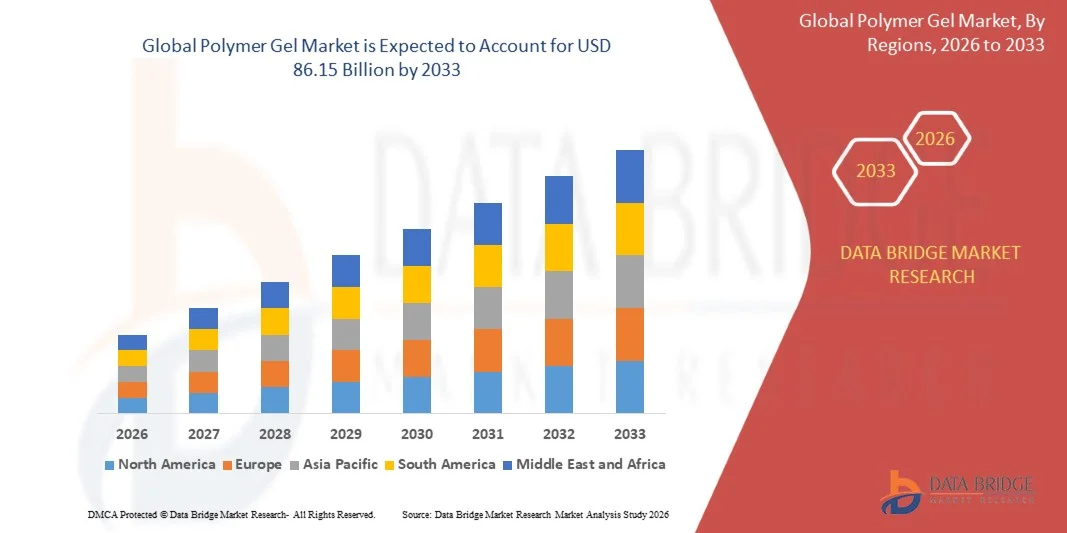
- As per Data Bridge Market Research analysis, the polymer gel market was valued at USD 66.97 billion in 2025 and is projected to reach USD 86.15 billion by 2033, growing at a CAGR of 6.50% from 2026 to 2033.
- The market is experiencing steady growth driven by increasing demand for superabsorbent polymers in personal care products, expanding use of hydrogels in healthcare and drug delivery systems, and rising adoption of polymer gels in agriculture, construction, and wastewater treatment applications.
- Growing investments in advanced biomaterials, sustainable water-retention technologies, and high-performance polymer formulations, along with increasing demand for environmentally friendly and multifunctional gel materials across industrial and medical sectors, are accelerating market expansion worldwide.
Market Size & Forecast
- Global Market Value (2025): USD 66.97 Billion
- Expected Market Value (2033): USD 86.15 Billion
- Forecast CAGR (2026–2033): 6.50%
- Leading Region in 2025: Asia-Pacific
- Fastest Growing Region: North America
What are the Major Takeaways of the Polymer Gel Market?
- Asia-Pacific dominated the global polymer gel market with the largest revenue share of over 36.0% in 2025, supported by rapid industrialization, expanding healthcare and personal care industries, strong manufacturing capabilities, and increasing demand for polymer gels across China, India, Japan, and South Korea.
- The North America polymer gel market is expected to witness the fastest growth rate from 2026 to 2033, primarily driven by increasing demand for advanced wound care products, drug delivery systems, superabsorbent polymers, and sustainable polymer materials across the healthcare, personal care, agriculture, and construction industries
- The polyacrylic acid segment dominated the raw material category in 2025, led by its extensive use in superabsorbent polymers for personal care products, agriculture, and wastewater treatment applications owing to its excellent water absorption and retention properties.
- The hydrogel segment is expected to be the fastest-growing type, projected to register a CAGR of 8.7% during the forecast period, reflecting the increasing demand for advanced wound care, drug delivery systems, tissue engineering, regenerative medicine, and other biomedical applications due to its superior biocompatibility and water-retention properties.
- The personal care segment dominated the application category with around 89.6% revenue share in 2025, led by increasing demand for baby diapers, adult incontinence products, feminine hygiene products, cosmetics, and skincare formulations incorporating superabsorbent polymer gels.
- The films segment dominated the form category in 2025, led by increasing adoption in wound dressings, transdermal drug delivery systems, food packaging, and protective industrial applications requiring flexible polymer gel materials.
Report Scope and Polymer Gel Market Segmentation
|
Attributes |
Polymer Gel Key Market Insights |
|
Segments Covered |
|
|
Countries Covered |
North America
Europe
Asia-Pacific
Middle East and Africa
South America
|
|
Key Market Players |
|
|
Market Opportunities |
|
|
Value Added Data Infosets |
In addition to the insights on market scenarios such as market value, growth rate, segmentation, geographical coverage, and major players, the market reports curated by the Data Bridge Market Research also include import export analysis, production capacity overview, production consumption analysis, price trend analysis, climate change scenario, supply chain analysis, value chain analysis, raw material/consumables overview, vendor selection criteria, PESTLE Analysis, Porter Analysis, and regulatory framework. |
What is the Key Trend in the Polymer Gel Market?
- The polymer gel market is witnessing a growing trend toward application-specific and sustainable polymer gel solutions, particularly across healthcare, personal care, and agriculture.
- Companies are increasingly developing advanced hydrogels for wound care, drug delivery, dermatological products, and biodegradable super absorbent polymer (SAP) applications to meet evolving performance and sustainability requirements.
- For instance, in July 2025, NEXGEL, Inc. expanded its partnership with STADA Arzneimittel AG to commercialize hydrogel-based products in North America, including digestive enzyme formulations and scar and stretch mark solutions. Under the expanded agreement, STADA provided USD 1 million in non-dilutive funding to accelerate product development, regulatory activities, and commercialization.
- For instance, in September 2025, EF Polymer completed the second close of its Series B funding round, raising its total funding to USD 17.8 million. The company is scaling its 100% bio-based super absorbent polymer technology through demonstration projects across drought-affected regions of France, Spain, Italy, and Portugal to improve agricultural water retention and fertilizer efficiency.
- As demand for biocompatible, biodegradable, and high-performance polymer gels continues to increase, manufacturers are expected to accelerate investments in innovative formulations for healthcare, agriculture, and personal care applications.
What are the Key Drivers of the Polymer Gel Market?
- The rising prevalence of chronic wounds, burns, and surgical procedures is driving demand for advanced hydrogel-based wound care products.
- Polymer gels provide excellent moisture retention, biocompatibility, and tissue regeneration properties, making them increasingly important in next-generation wound management and regenerative medicine.
- For instance, in January 2025, Fesarius Therapeutics Inc. received U.S. FDA 510(k) clearance for its DermiSphere Hydrogel Dermal Regeneration Template, a collagen-based hydrogel designed to promote tissue integration and revascularization for the treatment of full-thickness wounds.
- Increasing investments in advanced wound care technologies and regenerative medicine are expected to support sustained demand for polymer gels across medical and healthcare applications.
Which Factors are Challenging the Growth of the Polymer Gel Market?
- The high production costs associated with advanced polymer gels, particularly medical-grade hydrogels and specialty super absorbent polymers, remain a significant challenge for market growth.
- Manufacturing these materials requires specialized raw materials, sophisticated cross-linking technologies, stringent quality control, and compliance with regulatory standards, resulting in high production and operational costs.
- In addition, fluctuations in the prices of petrochemical- and bio-based raw materials increase manufacturing expenses and create pricing uncertainties for producers.
- These cost pressures are particularly challenging for small and medium-sized manufacturers operating in price-sensitive and emerging markets.
- The combination of high manufacturing costs, raw material price volatility, and stringent regulatory requirements continues to limit the widespread adoption of advanced polymer gel technologies despite growing demand across healthcare, agriculture, personal care, and industrial applications.
How is the Polymer Gel Market Segmented?
The polymer gel market is segmented on the basis of raw material, type, form, application, and end-use sectors.
- By Raw Material
On the basis of raw material, the global polymer gel market is segmented into polyacrylic acid, polyacrylamide, polyacrylates, polyvinyl alcohol, polyacrylonitrile, and silicone. the polyacrylic acid segment dominated the market in 2025, owing to its superior water absorption and retention properties, extensive use in superabsorbent polymers, and widespread applications across personal care, agriculture, and wastewater treatment. Its excellent swelling capacity and cost-effectiveness have made it the preferred raw material for high-performance polymer gel formulations.
The silicone segment is projected to register the fastest growth during the forecast period, driven by increasing demand for high-performance gel materials in medical devices, wound care, personal care products, electronics, and specialty industrial applications. Advancements in silicone chemistry, coupled with growing adoption of biocompatible and durable gel materials, are accelerating segment expansion.
- By Type
On the basis of type, the polymer gel market is segmented into aerogel and hydrogel. the aerogel segment dominated the market in 2025, owing to its exceptional thermal insulation properties, lightweight structure, low density, and extensive use across construction, oil & gas, aerospace, and industrial insulation applications. increasing investments in energy-efficient infrastructure and high-performance insulation materials have further strengthened the segment's market position.
The hydrogel segment is projected to register the fastest growth at a CAGR of 8.7% during the forecast period, driven by rising demand for advanced wound care, drug delivery systems, tissue engineering, regenerative medicine, and other biomedical applications. Advancements in hydrogel formulations, coupled with increasing adoption in healthcare and personal care products, are accelerating segment expansion.
- By Form
On the basis of form, the polymer gel market is segmented into pressed powder matrics, membranes/sheets, blankets, films, monoliths, custom shapes, particles, amorphous gels, solid molded forms, panels, tiles, and soft gel capsules. the films segment dominated the market in 2025, owing to its widespread use in wound dressings, transdermal drug delivery systems, food packaging, and protective industrial applications. their flexibility, ease of processing, and excellent barrier properties have made films the preferred form across healthcare, packaging, and specialty industrial applications.
The soft gel capsules segment is projected to register the fastest growth during the forecast period, driven by increasing demand for advanced pharmaceutical formulations, nutraceutical products, and controlled drug delivery systems. Growing consumer preference for easy-to-swallow dosage forms and continuous innovations in encapsulation technologies are accelerating segment expansion.
- By Application
On the basis of application, the global polymer gel market is segmented into personal care, agriculture, construction, drug delivery system, and waste treatment. the personal care segment dominated the market with around 89.6% revenue share in 2025, owing to the extensive use of polymer gels in baby diapers, adult incontinence products, feminine hygiene products, cosmetics, and skincare formulations. superior absorbency, moisture retention, and skin-friendly properties have made polymer gels an essential material in personal care applications.
The drug delivery system segment is projected to register the fastest growth during the forecast period, driven by increasing demand for targeted drug delivery, controlled-release formulations, wound care products, and regenerative medicine. Continuous advancements in hydrogel-based therapeutics and biocompatible polymer technologies are accelerating segment expansion.
- By End-Use Sectors
On the basis of end-use sectors, the global polymer gel market is segmented into residential, commercial, and infrastructure. the commercial segment dominated the market in 2025, owing to the extensive use of polymer gel materials across hospitals, healthcare facilities, commercial buildings, laboratories, and industrial establishments for medical, insulation, and water treatment applications. Increasing investments in healthcare infrastructure and commercial construction have further strengthened the segment's market position.
The infrastructure segment is projected to register the fastest growth during the forecast period, driven by rising investments in sustainable construction, energy-efficient buildings, transportation infrastructure, and advanced insulation materials. Growing adoption of polymer gel-based solutions for thermal insulation, moisture control, and environmental protection is accelerating segment expansion.
Which Region Holds the Largest Share of the Polymer Gel Market?
- Asia-Pacific dominated the polymer gel market and accounted for the largest revenue share of over 36.0% in 2025, supported by rapid industrialization, expanding healthcare and personal care industries, strong manufacturing capabilities, and increasing demand for polymer gels across China, India and Japan.
- The region also benefits from the presence of leading polymer manufacturers, rising consumption of superabsorbent polymers in hygiene products, increasing adoption of hydrogels in medical applications, and growing investments in sustainable agriculture and wastewater treatment. Continuous expansion of healthcare infrastructure and specialty polymer production further strengthens Asia-Pacific's leadership position in the global market.
Japan Polymer Gel Market Insight
The Japan polymer gel market is witnessing consistent growth, supported by the country's advanced material science expertise and strong electronics, automotive, and healthcare industries. Japan remains a leading hub for specialty polymer manufacturing, driven by continuous innovation in engineering materials and high-performance polymers. Moreover, increasing investments in biomedical applications, sustainable polymer technologies, and advanced manufacturing are further supporting the growth of the polymer gel market in the country.
China Polymer Gel Market Insight
The China polymer gel market is growing rapidly, driven by strong demand across the packaging, construction, automotive, electronics, healthcare, and personal care industries. The country's extensive manufacturing capabilities, expanding industrial production, and well-established polymer supply chain continue to support market growth. Furthermore, government initiatives promoting industrial modernization, sustainable manufacturing, advanced polymer technologies, and recycling infrastructure are encouraging investments and strengthening China's position in the Asia-Pacific polymer gel market.
North America Polymer Gel Market Insight
The North America polymer gel market is expected to witness the fastest growth rate from 2026 to 2033, primarily driven by increasing demand for advanced wound care products, drug delivery systems, superabsorbent polymers, and sustainable polymer materials across the healthcare, personal care, agriculture, and construction industries. The region's strong research and development capabilities, well-established chemical manufacturing sector, and growing investments in biomedical innovations and specialty polymer technologies are further accelerating market growth.
U.S. Polymer Gel Market Insight
The U.S. polymer gel market is witnessing significant growth, supported by its well-established chemical manufacturing industry, strong healthcare infrastructure, and increasing demand for advanced polymer materials across medical, personal care, agriculture, and industrial applications. Rising investments in biomedical research, specialty polymers, and sustainable material innovations, along with expanding adoption of hydrogels in wound care and drug delivery systems, are further driving the growth of the polymer gel market in the country.
Which are the Top Companies in Polymer Gel Market?
The polymer gel market is primarily led by well-established companies, including:
- BASF (Germany)
- Dow Inc. (U.S.)
- Evonik Industries AG (Germany)
- Mitsubishi Chemical Group Corporation (Japan)
- LG Chem (South Korea)
- Shin-Etsu Chemical Co., Ltd. (Japan)
- Arkema (France)
- Nippon Shokubai Co., Ltd. (Japan)
- Kuraray Co., Ltd. (Japan)
- Wacker Chemie AG (Germany)
- 3M (U.S.)
- Ashland (U.S.)
- Merck KGaA (Germany)
- Sika AG (Switzerland)
- Lubrizol (U.S.)
- SNF (France)
- Sumitomo Seika Chemicals Co., Ltd. (Japan)
- Solenis (U.S.)
- Cabot Corporation (U.S.)
What are Latest Developments in Polymer Gel Market?
- In July 2025, Evonik Industries introduced a next-generation superabsorbent polymer gel designed for advanced wound care applications, strengthening its portfolio of high-performance healthcare materials. The newly developed polymer gel provides superior moisture management, enhanced absorbency, and integrated antimicrobial properties that help create an optimal healing environment while reducing the risk of infection
- In June 2025, Sumitomo Seika Chemicals expanded its polymer hydrogel production capacity in Southeast Asia to address the rising regional demand for high-quality hydrogel materials. The expansion is aimed at strengthening the company's manufacturing capabilities for applications including incontinence products, baby diapers, feminine hygiene products, and other personal care solutions
- March 2024, Linxens collaborated with Clayens to develop a medical tracker directly integrated into polymer gel-based materials, enhancing the capabilities of smart healthcare devices and next-generation medical monitoring solutions.

- Interactive Data Analysis Dashboard
- Company Analysis Dashboard for high growth potential opportunities
- Research Analyst Access for customization & queries
- Competitor Analysis with Interactive dashboard
- Latest News, Updates & Trend analysis
- Harness the Power of Benchmark Analysis for Comprehensive Competitor Tracking
Global Polymer Gel Market, Supply Chain Analysis and Ecosystem Framework
To support market growth and help clients navigate the impact of geopolitical shifts, DBMR has integrated in-depth supply chain analysis into its Global Polymer Gel Market research reports. This addition empowers clients to respond effectively to global changes affecting their industries. The supply chain analysis section includes detailed insights such as Global Polymer Gel Market consumption and production by country, price trend analysis, the impact of tariffs and geopolitical developments, and import and export trends by country and HSN code. It also highlights major suppliers with data on production capacity and company profiles, as well as key importers and exporters. In addition to research, DBMR offers specialized supply chain consulting services backed by over a decade of experience, providing solutions like supplier discovery, supplier risk assessment, price trend analysis, impact evaluation of inflation and trade route changes, and comprehensive market trend analysis.
Data collection and base year analysis are done using data collection modules with large sample sizes. The stage includes obtaining market information or related data through various sources and strategies. It includes examining and planning all the data acquired from the past in advance. It likewise envelops the examination of information inconsistencies seen across different information sources. The market data is analysed and estimated using market statistical and coherent models. Also, market share analysis and key trend analysis are the major success factors in the market report. To know more, please request an analyst call or drop down your inquiry.
The key research methodology used by DBMR research team is data triangulation which involves data mining, analysis of the impact of data variables on the market and primary (industry expert) validation. Data models include Vendor Positioning Grid, Market Time Line Analysis, Market Overview and Guide, Company Positioning Grid, Patent Analysis, Pricing Analysis, Company Market Share Analysis, Standards of Measurement, Global versus Regional and Vendor Share Analysis. To know more about the research methodology, drop in an inquiry to speak to our industry experts.
Data Bridge Market Research is a leader in advanced formative research. We take pride in servicing our existing and new customers with data and analysis that match and suits their goal. The report can be customized to include price trend analysis of target brands understanding the market for additional countries (ask for the list of countries), clinical trial results data, literature review, refurbished market and product base analysis. Market analysis of target competitors can be analyzed from technology-based analysis to market portfolio strategies. We can add as many competitors that you require data about in the format and data style you are looking for. Our team of analysts can also provide you data in crude raw excel files pivot tables (Fact book) or can assist you in creating presentations from the data sets available in the report.













