


Polymer Stabilizer Market Overview
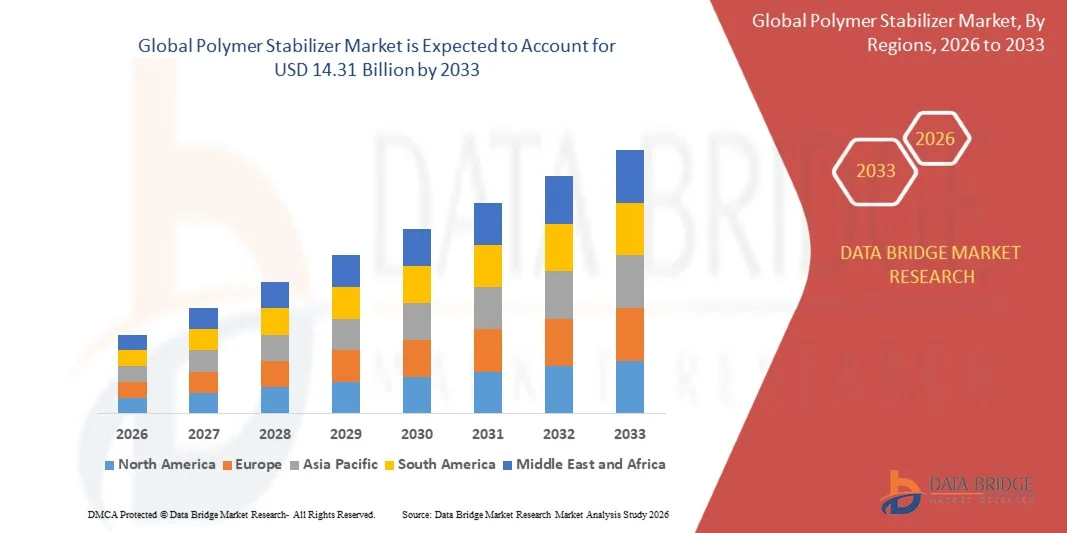
As per Data Bridge Market Research analysis, the polymer stabilizer market was valued at USD 9.99 billion in 2025 and is projected to reach USD 14.31 billion by 2033, growing at a CAGR of 4.60% from 2026 to 2033. The market is experiencing consistent growth driven by increasing demand for durable and high-performance polymer materials, rising consumption of plastics across packaging, automotive, construction, and electrical industries, and the growing adoption of advanced heat, light, and antioxidant stabilizers to improve polymer longevity and processing efficiency.
The growing emphasis on extending the service life of plastic products, combined with stricter environmental and product performance regulations, is encouraging manufacturers to incorporate high-performance and sustainable polymer stabilizers into resin formulations. Advanced stabilizer technologies, including non-toxic, low-VOC, and UV-resistant solutions, are increasingly replacing conventional additives across multiple end-use industries, enhancing material durability, weather resistance, and long-term performance while supporting evolving sustainability requirements
Market Size & Forecast
- Global Market Value (2025): USD 9.99 Billion
- Expected Market Value (2033): USD 14.31 Billion
- Forecast CAGR (2026–2033): 4.60%
- Leading Region in 2025: North America
- Fastest Growing Region: Asia Pacific
Key Market Trends & Insights
- North America dominated the polymer stabilizer market with the largest revenue share of 38.7% in 2025, supported by strong demand from the packaging, automotive, and construction industries, along with the presence of major polymer additive manufacturers and advanced plastics processing infrastructure
- The heat stabilizers segment led the market with a 41.2% share in 2025, driven by its extensive use in protecting polymers, particularly PVC, from thermal degradation during processing and end-use applications
- Asia-Pacific is expected to be the fastest-growing region, registering a CAGR of 8.9% during the forecast period, fueled by expanding polymer production capacity, rapid industrialization, and increasing demand for high-performance plastics
- Light stabilizers are the fastest-growing type, projected to register a CAGR of 8.4%, reflecting the surge in demand for UV-resistant plastics across automotive, agricultural, packaging, and construction applications
- The polyvinyl chloride (PVC) segment dominated the polymer type category with a 46.35% revenue share in 2025, led by the extensive requirement for stabilization systems in PVC processing and end-use applications.
- Packaging accounted for 49.5% of the market, preferred by the substantial consumption of stabilized polymers in food packaging, beverage containers, pharmaceutical packaging, and consumer goods applications
- The polypropylene (PP) segment is the fastest-growing polymer type category, with a CAGR of 8.1%, driven by increasing consumption across packaging, automotive, consumer goods, and healthcare industries.
Report Scope and Polymer Stabilizer Market Segmentation
|
Attributes |
Polymer Stabilizer Key Market Insights |
|
Segments Covered |
|
|
Countries Covered |
North America
Europe
Asia-Pacific
Middle East and Africa
South America
|
|
Key Market Players |
|
|
Market Opportunities |
|
|
Value Added Data Infosets |
In addition to the insights on market scenarios such as market value, growth rate, segmentation, geographical coverage, and major players, the market reports curated by the Data Bridge Market Research also include import export analysis, production capacity overview, production consumption analysis, price trend analysis, climate change scenario, supply chain analysis, value chain analysis, raw material/consumables overview, vendor selection criteria, PESTLE Analysis, Porter Analysis, and regulatory framework. |
Polymer Stabilizer Market Trends
Trend: Rising Adoption of Sustainable and Recyclable Polymer Stabilizers
Polymer manufacturers are increasingly adopting sustainable, non-toxic, and high-performance stabilizers to improve the durability of virgin and recycled plastics while complying with evolving environmental regulations. Demand for advanced antioxidant, heat, and light stabilizers is accelerating as packaging, automotive, and construction industries seek longer product life, improved recyclability, and enhanced weather resistance. The development of specialized stabilization systems for mechanically recycled polymers is further supporting circular economy initiatives and expanding the use of recycled resins in high-value applications. For instance, in July 2024, BASF launched Tinuvin NOR 211 AR, a heat and light stabilizer designed to extend the service life of agricultural plastics under severe UV and chemical exposure while supporting sustainability goals.
The innovation in sustainable stabilizer technologies is becoming a key trend shaping long-term market growth. As regulatory pressures increase and industries prioritize circular economy objectives, demand for advanced stabilizers that enhance recyclability, durability, and environmental performance is expected to accelerate, supporting broader adoption across packaging, automotive, agricultural, and construction applications.
Polymer Stabilizer Market Dynamics
Key Market Driver: Increasing Demand for High-Performance Plastics
The growing consumption of high-performance plastics across packaging, automotive, construction, electrical, and consumer goods industries is creating substantial demand for polymer stabilizers that protect materials against heat, oxidation, and ultraviolet degradation. Manufacturers are increasingly incorporating advanced stabilizer systems to improve processing efficiency, extend product lifespan, and maintain mechanical performance under demanding operating conditions. Rising regulatory requirements for product durability and sustainable material performance are further accelerating the adoption of next-generation stabilization technologies. For instance, in April 2024, SONGWON Industrial showcased its high-performance polymer stabilizers and sustainable additive portfolio at NPE 2024, highlighting solutions that improve thermal stability, oxidation resistance, UV protection, and the long-term durability of polymers, including recycled plastics.
The expanding performance requirements are driving continuous innovation and adoption of advanced polymer stabilizer technologies across multiple industries
Key Restraint/Challenge: Stringent Environmental Regulations on Conventional Stabilizer Chemistries
A significant restraint in the polymer stabilizer market is the tightening of environmental regulations governing conventional heavy metal-based stabilizers, requiring manufacturers to reformulate products using safer alternatives that often involve higher development costs and complex qualification processes. Compliance with evolving global sustainability standards, raw material substitution, and regulatory approvals increases production costs while creating technical challenges for maintaining polymer performance across multiple applications. The transition away from traditional chemistries also places additional pressure on manufacturers to balance regulatory compliance with cost competitiveness. For instance, in November 2024, the European Chemicals Agency (ECHA) and five European countries issued a progress update on the proposed PFAS restriction under the REACH Regulation, advancing the evaluation of safer alternatives and reinforcing regulatory scrutiny of chemical additives used across industries.
The regulatory compliance remains one of the primary challenges influencing market expansion and product development strategies across the polymer stabilizer industry.
Key Market Opportunity: Expansion of Stabilizers for Recycled and Bio-Based Polymers
The rapid expansion of recycled plastics and bio-based polymer production presents a significant opportunity for polymer stabilizer manufacturers. Advanced re-stabilization technologies can restore polymer performance after repeated processing, while renewable stabilizer formulations support sustainable material development across packaging, automotive, and consumer applications. Increasing investment in circular economy initiatives and bio-based plastics is creating new demand for specialized stabilizer solutions compatible with next-generation polymers. For instance, in April 2024, BASF highlighted its VALERAS portfolio at NPE 2024, showcasing additive solutions that improve plastics recyclability and support the use of post-consumer and post-industrial recycled materials in high-value applications.
The strong long-term opportunity created by the global transition toward circular plastics, increasing demand for advanced polymer stabilizer technologies.
Polymer Stabilizer Market Scope
The polymer stabilizer market is segmented on the basis of type, polymer type, and end-use industry.
- By Type
On the basis of type, the polymer stabilizer market is segmented into antioxidants, heat stabilizers, light stabilizers, and others. The heat stabilizers segment dominated the market with a 41.2% revenue share in 2025, owing to its extensive use in protecting polymers, particularly PVC, from thermal degradation during processing and end-use applications. Heat stabilizers play a critical role in maintaining polymer integrity, mechanical strength, and color stability under elevated temperatures. They are widely utilized in pipes, fittings, wire and cable insulation, window profiles, and construction materials where long-term thermal resistance is essential. Increasing infrastructure development and growing demand for durable plastic products continue to support segment growth. Manufacturers are also developing environmentally compliant stabilizer formulations to meet evolving regulatory requirements. The indispensable role of heat stabilizers in high-volume PVC applications continues to reinforce their leadership position in the market.
The light stabilizers segment is projected to register the fastest growth at a CAGR of 8.4% during the forecast period, driven by increasing demand for UV-resistant plastics across automotive, agricultural, packaging, and construction applications. These stabilizers protect polymers from sunlight-induced degradation, discoloration, and loss of mechanical performance. Growing use of outdoor plastic products and agricultural films is accelerating adoption worldwide. Rising investments in advanced UV protection technologies are further supporting market expansion. The shift toward longer-lasting and weather-resistant polymer products is increasing demand for high-performance light stabilizers. Expanding use of engineering plastics in demanding outdoor environments is expected to sustain strong growth momentum.
- By Polymer Type
On the basis of polymer type, the polymer stabilizer market is segmented into polyethylene (PE), polypropylene (PP), polyvinyl chloride (PVC), and polystyrene (PS). The polyvinyl chloride (PVC) segment accounted for the largest market share of 46.35% in 2025, driven by the extensive requirement for stabilization systems in PVC processing and end-use applications. PVC is highly susceptible to heat-induced degradation, making stabilizers essential for maintaining performance and durability. The material is widely used in construction products, pipes, fittings, cable insulation, flooring, and window profiles. Rising urbanization and infrastructure investments are increasing demand for stabilized PVC products globally. Manufacturers continue to invest in advanced calcium-zinc and environmentally friendly stabilization technologies to improve performance and regulatory compliance. The broad application base of PVC continues to make it the largest consumer of polymer stabilizers worldwide.
The polypropylene (PP) segment is expected to witness the fastest growth at a CAGR of 8.1% during the forecast period, supported by increasing consumption across packaging, automotive, consumer goods, and healthcare industries. Polypropylene requires stabilization against oxidation and thermal degradation during processing and long-term use. Growing demand for lightweight materials in automotive manufacturing is significantly boosting polypropylene utilization. Expanding flexible packaging applications and increasing adoption in consumer products are further supporting growth. Advancements in polypropylene formulations are increasing the need for specialized stabilization solutions. Strong demand from emerging economies is expected to drive continued expansion of this segment.
- By End-Use Industry
On the basis of end-use industry, the polymer stabilizer market is segmented into packaging, automotive, building & construction, consumer goods, and others. The packaging segment dominated the market with a 49.5% revenue share in 2025, owing to the substantial consumption of stabilized polymers in food packaging, beverage containers, pharmaceutical packaging, and consumer goods applications. Polymer stabilizers help maintain product performance, appearance, and shelf life by protecting packaging materials against oxidation, heat, and ultraviolet exposure. Increasing demand for flexible and rigid plastic packaging is supporting market growth. The rapid expansion of e-commerce and packaged food industries is further driving polymer consumption. Growing emphasis on sustainable and recyclable packaging solutions is also creating demand for advanced stabilizer technologies. The segment continues to benefit from the essential role of plastics in modern packaging supply chains.
The automotive segment is projected to register the fastest growth at a CAGR of 8.7% during the forecast period, driven by increasing use of lightweight polymers to improve vehicle efficiency and reduce emissions. Stabilizers are essential for protecting automotive plastics from heat, UV radiation, and long-term environmental exposure. Rising production of electric vehicles is increasing demand for high-performance polymer components used in interiors, exteriors, and battery systems. Automakers are increasingly adopting advanced polymer formulations to enhance durability and reduce vehicle weight. Continuous innovation in automotive materials is creating opportunities for specialized stabilization technologies. Growing investments in electric mobility and sustainable transportation are expected to further accelerate segment growth.
Polymer Stabilizer Market Regional Analysis
North America dominated the global polymer stabilizer market with the largest revenue share of 38.7% in 2025, supported by strong demand from the packaging, automotive, and construction industries, along with the presence of major polymer additive manufacturers and advanced plastics processing infrastructure. The region also benefits from advanced polymer processing capabilities, high adoption of performance-enhancing additives, and increasing investments in sustainable plastic technologies. Growing emphasis on recyclable materials, circular economy initiatives, and regulatory compliance is accelerating the adoption of advanced stabilization solutions. Continuous innovation in heat, light, and antioxidant stabilizer formulations is further supporting market expansion across diverse industrial applications. Increasing demand for durable, lightweight, and high-performance polymer products continues to strengthen North America's leadership position in the polymer stabilizer market.
U.S. Polymer Stabilizer Market Insight
The U.S. polymer stabilizer market is witnessing strong growth due to rising demand for high-performance plastics across packaging, automotive, construction, and consumer goods industries. The country's well-established petrochemical and plastics manufacturing ecosystem, combined with increasing adoption of advanced antioxidant, heat, and light stabilizer technologies, is driving market expansion. In addition, growing investments in plastics recycling infrastructure and circular economy initiatives are accelerating demand for stabilization solutions that improve recycled polymer performance. In April 2024, BASF highlighted its VALERAS additive portfolio at NPE 2024, designed to enhance the quality and durability of recycled plastics and support higher recycled content in end-use applications. This continued focus on sustainable plastics and advanced material performance is strengthening market growth across the United States.
Europe Polymer Stabilizer Market Insight
The Europe polymer stabilizer market remains a major contributor to global revenue, driven by stringent environmental regulations, strong sustainability initiatives, and extensive demand from packaging, automotive, and construction sectors. The region is actively promoting recyclable and bio-based plastics, increasing the need for advanced stabilization technologies that extend polymer life and improve material performance. Growing investments in circular economy programs and sustainable product development continue to support market expansion. The European Commission's Circular Economy Action Plan promotes increased use of recyclable materials, sustainable product design, and higher recycled content across industrial value chains, supporting demand for advanced polymer stabilization technologies that improve material durability and recyclability. This regulatory and sustainability-focused environment continues to enhance the adoption of polymer stabilizers throughout Europe.
U.K. Polymer Stabilizer Market Insight
The U.K. polymer stabilizer market is experiencing steady growth, supported by increasing demand for sustainable packaging materials, recycled plastics, and high-performance polymer products. Rising investments in plastic recycling technologies and government initiatives aimed at reducing plastic waste are contributing to market development. Furthermore, growing adoption of advanced stabilization systems to improve polymer durability and recyclability is supporting demand across packaging and consumer goods industries. The U.K. Plastic Packaging Tax requires plastic packaging manufactured in or imported into the U.K. to contain at least 30% recycled plastic or be subject to taxation, encouraging greater use of recycled polymers and increasing demand for additives and stabilizers that help maintain material performance and quality. This regulatory framework is helping strengthen long-term market growth in the country.
Germany Polymer Stabilizer Market Insight
The Germany polymer stabilizer market is expanding steadily due to the country's strong automotive manufacturing base, advanced polymer processing capabilities, and increasing focus on sustainable materials. Automotive manufacturers are increasingly utilizing lightweight polymer components that require advanced stabilization against heat, oxidation, and UV degradation. Growing investments in circular plastics and high-performance engineering materials are further supporting demand. According to the VDA's January 2025 "Production and Market in Germany: December 2024" press release, Germany produced approximately 4.1 million passenger cars in 2024, reinforcing its position as Europe's largest automotive manufacturing hub. This strong automotive industry continues to create significant demand for advanced polymer stabilizer solutions used in lightweight, durable, and high-performance vehicle components.
Asia-Pacific Polymer Stabilizer Market Insight
The Asia-Pacific polymer stabilizer market is expected to witness rapid growth, driven by expanding plastics production, increasing industrialization, and rising demand from packaging, automotive, electronics, and construction industries across China, India, Japan, and Southeast Asia. Growing investments in polymer manufacturing capacity and infrastructure development are supporting regional market expansion. In addition, increasing consumption of consumer goods and packaged products is accelerating demand for stabilized polymers. Asia-Pacific accounts for the largest share of global plastics production, led by China and other emerging manufacturing economies. The region's expanding industrial base and rising polymer consumption continue to accelerate adoption of polymer stabilizers.
Japan Polymer Stabilizer Market Insight
The Japan polymer stabilizer market is witnessing consistent growth due to increasing demand for high-performance polymers in automotive, electronics, and advanced industrial applications. Manufacturers are focusing on developing durable and lightweight materials that require advanced stabilization against thermal and environmental degradation. Moreover, the country's emphasis on technological innovation and sustainable manufacturing practices is contributing to market growth. Japan's Ministry of Economy, Trade and Industry (METI) continues to prioritize the development of advanced functional materials and specialty chemicals through initiatives that strengthen industrial competitiveness and sustainable manufacturing. These ongoing investments continue to drive demand for high-performance polymer additives and stabilizers while supporting long-term market development across the country.
China Polymer Stabilizer Market Insight
The China polymer stabilizer market is growing rapidly, driven by expanding plastics production capacity, rising infrastructure development, and increasing demand from packaging, automotive, construction, and consumer goods sectors. Growing adoption of high-performance polymers and increasing focus on improving material durability are significantly boosting stabilizer consumption. In addition, rising investments in sustainable plastics and recycling technologies are supporting market growth. In April 2025, CHINAPLAS 2025 highlighted China's continued investments in advanced plastics manufacturing, sustainable materials, recycling technologies, and high-performance polymer applications. The exhibition featured more than 4,500 exhibitors from around the world, reflecting the country's central role in the global plastics value chain. These developments continue to strengthen demand for polymer stabilizers and support China's position as one of the fastest-growing markets globally.
Polymer Stabilizer Market Share
The polymer stabilizer industry is primarily led by well-established companies, including:
- BASF (Germany)
- SONGWON (South Korea)
- CLARIANT (Switzerland)
- ADEKA CORPORATION (Japan)
- Evonik (Germany)
- Solvay (Belgium)
- SABO S.p.A. (Italy)
- SI Group, Inc. (U.S.)
- DOVER CHEMICAL CORPORATION (U.S.)
- PMC Group, Inc. (U.S.)
- Milliken (U.S.)
- Chitec Technology Co., Ltd. (Taiwan)
- Mayzo, Inc. (U.S.)
- Galata Chemicals (U.S.)
- Baerlocher GmbH (Germany)
- Valtris Specialty Chemicals (U.S.)
- Emery Oleochemicals (Malaysia)
- Reagens (Italy)
- Rianlon Corporation (China)
Latest Developments in Polymer Stabilizer Market
- In July 2025, SONGWON Industrial Co., Ltd. announced that it would showcase its latest polymer stabilizer portfolio at K 2025, including advanced SONGSORB® light stabilizers and the newly expanded SONGSTAB Calcium Organic PVC stabilizer family. The company emphasized sustainability, high-performance polymer protection, and reliable global supply to meet increasing demand across packaging, automotive, and construction applications. This development reinforces SONGWON's commitment to innovation and next-generation stabilization technologies for modern polymer processing
- In July 2024, BASF SE launched Tinuvin NOR 211 AR, a next-generation heat and light stabilizer developed for agricultural plastics exposed to severe ultraviolet radiation, heat, sulfur, and chlorine. The product extends the service life of polyethylene agricultural films while supporting downgauging, recycling, and sustainable farming practices through BASF's VALERAS® portfolio. The launch highlights BASF's continued investment in advanced polymer stabilization technologies
- In April 2023, Clariant announced at CHINAPLAS 2023 the expansion of its additive portfolio for the plastics industry, featuring AddWorks PKG 906 Circle and AddWorks AGC 970 G stabilizers designed to improve plastic film recycling, extend product service life, and support circular economy initiatives. The company also showcased new flame retardants and sustainable wax additives for high-performance polymer applications
- In October 2022, SONGWON Industrial introduced new polymer stabilizer solutions at K 2022, including expanded antioxidant, light stabilizer, and PVC stabilizer portfolios designed to improve polymer durability, processing stability, and recyclability. The company also highlighted innovative solutions for mechanical recycling, reinforcing its commitment to supporting the plastics industry's transition toward circular economy practices and sustainable polymer production
- In June 2021, BASF SE introduced VALERAS, a new global brand for its plastic additives portfolio, bringing together sustainable additive solutions that improve polymer durability, enable higher recycled content, and support plastics circularity. The portfolio includes advanced stabilization technologies designed to enhance polymer performance throughout the value chain while helping customers achieve their sustainability objectives. This launch reinforces BASF's commitment to advancing innovative polymer stabilizer solutions for a circular plastics economy

- Interactive Data Analysis Dashboard
- Company Analysis Dashboard for high growth potential opportunities
- Research Analyst Access for customization & queries
- Competitor Analysis with Interactive dashboard
- Latest News, Updates & Trend analysis
- Harness the Power of Benchmark Analysis for Comprehensive Competitor Tracking
Global Polymer Stabilizer Market, Supply Chain Analysis and Ecosystem Framework
To support market growth and help clients navigate the impact of geopolitical shifts, DBMR has integrated in-depth supply chain analysis into its Global Polymer Stabilizer Market research reports. This addition empowers clients to respond effectively to global changes affecting their industries. The supply chain analysis section includes detailed insights such as Global Polymer Stabilizer Market consumption and production by country, price trend analysis, the impact of tariffs and geopolitical developments, and import and export trends by country and HSN code. It also highlights major suppliers with data on production capacity and company profiles, as well as key importers and exporters. In addition to research, DBMR offers specialized supply chain consulting services backed by over a decade of experience, providing solutions like supplier discovery, supplier risk assessment, price trend analysis, impact evaluation of inflation and trade route changes, and comprehensive market trend analysis.
Data collection and base year analysis are done using data collection modules with large sample sizes. The stage includes obtaining market information or related data through various sources and strategies. It includes examining and planning all the data acquired from the past in advance. It likewise envelops the examination of information inconsistencies seen across different information sources. The market data is analysed and estimated using market statistical and coherent models. Also, market share analysis and key trend analysis are the major success factors in the market report. To know more, please request an analyst call or drop down your inquiry.
The key research methodology used by DBMR research team is data triangulation which involves data mining, analysis of the impact of data variables on the market and primary (industry expert) validation. Data models include Vendor Positioning Grid, Market Time Line Analysis, Market Overview and Guide, Company Positioning Grid, Patent Analysis, Pricing Analysis, Company Market Share Analysis, Standards of Measurement, Global versus Regional and Vendor Share Analysis. To know more about the research methodology, drop in an inquiry to speak to our industry experts.
Data Bridge Market Research is a leader in advanced formative research. We take pride in servicing our existing and new customers with data and analysis that match and suits their goal. The report can be customized to include price trend analysis of target brands understanding the market for additional countries (ask for the list of countries), clinical trial results data, literature review, refurbished market and product base analysis. Market analysis of target competitors can be analyzed from technology-based analysis to market portfolio strategies. We can add as many competitors that you require data about in the format and data style you are looking for. Our team of analysts can also provide you data in crude raw excel files pivot tables (Fact book) or can assist you in creating presentations from the data sets available in the report.













