


Global Polyol Sweeteners Market Size
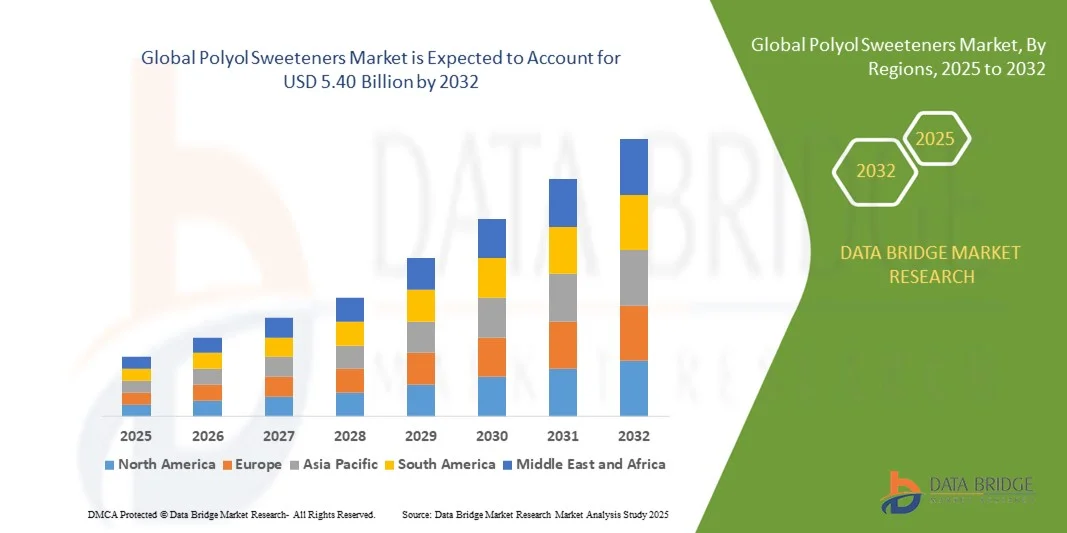
- The global Polyol Sweeteners Market size was valued at USD 3.35 billion in 2024 and is expected to reach USD 5.40 billion by 2032, growing at a CAGR of 6.15% during the forecast period.
- The market growth is primarily driven by the increasing demand for low-calorie and sugar-free food and beverage products, coupled with rising health consciousness among consumers worldwide.
- Additionally, advancements in production technologies and expanding applications of polyol sweeteners in pharmaceuticals and personal care products are further propelling market expansion. These combined factors are fueling the rising adoption of polyol sweeteners, thereby significantly boosting the industry's growth.
Global Polyol Sweeteners Market Analysis
- Polyol sweeteners, used as low-calorie sugar substitutes in food, beverages, and pharmaceutical products, are gaining significant importance due to their health benefits and versatility in various applications across the food industry.
- The increasing consumer shift towards healthier lifestyles, growing prevalence of diabetes, and demand for sugar-free and reduced-calorie products are the primary factors driving the rising adoption of polyol sweeteners globally.
- Europe dominated the Global Polyol Sweeteners Market with the largest revenue share of 34.7% in 2024, supported by strong health awareness, established food and beverage industries, and the presence of major market players investing in product innovation and expansion.
- Asia-Pacific is expected to be the fastest-growing region in the Global Polyol Sweeteners Market during the forecast period, driven by rapid urbanization, increasing disposable incomes, and growing demand for functional and health-oriented food products.
- The sorbitol segment dominated the market with the largest revenue share of 35.6% in 2024, driven by its widespread use across various applications including oral care, pharmaceuticals, and food products due to its cost-effectiveness and multifunctionality
Report Scope and Global Polyol Sweeteners Market Segmentation
|
Attributes |
Polyol Sweeteners Key Market Insights |
|
Segments Covered |
|
|
Countries Covered |
North America
Europe
Asia-Pacific
Middle East and Africa
South America
|
|
Key Market Players |
|
|
Market Opportunities |
|
|
Value Added Data Infosets |
In addition to the insights on market scenarios such as market value, growth rate, segmentation, geographical coverage, and major players, the market reports curated by the Data Bridge Market Research also include in-depth expert analysis, pricing analysis, brand share analysis, consumer survey, demography analysis, supply chain analysis, value chain analysis, raw material/consumables overview, vendor selection criteria, PESTLE Analysis, Porter Analysis, and regulatory framework. |
Global Polyol Sweeteners Market Trends
Enhanced Functionality Through Innovation and Health Focus
- A significant and accelerating trend in the global Polyol Sweeteners Market is the continuous innovation in product formulations and the growing focus on health benefits, driving expanded applications across food, beverage, and pharmaceutical industries.
- For instance, companies are developing new polyol blends that offer improved sweetness profiles, better digestive tolerance, and enhanced compatibility with various food matrices, meeting consumer demand for better taste and healthier alternatives to sugar.
- Advances in production technologies are enabling cost-effective manufacturing of polyols like erythritol and xylitol, which are increasingly used in sugar-free confectionery, dairy products, and oral care formulations. Additionally, the rise of clean-label trends encourages manufacturers to adopt natural polyols, appealing to health-conscious consumers.
- The expanding integration of polyol sweeteners in functional foods and nutraceuticals allows brands to cater to consumers seeking products with added health benefits such as reduced glycemic response and improved gut health. This also supports regulatory approvals in multiple markets, further broadening usage opportunities.
- Leading companies such as Archer Daniels Midland Company and Cargill are investing heavily in R&D to enhance polyol efficacy and sustainability, focusing on bio-based sourcing and reducing environmental impact in production processes.
- The demand for innovative, health-oriented polyol sweeteners is rapidly growing worldwide, particularly in emerging markets, as consumers increasingly prioritize healthier lifestyles without compromising on taste and convenience.
Global Polyol Sweeteners Market Dynamics
Driver
Growing Demand Driven by Health Awareness and Sugar Reduction Trends
- The rising global health consciousness, increasing prevalence of diabetes and obesity, and growing demand for sugar reduction in food and beverages are major drivers propelling the growth of the polyol sweeteners market.
- For instance, in 2024, Ingredion Incorporated launched a new range of erythritol-based sweeteners targeting sugar-free and reduced-calorie product formulations, reflecting industry efforts to meet consumer needs for healthier alternatives. Such innovations by leading companies are expected to significantly boost market growth during the forecast period.
- As consumers become more focused on managing calorie intake and maintaining healthy diets, polyol sweeteners offer an attractive solution by providing sweetness with fewer calories and a lower glycemic index compared to traditional sugars.
- Additionally, the growing trend of clean-label and natural ingredients in food products is encouraging manufacturers to incorporate polyols derived from natural sources, enhancing product appeal and trust.
- The expansion of functional food and beverage segments, including sugar-free confectionery, dairy, and beverages, is further driving the demand for polyol sweeteners in both developed and emerging markets. Increased availability of cost-effective and versatile polyols is facilitating wider adoption across various end-use industries.
Restraint/Challenge
Concerns Over Digestive Side Effects and Cost Factors
- Concerns regarding the digestive tolerance of certain polyol sweeteners, which can cause gastrointestinal discomfort such as bloating and laxative effects when consumed in excess, present a challenge to market expansion. Consumers with sensitive digestion may limit their intake, impacting demand.
- For Instance, some studies and consumer reports have highlighted mild adverse effects linked to high consumption of sugar alcohols like sorbitol and maltitol, which may discourage broader usage in some markets.
- Addressing these concerns through improved formulations, consumer education on appropriate consumption levels, and clear labeling is essential for maintaining consumer confidence. Companies such as Roquette and Cargill focus on developing polyol blends that minimize side effects while maintaining sweetness.
- Additionally, the relatively higher production cost of certain polyols compared to conventional sugars can translate to increased product prices, which may affect price-sensitive consumers, especially in developing regions.
- Although ongoing advancements and scale-up in manufacturing are gradually reducing costs, the price premium of polyol-based products compared to traditional sweeteners remains a restraint to widespread adoption.
- Overcoming these challenges by enhancing product formulations, optimizing cost efficiencies, and educating consumers about health benefits will be key to sustaining long-term market growth.
Global Polyol Sweeteners Market Scope
The polyol sweeteners market is segmented on the basis of type, form, application and function.
- By Type
On the basis of type, the Global Polyol Sweeteners Market is segmented into sorbitol, erythritol, maltitol, isomalt, lactitol, xylitol, hydrogenated starch hydrolysate (HSH), and others. The sorbitol segment dominated the market with the largest revenue share of 35.6% in 2024, driven by its widespread use across various applications including oral care, pharmaceuticals, and food products due to its cost-effectiveness and multifunctionality. Sorbitol’s role as a humectant and bulking agent also supports its broad adoption.
The erythritol segment is expected to witness the fastest CAGR of 18.3% from 2025 to 2032, owing to its low-calorie content, non-glycemic properties, and growing demand in sugar-free and diabetic-friendly products. Rising consumer health awareness and preference for natural sweeteners are propelling the growth of erythritol and other premium polyols.
- By Form
Based on form, the Global Polyol Sweeteners Market is categorized into powder or crystal and liquid or syrup. The powder or crystal segment held the largest market share of 62.4% in 2024, attributed to its stability, ease of storage, and wide application in bakery, confectionery, and oral care products. Powders are preferred for their longer shelf life and compatibility with dry product formulations.
The liquid or syrup segment is projected to grow at the fastest CAGR of 17.8% during the forecast period, driven by rising demand in beverages, dairy, and pharmaceutical formulations where liquid polyols offer better solubility and ease of blending. Increasing use of syrups in processed foods and low-calorie drinks supports this growth trajectory.
- By Application
On the basis of application, the Global Polyol Sweeteners Market is segmented into bakery and confectionery, beverages, dairy, oral care, pharmaceuticals, and others. The bakery and confectionery segment accounted for the largest market revenue share of 41.9% in 2024, fueled by increasing demand for sugar-free and reduced-calorie products. Polyols provide essential sweetness and texture without the calories of sugar, making them vital in this segment.
The beverages segment is forecasted to exhibit the fastest CAGR of 19.5% from 2025 to 2032, supported by growing consumer interest in low-sugar and functional drinks. The expanding use of polyols in dairy and pharmaceutical applications also contributes to market diversification and growth.
- By Function
By function, the Global Polyol Sweeteners Market is segmented into flavoring or sweetening agents, bulking agents, excipients, humectants, and others. The flavoring or sweetening agents segment led the market with a revenue share of 53.7% in 2024, as polyols primarily serve as sugar substitutes providing sweetness with fewer calories and lower glycemic impact. This function is critical for diabetic-friendly and health-conscious products.
The bulking agents segment is expected to witness the fastest CAGR of 16.9% from 2025 to 2032, driven by its importance in maintaining texture, volume, and mouthfeel in sugar-reduced formulations. Additionally, the humectants and excipients segments continue to support steady growth due to their applications in pharmaceuticals and oral care.
Global Polyol Sweeteners Market Regional Analysis
- Europe dominated the Global Polyol Sweeteners Market with the largest revenue share of 34.7% in 2024, driven by strong demand for low-calorie and sugar-free food products alongside rising health consciousness among consumers.
- The region benefits from well-established food and beverage industries, advanced manufacturing infrastructure, and supportive regulatory frameworks that encourage the use of polyol sweeteners in various applications such as bakery, confectionery, and pharmaceuticals.
- High consumer awareness regarding diabetic-friendly and natural sweetener alternatives, coupled with growing research and development activities, is further propelling market growth. Additionally, increasing investment by key players to expand their product portfolios and enhance distribution networks contributes to the widespread adoption of polyol sweeteners across North America in both commercial and residential sectors.
U.S. Polyol Sweeteners Market Insight
The U.S. polyol sweeteners market captured the largest revenue share of 38% in North America in 2024, driven by rising consumer demand for low-calorie and sugar-free products amid growing health awareness. The food and beverage industry’s increasing incorporation of polyol sweeteners in bakery, confectionery, and beverages is a key growth factor. Additionally, regulatory support for sugar reduction and rising prevalence of diabetes are encouraging the adoption of polyols as sugar alternatives. Innovations in product formulations and expanding distribution channels, including e-commerce, further fuel market expansion.
Europe Polyol Sweeteners Market Insight
The Europe polyol sweeteners market is projected to grow at a significant CAGR during the forecast period, propelled by stringent food safety regulations and consumer inclination towards healthier food options. Countries like Germany, France, and the U.K. are witnessing increased use of polyols in bakery, dairy, and confectionery applications. Rising awareness about sugar substitutes and government initiatives promoting reduced sugar consumption are major growth drivers. The market also benefits from advanced food processing technologies and growing investments in research and development.
U.K. Polyol Sweeteners Market Insight
The U.K. polyol sweeteners market is expected to witness steady growth owing to heightened health consciousness among consumers and increasing demand for diabetic-friendly and sugar-free products. The growing bakery and confectionery sectors are major end-users, and rising demand for natural and clean-label ingredients is encouraging product innovation. Moreover, government-led sugar reduction programs and a strong retail infrastructure are driving market penetration in both urban and rural areas.
Germany Polyol Sweeteners Market Insight
Germany’s polyol sweeteners market is anticipated to grow steadily, supported by strong consumer preference for low-calorie sweeteners and high demand in pharmaceutical and food industries. The country’s focus on sustainable and health-oriented food products encourages manufacturers to incorporate polyols as sugar alternatives. Additionally, Germany’s advanced food technology sector and stringent food safety standards ensure continuous product development and market expansion, especially in bakery, dairy, and oral care applications.
Asia-Pacific Polyol Sweeteners Market Insight
The Asia-Pacific polyol sweeteners market is poised to grow at the fastest CAGR of 22% between 2025 and 2032, fueled by rising urbanization, increasing disposable incomes, and growing health awareness in countries such as China, India, Japan, and South Korea. The expanding food processing industry and rising demand for sugar alternatives in beverages, bakery, and confectionery are driving growth. Government initiatives promoting healthier diets and the presence of major manufacturers in the region are further enhancing market accessibility and affordability.
Japan Polyol Sweeteners Market Insight
Japan’s polyol sweeteners market is gaining momentum due to a strong health-conscious consumer base and an aging population demanding healthier food and pharmaceutical products. The market is driven by increased adoption in functional foods, oral care, and pharmaceuticals. Japan’s advanced food technology and innovation capabilities facilitate the development of novel polyol-based sweeteners that meet consumer preferences for low glycemic index and sugar-free products, supporting steady market growth.
China Polyol Sweeteners Market Insight
China accounted for the largest revenue share in the Asia-Pacific polyol sweeteners market in 2024, supported by rapid urbanization, growing middle-class population, and increasing awareness of healthy eating habits. The country is a major producer and consumer of polyol sweeteners, with widespread use across bakery, confectionery, dairy, and pharmaceutical sectors. Government efforts to promote sugar reduction and the growing demand for natural and safe sugar alternatives from both manufacturers and consumers are key drivers accelerating the market’s expansion.
Global Polyol Sweeteners Market Share
The Polyol Sweeteners industry is primarily led by well-established companies, including:
- Archer Daniels Midland Company (U.S.)
- Cargill, Inc. (U.S.)
- Ingredion Incorporated (U.S.)
- DuPont de Nemours, Inc. (U.S.)
- Roquette Frères S.A. (France)
- Tereos Starch & Sweeteners Europe (France)
- Südzucker AG (Germany)
- Gulshan Polyols Ltd. (India)
- Jungbunzlauer Suisse AG (Switzerland)
- B Food Science Co., Ltd. (Japan)
- BENEO GmbH (Germany)
- Hebei Huaxu Pharmaceutical Co., Ltd. (China)
- Nutra Food Ingredients (U.S.)
- TIC Gums (U.S.)
- Western Polymer (U.S.)
- PureCircle (Malaysia)
- Sun Flour Industry Co. (Thailand)
- Gulshan Polyols Ltd. (India)
- Jungbunzlauer Suisse AG (Switzerland)
- Sweeteners Plus Inc. (U.S.)
What are the Recent Developments in Global Polyol Sweeteners Market?
- In April 2023, Roquette Frères S.A., a global leader in plant-based ingredients, announced a major capacity expansion at its polyol production facility in Lestrem, France. This strategic initiative aims to meet the increasing global demand for low-calorie sweeteners such as maltitol and sorbitol, widely used in confectionery, pharmaceuticals, and functional foods. By enhancing its manufacturing capabilities, Roquette is reinforcing its position as a key player in the polyol sweeteners market and supporting its commitment to sustainable, health-focused ingredient solutions.
- In March 2023, Cargill, Inc. introduced a new sweetening solution under its EverSweet™ brand, combining erythritol with stevia to deliver sugar-like taste with fewer calories. The innovation is designed to support beverage, bakery, and dairy manufacturers in reformulating products to align with consumer demand for healthier, reduced-sugar options. This launch reflects Cargill’s continued investment in next-generation sweetener technologies to address the evolving dietary preferences of global consumers.
- In March 2023, BENEO GmbH announced a research collaboration with several European food companies to explore isomalt’s potential in sugar-reduced baked goods. The initiative aims to provide manufacturers with clean-label, functional sweeteners that maintain texture and taste without compromising on nutritional profile. This move highlights BENEO’s focus on innovation and its commitment to delivering scientifically-backed polyol solutions that support balanced diets and regulatory compliance across the EU.
- In February 2023, Ingredion Incorporated formed a strategic partnership with a major North American dairy producer to develop customized formulations using maltitol and lactitol. The collaboration is geared toward creating sugar-reduced yogurt and frozen desserts with improved mouthfeel and taste. By working directly with food manufacturers, Ingredion is expanding the application scope of polyol sweeteners and strengthening its foothold in the health-conscious dairy segment.
- In January 2023, Gulshan Polyols Ltd., a prominent India-based producer of specialty sweeteners, announced the commissioning of a new hydrogenation facility dedicated to sorbitol and hydrogenated starch hydrolysate (HSH) production. The expansion supports the company’s strategy to meet growing domestic and export demand across the food, beverage, and personal care industries. This initiative reflects Gulshan’s commitment to technological advancement and capacity growth within the highly competitive global polyol sweeteners landscape.

- Interactive Data Analysis Dashboard
- Company Analysis Dashboard for high growth potential opportunities
- Research Analyst Access for customization & queries
- Competitor Analysis with Interactive dashboard
- Latest News, Updates & Trend analysis
- Harness the Power of Benchmark Analysis for Comprehensive Competitor Tracking
Global Polyol Sweeteners Market, Supply Chain Analysis and Ecosystem Framework
To support market growth and help clients navigate the impact of geopolitical shifts, DBMR has integrated in-depth supply chain analysis into its Global Polyol Sweeteners Market research reports. This addition empowers clients to respond effectively to global changes affecting their industries. The supply chain analysis section includes detailed insights such as Global Polyol Sweeteners Market consumption and production by country, price trend analysis, the impact of tariffs and geopolitical developments, and import and export trends by country and HSN code. It also highlights major suppliers with data on production capacity and company profiles, as well as key importers and exporters. In addition to research, DBMR offers specialized supply chain consulting services backed by over a decade of experience, providing solutions like supplier discovery, supplier risk assessment, price trend analysis, impact evaluation of inflation and trade route changes, and comprehensive market trend analysis.
Data collection and base year analysis are done using data collection modules with large sample sizes. The stage includes obtaining market information or related data through various sources and strategies. It includes examining and planning all the data acquired from the past in advance. It likewise envelops the examination of information inconsistencies seen across different information sources. The market data is analysed and estimated using market statistical and coherent models. Also, market share analysis and key trend analysis are the major success factors in the market report. To know more, please request an analyst call or drop down your inquiry.
The key research methodology used by DBMR research team is data triangulation which involves data mining, analysis of the impact of data variables on the market and primary (industry expert) validation. Data models include Vendor Positioning Grid, Market Time Line Analysis, Market Overview and Guide, Company Positioning Grid, Patent Analysis, Pricing Analysis, Company Market Share Analysis, Standards of Measurement, Global versus Regional and Vendor Share Analysis. To know more about the research methodology, drop in an inquiry to speak to our industry experts.
Data Bridge Market Research is a leader in advanced formative research. We take pride in servicing our existing and new customers with data and analysis that match and suits their goal. The report can be customized to include price trend analysis of target brands understanding the market for additional countries (ask for the list of countries), clinical trial results data, literature review, refurbished market and product base analysis. Market analysis of target competitors can be analyzed from technology-based analysis to market portfolio strategies. We can add as many competitors that you require data about in the format and data style you are looking for. Our team of analysts can also provide you data in crude raw excel files pivot tables (Fact book) or can assist you in creating presentations from the data sets available in the report.













