


What is the Global Polyolefin Catalyst Market Size and Growth Rate?
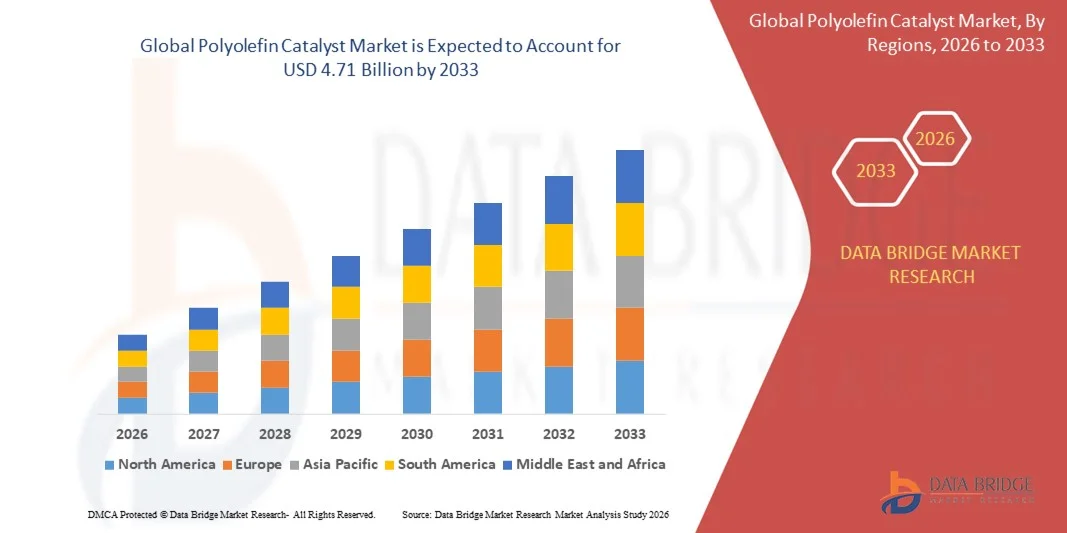
- As per Data Bridge Market Research Analysis the global polyolefin catalyst market size was valued at USD 3.19 billion in 2025 and is expected to reach USD 4.71 billion by 2033, at a CAGR of 5.00% during the forecast period
- Major factors that are expected to boost the growth of the polyolefin catalyst market in the forecast period are the rise in the manufacturing of capacity by polyolefin manufacturers
- Furthermore, the change in the end user inclination towards the flexible packaging is further anticipated to propel the growth of the polyolefin catalyst market
Market Size & Forecast
- Global Market Value (2025): USD 3.19 billion
- Expected Market Value (2033): USD 4.71 billion
- Forecast CAGR (2026–2033): 5.00%
What are the Major Takeaways of Polyolefin Catalyst Market?
- The upsurge in the demand from the construction sector is further estimated to cushion the growth of the polyolefin catalyst market. On the other hand, the variation of the crude oil costs is further projected to impede the growth of the polyolefin catalyst market
- Asia-Pacific dominated the polyolefin catalyst market with an estimated 43.69% revenue share in 2025, driven by massive polyolefin production capacity, strong petrochemical integration, and high demand from packaging, automotive, construction, and consumer goods industries across China, India, Japan, South Korea, and Southeast Asia
- North America is projected to register the fastest CAGR of 8.25% from 2026 to 2033, driven by strong shale gas availability, expanding polyethylene and polypropylene capacity, and rising demand for advanced and sustainable polymer grades across the U.S. and Canada
- The Polyethylene segment dominated the market with an estimated ~58% share in 2025, driven by its extensive use in packaging films, containers, pipes, geomembranes, and consumer goods
Report Scope and Polyolefin Catalyst Market Segmentation
|
Attributes |
Polyolefin Catalyst Key Market Insights |
|
Segments Covered |
|
|
Countries Covered |
North America
Europe
Asia-Pacific
Middle East and Africa
South America
|
|
Key Market Players |
|
|
Market Opportunities |
|
|
Value Added Data Infosets |
In addition to the insights on market scenarios such as market value, growth rate, segmentation, geographical coverage, and major players, the market reports curated by the Data Bridge Market Research also include in-depth expert analysis, pricing analysis, brand share analysis, consumer survey, demography analysis, supply chain analysis, value chain analysis, raw material/consumables overview, vendor selection criteria, PESTLE Analysis, Porter Analysis, and regulatory framework. |
What is the Key Trend in the Polyolefin Catalyst Market?
Rising Shift Toward Advanced Single-Site, Metallocene, and Post-Metallocene Polyolefin Catalysts
- The polyolefin catalyst market is witnessing a strong shift toward single-site, metallocene, and post-metallocene catalysts that enable precise control over polymer structure, molecular weight distribution, and material performance
- Manufacturers are increasingly developing high-activity catalysts that support the production of differentiated polyethylene and polypropylene grades with enhanced strength, clarity, flexibility, and processability
- Growing demand for lightweight, high-performance, and recyclable plastics in packaging, automotive, construction, and consumer goods is accelerating adoption of advanced catalyst systems
- For instance, companies such as BASF, Dow, LyondellBasell, W. R. Grace, and Mitsui Chemicals are expanding their advanced catalyst portfolios to support specialty polyolefin grades
- Increasing focus on sustainability, downgauging, and energy-efficient polymerization processes is further driving innovation in catalyst chemistry
- As polymer applications become more performance-driven, advanced polyolefin catalysts will remain critical for enabling next-generation material development
What are the Key Drivers of Polyolefin Catalyst Market?
- Rising global demand for polyethylene and polypropylene across packaging, automotive, healthcare, construction, and consumer applications
- For instance, during 2024–2025, leading producers including Dow, BASF, and Sinopec invested in advanced catalyst technologies to improve polymer efficiency and product differentiation
- Rapid growth of flexible packaging, electric vehicles, and lightweight components is boosting demand for catalysts that deliver superior mechanical and thermal properties
- Continuous advancements in catalyst design, productivity, and selectivity are reducing production costs and improving polymer yields
- Increasing adoption of circular economy initiatives, including recyclable and bio-based polyolefins, is creating new opportunities for innovative catalyst systems
- Supported by strong investments in petrochemicals and polymer R&D, the Polyolefin Catalyst market is expected to witness sustained long-term growth
Which Factor is Challenging the Growth of the Polyolefin Catalyst Market?
- High development and commercialization costs associated with advanced metallocene and post-metallocene catalysts limit adoption among smaller producers
- For instance, during 2024–2025, volatility in raw material prices and complex supply chains increased catalyst manufacturing and deployment costs
- Stringent regulatory requirements related to chemical safety, environmental impact, and emissions increase compliance complexity
- Technical challenges in catalyst handling, activation, and reactor compatibility can restrict large-scale implementation
- Competition from conventional Ziegler–Natta catalysts, which remain cost-effective for commodity polyolefin production, creates pricing pressure
- To overcome these challenges, companies are focusing on process optimization, sustainable catalyst formulations, and long-term supplier partnerships to strengthen market adoption
How is the Polyolefin Catalyst Market Segmented?
The market is segmented on the basis of classification, catalyst type, and application.
- By Classification
On the basis of classification, the polyolefin catalyst market is segmented into Polypropylene (PP) and Polyethylene (PE). The Polyethylene segment dominated the market with an estimated ~58% share in 2025, driven by its extensive use in packaging films, containers, pipes, geomembranes, and consumer goods. High demand for flexible packaging, lightweight materials, and moisture-resistant products continues to support PE production globally. Polyethylene catalysts are widely adopted due to their ability to deliver superior toughness, clarity, and process efficiency across high-density and low-density grades.
The Polypropylene segment is expected to grow at the fastest CAGR from 2026 to 2033, supported by rising use in automotive components, medical devices, household products, and fibers. Increasing demand for lightweight, recyclable, and high-performance plastics is accelerating catalyst innovation for advanced polypropylene grades.
- By Catalyst
Based on catalyst type, the market is segmented into Ziegler–Natta Catalysts, Single-site Catalysts, and Chromium Catalysts. The Ziegler–Natta catalyst segment dominated the market with approximately 46% share in 2025, owing to its widespread adoption in large-scale polyolefin production, cost-effectiveness, and proven performance in commodity plastics. These catalysts remain highly preferred for polypropylene and polyethylene manufacturing due to their stability and high productivity.
The Single-site catalyst segment is projected to grow at the fastest CAGR from 2026 to 2033, driven by increasing demand for specialty polyolefins with narrow molecular weight distribution, improved clarity, and enhanced mechanical properties. Rising focus on downgauging, sustainability, and advanced polymer applications is accelerating adoption of single-site and metallocene catalyst systems.
- By Application
On the basis of application, the polyolefin catalyst market is segmented into Injection Molding, Blow Molding, Films, Fibers, and Other Applications. The Films segment dominated the market with around 41% share in 2025, supported by strong demand from food packaging, agricultural films, industrial wraps, and consumer packaging. Polyolefin catalysts enable high-strength, flexible, and lightweight film production, making them essential for modern packaging requirements.
The Injection Molding segment is expected to grow at the fastest CAGR from 2026 to 2033, driven by increasing use of molded polyolefin components in automotive interiors, medical devices, appliances, and consumer goods. Rising emphasis on lightweighting, durability, and cost-efficient mass production continues to fuel catalyst demand in injection molding applications.
Which Region Holds the Largest Share of the Polyolefin Catalyst Market?
- Asia-Pacific dominated the polyolefin catalyst market with an estimated 43.69% revenue share in 2025, driven by massive polyolefin production capacity, strong petrochemical integration, and high demand from packaging, automotive, construction, and consumer goods industries across China, India, Japan, South Korea, and Southeast Asia. Rapid urbanization, expanding middle-class consumption, and large-scale investments in polyethylene and polypropylene plants continue to fuel catalyst demand across the region
- Leading manufacturers in Asia-Pacific are expanding catalyst production facilities and investing in advanced Ziegler–Natta and single-site catalyst technologies, strengthening regional self-sufficiency and cost competitiveness. Continuous capacity additions in downstream plastics manufacturing further support long-term market dominance
- Abundant feedstock availability, cost-efficient manufacturing, and strong government support for petrochemical expansion reinforce Asia-Pacific’s leadership in the global Polyolefin Catalyst market
China Polyolefin Catalyst Market Insight
China is the largest contributor within Asia-Pacific, supported by world-leading polyolefin production volumes, rapid capacity expansion of integrated petrochemical complexes, and strong domestic demand for packaging films, pipes, automotive parts, and consumer products. Government-backed investments in advanced catalyst technologies and localized production further accelerate market growth.
Japan Polyolefin Catalyst Market Insight
Japan shows steady growth driven by advanced polymer R&D, high-quality catalyst innovation, and strong demand for specialty polyolefins used in automotive, electronics, and medical applications. Focus on performance optimization and sustainability supports adoption of premium catalyst systems.
India Polyolefin Catalyst Market Insight
India is emerging as a high-growth market due to expanding polymer consumption, rising infrastructure development, and increasing investments in refining and petrochemical capacity. Growing demand for packaging, agriculture films, and automotive plastics fuels catalyst adoption.
North America Polyolefin Catalyst Market
North America is projected to register the fastest CAGR of 8.25% from 2026 to 2033, driven by strong shale gas availability, expanding polyethylene and polypropylene capacity, and rising demand for advanced and sustainable polymer grades across the U.S. and Canada. Increasing investments in specialty polyolefins, recyclable plastics, and high-performance materials are accelerating adoption of single-site and next-generation catalyst technologies
U.S. Polyolefin Catalyst Market Insight
The U.S. leads regional growth due to abundant low-cost feedstock, large-scale petrochemical expansions, and strong demand from packaging, automotive, and industrial sectors. Continuous innovation in catalyst efficiency and sustainability supports long-term market expansion.
Canada Polyolefin Catalyst Market Insight
Canada contributes steadily, supported by growing polymer exports, strong integration with U.S. petrochemical supply chains, and rising demand for durable and lightweight plastic materials across construction and industrial applications.
Which are the Top Companies in Polyolefin Catalyst Market?
The polyolefin catalyst industry is primarily led by well-established companies, including:
- BASF SE (Germany)
- Dow (U.S.)
- Royal Dutch Shell Plc (Netherlands)
- Honeywell International Inc. (U.S.)
- China Petrochemical Corporation (Sinopec) (China)
- Albemarle Corporation (U.S.)
- Chicago Bridge & Iron Company N.V. (Netherlands)
- Clariant (Switzerland)
- Dorf Ketal Chemicals India Private Limited (India)
- Evonik Industries AG (Germany)
- Haldor Topsøe (Denmark)
- LyondellBasell Industries Holdings B.V. (Netherlands)
- Mitsui Chemicals, Inc. (Japan)
- NOVA Chemicals (Canada)
- W. R. Grace & Co.-Conn. (U.S.)
- Zeochem AG (Switzerland)
- Zeolyst International, Inc. (U.S.)
- INEOS (U.K.)
- LG Chem (South Korea)
- LANXESS (Germany)
What are the Recent Developments in Global Polyolefin Catalyst Market?
- In June 2025, Clariant launched its PFAS-free AddWorks PPA product line for sustainable polyolefin extrusion at the K’ 2025 trade fair, introducing new polymer processing aids that comply with global regulations and enhance recyclability for applications such as food packaging, thereby supporting the industry’s shift toward sustainable polyolefin processing solutions
- In June 2025, SHCCIG Yulin Chemical selected LyondellBasell’s polyolefin technologies for a large-scale petrochemical complex in Yulin, China, securing licenses for Spheripol, Spherizone, Hostalen ACP, and Lupotech T technologies to produce polypropylene, HDPE, and EVA, which will enable advanced and sustainable polyolefin materials across multiple end-use sectors
- In June 2025, SIBUR initiated construction of Russia’s largest catalyst production facility in Kazan, focusing on polyolefin applications with an initial phase dedicated to chromium catalysts for polyethylene and a second phase targeting metallocene catalysts for high-performance polyolefins, reinforcing regional self-sufficiency and long-term supply security upon completion expected in 2027
- In September 2023, ExxonMobil announced the development of a new, more sustainable polyolefin catalyst compared to conventional alternatives, highlighting the company’s focus on reducing environmental impact while improving catalyst efficiency and performance for future polymer production
- In August 2023, LyondellBasell signed a contract to supply polyolefin catalysts to a new packaging plant in China, strengthening its presence in the Asia-Pacific region and supporting growing demand for high-quality packaging-grade polyolefins

- Interactive Data Analysis Dashboard
- Company Analysis Dashboard for high growth potential opportunities
- Research Analyst Access for customization & queries
- Competitor Analysis with Interactive dashboard
- Latest News, Updates & Trend analysis
- Harness the Power of Benchmark Analysis for Comprehensive Competitor Tracking
Global Polyolefin Catalyst Market, Supply Chain Analysis and Ecosystem Framework
To support market growth and help clients navigate the impact of geopolitical shifts, DBMR has integrated in-depth supply chain analysis into its Global Polyolefin Catalyst Market research reports. This addition empowers clients to respond effectively to global changes affecting their industries. The supply chain analysis section includes detailed insights such as Global Polyolefin Catalyst Market consumption and production by country, price trend analysis, the impact of tariffs and geopolitical developments, and import and export trends by country and HSN code. It also highlights major suppliers with data on production capacity and company profiles, as well as key importers and exporters. In addition to research, DBMR offers specialized supply chain consulting services backed by over a decade of experience, providing solutions like supplier discovery, supplier risk assessment, price trend analysis, impact evaluation of inflation and trade route changes, and comprehensive market trend analysis.
Data collection and base year analysis are done using data collection modules with large sample sizes. The stage includes obtaining market information or related data through various sources and strategies. It includes examining and planning all the data acquired from the past in advance. It likewise envelops the examination of information inconsistencies seen across different information sources. The market data is analysed and estimated using market statistical and coherent models. Also, market share analysis and key trend analysis are the major success factors in the market report. To know more, please request an analyst call or drop down your inquiry.
The key research methodology used by DBMR research team is data triangulation which involves data mining, analysis of the impact of data variables on the market and primary (industry expert) validation. Data models include Vendor Positioning Grid, Market Time Line Analysis, Market Overview and Guide, Company Positioning Grid, Patent Analysis, Pricing Analysis, Company Market Share Analysis, Standards of Measurement, Global versus Regional and Vendor Share Analysis. To know more about the research methodology, drop in an inquiry to speak to our industry experts.
Data Bridge Market Research is a leader in advanced formative research. We take pride in servicing our existing and new customers with data and analysis that match and suits their goal. The report can be customized to include price trend analysis of target brands understanding the market for additional countries (ask for the list of countries), clinical trial results data, literature review, refurbished market and product base analysis. Market analysis of target competitors can be analyzed from technology-based analysis to market portfolio strategies. We can add as many competitors that you require data about in the format and data style you are looking for. Our team of analysts can also provide you data in crude raw excel files pivot tables (Fact book) or can assist you in creating presentations from the data sets available in the report.













