


Polyurea Coating Market Overview
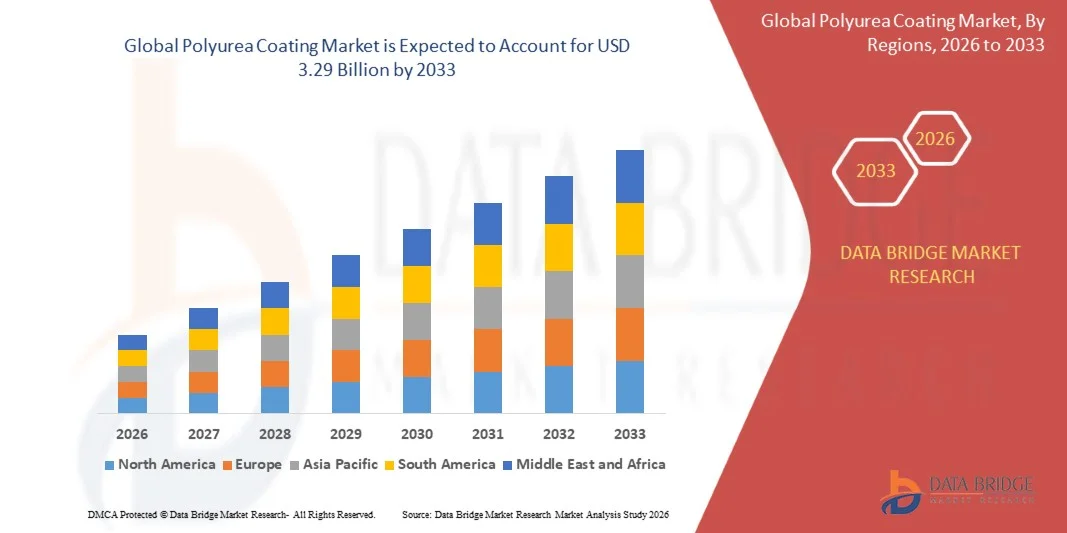
As per Data Bridge Market Research analysis the polyurea coating market was valued at USD 1.47 billion in 2025 and is projected to reach USD 3.29 billion by 2033, growing at a CAGR of 10.66% from 2026 to 2033. The market is witnessing strong growth driven by increasing demand for high-performance protective coatings across construction, industrial, transportation, and infrastructure sectors, along with rising investments in asset protection and rehabilitation projects.
The growing need for durable, fast-curing, and corrosion-resistant coating solutions is accelerating the adoption of polyurea coatings in bridges, pipelines, wastewater treatment facilities, secondary containment systems, and commercial buildings. Their superior abrasion resistance, waterproofing capabilities, chemical resistance, and ability to perform under extreme environmental conditions make polyurea coatings a preferred alternative to conventional epoxy and polyurethane coatings. Furthermore, expanding infrastructure development, increasing industrial maintenance activities, and stricter regulations regarding asset longevity and environmental protection are expected to continue driving market growth throughout the forecast period.
Market Size & Forecast
- Market Value (2025): USD 1.47 Billion
- Expected Market Value (2033): USD 3.29 Billion
- Forecast CAGR (2026–2033): 10.66%
- Leading Region in 2025: North America
- Fastest Growing Region: Asia-Pacific
Key Market Trends & Insights
- North America dominated the polyurea coating market with the largest revenue share of 41.2% in 2025, supported by substantial investments in infrastructure rehabilitation, industrial asset protection, and commercial construction activities.
- Asia-Pacific polyurea coating market is expected to witness the fastest growth rate from 2026 to 2033, supported by rapid urbanization, expanding industrialization, and increasing infrastructure investments across China, India, Japan, and Southeast Asia.
- The aromatic isocyanate segment held the largest market revenue share of 67.7% in 2025, driven by its widespread use in industrial flooring, secondary containment, pipelines, wastewater treatment facilities, and construction applications. Aromatic polyurea coatings are preferred due to their cost-effectiveness, excellent mechanical strength, abrasion resistance, and chemical protection in environments where UV exposure is not a primary concern.
- The aliphatic isocyanate segment is projected to register the fastest growth during the forecast period of 2026 to 2033, driven by increasing demand for UV-stable coatings across bridges, commercial buildings, transportation infrastructure, and decorative applications. Rising investments in long-lasting exterior protection and aesthetically durable coatings are supporting segment growth.
- The pure polyurea segment accounted for the largest market revenue share in 2025 owing to its rapid curing characteristics, excellent waterproofing performance, and exceptional durability under harsh environmental conditions. It is widely adopted for bridges, storage tanks, marine structures, and containment systems requiring long-term asset protection.
- The hybrid polyurea segment is projected to register the fastest growth during the forecast period of 2026 to 2033, supported by increasing demand for economical protective coating solutions across commercial buildings, industrial flooring, and infrastructure rehabilitation projects. Improved formulation technologies are also expanding its range of end-use applications.
- The spraying segment held the largest market revenue share in 2025, driven by its ability to provide seamless, uniform, and rapid coating application over large surface areas. Spray technology is extensively used in industrial facilities, transportation infrastructure, wastewater treatment plants, and waterproofing projects due to its high productivity and superior coating performance.
- The hand mixing segment is expected to register the fastest growth during the forecast period of 2026 to 2033, supported by increasing demand for small-scale repair, maintenance, and localized coating applications where specialized spray equipment is not economically feasible. Growing renovation activities are further contributing to segment expansion.
- The building and construction segment held the largest market revenue share in 2025, driven by increasing demand for waterproofing, corrosion protection, roofing, parking decks, bridge structures, and commercial infrastructure rehabilitation. Rising investments in durable construction materials and long-life protective coatings continue to support segment growth.
- The transportation segment is projected to register the fastest growth during the forecast period of 2026 to 2033, driven by increasing use of polyurea coatings in railcars, truck bed liners, marine vessels, automotive components, and transport infrastructure. Growing emphasis on corrosion resistance, impact protection, and extended service life is accelerating adoption across the transportation industry.
Report Scope and Polyurea Coating Market Segmentation
|
Attributes |
Polyurea Coating Key Market Insights |
|
Segments Covered |
|
|
Countries Covered |
North America
Europe
Asia-Pacific
Middle East and Africa
South America
|
|
Key Market Players |
|
|
Market Opportunities |
|
|
Value Added Data Infosets |
In addition to the insights on market scenarios such as market value, growth rate, segmentation, geographical coverage, and major players, the market reports curated by the Data Bridge Market Research also include import export analysis, production capacity overview, production consumption analysis, price trend analysis, climate change scenario, supply chain analysis, value chain analysis, raw material/consumables overview, vendor selection criteria, PESTLE Analysis, Porter Analysis, and regulatory framework. |
Polyurea Coating Market Trends
Trend: Rising Adoption Of High-Performance Protective Coatings For Infrastructure And Industrial Assets
Growing investments in infrastructure modernization, industrial asset protection, and waterproofing solutions are accelerating the demand for polyurea coatings across construction, transportation, energy, and water management sectors. Conventional epoxy and polyurethane coatings often require longer curing times and are more susceptible to cracking, UV degradation, and chemical attack, encouraging industries to adopt fast-curing polyurea systems that provide superior abrasion resistance, flexibility, and long-term durability.
In modern infrastructure projects, manufacturers are introducing advanced coating technologies to improve durability and sustainability. For instance, in March 2025, BASF and Sika jointly introduced Baxxodur EC 151, a bio-based curing agent for epoxy and polyurea coatings that delivers significantly lower VOC emissions while improving curing speed and coating performance for industrial flooring, parking decks, and infrastructure applications.
The rapid expansion of industrial flooring, water infrastructure, and transportation assets is also increasing demand for seamless protective coatings capable of resisting chemicals, abrasion, and moisture in harsh operating environments. In addition, innovations in sustainable formulations continue to support infrastructure rehabilitation. According to BASF, Baxxodur EC 151 enables coating applications at temperatures as low as 5–10°C while reducing curing time by up to two-thirds compared with conventional hardeners, helping minimize maintenance downtime.
Polyurea Coating Market Dynamics
Key Market Driver: Increasing Demand For Corrosion Protection And Infrastructure Rehabilitation
Governments and private asset owners worldwide are increasing investments in maintaining aging infrastructure while minimizing lifecycle maintenance costs. Bridges, industrial plants, pipelines, marine structures, and water treatment facilities are continuously exposed to moisture, chemicals, abrasion, and extreme weather, creating strong demand for protective coating systems that deliver long-term performance with minimal operational disruption.
Industries such as oil & gas, construction, transportation, and utilities are increasingly adopting polyurea coatings to protect steel and concrete structures from corrosion, impact damage, and chemical exposure. For instance, in July 2025, UK infrastructure engineering company Ipsum entered an exclusive partnership with OBIC to deploy advanced polyurea coating technology across water infrastructure assets, including manholes, pumping stations, and wastewater facilities. The solution is designed to rehabilitate deteriorating concrete structures, provide long-term corrosion protection, and extend asset service life by up to 50 years while reducing maintenance requirements.
Similarly, infrastructure operators are prioritizing protective coatings that reduce maintenance frequency and improve asset longevity. According to the U.S. Federal Highway Administration, corrosion of reinforced concrete and steel infrastructure costs billions of dollars annually, encouraging broader adoption of high-performance protective coating systems for bridges, tunnels, and transportation assets.
Key Restraint/Challenge: High Application Costs And Specialized Installation Requirements
Although polyurea coatings provide exceptional durability and rapid curing performance, their adoption is constrained by relatively high installation costs and the need for specialized application equipment. Proper application requires plural-component high-pressure spray systems, precise temperature control, and trained technicians to ensure correct mixing and consistent coating performance.
In addition, premium raw materials such as isocyanates and specialty resin systems increase coating costs compared with conventional epoxy and polyurethane alternatives, creating affordability concerns for cost-sensitive construction and industrial projects. Surface preparation requirements, substrate compatibility, and strict environmental controls during installation further increase total project expenses, particularly for large infrastructure developments.
For instance, in January 2025, Sika expanded its roofing and waterproofing portfolio with the launch of Sikalastic-702, a two-component, cold-applied, polyurea-based waterproofing membrane. The company specifies that the product requires controlled two-component mixing and professional installation to achieve the required waterproofing performance and durability, demonstrating the technical complexity and specialized application requirements associated with polyurea coating systems.
Key Market Opportunity: Expansion Across Renewable Energy, Water Infrastructure, And Industrial Facilities
Growing investments in renewable energy infrastructure, water management systems, and industrial modernization are creating significant opportunities for advanced polyurea coating solutions. Wind farms, solar installations, desalination plants, wastewater treatment facilities, and hydrogen infrastructure increasingly require protective coatings capable of resisting moisture, chemicals, UV exposure, and mechanical wear throughout long operating lifecycles.
Project developers are increasingly utilizing polyurea coatings for wind turbine foundations, water containment structures, and industrial flooring to improve durability while reducing maintenance frequency.
In addition, innovations in bio-based raw materials and sustainable coating technologies are expanding application opportunities across Europe, North America, and Asia-Pacific. Growing investments in water infrastructure rehabilitation and renewable energy facilities are expected to further increase demand for long-life polyurea protective coatings capable of reducing maintenance costs and improving infrastructure resilience.
Polyurea Coating Market Scope
The market is segmented on the basis of raw material, product, technology, and end-use.
- By Raw Material
On the basis of raw material, the polyurea coating market is segmented into aromatic isocyanate and aliphatic isocyanate. The aromatic isocyanate segment held the largest market revenue share of 67.7% in 2025, driven by its widespread use in industrial flooring, secondary containment, pipelines, wastewater treatment facilities, and construction applications. Aromatic polyurea coatings are preferred due to their cost-effectiveness, excellent mechanical strength, abrasion resistance, and chemical protection in environments where UV exposure is not a primary concern.
The aliphatic isocyanate segment is projected to register the fastest growth during the forecast period of 2026 to 2033, driven by increasing demand for UV-stable coatings across bridges, commercial buildings, transportation infrastructure, and decorative applications. Rising investments in long-lasting exterior protection and aesthetically durable coatings are supporting segment growth.
- By Product
On the basis of product, the polyurea coating market is segmented into pure polyurea and hybrid polyurea. The pure polyurea segment accounted for the largest market revenue share in 2025 owing to its rapid curing characteristics, excellent waterproofing performance, and exceptional durability under harsh environmental conditions. It is widely adopted for bridges, storage tanks, marine structures, and containment systems requiring long-term asset protection.
The hybrid polyurea segment is projected to register the fastest growth during the forecast period of 2026 to 2033, supported by increasing demand for economical protective coating solutions across commercial buildings, industrial flooring, and infrastructure rehabilitation projects. Improved formulation technologies are also expanding its range of end-use applications.
- By Technology
On the basis of technology, the polyurea coating market is segmented into spraying, pouring, and hand mixing. The spraying segment held the largest market revenue share in 2025, driven by its ability to provide seamless, uniform, and rapid coating application over large surface areas. Spray technology is extensively used in industrial facilities, transportation infrastructure, wastewater treatment plants, and waterproofing projects due to its high productivity and superior coating performance.
The hand mixing segment is expected to register the fastest growth during the forecast period of 2026 to 2033, supported by increasing demand for small-scale repair, maintenance, and localized coating applications where specialized spray equipment is not economically feasible. Growing renovation activities are further contributing to segment expansion.
- By End-Use
On the basis of end-use, the polyurea coating market is segmented into building and construction, transportation, industrial, and landscape. The building and construction segment held the largest market revenue share in 2025, driven by increasing demand for waterproofing, corrosion protection, roofing, parking decks, bridge structures, and commercial infrastructure rehabilitation. Rising investments in durable construction materials and long-life protective coatings continue to support segment growth.
The transportation segment is projected to register the fastest growth during the forecast period of 2026 to 2033, driven by increasing use of polyurea coatings in railcars, truck bed liners, marine vessels, automotive components, and transport infrastructure. Growing emphasis on corrosion resistance, impact protection, and extended service life is accelerating adoption across the transportation industry.
Polyurea Coating Market Regional Analysis
North America Polyurea Coating Market Insight
North America dominated the polyurea coating market with the largest revenue share of 41.2% in 2025, supported by substantial investments in infrastructure rehabilitation, industrial asset protection, and commercial construction activities. The region has witnessed widespread adoption of polyurea coatings across bridges, parking structures, pipelines, wastewater treatment facilities, and secondary containment systems due to their superior corrosion resistance, rapid curing properties, and long service life. Strong regulatory emphasis on infrastructure durability, coupled with increasing maintenance expenditure and the presence of leading coating manufacturers, continues to strengthen the regional market.
U.S. Polyurea Coating Market Insight
The U.S. polyurea coating market captured the largest revenue share in 2025 within North America, fueled by increasing investments in transportation infrastructure, industrial maintenance, and water treatment projects. Growing adoption of spray-applied polyurea coatings for bridge decks, roofing systems, tank linings, truck bed liners, and concrete protection is supporting market expansion. Furthermore, federal infrastructure funding initiatives, rising demand for corrosion-resistant protective coatings, and continuous innovation by domestic manufacturers are driving the growth of the polyurea coating market across the country.
Canada Polyurea Coating Market Insight
The Canada polyurea coating market is expected to witness significant growth from 2026 to 2033, driven by increasing investments in transportation infrastructure, energy facilities, mining operations, and water treatment projects. Growing demand for durable waterproofing and corrosion-resistant coatings across bridges, pipelines, storage tanks, parking structures, and industrial facilities is accelerating the adoption of polyurea coating systems. Furthermore, government initiatives focused on infrastructure renewal, coupled with rising maintenance expenditure for public assets and expanding industrial construction activities, are expected to continue supporting the growth of the polyurea coating market in Canada.
Europe Polyurea Coating Market Insight
The Europe polyurea coating market is expected to witness the fastest growth rate from 2026 to 2033, primarily driven by increasing investments in sustainable construction, infrastructure modernization, and industrial asset protection. Stringent environmental regulations encouraging durable, low-maintenance coating systems are accelerating the adoption of polyurea technologies across transportation, energy, and commercial infrastructure. The growing focus on extending infrastructure lifespan while reducing lifecycle maintenance costs is expected to further support regional market growth.
U.K. Polyurea Coating Market Insight
The U.K. polyurea coating market is expected to witness the fastest growth rate from 2026 to 2033, driven by rising investments in water infrastructure rehabilitation, commercial construction, and transportation asset maintenance. Increasing adoption of advanced waterproofing and corrosion-protection solutions for bridges, tunnels, roofing systems, and wastewater facilities is contributing to market expansion. In addition, growing emphasis on sustainable infrastructure development and reduced maintenance downtime continues to stimulate demand for polyurea coatings.
Germany Polyurea Coating Market Insight
The Germany polyurea coating market is expected to witness the fastest growth rate from 2026 to 2033, fueled by the country's strong industrial manufacturing base and increasing demand for high-performance protective coatings across automotive, chemical processing, and infrastructure sectors. Rising investments in industrial modernization, energy facilities, and corrosion-resistant asset protection are accelerating product adoption. The country's focus on engineering excellence and long-term infrastructure sustainability further supports market growth.
Asia-Pacific Polyurea Coating Market Insight
The Asia-Pacific polyurea coating market is expected to witness the fastest growth rate from 2026 to 2033, supported by rapid urbanization, expanding industrialization, and increasing infrastructure investments across China, India, Japan, and Southeast Asia. Rising demand for durable waterproofing, industrial flooring, transportation infrastructure, and protective coating solutions is driving market expansion. The region's growing manufacturing sector and increasing government spending on public infrastructure projects continue to create significant growth opportunities for polyurea coating manufacturers.
Japan Polyurea Coating Market Insight
The Japan polyurea coating market is expected to witness the fastest growth rate from 2026 to 2033 due to increasing investments in resilient infrastructure, industrial automation, and advanced manufacturing facilities. Growing demand for corrosion-resistant and waterproof protective coatings across transportation networks, industrial plants, and commercial buildings is supporting market expansion. Furthermore, Japan's emphasis on infrastructure longevity, disaster resilience, and high-quality construction materials continues to encourage the adoption of advanced polyurea coating technologies.
China Polyurea Coating Market Insight
The China polyurea coating market accounted for the largest market revenue share in Asia-Pacific in 2025, attributed to rapid infrastructure development, large-scale industrial expansion, and increasing investments in transportation, manufacturing, and water management projects. Rising adoption of protective coatings for industrial flooring, pipelines, bridges, storage tanks, and commercial construction is driving market growth. Strong domestic manufacturing capabilities, expanding construction activities, and continued government investments in urban infrastructure further reinforce China's leading position in the regional polyurea coating market.
Polyurea Coating Market Share
The polyurea coating industry is primarily led by well-established companies, including:
- PPG Industries, Inc. (U.S.)
- The Sherwin-Williams Company (U.S.)
- Nukote Coating Systems, Intl (U.S.)
- The VersaFlex Companies (U.S.)
- Armorthane (U.S.)
- POLYFLEX AND WASSER® (U.S.)
- Rhino Linings Corporation (U.S.)
- Kukdo Chemical Co., Ltd. (South Korea)
- VIP Coatings Intl Gmbh & Co. KG (Germany)
- Huntsman International LLC. (U.S.)
- Rust-Oleum (U.S.)
- SPI Performance Coatings (U.K)
- Lse Building Preservation Ltd (U.K.)
- Teknos Group (Finland)
- BASF SE (Germany)
- M&I Materials Limited (U.K)
- Dupont (U.S.)
- SOLVAY (Belgium)
- R. Grace & Co.-Conn. (U.S.)
Latest Developments in Polyurea Coating Market
- In July 2025, Ipsum, Partnership, entered an exclusive partnership with OBIC to deploy advanced polyurea coating technology across the U.K. water infrastructure sector. The partnership aims to rehabilitate manholes, pumping stations, and wastewater assets by providing long-term corrosion protection and extending asset service life by up to 50 years. The development is expected to increase the adoption of polyurea coatings in water infrastructure applications.
- In March 2025, BASF and Sika, Product Launch, introduced Baxxodur EC 151, a bio-based curing agent for epoxy and polyurea coating systems. The new solution improves curing performance, reduces VOC emissions, and supports sustainable protective coating formulations for industrial and infrastructure applications. The launch strengthens innovation in the polyurea coating market.
- In January 2025, Sika, Product Launch, launched Sikalastic-702, a two-component, cold-applied polyurea-based waterproofing membrane for roofing and infrastructure applications. The product provides rapid curing, durable waterproofing, and high crack-bridging performance, supporting growing demand for high-performance polyurea coating solutions.
- In July 2024, LINE-X, Business Milestone, announced that its Fleet Solutions division had serviced more than 10,000 commercial fleet vehicles across the U.S. and Canada using its protective coating systems. The milestone reflects increasing adoption of polyurea coatings for commercial vehicle protection, improving corrosion resistance, durability, and service life.

- Interactive Data Analysis Dashboard
- Company Analysis Dashboard for high growth potential opportunities
- Research Analyst Access for customization & queries
- Competitor Analysis with Interactive dashboard
- Latest News, Updates & Trend analysis
- Harness the Power of Benchmark Analysis for Comprehensive Competitor Tracking
Global Polyurea Coating Market, Supply Chain Analysis and Ecosystem Framework
To support market growth and help clients navigate the impact of geopolitical shifts, DBMR has integrated in-depth supply chain analysis into its Global Polyurea Coating Market research reports. This addition empowers clients to respond effectively to global changes affecting their industries. The supply chain analysis section includes detailed insights such as Global Polyurea Coating Market consumption and production by country, price trend analysis, the impact of tariffs and geopolitical developments, and import and export trends by country and HSN code. It also highlights major suppliers with data on production capacity and company profiles, as well as key importers and exporters. In addition to research, DBMR offers specialized supply chain consulting services backed by over a decade of experience, providing solutions like supplier discovery, supplier risk assessment, price trend analysis, impact evaluation of inflation and trade route changes, and comprehensive market trend analysis.
Data collection and base year analysis are done using data collection modules with large sample sizes. The stage includes obtaining market information or related data through various sources and strategies. It includes examining and planning all the data acquired from the past in advance. It likewise envelops the examination of information inconsistencies seen across different information sources. The market data is analysed and estimated using market statistical and coherent models. Also, market share analysis and key trend analysis are the major success factors in the market report. To know more, please request an analyst call or drop down your inquiry.
The key research methodology used by DBMR research team is data triangulation which involves data mining, analysis of the impact of data variables on the market and primary (industry expert) validation. Data models include Vendor Positioning Grid, Market Time Line Analysis, Market Overview and Guide, Company Positioning Grid, Patent Analysis, Pricing Analysis, Company Market Share Analysis, Standards of Measurement, Global versus Regional and Vendor Share Analysis. To know more about the research methodology, drop in an inquiry to speak to our industry experts.
Data Bridge Market Research is a leader in advanced formative research. We take pride in servicing our existing and new customers with data and analysis that match and suits their goal. The report can be customized to include price trend analysis of target brands understanding the market for additional countries (ask for the list of countries), clinical trial results data, literature review, refurbished market and product base analysis. Market analysis of target competitors can be analyzed from technology-based analysis to market portfolio strategies. We can add as many competitors that you require data about in the format and data style you are looking for. Our team of analysts can also provide you data in crude raw excel files pivot tables (Fact book) or can assist you in creating presentations from the data sets available in the report.













