


Polyurethane Coating Market Size
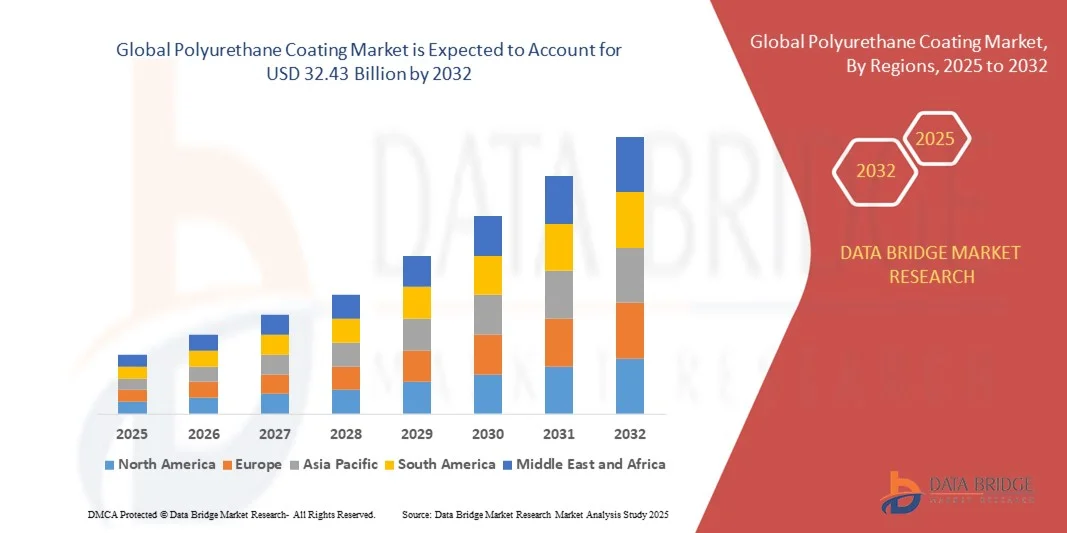
- The global polyurethane coating market size was valued at USD 21.13 billion in 2024 and is expected to reach USD 32.43 billion by 2032, at a CAGR of 5.50% during the forecast period
- The market growth is largely fueled by the increasing adoption of polyurethane coatings in construction, automotive, and industrial sectors, driven by their superior durability, chemical resistance, and weather protection properties. Expanding infrastructure projects, rising demand for high-performance flooring, and the growing use of protective coatings in pipelines and machinery are key contributors to market expansion
- Furthermore, rising environmental awareness and regulatory pressure are accelerating the shift toward water-based and low-VOC polyurethane coatings, creating strong demand for sustainable solutions. These converging factors are boosting the uptake of polyurethane coatings across diverse applications, thereby significantly driving the industry’s growth
Polyurethane Coating Market Analysis
- Polyurethane coatings are high-performance protective and decorative solutions widely applied across substrates such as concrete, metal, wood, and plastics. They provide excellent resistance to abrasion, corrosion, and chemicals, making them essential for applications in construction, automotive, industrial equipment, and energy sectors
- The escalating demand for polyurethane coatings is primarily fueled by rapid urbanization, increasing automotive production, and rising adoption of eco-friendly water-based formulations. Their versatility, durability, and alignment with sustainability trends are positioning polyurethane coatings as a preferred choice across multiple end-user industries
- Asia-Pacific dominated the polyurethane coating market with a share of 55.66% in 2024, due to rapid urbanization, strong construction growth, and expanding automotive production across key economies
- North America is expected to be the fastest growing region in the polyurethane coating market during the forecast period due to rising adoption in construction, aerospace, and automotive industries
- Solvent-based segment dominated the market with a market share of 64.3% in 2024, due to its superior adhesion, durability, and resistance to chemicals and abrasion. Solvent-based polyurethane coatings are widely used in industries such as automotive, aerospace, and construction, where performance reliability is critical. They also offer excellent gloss and finish, making them popular in applications requiring both aesthetics and durability. Despite environmental regulations, their performance advantages continue to secure dominance in high-demand industries. In addition, the development of low-VOC solvent-based coatings has helped sustain their demand amidst tightening environmental restrictions
Report Scope and Polyurethane Coating Market Segmentation
|
Attributes |
Polyurethane Coating Key Market Insights |
|
Segments Covered |
|
|
Countries Covered |
North America
Europe
Asia-Pacific
Middle East and Africa
South America
|
|
Key Market Players |
|
|
Market Opportunities |
|
|
Value Added Data Infosets |
In addition to the insights on market scenarios such as market value, growth rate, segmentation, geographical coverage, and major players, the market reports curated by the Data Bridge Market Research also include import export analysis, production capacity overview, production consumption analysis, price trend analysis, climate change scenario, supply chain analysis, value chain analysis, raw material/consumables overview, vendor selection criteria, PESTLE Analysis, Porter Analysis, and regulatory framework. |
Polyurethane Coating Market Trends
Rising Adoption of Eco-Friendly Polyurethane Coatings
- The polyurethane coating market is increasingly driven by demand for eco-friendly solutions that comply with stricter environmental regulations and growing consumer preferences. Waterborne and bio-based polyurethane coatings, characterized by low volatile organic compound (VOC) emissions, are replacing traditional solvent-based systems across industries such as automotive, construction, and consumer goods
- For instance, BASF and Covestro have accelerated the development of waterborne polyurethane dispersions with superior durability and aesthetic qualities tailored for automotive and architectural applications. PPG Industries has introduced bio-based polyurethane coatings with enhanced UV resistance, targeting sustainable building and furniture sectors in Europe and North America
- Technological advancements have significantly improved the performance of eco-friendly polyurethane coatings, including abrasion resistance, chemical stability, and color retention. These improvements enable wider adoption in sectors requiring high durability alongside environmental compliance, reinforcing sustainability as a market priority
- Enhanced government policies and incentives promoting green chemistry and sustainable materials are fostering increased investment in eco-friendly polyurethane technologies. The growing electric vehicle market, coupled with stricter EU REACH and EPA VOC regulations, further incentivizes the transition to waterborne and bio-based coatings
- Industry collaborations focusing on circular economy principles, extended product lifecycles, and recyclability of polyurethane coatings are setting new benchmarks for sustainable coatings innovation. These innovations ensure the polyurethane coatings market remains aligned with global carbon reduction and environmental stewardship goals
- The growing synergy between performance, aesthetics, and sustainability is steering polyurethane coatings toward eco-friendlier formulations, establishing this as a core market trend expected to dominate industry developments through 2030
Polyurethane Coating Market Dynamics
Driver
Growth in Construction and Infrastructure Demand
- Robust infrastructure development and accelerating construction activities worldwide are significantly boosting demand for polyurethane coatings. These coatings provide essential protection against environmental degradation, corrosion, and abrasion for steel structures, concrete surfaces, and architectural elements, extending service life and reducing maintenance costs
- For instance, Sherwin-Williams has secured major contracts supplying polyurethane coatings for bridges and commercial buildings in North America, emphasizing durability and fast-curing properties. Asian infrastructure booms, particularly in China and India, are driving polyurethane coating demand for residential, commercial, and industrial construction projects
- Polyurethane coatings’ water resistance, chemical stability, and UV protection make them ideal for diverse infrastructure applications, including tunnels, pipelines, and concrete flooring. The rapid urbanization and government-led smart city initiatives further expand market opportunities for protective coatings
- Increased investments in energy infrastructure, including oil & gas pipelines and renewable energy installations, require advanced coating solutions capable of withstanding harsh environmental conditions, driving polyurethane coatings usage. These coatings support sustainability goals by enhancing asset longevity and minimizing environmental wear
- The construction sector’s expanding scale and complexity underscore the polyurethane coatings’ critical role in ensuring infrastructure resilience and safety. This growth trajectory is a key market driver reinforcing rising demand for polyurethane coatings globally
Restraint/Challenge
Fluctuating Raw Material Costs
- The polyurethane coatings market contends with challenges from fluctuations in raw material costs, influenced by volatile petrochemical feedstocks and changes in renewable resource availability. Such price swings impact manufacturer margins and overall product pricing, affecting competitive positioning
- For instance, increasing crude oil prices have led to higher production costs for polyols and isocyanates, key components in polyurethane coatings, causing price volatility globally. Periodic shortages of bio-based raw materials due to agricultural supply disruptions further complicate cost stability for eco-friendly formulations
- Raw material price volatility generates uncertainty for manufacturers and buyers, sometimes leading to supply delays or contract renegotiations. This instability can hinder long-term investment in innovation and capacity expansion, especially in markets sensitive to cost fluctuations
- Efforts to diversify raw material sources, invest in synthetic alternatives, and improve supply chain resilience are ongoing but have yet to fully mitigate price risks. Regional economic and geopolitical factors continue to contribute to raw material cost unpredictability
- In conclusion, while the market for polyurethane coatings grows steadily, fluctuating raw material costs remain a significant restraint. Proactive sourcing strategies and technological advancements in raw material utilization will be crucial to maintaining market stability and supporting sustainable growth
Polyurethane Coating Market Scope
The market is segmented on the basis of application method, substrate material, grade, packaging, product type, application, and end-use industry.
- By Application Method
On the basis of application method, the polyurethane coating market is segmented into spray, brush, and roller. The spray segment dominated the market in 2024, primarily due to its ability to provide a smooth, uniform finish over large surfaces with high efficiency. Spray methods reduce application time, minimize labor intensity, and ensure consistent coating thickness even on complex geometries. Industries such as automotive, construction, and aerospace heavily rely on spray applications for both protective and decorative purposes. In addition, the use of advanced spray technologies enhances precision, reducing material wastage and improving cost-effectiveness. The growing demand for fast and reliable surface finishing across diverse industries continues to strengthen the dominance of spray applications.
The brush segment is anticipated to witness the fastest growth from 2025 to 2032, fueled by its suitability for small-scale applications, maintenance, and repairs. Brush application allows greater control in applying polyurethane coatings, making it ideal for precision-based work. It is often preferred in areas where surface detailing or localized coverage is required. The low cost of brush application also makes it attractive for residential and small commercial projects. Furthermore, compatibility with a wide range of polyurethane formulations ensures flexibility across industries. Rising demand in renovation projects and niche markets contributes significantly to its accelerated adoption during the forecast period.
- By Substrate Material
On the basis of substrate material, the market is segmented into concrete, metal, wood, plastic, fabric, and others. The metal segment held the largest market share in 2024, owing to the widespread use of polyurethane coatings for corrosion resistance, durability, and enhanced aesthetics. Metals used in automotive, industrial machinery, and construction require long-term protection against rust, weather, and chemical exposure. Polyurethane coatings form a strong, resilient layer, ensuring extended equipment life and reduced maintenance costs. The demand for advanced coatings on metals has also increased due to stricter environmental regulations and performance standards. Rapid urbanization and industrialization across developed and emerging economies further strengthen the need for metal-focused polyurethane coatings.
The concrete segment is projected to register the fastest growth during 2025–2032, driven by its critical role in infrastructure and flooring applications. Concrete surfaces benefit from polyurethane coatings due to their superior abrasion resistance, chemical resistance, and weatherproofing properties. This makes them an ideal choice for industrial floors, pavements, and warehouses, where heavy traffic and harsh conditions are common. Growing infrastructure development, particularly in emerging markets, accelerates demand for concrete coatings. Furthermore, the need for long-lasting, low-maintenance flooring solutions supports adoption across commercial and public facilities. Rising investments in smart cities and modern urban infrastructure projects will further propel growth in this segment.
- By Grade
On the basis of grade, the polyurethane coating market is categorized into technical grade and industrial grade. The industrial grade segment dominated in 2024, largely due to its suitability for high-performance applications that demand superior chemical, mechanical, and thermal resistance. Industries such as aerospace, automotive, and power generation require coatings that can withstand extreme operating conditions. Industrial grade polyurethane coatings extend equipment life, reduce downtime, and meet stringent regulatory standards for durability and safety. Their adoption is further supported by the growing need for protective coatings in heavy industrial settings. The continuous expansion of industrial infrastructure worldwide has reinforced the dominance of industrial-grade polyurethane coatings.
The technical grade segment is expected to witness the fastest growth from 2025 to 2032, driven by its tailored use in specialized and small-scale applications. Technical grade polyurethane coatings are designed for precision needs, often providing specific performance attributes such as enhanced adhesion or finish quality. They are widely used in niche industries, research facilities, and specialty products that require customized formulations. The flexibility to adjust formulations for unique requirements makes technical grade coatings highly versatile. Rising demand for specialty coatings in electronics, textiles, and other precision-driven sectors is contributing to its rapid expansion. In addition, increasing R&D activity is enabling more advanced technical-grade formulations that support industry innovation.
- By Packaging
On the basis of packaging, the market is segmented into cans, plastic drums, and others. The plastic drum segment dominated in 2024, owing to its suitability for bulk storage and transportation of polyurethane coatings in industrial settings. Plastic drums are durable, cost-effective, and resistant to leaks, making them ideal for large-scale applications. They ensure safe handling of liquid coatings, minimizing risks of contamination and spillage. Industries such as construction, automotive, and marine prefer plastic drums for their logistical convenience. In addition, drums allow coatings to be transported in larger volumes, reducing distribution costs. Rising industrial demand and the need for efficient supply chain management continue to drive the dominance of plastic drum packaging.
The cans segment is projected to witness the fastest growth during 2025–2032, fueled by the rising popularity of small-scale and DIY applications. Cans offer portability, precise quantity control, and ease of use, making them suitable for household projects and minor commercial applications. They are particularly favored for maintenance, touch-up, and decorative work where smaller quantities of polyurethane coatings are required. Growing urbanization has also spurred demand from residential renovation and remodeling projects. Furthermore, the availability of water-based and eco-friendly formulations in small cans has increased accessibility to environmentally conscious consumers. The combination of convenience and adaptability is propelling rapid growth in this packaging format.
- By Product Type
On the basis of product type, the market is segmented into water-based, solvent-based, powder-based, and others. The solvent-based segment held the largest revenue share of 64.3% in 2024, driven by its superior adhesion, durability, and resistance to chemicals and abrasion. Solvent-based polyurethane coatings are widely used in industries such as automotive, aerospace, and construction, where performance reliability is critical. They also offer excellent gloss and finish, making them popular in applications requiring both aesthetics and durability. Despite environmental regulations, their performance advantages continue to secure dominance in high-demand industries. In addition, the development of low-VOC solvent-based coatings has helped sustain their demand amidst tightening environmental restrictions.
The water-based segment is expected to witness the fastest CAGR from 2025 to 2032, owing to increasing regulatory pressures and a shift toward sustainable solutions. Water-based polyurethane coatings provide lower emissions, improved safety, and reduced environmental impact compared to solvent-based alternatives. They are gaining popularity in residential and commercial applications where eco-friendliness is a key purchasing factor. Advances in water-based formulations have significantly improved their durability, chemical resistance, and application performance. Rising consumer preference for low-VOC products across developed regions further accelerates adoption. Government initiatives promoting green building and sustainable manufacturing practices are likely to amplify the segment’s growth trajectory.
- By Application
On the basis of application, the market is segmented into pavement, industrial flooring, metal roofs, pipeline externals, automotive finishes, wind turbines, industrial equipment, airport hanger floors, and others. The industrial flooring segment dominated in 2024, owing to its extensive use in warehouses, manufacturing plants, and commercial facilities. Polyurethane coatings enhance the durability of industrial flooring by offering abrasion resistance, chemical protection, and a long-lasting surface finish. Their ability to withstand heavy traffic and harsh operational conditions makes them indispensable for high-performance flooring. The rising demand for modernized infrastructure and resilient flooring solutions in industrial facilities further boosts their adoption. Investments in smart manufacturing hubs and logistics centers reinforce the dominance of industrial flooring applications.
The automotive finishes segment is anticipated to witness the fastest growth during 2025–2032, supported by the rapid expansion of the global automotive industry. Polyurethane coatings are widely used in vehicle exteriors to provide high-gloss finishes, scratch resistance, and long-term weather protection. With consumers demanding better aesthetics and durability, the adoption of polyurethane-based automotive finishes is growing significantly. Technological advancements in coating formulations have also improved efficiency, sustainability, and performance. Rising automotive production in emerging economies such as China and India further accelerates demand. The growing trend toward lightweight vehicles and advanced protective coatings strengthens this segment’s growth outlook.
- By End-Use Industry
On the basis of end-use industry, the market is segmented into construction, automotive, electronics, textile, and power and energy. The construction segment held the largest share in 2024, owing to the broad use of polyurethane coatings in infrastructure projects, including flooring, roofing, and bridges. Construction applications demand coatings that provide weather resistance, durability, and protection against environmental stressors. Polyurethane coatings offer these benefits while ensuring long service life and minimal maintenance. Rapid urbanization and rising investments in infrastructure development across developing economies support the segment’s strong market presence. In addition, sustainability-driven innovations in polyurethane coatings are being increasingly adopted in green building projects.
The automotive segment is projected to register the fastest growth from 2025 to 2032, driven by rising global vehicle production and advancements in automotive coating technologies. Polyurethane coatings play a critical role in enhancing the appearance, durability, and environmental resistance of vehicles. The segment’s growth is fueled by increasing consumer demand for premium finishes and protection against scratches, UV rays, and harsh climates. Furthermore, the transition toward electric vehicles is creating opportunities for specialized polyurethane coatings that support lightweight materials and energy efficiency. Growing demand in emerging automotive hubs across Asia-Pacific further accelerates expansion in this segment.
Polyurethane Coating Market Regional Analysis
- Asia-Pacific dominated the polyurethane coating market with the largest revenue share of 55.66% in 2024, driven by rapid urbanization, strong construction growth, and expanding automotive production across key economies
- The region’s cost-competitive manufacturing environment, rising infrastructure investments, and increasing demand for protective coatings in industrial flooring and metal applications are accelerating market expansion
- Supportive government initiatives, availability of skilled labor, and the presence of leading raw material suppliers further enhance consumption of polyurethane coatings in construction, automotive, and energy sectors
China Polyurethane Coating Market Insight
China held the largest share in the Asia-Pacific polyurethane coating market in 2024, owing to its leadership in construction output, rapid industrialization, and the world’s largest automotive production base. The country benefits from an extensive supply chain network, government-backed infrastructure projects, and rising adoption of eco-friendly water-based coatings. Growing demand for high-performance industrial coatings and expanding exports of finished goods are reinforcing China’s dominant position.
India Polyurethane Coating Market Insight
India is witnessing the fastest growth in the Asia-Pacific region, fueled by massive infrastructure development, rapid urban housing projects, and the expanding domestic automotive industry. Government-led initiatives such as “Make in India” and growing foreign investments in manufacturing facilities are supporting strong demand for polyurethane coatings. Increasing adoption in industrial flooring, power, and energy sectors further accelerates market expansion.
Europe Polyurethane Coating Market Insight
The Europe polyurethane coating market is expanding steadily, supported by stringent environmental regulations, rising demand for low-VOC water-based formulations, and growing focus on sustainable construction practices. High demand from the automotive sector, along with increasing adoption in industrial flooring and wind energy applications, underpins growth. The region emphasizes advanced formulations and compliance-driven innovations, reinforcing the use of polyurethane coatings in diverse end-user industries.
Germany Polyurethane Coating Market Insight
Germany’s polyurethane coating market is driven by its advanced automotive manufacturing base, strong engineering sector, and extensive focus on industrial protective coatings. Well-established R&D infrastructure and industry-academia collaborations support continuous product innovation. The country’s growing renewable energy sector, particularly wind turbines, is also driving demand for durable polyurethane coatings.
U.K. Polyurethane Coating Market Insight
The U.K. market benefits from a mature construction sector, increasing investments in infrastructure modernization, and rising demand for lightweight coatings in automotive applications. Post-Brexit focus on localized supply chains and investments in sustainable chemical production are supporting market growth. In addition, R&D-led innovations in eco-friendly polyurethane formulations are strengthening the U.K.’s position in high-performance coatings.
North America Polyurethane Coating Market Insight
North America is projected to grow at the fastest CAGR from 2025 to 2032, driven by rising adoption in construction, aerospace, and automotive industries. Strong demand for high-performance coatings in industrial flooring, pipelines, and advanced material applications underpins expansion. The region’s emphasis on sustainable and energy-efficient formulations, combined with reshoring of manufacturing activities, is supporting long-term market growth.
U.S. Polyurethane Coating Market Insight
The U.S. accounted for the largest share in the North America market in 2024, supported by a robust automotive sector, extensive infrastructure development, and significant investments in aerospace and industrial coatings. The country’s leadership in R&D, strong focus on sustainability, and presence of major global players reinforce its market dominance. Increasing demand for water-based and low-VOC coatings in construction and consumer applications further strengthens the U.S. market position.
Polyurethane Coating Market Share
The polyurethane coating industry is primarily led by well-established companies, including:
- Akzo Nobel N.V. (Netherlands)
- PPG Industries, Inc. (U.S.)
- The Sherwin-Williams Company (U.S.)
- DOW (U.S.)
- Axalta Coating System (U.S.)
- BASF SE (Germany)
- Jotun (Norway)
- Covestro AG (Germany)
- Huntsman International LLC. (U.S.)
- Mitsubishi Chemical Corporation (Japan)
- Mapei S.p.A (Italy)
- Eastman Chemical Company (U.S.)
- Tosoh Corporation (Japan)
- Asahi Kasei Chemicals Corporation (Japan)
- Mascoat (U.S.)
- Asian Paints (India)
- The Valspar Corporation (U.S.)
- VCM Polyurethanes Pvt. Ltd (India)
- Tuff Coat Polymers Pvt. Ltd (India
- deckencoatings (India)
Latest Developments in Global Polyurethane Coating Market
- In October 2023, SKC completed the sale of its 100% stake in SK pucore, a polyurethane manufacturer, to Glenwood Private Equity for USD 304.1 million. This divestment forms part of SKC’s strategy to focus on semiconductor and EV battery materials. The move reshapes the competitive landscape of the polyurethane market by bringing new private equity investment into the sector, potentially driving restructuring, expansion, and renewed competitiveness within polyurethane manufacturing in Asia
- In August 2023, Covestro commenced production of polyurethane elastomer systems at its new plant in Shanghai, following an investment of tens of millions of Euros. This expansion strengthens Covestro’s presence in the Asia-Pacific market and addresses rising regional demand for high-performance polyurethane materials. By expanding capacity, Covestro is positioned to better serve key industries such as construction, automotive, and energy, enhancing supply reliability and supporting long-term market growth
- In February 2021, PPG Industries, Inc. finalized its acquisition of VersaFlex from DalFort Capital Partners, significantly broadening its polyurethane coatings portfolio. VersaFlex’s strong position in industrial, transportation, and water infrastructure coatings enhances PPG’s capabilities in high-performance protective solutions. This acquisition bolstered PPG’s global market reach and reinforced its leadership in specialty polyurethane coatings tailored to critical infrastructure needs
- In February 2021, The Sherwin-Williams Company acquired Tennant Coatings, a supplier of outdoor and indoor coating systems for multiple end-use industries. The acquisition expanded Sherwin-Williams’ product offerings in floor and protective coatings, strengthening its market position in both commercial and industrial segments. This strategic move supported the company’s goal of providing a comprehensive range of polyurethane-based coating solutions, boosting competitiveness and customer reach
- In November 2020, BASF announced the expansion of its polyurethane dispersion (PUD) production capacity at its Ludwigshafen site in Germany. This investment enhanced BASF’s ability to meet growing demand for environmentally friendly, water-based polyurethane coatings. The expansion reinforced the company’s leadership in sustainable coating technologies, aligned with stricter European regulations on VOC emissions, and supported customer needs across automotive, furniture, and construction industries

- Interactive Data Analysis Dashboard
- Company Analysis Dashboard for high growth potential opportunities
- Research Analyst Access for customization & queries
- Competitor Analysis with Interactive dashboard
- Latest News, Updates & Trend analysis
- Harness the Power of Benchmark Analysis for Comprehensive Competitor Tracking
Global Polyurethane Coating Market, Supply Chain Analysis and Ecosystem Framework
To support market growth and help clients navigate the impact of geopolitical shifts, DBMR has integrated in-depth supply chain analysis into its Global Polyurethane Coating Market research reports. This addition empowers clients to respond effectively to global changes affecting their industries. The supply chain analysis section includes detailed insights such as Global Polyurethane Coating Market consumption and production by country, price trend analysis, the impact of tariffs and geopolitical developments, and import and export trends by country and HSN code. It also highlights major suppliers with data on production capacity and company profiles, as well as key importers and exporters. In addition to research, DBMR offers specialized supply chain consulting services backed by over a decade of experience, providing solutions like supplier discovery, supplier risk assessment, price trend analysis, impact evaluation of inflation and trade route changes, and comprehensive market trend analysis.
Data collection and base year analysis are done using data collection modules with large sample sizes. The stage includes obtaining market information or related data through various sources and strategies. It includes examining and planning all the data acquired from the past in advance. It likewise envelops the examination of information inconsistencies seen across different information sources. The market data is analysed and estimated using market statistical and coherent models. Also, market share analysis and key trend analysis are the major success factors in the market report. To know more, please request an analyst call or drop down your inquiry.
The key research methodology used by DBMR research team is data triangulation which involves data mining, analysis of the impact of data variables on the market and primary (industry expert) validation. Data models include Vendor Positioning Grid, Market Time Line Analysis, Market Overview and Guide, Company Positioning Grid, Patent Analysis, Pricing Analysis, Company Market Share Analysis, Standards of Measurement, Global versus Regional and Vendor Share Analysis. To know more about the research methodology, drop in an inquiry to speak to our industry experts.
Data Bridge Market Research is a leader in advanced formative research. We take pride in servicing our existing and new customers with data and analysis that match and suits their goal. The report can be customized to include price trend analysis of target brands understanding the market for additional countries (ask for the list of countries), clinical trial results data, literature review, refurbished market and product base analysis. Market analysis of target competitors can be analyzed from technology-based analysis to market portfolio strategies. We can add as many competitors that you require data about in the format and data style you are looking for. Our team of analysts can also provide you data in crude raw excel files pivot tables (Fact book) or can assist you in creating presentations from the data sets available in the report.













