Pore Strips Market Overview
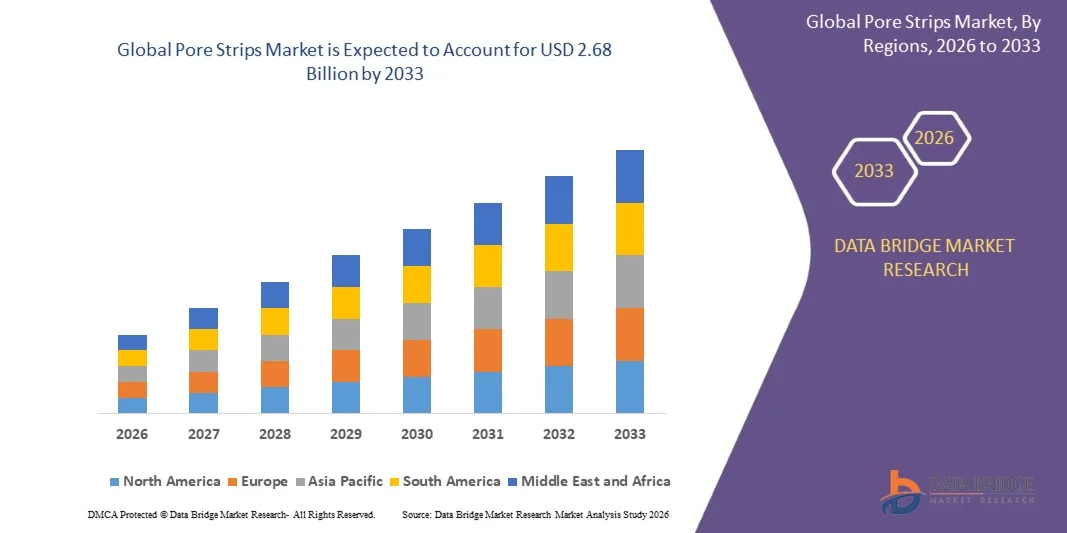
The Pore Strips Market was valued at USD 1.77 billion in 2025 and is projected to reach USD 2.68 billion by 2033, growing at a CAGR of 5.30% from 2026 to 2033. The market is witnessing steady growth driven by rising consumer focus on personal skincare, increasing prevalence of acne and blackhead-related skin concerns, and growing demand for quick and convenient at-home skincare solutions. Expanding influence of beauty and skincare trends through social media platforms and beauty influencers is further accelerating product adoption across younger demographics.
The growing preference for easy-to-use, non-invasive skincare products is encouraging consumers to adopt pore strips as part of their routine facial care regimen. In addition, increasing availability of product variants such as charcoal-based, natural ingredient-infused, and sensitive-skin formulations is enhancing market penetration across diverse consumer groups. Rising awareness regarding skin hygiene and expanding distribution through e-commerce platforms, pharmacies, and specialty beauty stores are further supporting consistent market growth globally.
Key Market Trends & Insights
- North America dominated the pore strips market with the largest revenue share of 37.9% in 2025, supported by high consumer spending on personal care products, strong penetration of skincare brands, and growing awareness of at-home facial treatment solutions.
- Asia-Pacific is expected to be the fastest-growing region, recording a CAGR of 6.8% from 2026 to 2033, driven by rising disposable incomes, expanding beauty and personal care industry, and increasing influence of K-beauty and J-beauty trends.
- The Charcoal segment held the largest market revenue share of approximately 41.6% in 2025 driven by its strong oil-absorbing and deep-cleansing properties, making it highly effective for blackhead removal and pore purification across mass-market skincare products. Charcoal-based pore strips are widely adopted due to their perceived natural detoxifying benefits and strong consumer preference in urban pollution-affected regions.
- The Tea-Tree Oil segment is projected to register the fastest growth at a CAGR of 9.4% from 2026 to 2033, driven by rising demand for natural, antibacterial, and acne-control skincare solutions. Increasing consumer inclination toward botanical and dermatologist-recommended ingredients is accelerating adoption across sensitive skin care formulations.
- The Home segment held the largest market revenue share of approximately 78.3% in 2025 driven by strong consumer preference for convenient, cost-effective, and at-home skincare solutions. Rising adoption of DIY skincare routines and increasing influence of social media beauty trends are further strengthening home-based usage.
- The Salon segment is projected to register steady growth at a CAGR of 7.1% from 2026 to 2033, driven by increasing demand for professional facial treatments and premium skincare services in urban beauty clinics and spas.
- The Economic segment accounted for the largest market revenue share of approximately 62.9% in 2025 driven by high affordability, mass-market availability, and strong penetration in drug stores and online retail platforms. Economic pore strips are widely preferred by first-time users and price-sensitive consumers across emerging economies.
- The Premium segment is expected to witness the fastest growth at a CAGR of 8.7% from 2026 to 2033, driven by increasing demand for dermatologically tested formulations, natural ingredients, and skin-safe cosmetic products with enhanced performance and reduced irritation risk.
- The Online Retailers segment held the largest market revenue share of approximately 36.8% in 2025 driven by rapid growth of e-commerce beauty platforms, influencer-led marketing, and easy product accessibility across global skincare brands.
- The Specialty Stores segment is projected to register the fastest growth at a CAGR of 9.1% from 2026 to 2033, driven by rising consumer preference for personalized skincare consultation, curated beauty products, and premium brand experiences in urban retail environments.
Market Size & Forecast
- Global Market Value (2025): USD 1.77 Billion
- Expected Market Value (2033): USD 2.68 Billion
- Forecast CAGR (2026–2033): 5.30%
- Leading Region in 2025: North America
- Fastest Growing Region: Asia-Pacific
Report Scope and Pore Strips Market Segmentation
|
Attributes |
Pore Strips Key Market Insights |
|
Segments Covered |
|
|
Countries Covered |
North America
Europe
Asia-Pacific
Middle East and Africa
South America
|
|
Key Market Players |
• Unilever (U.K.) |
|
Market Opportunities |
|
|
Value Added Data Infosets |
In addition to the insights on market scenarios such as market value, growth rate, segmentation, geographical coverage, and major players, the market reports curated by the Data Bridge Market Research also include in-depth expert analysis, pricing analysis, brand share analysis, consumer survey, demography analysis, supply chain analysis, value chain analysis, raw material/consumables overview, vendor selection criteria, PESTLE Analysis, Porter Analysis, and regulatory framework. |
Pore Strips Market Trends
Trend: Rising Adoption Of Skincare Convenience Solutions And Dermatologically Tested Pore Care Products
Increasing demand for quick, easy-to-use, and at-home skincare solutions is driving growth in the pore strips market across personal care and beauty sectors. Consumers are increasingly shifting toward non-invasive skincare products that offer immediate results for blackhead removal, pore cleansing, and oil control, reducing reliance on salon-based treatments. Conventional deep cleansing procedures often require higher time, cost, and professional assistance, encouraging adoption of affordable and accessible pore strip solutions.
In modern skincare routines, manufacturers are introducing advanced pore strips, For instance charcoal-based strips and hydrocolloid-infused variants for enhanced impurity absorption and improved skin compatibility, to strengthen cleansing efficiency while minimizing skin irritation. In the personal care industry, these products are being widely used as part of weekly skincare regimens to target clogged pores caused by pollution, makeup residue, and excess sebum, improving overall skin clarity and texture.
The rapid expansion of e-commerce beauty platforms and social media-driven skincare trends is also increasing demand for targeted facial care products with visible instant effects. In addition, dermatology-backed formulations and ingredient innovations such as tea tree oil, activated charcoal, and natural plant extracts are gaining popularity due to rising consumer awareness regarding skin sensitivity and product safety. Growing product validation through influencer-led skincare routines in 2025, particularly on platforms such as Instagram and TikTok, has significantly boosted adoption rates among Gen Z and millennial consumers, with pore cleansing products showing strong repeat purchase behavior in urban markets.
Pore Strips Market Dynamics
Key Market Driver: Rising Consumer Focus On Affordable And Instant Skincare Solutions
Consumers worldwide are increasingly prioritizing affordable, time-efficient, and result-oriented skincare products, creating strong demand for pore strips as part of daily and weekly facial care routines. Growing awareness of skin health, rising pollution levels in urban areas, and increasing prevalence of acne and blackhead concerns are further supporting market expansion.
Beauty and personal care brands are actively launching innovative pore strip formulations, For instance oil-control and deep-cleansing variants for different skin types, to cater to expanding consumer needs and improve product accessibility across mass-market retail channels. Rising penetration of beauty products through online retail platforms and pharmacy chains is further accelerating adoption among young consumers and first-time skincare users.
Real-world market indicators show strong growth in the global facial care segment, with increasing consumer spending on personal grooming products in emerging economies such as India, China, and Brazil during 2024–2025, where urban consumers are rapidly adopting simplified skincare routines that include pore cleansing products as essential items
Key Restraint/Challenge: Skin Sensitivity Concerns And Limited Long-Term Effectiveness
Despite strong demand, pore strips face limitations due to skin sensitivity issues, temporary effectiveness, and concerns regarding overuse leading to skin irritation or pore enlargement. Dermatologists often recommend cautious usage, which restricts continuous adoption among sensitive skin consumers.
In addition, growing awareness of advanced skincare alternatives such as chemical exfoliants, salicylic acid-based cleansers, and professional dermatological treatments is reducing dependency on mechanical pore-cleansing products. Limited long-term effectiveness in preventing blackhead recurrence further impacts product retention rates in premium skincare segments.
Consumer feedback trends indicate that while pore strips provide immediate visible results, repeated usage concerns and preference shifts toward multi-functional skincare solutions are influencing purchasing decisions, particularly in developed markets where dermatologically advanced alternatives are widely available
Key Market Opportunity: Expansion Of Premium Skincare Brands And Ingredient Innovation
Modern skincare consumers, especially in urban populations, are increasingly demanding premium, dermatologist-tested, and ingredient-enriched pore care solutions that offer both efficacy and skin protection. This is creating significant opportunities for innovation in pore strip formulations and hybrid skincare products.
Brands are increasingly developing advanced pore strips, For instance infused with natural extracts such as green tea, aloe vera, and activated charcoal combinations, to improve skin compatibility and expand usage across sensitive skin segments. In addition, the rise of clean beauty and vegan skincare trends is encouraging manufacturers to develop biodegradable and chemical-free pore strip variants.
Furthermore, expansion of skincare-focused e-commerce platforms and subscription-based beauty kits is strengthening market reach across North America, Europe, and Asia-Pacific. Increasing dermatology-led product endorsements and influencer-driven skincare education campaigns conducted in 2025 have significantly boosted awareness, leading to higher trial rates and repeat purchases among young consumers seeking fast and visible skincare results.
Pore Strips Market Scope
The market is segmented on the basis of ingredients, end-use, price, and sales channel.
• By Ingredients
On the basis of ingredients, the pore strips market is segmented into Charcoal, Silica, Tea-Tree Oil, and Others. The Charcoal segment held the largest market revenue share of approximately 41.6% in 2025 driven by its strong oil-absorbing and deep-cleansing properties, making it highly effective for blackhead removal and pore purification across mass-market skincare products. Charcoal-based pore strips are widely adopted due to their perceived natural detoxifying benefits and strong consumer preference in urban pollution-affected regions.
The Tea-Tree Oil segment is projected to register the fastest growth at a CAGR of 9.4% from 2026 to 2033, driven by rising demand for natural, antibacterial, and acne-control skincare solutions. Increasing consumer inclination toward botanical and dermatologist-recommended ingredients is accelerating adoption across sensitive skin care formulations.
• By End-Use
On the basis of end-use, the pore strips market is segmented into Salon and Homes. The Home segment held the largest market revenue share of approximately 78.3% in 2025 driven by strong consumer preference for convenient, cost-effective, and at-home skincare solutions. Rising adoption of DIY skincare routines and increasing influence of social media beauty trends are further strengthening home-based usage.
The Salon segment is projected to register steady growth at a CAGR of 7.1% from 2026 to 2033, driven by increasing demand for professional facial treatments and premium skincare services in urban beauty clinics and spas.
• By Price
On the basis of price, the pore strips market is segmented into Premium and Economic. The Economic segment accounted for the largest market revenue share of approximately 62.9% in 2025 driven by high affordability, mass-market availability, and strong penetration in drug stores and online retail platforms. Economic pore strips are widely preferred by first-time users and price-sensitive consumers across emerging economies.
The Premium segment is expected to witness the fastest growth at a CAGR of 8.7% from 2026 to 2033, driven by increasing demand for dermatologically tested formulations, natural ingredients, and skin-safe cosmetic products with enhanced performance and reduced irritation risk.
• By Sales Channel
On the basis of sales channel, the pore strips market is segmented into Modern Trade, Departmental Stores, Convenience Stores, Specialty Stores, Drug Stores, Online Retailers, and Other Sales Channel. The Online Retailers segment held the largest market revenue share of approximately 36.8% in 2025 driven by rapid growth of e-commerce beauty platforms, influencer-led marketing, and easy product accessibility across global skincare brands.
The Specialty Stores segment is projected to register the fastest growth at a CAGR of 9.1% from 2026 to 2033, driven by rising consumer preference for personalized skincare consultation, curated beauty products, and premium brand experiences in urban retail environments.
Pore Strips Market Regional Analysis
North America Pore Strips Market Insight
North America dominated the pore strips market with the largest revenue share of 37.9% in 2025, supported by high consumer spending on personal care products, strong penetration of skincare brands, and growing awareness of at-home facial treatment solutions. The region benefits from advanced beauty retail infrastructure, widespread availability of dermatologically tested skincare products, and strong influence of social media-driven beauty trends. Consumers in the region increasingly prefer quick, effective, and affordable pore-cleansing solutions, making pore strips a widely adopted skincare product across daily grooming routines.
U.S. Pore Strips Market Insight
The U.S. pore strips market captured the largest revenue share in 2025 within North America, driven by rising demand for convenient skincare solutions, strong presence of leading beauty brands, and increasing focus on acne and blackhead treatment among young consumers. The growing popularity of DIY skincare routines, combined with strong e-commerce penetration and availability of product variants such as charcoal and tea-tree infused strips, is further strengthening market growth. In 2025, online beauty platforms and drugstore retail chains reported significant sales growth in facial pore cleansing products, supported by influencer-led skincare trends and dermatology-backed product recommendations.
Europe Pore Strips Market Insight
The Europe pore strips market is expected to witness steady growth from 2026 to 2033, driven by rising consumer preference for natural skincare products, increasing awareness of skin health, and growing demand for non-invasive facial cleansing solutions. The region is experiencing strong adoption of premium skincare formulations with dermatologically tested and eco-friendly ingredients. Countries such as Germany, France, and the U.K. are witnessing increased penetration of pore strips through specialty beauty stores and online retail channels, supported by expanding clean beauty trends and regulatory focus on safe cosmetic formulations.
U.K. Pore Strips Market Insight
The U.K. pore strips market is expected to witness strong growth from 2026 to 2033, driven by increasing demand for affordable skincare solutions, rising concerns related to skin pollution effects, and growing adoption of at-home beauty treatments. Consumers in the country are increasingly influenced by digital beauty content and skincare influencers promoting quick-result facial care products. The expansion of online retail platforms and pharmacy chains is further supporting product accessibility and boosting adoption among younger consumers seeking simple and effective skincare routines.
Germany Pore Strips Market Insight
The Germany pore strips market is expected to witness steady growth from 2026 to 2033, driven by increasing demand for dermatologically safe skincare products, rising preference for natural ingredient-based formulations, and strong awareness of skin health and hygiene. Germany’s well-developed beauty and personal care industry supports adoption of scientifically formulated skincare solutions. Consumers are increasingly opting for gentle pore-cleansing products that align with sustainability and clean beauty trends, particularly in urban regions.
Asia-Pacific Pore Strips Market Insight
The Asia-Pacific pore strips market is expected to witness the fastest growth rate from 2026 to 2033, supported by rising disposable incomes, expanding beauty and personal care industry, and increasing influence of Korean and Japanese skincare routines across the region. Growing urbanization and pollution levels are driving demand for effective pore-cleansing solutions among young consumers. In 2025, skincare brands in countries such as China, India, and South Korea reported strong growth in facial cleansing product sales, supported by rapid expansion of e-commerce beauty platforms and influencer-driven skincare trends.
Japan Pore Strips Market Insight
The Japan pore strips market is expected to witness strong growth from 2026 to 2033 due to high consumer focus on skincare, advanced beauty culture, and demand for gentle yet effective facial cleansing products. Japanese consumers strongly prefer dermatologically tested and mild formulations, driving adoption of premium pore cleansing solutions. The integration of skincare routines into daily personal care habits, along with increasing availability of innovative pore strip variants in convenience stores and cosmetic retail outlets, is supporting steady market expansion.
China Pore Strips Market Insight
The China pore strips market accounted for the largest revenue share in Asia-Pacific in 2025, attributed to rapid urbanization, expanding middle-class population, and strong penetration of beauty and personal care products across e-commerce platforms. Rising awareness of skincare routines and increasing demand for affordable facial cleansing solutions are driving product adoption. In 2025, major online retail platforms in China reported significant growth in skincare tool and pore cleansing product sales, supported by influencer marketing, livestream shopping trends, and strong domestic manufacturing capabilities in the beauty sector.
Pore Strips Market Share
The Pore Strips industry is primarily led by well-established companies, including:
• Unilever (U.K.)
• Kao Corporation (Japan)
• Walgreen Co. (U.S.)
• Ulta Beauty, Inc. (U.S.)
• EARTH THERAPEUTICS (U.S.)
• NNNOW (India)
• The Boots Company PLC (U.K.)
• boscia, LLC (U.S.)
• Sephora SA (France)
• Tonymoly Co., Ltd. (South Korea)
• FANCL International, Inc. (Japan)
• Elegare Beauty Pvt Ltd (India)
• L’Oréal S.A. (France)
• Johnson & Johnson Private Limited (U.S.)
• Procter & Gamble (U.S.)
• Crabtree & Evelyn (U.K.)
• Hempz (U.S.)
• Murad LLC (U.S.)
• Beiersdorf (Germany)
• Colgate-Palmolive Company (U.S.)
• The Estée Lauder Companies (U.S.)
• The Avon Company (U.K.)

- Interactive Data Analysis Dashboard
- Company Analysis Dashboard for high growth potential opportunities
- Research Analyst Access for customization & queries
- Competitor Analysis with Interactive dashboard
- Latest News, Updates & Trend analysis
- Harness the Power of Benchmark Analysis for Comprehensive Competitor Tracking
Data collection and base year analysis are done using data collection modules with large sample sizes. The stage includes obtaining market information or related data through various sources and strategies. It includes examining and planning all the data acquired from the past in advance. It likewise envelops the examination of information inconsistencies seen across different information sources. The market data is analysed and estimated using market statistical and coherent models. Also, market share analysis and key trend analysis are the major success factors in the market report. To know more, please request an analyst call or drop down your inquiry.
The key research methodology used by DBMR research team is data triangulation which involves data mining, analysis of the impact of data variables on the market and primary (industry expert) validation. Data models include Vendor Positioning Grid, Market Time Line Analysis, Market Overview and Guide, Company Positioning Grid, Patent Analysis, Pricing Analysis, Company Market Share Analysis, Standards of Measurement, Global versus Regional and Vendor Share Analysis. To know more about the research methodology, drop in an inquiry to speak to our industry experts.
Data Bridge Market Research is a leader in advanced formative research. We take pride in servicing our existing and new customers with data and analysis that match and suits their goal. The report can be customized to include price trend analysis of target brands understanding the market for additional countries (ask for the list of countries), clinical trial results data, literature review, refurbished market and product base analysis. Market analysis of target competitors can be analyzed from technology-based analysis to market portfolio strategies. We can add as many competitors that you require data about in the format and data style you are looking for. Our team of analysts can also provide you data in crude raw excel files pivot tables (Fact book) or can assist you in creating presentations from the data sets available in the report.