What is the Portable Density Meter Market Size and Growth Rate?
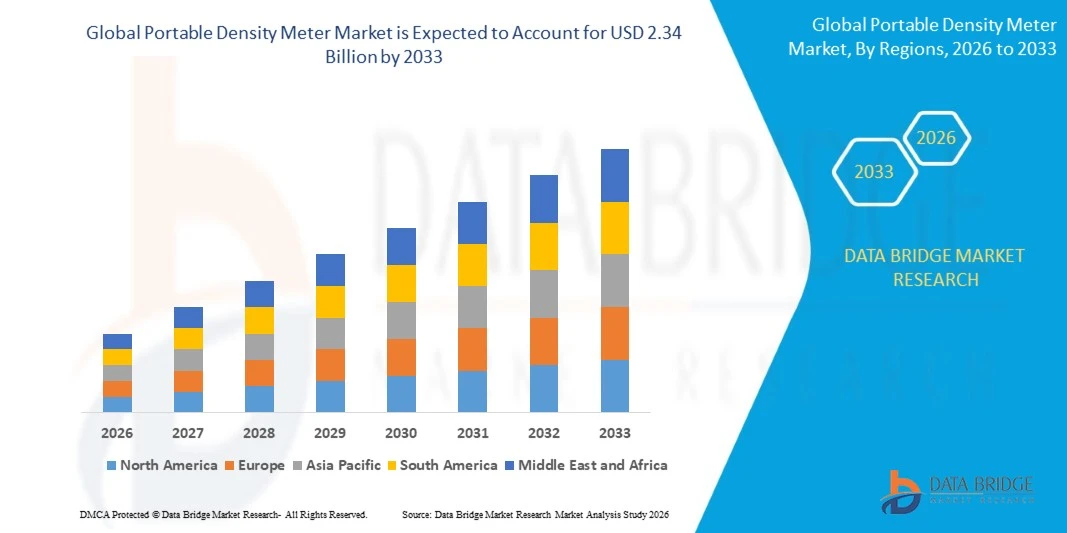
- As per Data Bridge Market Research analysis, the portable density meter market was valued at USD 1.45 billion in 2025 and is projected to reach USD 2.34 billion by 2033, growing at a CAGR of 6.20% from 2026 to 2033.
- The market is experiencing consistent growth driven by rising demand for precise liquid analysis, advancements in portable measurement technologies, and expanding applications across industrial processing, laboratory testing, and field-based quality assurance.
- The increasing emphasis on product consistency, regulatory compliance, and operational efficiency is encouraging manufacturers to adopt portable density meters for rapid and reliable measurements. Technological advancements in digital sensors, vibrating-tube systems, and compact handheld devices are improving measurement accuracy, portability, and ease of use, supporting broader adoption across diverse industries
Market Size & Forecast
- Global Market Value (2025): USD 1.45 Billion
- Expected Market Value (2033): USD 2.34 Billion
- Forecast CAGR (2026–2033): 6.20%
- Leading Region in 2025: North America
- Fastest Growing Region: Asia Pacific
What are the Major Takeaways of the Portable Density Meter Market?
- North America dominated the portable density meter market with the largest revenue share of 32.9% in 2025, supported by advanced industrial infrastructure and strong demand for precision measurement across pharmaceutical, chemical, and food processing industries.
- Asia-Pacific is expected to be the fastest-growing region at a CAGR of 10.2% from 2026 to 2033, fueled by rapid industrialization and rising demand for portable measurement solutions across China, India, and other emerging economies.
- The process segment led the market with a 58% share in 2025, driven by increasing demand for on-site density measurement and industrial process monitoring.
- Lab are the fastest-growing implementation type, projected to register a CAGR of 5.9%, reflecting the surge in demand for analytical testing and product development
- The digital portable density meters segment dominated the product type category with a 65% revenue share in 2025, led by increasing demand for accurate and convenient measurement solutions
- Process characterization device accounted for 35% of the market share in 2025, preferred by widespread demand for monitoring fluid properties and verifying product consistency
- The ultrasonic segment is the fastest-growing application category, with a CAGR of 6.5%, driven by increasing interest in efficient fluid-measurement technologies.
Report Scope and Portable Density Meter Market Segmentation
|
Attributes |
Portable Density Meter Key Market Insights |
|
Segments Covered |
|
|
Countries Covered |
North America
Europe
Asia-Pacific
Middle East and Africa
South America
|
|
Key Market Players |
|
|
Market Opportunities |
|
|
Value Added Data Infosets |
In addition to the insights on market scenarios such as market value, growth rate, segmentation, geographical coverage, and major players, the market reports curated by the Data Bridge Market Research also include in-depth expert analysis, geographically represented company-wise production and capacity, network layouts of distributors and partners, detailed and updated price trend analysis and deficit analysis of supply chain and demand. |
What is the Key Trend in the Portable Density Meter Market?
- Manufacturers are increasingly developing compact, digital portable density meters to support rapid, accurate measurements in laboratories and industrial field environments.
- For instance, in September 2025, the U.S. National Institute of Standards and Technology (NIST) presented a study evaluating portable digital density meters as field inspection devices for liquid food packages, highlighting their potential to make density testing faster and improve the efficiency of package inspections.
- Temperature compensation and automated sampling are becoming important features, helping users improve measurement consistency and reduce manual handling during testing.
- Portable instruments are also expanding the use of density measurements for product concentration analysis, including specific gravity, Brix, and API gravity measurements across different industries.
- For instance, in April 2025, Kyoto Electronics Manufacturing featured its DA-135 portable density meter, which weighs approximately 310 grams and offers QR-code-based measurement result display, supporting convenient field measurements and digital capture of density data for quality control and process
- As manufacturers prioritize mobility, measurement accuracy, and faster field testing, compact digital density meters are expected to gain wider adoption across quality control, chemical processing, and food and beverage production.
What are the Key Drivers of the Portable Density Meter Market?
- The growing need for accurate fluid analysis in petroleum, chemical, pharmaceutical, and food processing industries is increasing demand for portable density meters that enable on-site testing and rapid quality verification.
- For instance, in September 2025, the U.S. National Institute of Standards and Technology (NIST) presented findings from a comparison study of portable digital density meters and conventional gravimetric testing methods, highlighting the potential to make liquid food package inspections faster and more efficient.
- Increasing emphasis on product quality and operational efficiency is encouraging manufacturers to use portable measurement devices for field inspections and routine process verification.
- The availability of digital displays, automated sampling, and temperature-compensated measurements further supports adoption by reducing manual measurement steps and simplifying routine testing.
- For instance, in September 2026, NIST discussed the use of portable digital density meters for commercial inspections of packaged liquid foodstuffs and beverages, reporting that previous comparison results showed similar outcomes to the established testing procedure and supporting their potential use in commercial inspection activities
- As industrial operators seek faster measurement and reliable quality verification, portable density meters are expected to remain valuable tools for petroleum testing, manufacturing quality control, and laboratory fieldwork.
What Factors are Challenging the Growth of the Portable Density Meter Market?
- Portable density meters require regular calibration and careful sample handling to maintain measurement accuracy, creating additional maintenance and training requirements for industrial users.
- For instance, in July 2024, ASTM International published the ASTM D7777-24 standard for measuring the density, relative density, and API gravity of liquid petroleum using portable digital density meters. The standard restricts its application to samples with viscosity below 100 mm²/s and vapor pressure equivalent up to 80 kPa, highlighting technical limitations that can restrict use across certain industrial applications.
- These requirements can complicate deployment in remote locations and facilities where trained personnel, calibration standards, or controlled testing conditions are not readily available.
- Measurement limitations associated with sample properties and operating conditions can also restrict the suitability of portable instruments for certain industrial applications.
- For instance, in July 2024, ASTM International specified that portable digital density meters under ASTM D7777 are suitable for density measurements to the nearest 1 kg/m³, while measurements requiring precision to the nearest 0.1 kg/m³ should use ASTM D4052. This difference in measurement precision can limit the suitability of portable devices for applications requiring higher accurac
- These calibration requirements and application-specific limitations can increase operating costs and restrict the use of portable density meters in demanding environments, potentially slowing adoption among smaller industrial facilities and cost-sensitive users.
How is the Portable Density Meter Market Segmented?
The portable density meter market is segmented on the basis of implementation type, product type, application, and end-user.
- By Implementation Type
On the basis of implementation type, the portable density meter market is segmented into process and lab. The process segment is expected to dominated the market with 58% share in 2025, driven by increasing demand for on-site density measurement and industrial process monitoring. Portable density meters allow operators to verify fluid properties directly at production and inspection locations. These instruments support quality control in chemical manufacturing, petroleum processing, and food production. Their portability reduces the need to transport samples to centralized laboratories. Immediate measurement results help operators identify inconsistencies and improve process efficiency.
The lab segment is expected to witness the fastest growth at CAGR of 5.9% from 2026 to 2033, supported by rising demand for analytical testing and product development. Laboratories use portable density meters to evaluate samples during research, formulation, and quality-control procedures. Digital measurement features improve convenience and measurement consistency. Temperature compensation helps users obtain comparable results under varying testing conditions. Increasing pharmaceutical research and chemical analysis activities are strengthening demand. The growing need for flexible analytical instruments is expected to accelerate adoption across laboratory environments.
- By Product Type
On the basis of product type, the portable density meter market is segmented into digital portable density meters, analog portable density meters, handheld density meters, portable vibrating-tube density meters, portable ultrasonic density meters, portable nuclear density meters, portable microwave density meters, portable differential pressure density meters, and others. The digital portable density meters segment is expected to dominated the market with 65% share in 2025, driven by increasing demand for accurate and convenient measurement solutions. Digital instruments provide clear readings and reduce errors associated with manual interpretation. Automated sampling and temperature compensation improve measurement consistency. Data-storage capabilities help users maintain records for quality assurance and traceability. These devices are widely used in pharmaceutical, chemical, petroleum, and food processing applications.
The portable vibrating-tube density meters segment is projected to register the fastest growth at CAGR of 6.9% from 2026 to 2033, supported by demand for precise liquid-density measurements. These instruments determine density by measuring changes in the oscillation of a tube containing the sample. Their repeatability makes them useful for laboratory testing and industrial quality verification. They support applications involving chemical formulations, pharmaceutical liquids, and selected petroleum products. Improvements in sensor technology and electronic processing are enhancing measurement performance. Increasing demand for reliable analytical instruments is expected to support further adoption.
- By Application
On the basis of application, the portable density meter market is segmented into process characterization devices, Coriolis, nuclear, microwave, and ultrasonic applications. The process characterization device segment is expected to dominate the market with 35% share in 2025, driven by widespread demand for monitoring fluid properties and verifying product consistency. Portable density meters help manufacturers assess liquid concentration and material characteristics during production. These measurements support quality assurance across chemical, petroleum, and food processing industries. On-site testing can reduce sample transportation and laboratory delays. Operators use density readings to identify variations and maintain product specifications.
The ultrasonic application segment is projected to register the fastest growth at CAGR of 6.5% from 2026 to 2033, driven by increasing interest in efficient fluid-measurement technologies. Ultrasonic techniques can support density-related measurements in selected industrial applications. The technology can avoid radioactive sources associated with nuclear measurement approaches. Applications include industrial fluid monitoring, water treatment, and selected petroleum operations. Advances in sensor design and electronic processing are improving measurement capabilities. Growing demand for flexible and safer measurement solutions is expected to support adoption.
- By End-User
On the basis of end-user, the portable density meter market is segmented into food and beverage industry, chemicals and material science, education/research, water and wastewater treatment, electronics, healthcare/life science, pharmaceutical, power and utilities, and others. The chemicals and material science segment is expected to dominate the market with 30% share in 2025, supported by extensive requirements for density measurement in chemical formulation and industrial production. Manufacturers use portable density meters to verify raw materials and monitor liquid concentration. These instruments support product consistency checks throughout manufacturing operations. Their portability enables inspections at multiple production locations. Density measurements are useful in evaluating solvents, specialty chemicals, and selected material formulations.
The pharmaceutical segment is projected to witness the fastest growth at CAGR of 6.8% from 2026 to 2033, driven by expanding pharmaceutical manufacturing and research activities. Portable density meters support selected liquid-analysis, formulation, and raw-material verification procedures. Their compact design enables testing across laboratories and production facilities. Digital measurement capabilities improve operational convenience and repeatability. Increasing emphasis on product quality and manufacturing consistency is encouraging the use of reliable analytical instruments. Growth in pharmaceutical research and the development of advanced formulations are expected to strengthen demand.
Which Region Holds the Largest Share of the Portable Density Meter Market?
- North America dominated the portable density meter market with the largest revenue share of 32.9% in 2025, supported by advanced industrial infrastructure and strong demand for precision measurement across pharmaceutical, chemical, and food processing industries
- The region also benefits from stringent quality standards, increasing adoption of portable analytical instruments, and growing use of density meters across laboratory testing, field inspections, and industrial process monitoring. Continued emphasis on measurement accuracy, product quality, and regulatory compliance strengthens North America's position in the global market.
U.S. Portable Density Meter Market Insight
The U.S. portable density meter market is witnessing steady growth due to rising demand for accurate density measurement, quality-control testing, and efficient industrial process monitoring. The country’s established pharmaceutical, chemical, petroleum, and food and beverage industries, along with increasing adoption of digital and handheld measurement instruments, are driving demand across laboratory and field applications. In addition, growing emphasis on measurement accuracy, product consistency, and regulatory compliance is accelerating the adoption of portable density meters across industrial and research facilities.
Asia-Pacific Portable Density Meter Market Insight
The Asia-Pacific portable density meter market is expected to witness rapid growth, driven by expanding industrial manufacturing, increasing pharmaceutical production, and rising investments in laboratory testing infrastructure across countries such as China, India, and Japan. Growing demand for quality assurance, increasing adoption of portable analytical instruments, and expanding chemical and food processing industries are supporting regional market expansion. In addition, the growing presence of research facilities and increasing focus on efficient industrial testing are accelerating the adoption of portable density meters across commercial and scientific applications.
Japan Portable Density Meter Market Insight
The Japan portable density meter market is witnessing consistent growth due to rising demand for precision measurement technologies, advanced manufacturing processes, and reliable quality-control solutions. Pharmaceutical companies, chemical manufacturers, food processors, and research institutes are increasingly adopting portable density meters for product testing, material characterization, and laboratory analysis. Moreover, increasing integration of digital measurement technologies and the country’s focus on manufacturing accuracy, automation, and product quality are further contributing to market growth.
China Portable Density Meter Market Insight
The China portable density meter market is growing rapidly, driven by expanding chemical and pharmaceutical manufacturing, increasing industrial production, and rising investments in laboratory and quality-control infrastructure. Growing adoption of digital and handheld measurement instruments across food and beverage, petroleum, chemical, and materials industries is significantly supporting market demand. In addition, increasing emphasis on product consistency, industrial testing efficiency, and technological advancements is strengthening China’s position as an important growth market for portable density meters.
U.K. Portable Density Meter Market Insight
The U.K. portable density meter market is experiencing steady growth, supported by rising adoption of precision testing instruments in pharmaceutical manufacturing, chemical processing, food and beverage production, and research applications. Increasing demand for portable measurement solutions and reliable quality-control procedures is contributing to market growth. Furthermore, advancements in digital density measurement, automated data recording, and laboratory testing technologies are improving measurement efficiency and supporting the adoption of portable density meters across industrial and scientific facilities.
Germany Portable Density Meter Market Insight
The Germany portable density meter market is expanding steadily due to the country’s strong chemical and pharmaceutical industries, advanced manufacturing capabilities, and increasing demand for precise analytical instruments. Industrial manufacturers, laboratories, and research institutes are increasingly utilizing portable density meters for material characterization, product quality assessment, and process monitoring. Continuous advancements in digital measurement technologies, growing emphasis on quality assurance, and Germany’s focus on industrial efficiency and manufacturing precision are further driving market growth.
Which are the Top Companies in Portable Density Meter Market?
The portable density meter industry is primarily led by well-established companies, including:
- METTLER TOLEDO (Switzerland)
- Anton Paar GmbH (Austria)
- Kyoto Electronics Manufacturing Co., Ltd. (Japan)
- Rudolph Research Analytical (U.S.)
- Eralytics GmbH (Austria)
- Rhosonics (Netherlands)
- Emerson Electric Co. (U.S.)
- Endress+Hauser Group Services AG (Switzerland)
- Yokogawa Electric Corporation (Japan)
- Thermo Fisher Scientific Inc. (U.S.)
- Berthold Technologies GmbH & Co. KG (Germany)
- A.KRÜSS Optronic GmbH (Germany)
- Koehler Instrument Company, Inc. (U.S.)
- PAC L.P. (U.S.)
- Schmidt + Haensch GmbH & Co. (Germany)
- Maselli Misure S.p.A. (Italy)
- LEMIS Process (Germany)
- Labtron Equipment Ltd. (U.K.)
- Xylem Inc. (U.S.)
- KEM Kyoto Electronics Manufacturing Co., Ltd. (Japan)
What are Latest Developments in Portable Density Meter Market?
- In July 2025, Anton Paar announced a new generation of digital density meters, including the DMA 502 benchtop units and the high-precision DMA 6002. The product range incorporates improvements in manufacturing tolerances, measurement consistency, and calibration processes to support accurate and repeatable density analysis. These developments reflect continued innovation in digital density measurement technology for laboratory and industrial quality-control applications.
- In February 2024, Rhosonics’ SDM ECO non-nuclear density meter was featured for its use of ultrasonic technology to measure slurry density in real time. Developed for applications including mineral processing, dredging, and tunneling, the instrument offers an alternative to conventional radiometric density measurement. Its emphasis on operational safety, measurement reliability, and process monitoring highlights the growing role of non-nuclear density measurement technologies in industrial environments.
- In October 2023, Rhosonics announced the upcoming launch of its SDM ECO non-nuclear density meter, following five years of development. The new instrument was designed to succeed the company’s SDM-4 and provide density monitoring for slurry-based industrial processes without relying on hazardous radioactive materials. The development highlights increasing interest in safer density measurement alternatives across mining, metals, battery production, and recycling applications.
- In January 2022, Eralytics introduced the ERADENS X, a compact, rugged, high-precision density meter designed for demanding measurement environments, including mobile laboratories. The instrument features a corrosion-resistant aluminum housing, a color touchscreen, and density measurements with five-digit precision. Its design emphasizes portability, durability, and reliable measurement under challenging operating conditions, supporting the demand for flexible density-testing solutions.
- In July 2021, Kyoto Electronics Manufacturing (KEM) announced the launch of its DA-860, DA-850, and DA-840 benchtop density and specific-gravity meters, alongside the AS-8030 autosampler. The new instruments focused on measurement reliability, improved operability, shorter measurement times, and enhanced laboratory workflow efficiency. Although these products are benchtop rather than portable meters, the launch illustrates broader advances in density measurement instrumentation and automated sample analysis.
- Interactive Data Analysis Dashboard
- Company Analysis Dashboard for high growth potential opportunities
- Research Analyst Access for customization & queries
- Competitor Analysis with Interactive dashboard
- Latest News, Updates & Trend analysis
- Harness the Power of Benchmark Analysis for Comprehensive Competitor Tracking
Global Portable Density Meter Market, Supply Chain Analysis and Ecosystem Framework
To support market growth and help clients navigate the impact of geopolitical shifts, DBMR has integrated in-depth supply chain analysis into its Global Portable Density Meter Market research reports. This addition empowers clients to respond effectively to global changes affecting their industries. The supply chain analysis section includes detailed insights such as Global Portable Density Meter Market consumption and production by country, price trend analysis, the impact of tariffs and geopolitical developments, and import and export trends by country and HSN code. It also highlights major suppliers with data on production capacity and company profiles, as well as key importers and exporters. In addition to research, DBMR offers specialized supply chain consulting services backed by over a decade of experience, providing solutions like supplier discovery, supplier risk assessment, price trend analysis, impact evaluation of inflation and trade route changes, and comprehensive market trend analysis.
Data collection and base year analysis are done using data collection modules with large sample sizes. The stage includes obtaining market information or related data through various sources and strategies. It includes examining and planning all the data acquired from the past in advance. It likewise envelops the examination of information inconsistencies seen across different information sources. The market data is analysed and estimated using market statistical and coherent models. Also, market share analysis and key trend analysis are the major success factors in the market report. To know more, please request an analyst call or drop down your inquiry.
The key research methodology used by DBMR research team is data triangulation which involves data mining, analysis of the impact of data variables on the market and primary (industry expert) validation. Data models include Vendor Positioning Grid, Market Time Line Analysis, Market Overview and Guide, Company Positioning Grid, Patent Analysis, Pricing Analysis, Company Market Share Analysis, Standards of Measurement, Global versus Regional and Vendor Share Analysis. To know more about the research methodology, drop in an inquiry to speak to our industry experts.
Data Bridge Market Research is a leader in advanced formative research. We take pride in servicing our existing and new customers with data and analysis that match and suits their goal. The report can be customized to include price trend analysis of target brands understanding the market for additional countries (ask for the list of countries), clinical trial results data, literature review, refurbished market and product base analysis. Market analysis of target competitors can be analyzed from technology-based analysis to market portfolio strategies. We can add as many competitors that you require data about in the format and data style you are looking for. Our team of analysts can also provide you data in crude raw excel files pivot tables (Fact book) or can assist you in creating presentations from the data sets available in the report.