


Portable DNA Sequencers Market Size
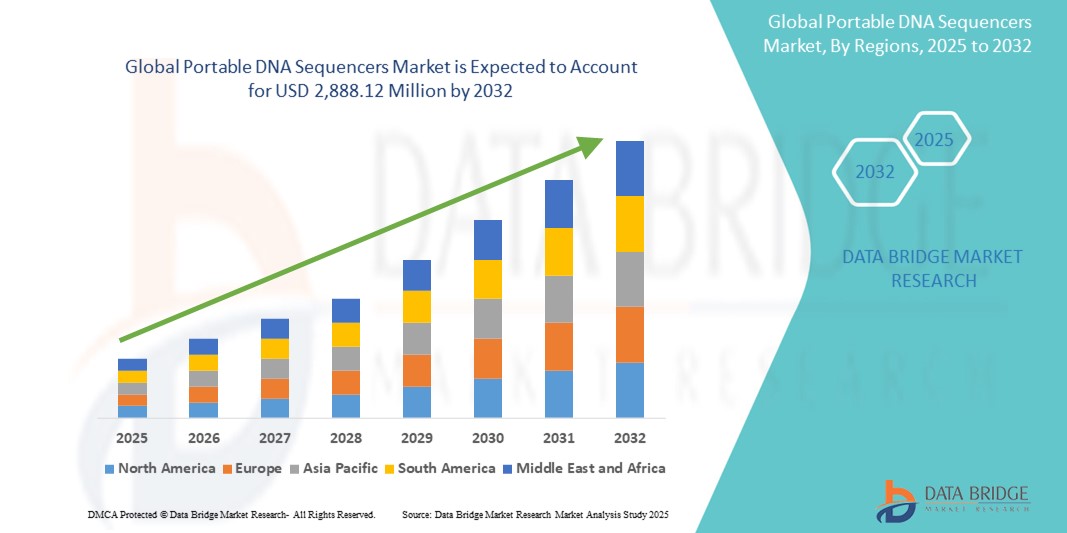
- The global portable DNA sequencers market size was valued at USD 931.1 million in 2024 and is expected to reach USD 2,888.12 million by 2032, at a CAGR of 15.20% during the forecast period
- The market growth is largely fueled by the growing adoption and technological progress within portable genetic testing tools and point-of-care sequencing technologies, leading to increased digitalization in both clinical diagnostics and field-based research applications
- Furthermore, rising demand for rapid, real-time DNA analysis, especially in remote or resource-limited settings, is establishing portable DNA sequencers as a transformative solution across various industries, including healthcare, agriculture, forensics, and environmental testing. These converging factors are accelerating the uptake of portable DNA sequencers solutions, thereby significantly boosting the industry's growth
Portable DNA Sequencers Market Analysis
- Portable DNA sequencers, offering compact and mobile genetic analysis, are increasingly vital tools in modern life sciences and diagnostics due to their enhanced portability, rapid turnaround time, and seamless integration with cloud-based bioinformatics platforms. These devices enable researchers and clinicians to perform real-time DNA sequencing outside of traditional lab settings, including in field and point-of-care environments
- The escalating demand for portable DNA sequencers is primarily fueled by rising adoption in clinical diagnostics, epidemiology, environmental testing, and forensics, where on-site analysis is crucial. The increasing use of precision medicine and decentralized testing further propels market expansion
- North America dominated the portable DNA sequencers market with the largest revenue share of 40.2% in 2024, characterized by robust research infrastructure, widespread integration in clinical genomics, and the presence of leading players such as Oxford Nanopore Technologies and Thermo Fisher Scientific. The U.S. in particular has experienced substantial growth in the adoption of portable sequencing tools for infectious disease surveillance and personalized medicine
- Asia-Pacific is expected to be the fastest growing region in the portable DNA sequencers market during the forecast period, projected to grow at a CAGR of over 19.8% from 2025 to 2032. This growth is driven by expanding genomic research initiatives, increased government funding, and growing awareness of portable diagnostic tools in countries such as China, India, and Japan
- Clinical diagnostics segment dominated the portable DNA sequencers market with a market share of 44.5% in 2024, driven by the increased adoption of portable sequencing tools in point-of-care testing, genetic screening, and infectious disease diagnostics. The demand for rapid, accurate, and on-site genetic analysis has fueled the integration of portable DNA sequencers in clinical settings, enabling timely decision-making and personalized treatment approaches
Report Scope and Portable DNA Sequencers Market Segmentation
|
Attributes |
Portable DNA Sequencers Key Market Insights |
|
Segments Covered |
|
|
Countries Covered |
North America
Europe
Asia-Pacific
Middle East and Africa
South America
|
|
Key Market Players |
|
|
Market Opportunities |
|
|
Value Added Data Infosets |
In addition to the insights on market scenarios such as market value, growth rate, segmentation, geographical coverage, and major players, the market reports curated by the Data Bridge Market Research also include in-depth expert analysis, pricing analysis, brand share analysis, consumer survey, demography analysis, supply chain analysis, value chain analysis, raw material/consumables overview, vendor selection criteria, PESTLE Analysis, Porter Analysis, and regulatory framework. |
Portable DNA Sequencers Market Trends
“Enhanced Convenience and Integration with Digital Platforms”
- A significant and accelerating trend in the global portable DNA sequencers market is the integration of sequencing devices with digital ecosystems and intelligent analysis platforms, enhancing real-time data access and decision-making for end users. This fusion of hardware and smart platforms is significantly improving user convenience and control in clinical and field-based genetic analysis
- For instance, Oxford Nanopore’s MinION connects via USB to laptops and tablets, allowing for portable, real-time sequencing anywhere—from remote environments to bedside diagnostics. This flexibility is empowering researchers and clinicians to obtain faster, decentralized insights
- Integration with cloud-based platforms enables automated data uploads and AI-assisted interpretation, where the system can flag genetic variants, align sequences, and even offer preliminary diagnostics without complex manual analysis. These advancements improve accessibility and reduce the expertise barrier in deploying genomic tools
- In addition, mobile application support allows users to monitor sequencing runs, access data, and receive notifications on their smartphones. This hands-free management of genomic workflows is especially valuable in field applications such as epidemiological surveillance and agricultural testing
- The seamless connectivity between sequencing hardware, cloud analytics, and mobile interfaces is creating a more unified, intuitive, and efficient workflow, facilitating broader adoption of portable DNA sequencers in both emerging markets and advanced laboratories
- Companies such as Thermo Fisher Scientific, Illumina, and BGI Genomics are investing in compact platforms that offer plug-and-play usability with automated setup, real-time base calling, and AI-enhanced analytics, driving demand across public health, forensics, and veterinary applications
- As a result, the demand for portable DNA sequencers with integrated digital and mobile capabilities is growing rapidly, transforming genetic testing into an accessible, real-time, and user-friendly process across diverse sectors
Portable DNA Sequencers Market Dynamics
Driver
“Growing Need Due to Advancements in Genomics and Point-of-Care Diagnostics”
- The rising global focus on personalized medicine and infectious disease surveillance is significantly boosting the demand for portable DNA sequencers. These compact, real-time genomic analysis devices are becoming critical tools in clinical diagnostics, agricultural genomics, and environmental monitoring
- For instance, during the COVID-19 pandemic, portable sequencers such as Oxford Nanopore's MinION played a vital role in tracking mutations and viral variants in real time, showcasing the value of portable genomics technology in outbreak management and global health response
- As the need for rapid, decentralized, and field-deployable genomic solutions increases, healthcare institutions and research centers are investing in portable DNA sequencers to support point-of-care diagnostics, especially in remote or under-resourced areas
- Furthermore, technological advancements—such as real-time data processing, cloud-based analysis platforms, and improved accuracy—are making portable DNA sequencers more accessible and appealing to a wider range of users beyond traditional laboratories
- The integration of these devices with mobile applications and cloud infrastructure is facilitating data sharing and collaboration, helping expand their adoption in clinical research, forensic science, food safety testing, and bio-surveillance
Restraint/Challenge
“High Cost and Technical Complexity Limit Wider Adoption”
- Despite the growing interest, the relatively high cost of portable DNA sequencing devices and consumables can be a significant barrier to widespread adoption, particularly in lower-income countries and smaller research institutions
- Moreover, the complexity of sample preparation, library construction, and data interpretation still demands skilled personnel, which can be a challenge for non-specialist users or field workers without genomics training
- Concerns around sequencing accuracy, limited read lengths (in some models), and environmental sensitivity also limit deployment in some extreme conditions
- Although newer models are becoming more user-friendly, interoperability issues and the need for consistent software updates can cause hesitation among potential buyers
- To overcome these challenges, market players need to focus on improving device affordability, simplifying workflows, offering training support, and building scalable ecosystems that allow integration with existing diagnostic or research infrastructures
Portable DNA Sequencers Market Scope
The market is segmented on the basis of type, connectivity type, user interface type, and application.
- By Type
On the basis of type, the portable DNA sequencers market is segmented into handheld sequencers, benchtop sequencers, pocket-sized sequencers, wearable sequencers, disposable sequencers, and others. The handheld sequencers segment dominated the market with the largest revenue share of 41.6% in 2024, driven by their portability and field-use applicability in clinical and research diagnostics.
The wearable sequencers segment is projected to register the fastest CAGR of 24.3% from 2025 to 2032, fueled by innovation in real-time health monitoring and point-of-care genetic testing.
- By Connectivity Type
On the basis of connectivity type, the portable DNA sequencers market is segmented into bluetooth, Wi-Fi, USB, cellular, and others. The Wi-Fi segment held the largest market share of 38.9% in 2024, due to widespread use of wireless networks and cloud-based sequencing platforms.
The Bluetooth segment is expected to expand at the fastest CAGR of 22.5% during 2025–2032, owing to its ease of pairing and energy efficiency in portable applications.
- By User Interface Type
On the basis of user interface type, the market is segmented into touchscreen interface, biometric authentication, app-based access, voice-controlled access, and button-based access. The touchscreen interface segment captured the highest market share of 36.7% in 2024, driven by user-friendly displays and increased preference in clinical and lab settings.
The app-based access segment is poised to grow at the fastest CAGR of 23.1% from 2025 to 2032, driven by the growing popularity of smartphone integration and remote operation in research and diagnostics.
- By Application
On the basis of application, the portable DNA sequencers market is segmented into clinical diagnostics, research and academic use, forensics, agriculture and food testing, and environmental monitoring. The clinical diagnostics segment led the market with a revenue share of 44.5% in 2024, owing to increased adoption in point-of-care testing and genetic screening.
The agriculture and food testing segment is projected to grow at the fastest CAGR of 25.4% during the forecast period, supported by increasing concerns about food traceability, crop diseases, and on-site pathogen detection.
Portable DNA Sequencers Market Regional Analysis
- North America dominated the portable DNA sequencers market with the largest revenue share of 40.2% in 2024, driven by the region’s well-established research infrastructure, significant funding for genomic studies, and a strong presence of key industry players such as Oxford Nanopore Technologies and Thermo Fisher Scientific
- The growing adoption of personalized medicine, point-of-care diagnostics, and infectious disease surveillance programs is fueling demand for portable DNA sequencing platforms in both clinical and field-based settings
- The region’s advanced healthcare ecosystem, supportive regulatory environment, and increasing investments in genomics research continue to support widespread deployment of portable sequencing tools
U.S. Portable DNA Sequencers Market Insight
The U.S. portable DNA sequencers market captured the largest revenue share of 86.1% in 2024 within North America, attributed to extensive academic and clinical research, biopharmaceutical innovation, and the early adoption of advanced diagnostic technologies. The market is further strengthened by ongoing collaborations between research institutes and sequencing companies to develop rapid genomic testing tools. Use cases in infectious disease surveillance (e.g., COVID-19 variants, monkeypox), agricultural genomics, and biosecurity have significantly propelled demand for portable DNA sequencers across the country.
Europe Portable DNA Sequencers Market Insight
The Europe portable DNA sequencers market is projected to grow at a CAGR of 16.8% from 2025 to 2032, fueled by national genome programs, increasing use of point-of-care diagnostics, and the rising focus on personalized healthcare. The integration of DNA sequencing in food safety, environmental testing, and forensic applications is contributing to regional expansion. Additionally, strong R&D funding from the EU’s Horizon Europe program and partnerships among academic institutions and biotechnology firms are helping drive innovation and accessibility in portable sequencing platforms.
U.K. Portable DNA Sequencers Market Insight
The U.K. Portable DNA Sequencers market is expected to grow at a CAGR of 17.3% during the forecast period, driven by initiatives such as Genomics England, the NHS Genomic Medicine Service, and rapid pathogen surveillance programs. Portable sequencers are increasingly used in hospitals, universities, and mobile labs, offering timely insights for both clinical and field-based research. The government’s investment in genomic innovation and the region’s expertise in bioinformatics continue to support strong market growth.
Germany Portable DNA Sequencers Market Insight
The Germany portable DNA sequencers market is anticipated to grow at a CAGR of 15.9% from 2025 to 2032, supported by a robust medical research ecosystem, strong industrial biotechnology sector, and expanding use of genomics in diagnostics and precision medicine. The country’s focus on healthcare digitalization, data standardization, and molecular surveillance (e.g., antibiotic resistance monitoring) is fostering the adoption of portable sequencing technologies.
Asia-Pacific Portable DNA Sequencers Market Insight
The Asia-Pacific portable DNA sequencers market is projected to grow at the fastest CAGR of 19.8% during 2025 to 2032, led by rapid expansion in healthcare infrastructure, growing investments in biotech R&D, and government-backed genomics initiatives in countries such as China, India, and Japan. The region is witnessing increased deployment of portable sequencers in field diagnostics for diseases such as dengue, tuberculosis, and COVID-19, as well as in agricultural genomics, biodiversity studies, and forensic science.
Japan Portable DNA Sequencers Market Insight
The Japan portable DNA sequencers market is expanding steadily due to high adoption of precision medicine, integration of genomic technologies in routine clinical workflows, and a technologically advanced research landscape. The demand is further driven by strong national support for genomic R&D, with the Ministry of Health and universities promoting local innovation in mobile genomics platforms for use in both urban and rural healthcare settings.
China Portable DNA Sequencers Market Insight
The China portable DNA sequencers market accounted for the largest revenue share in Asia-Pacific in 2024, driven by the country's rapid advancements in biotechnology, government-backed genomics infrastructure (e.g., China National GeneBank), and increasing demand for fast, decentralized diagnostic tools. The presence of local manufacturing capabilities and affordability of portable DNA sequencing systems are accelerating their penetration in disease surveillance, food safety testing, and academic research applications.
Portable DNA Sequencers Market Share
The Portable DNA Sequencers industry is primarily led by well-established companies, including:
- Oxford Nanopore Technologies (U.K.)
- Thermo Fisher Scientific Inc. (U.S.)
- Illumina, Inc. (U.S.)
- BGI Genomics (China)
- F. Hoffmann-La Roche Ltd. (Switzerland)
- QIAGEN N.V. (Netherlands)
- Agilent Technologies, Inc. (U.S.)
- Bio-Rad Laboratories, Inc. (U.S.)
- GenapSys, Inc. (U.S.)
- NabSys Inc. (U.S.)
- STRATEC SE (Germany)
- Mobidiag Ltd. (Finland)
- Genia Technologies (U.S.)
- EpiGentek Group Inc. (U.S.)
- SeqLL Inc. (U.S.)
Latest Developments in Global Portable DNA Sequencers Market
- In April 2025, researchers leveraged Oxford Nanopore Technologies’ portable MinION sequencer as part of the Pgt MARPLE diagnostics platform for field-based identification of wheat stem rust lineages and fungicide resistance in East Africa. This rapid diagnostic approach enabled results in under 48 hours, reinforcing the utility of portable DNA sequencers in agricultural disease surveillance and showcasing the growing applicability of handheld sequencing in real-world environments
- In April 2025, Oxford Nanopore Technologies partnered with Cepheid to develop an integrated, automated sequencing workflow combining Cepheid’s GeneXpert sample prep systems with Oxford Nanopore’s portable sequencers. This collaboration aims to deliver same-day infectious disease diagnostics, enhancing rapid pathogen identification and supporting faster clinical decisions in decentralized settings
- In April 2025, Oxford Nanopore announced new enhancements to its multi‑omic sequencing platform during its “London Calling 2025” conference. These updates further streamline portable sequencing workflows and enable users to gather genomic, transcriptomic, and epigenomic data using a single portable device. This development underscores the market’s shift toward compact, multi-functional sequencing tools with broad application in research and diagnostics

- Interactive Data Analysis Dashboard
- Company Analysis Dashboard for high growth potential opportunities
- Research Analyst Access for customization & queries
- Competitor Analysis with Interactive dashboard
- Latest News, Updates & Trend analysis
- Harness the Power of Benchmark Analysis for Comprehensive Competitor Tracking
Data collection and base year analysis are done using data collection modules with large sample sizes. The stage includes obtaining market information or related data through various sources and strategies. It includes examining and planning all the data acquired from the past in advance. It likewise envelops the examination of information inconsistencies seen across different information sources. The market data is analysed and estimated using market statistical and coherent models. Also, market share analysis and key trend analysis are the major success factors in the market report. To know more, please request an analyst call or drop down your inquiry.
The key research methodology used by DBMR research team is data triangulation which involves data mining, analysis of the impact of data variables on the market and primary (industry expert) validation. Data models include Vendor Positioning Grid, Market Time Line Analysis, Market Overview and Guide, Company Positioning Grid, Patent Analysis, Pricing Analysis, Company Market Share Analysis, Standards of Measurement, Global versus Regional and Vendor Share Analysis. To know more about the research methodology, drop in an inquiry to speak to our industry experts.
Data Bridge Market Research is a leader in advanced formative research. We take pride in servicing our existing and new customers with data and analysis that match and suits their goal. The report can be customized to include price trend analysis of target brands understanding the market for additional countries (ask for the list of countries), clinical trial results data, literature review, refurbished market and product base analysis. Market analysis of target competitors can be analyzed from technology-based analysis to market portfolio strategies. We can add as many competitors that you require data about in the format and data style you are looking for. Our team of analysts can also provide you data in crude raw excel files pivot tables (Fact book) or can assist you in creating presentations from the data sets available in the report.













