What is the Portable Speakers Market Size and Growth Rate?
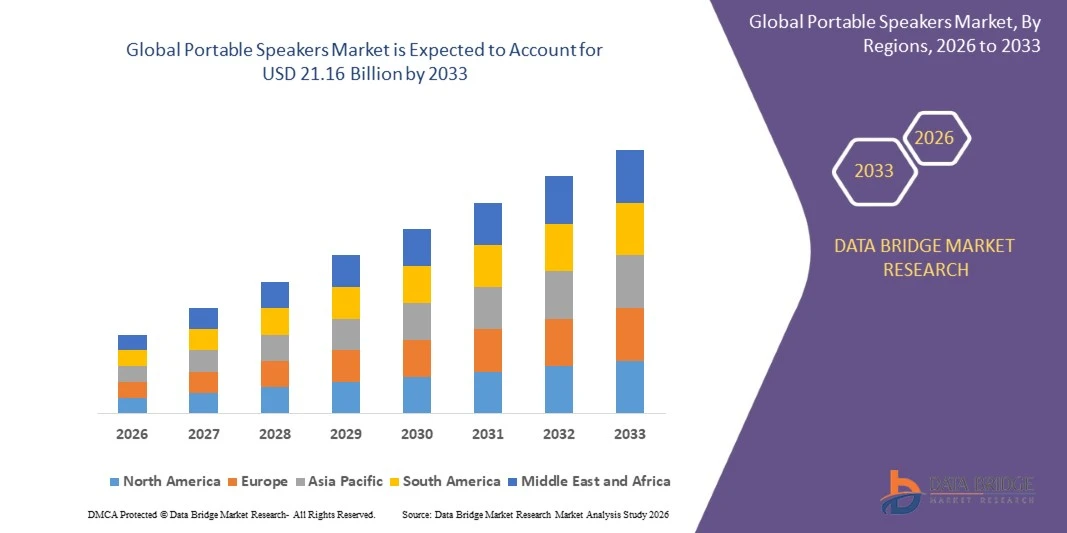
- As per Data Bridge Market Research analysis, the portable speakers market was valued at USD 8.73 Billion in 2025 and is projected to reach USD 21.16 Billion by 2033, growing at a CAGR of 11.7% from 2026 to 2033.
- The market is witnessing steady growth, driven by the increasing consumption of online music and video streaming services, widespread availability of digital audio content on smartphones, laptops, and tablets, and rising demand for compact, wireless, and portable audio devices. Growing consumer preference for waterproof, durable, and battery-powered speakers is further supporting adoption across residential, travel, outdoor, and recreational applications.
- Technological advancements in wireless connectivity, improvements in battery efficiency, and the growing integration of Bluetooth, Wi-Fi, and Auracast-enabled audio sharing are expanding the functionality of portable speakers. Consumers are increasingly connecting speakers with smartphones, tablets, and laptops to stream music, podcasts, and video audio across different environments. Furthermore, the availability of conventional Bluetooth speakers, Wi-Fi-enabled portable models, and smart speakers is broadening consumer choice and supporting demand across homes, offices, retail establishments, and leisure settings.
Market Size & Forecast
- Global Market Value (2025): USD 8.73 Billion
- Expected Market Value (2033): USD 21.16 Billion
- Forecast CAGR (2026–2033): 11.7%
- Leading Region in 2025: North America
- Fastest Growing Region: Asia Pacific
What are the Major Takeaways of the Portable Speakers Market?
- North America dominated the portable speakers market with the largest revenue share of 33.82% in 2025, supported by strong adoption of Wi-Fi- and AI-enabled Bluetooth speakers, smart home systems, and premium audio brands.
- Asia-Pacific is expected to be the fastest-growing region at a CAGR of 13.91% from 2026 to 2033, fueled by rising smartphone penetration, growing preference for technology-led premium products, and expanding e-commerce across emerging economies.
- The mini segment led the product type category with a 41.37% share in 2025, driven by demand for compact, lightweight, and affordable speakers for personal and travel use.
- Capsule is the fastest-growing product type, projected to register a CAGR of 13.41%, reflecting rising preference for rugged, cylindrical, and waterproof speakers for outdoor and party use.
- The Bluetooth segment dominated the connectivity type category with a 72.67% revenue share in 2025, led by universal compatibility with smartphones, tablets, and laptops.
- Mass-market accounted for 63.22% of the market share in 2025, preferred for its affordability and wide availability across retail formats.
- The non-store-based segment is the fastest-growing distribution channel, with a CAGR of 13.69%, driven by growing e-commerce penetration, direct-to-consumer brand websites, and online-exclusive launches.
Report Scope and Portable Speakers Market Segmentation
|
Attributes |
Portable Speakers Key Market Insights |
|
Segments Covered |
|
|
Countries Covered |
North America
Europe
Asia-Pacific
Middle East and Africa
South America
|
|
Key Market Players |
|
|
Market Opportunities |
|
|
Value Added Data Infosets |
In addition to the insights on market scenarios such as market value, growth rate, segmentation, geographical coverage, and major players, the market reports curated by the Data Bridge Market Research also include in-depth expert analysis, pricing analysis, brand share analysis, consumer survey, demography analysis, supply chain analysis, value chain analysis, raw material/consumables overview, vendor selection criteria, PESTLE Analysis, Porter Analysis, and regulatory framework. |
What is the Key Trend in the Portable Speakers Market?
- Portable speakers are increasingly evolving from simple Bluetooth playback devices into intelligent, connected sound platforms, combining AI-based sound optimization, longer battery life, multi-speaker broadcast pairing, and ruggedized waterproof designs.
- For instance, in March 2025, according to JBL (Harman International), the company launched the JBL Flip 7 and Charge 6 portable speakers featuring AI Sound Boost, Bluetooth 5.4, Auracast multi-speaker pairing, and IP68 protection, with the Flip 7 available from April 1, 2025 at USD 163, highlighting the shift toward AI-enhanced portable audio.
- Auracast broadcast audio is enabling users to link multiple compatible speakers wirelessly, creating larger shared sound experiences without the limitations of traditional one-to-one pairing.
- Bass-focused and party-oriented portable speakers are expanding as manufacturers target outdoor gatherings, karaoke, and social listening with higher output power and dedicated sound modes.
- For instance, in April 2024, according to eCoustics, Sony introduced its new ULT line of speakers and headphones, delivering powerful bass for parties large and small, illustrating how leading brands are building dedicated sub-lines around high-output portable audio.
- As AI-based tuning, Auracast connectivity, battery efficiency, and rugged design continue to advance, portable speakers are expected to expand beyond personal listening into shared, social, and hybrid Wi-Fi and Bluetooth audio ecosystems.
What are the Key Drivers of the Portable Speakers Market?
- The rising access to online music and video streaming services has significantly increased demand for compact, wireless speakers that deliver high-quality sound without dependence on fixed home audio systems.
- For instance, in April 2026, according to TechRadar, the Tribit Stormbox Micro 3 was released at USD 64.99 with 24 hours of battery life and IP68 dust and water resistance, while the JBL Go 5 launched at USD 54.95, demonstrating the availability of durable, feature-rich speakers at entry-level prices.
- Easy availability of large data storage on phones, tablets, and laptops, together with the growing penetration of Wi-Fi networks and connected devices, is encouraging consumers to adopt portable speakers for home, travel, and outdoor use.
- For instance, in May 2025, according to eCoustics, TCL introduced its TP200K and TP300K party speakers to challenge established offerings from Sony and JBL, showing how new entrants are widening product choice and price tiers across the portable and party speaker space.
- With consumers increasingly replacing wired and home-bound audio equipment with wireless, battery-powered devices, portable speakers can support on-the-go listening, social entertainment, and integration with smart home ecosystems.
What are the Key Challenges of the Portable Speakers Market?
- Portable speakers depend on batteries, wireless chipsets, drivers, and waterproof enclosures, and higher maintenance and replacement expenses can reduce the perceived value of devices for price-sensitive buyers.
- For instance, in August 2025, according to Sonos' third fiscal quarter earnings presentation, tariffs cost the company USD 2.1 million in the quarter, with the estimate rising to USD 5 million in the fourth fiscal quarter, and the company said it would raise prices across its product portfolio.
- These cost pressures can be intensified by volatile component prices, trade barriers, and logistics costs, which may push manufacturers to raise retail prices or accept lower margins in a highly competitive market.
- The availability of low-cost wired speakers and ultra-affordable wireless alternatives also challenges growth, as value-focused consumers may choose basic products over feature-rich branded models.
- For instance, in July 2026, according to TechRadar, IKEA's USD 10 Kallsup Bluetooth speaker was among the budget speakers launched during 2026, while the Tribit Stormbox Micro 3 (USD 64.99) and JBL Go 5 (USD 54.95) offered waterproof designs at entry-level prices, illustrating intense price competition at the low end of the market.
- The combination of rising input costs, tariff exposure, intense price competition, and the need to keep adding new features can constrain profit margins and slow adoption among cost-sensitive consumers, particularly where basic wired or low-cost speakers already meet everyday listening needs.
How is the Portable Speakers Market Segmented?
The portable speakers market is segmented on the basis of product type, connectivity type, category, and distribution channel.
- By Product Type
On the basis of product type, the portable speakers market is segmented into mini, pocket, capsule, and others. The mini segment dominated the market with 41.37% share in 2025, supported by strong demand for compact, lightweight, and affordable speakers that fit easily into bags, pockets, and travel kits. Mini speakers are widely used for personal listening, commuting, workouts, and small-room entertainment, and many models now offer waterproof bodies and long battery life at entry-level prices. Improvements in driver design, Bluetooth chipsets, and battery efficiency are strengthening sound quality in small formats. Wide availability across price points and strong brand promotion on digital platforms also sustain volume demand.
The capsule segment is projected to register the fastest growth at a CAGR of 13.41% from 2026 to 2033, driven by rising preference for rugged, cylindrical speakers designed for outdoor, beach, and party use. Capsule speakers typically combine strong bass output, 360-degree sound, water and dust resistance, and carry straps or clips that suit active lifestyles. Features such as multi-speaker pairing, built-in power banks, and fast charging are improving their appeal among younger consumers. Growing participation in outdoor recreation, travel, and social gatherings is creating additional demand. Premium models from established audio brands and affordable options from emerging manufacturers are broadening the buyer base.
- By Connectivity Type
On the basis of connectivity type, the portable speakers market is segmented into Bluetooth, hybrid, and others. The Bluetooth segment dominated the market with 72.67% share in 2025, supported by universal compatibility with smartphones, tablets, and laptops and simple pairing that requires no network setup. Bluetooth speakers work reliably outdoors and while travelling, where Wi-Fi is unavailable. Newer Bluetooth versions improve range, stability, and power efficiency, while Auracast broadcast audio is enabling multi-speaker pairing across compatible devices. Low production costs allow manufacturers to serve entry-level, mid-range, and premium buyers. Continuous expansion of music and video streaming services further strengthens demand for wireless audio playback devices.
The hybrid segment is projected to register the fastest growth at a CAGR of 14.29% from 2026 to 2033, supported by rising adoption of speakers that combine Bluetooth with Wi-Fi connectivity. Hybrid models allow users to stream higher-quality audio over home networks, join multi-room systems, and use voice assistants, while retaining Bluetooth for portability outdoors. Growing penetration of Wi-Fi networks, smart home devices, and connected services is creating additional opportunities. Manufacturers are adding battery-powered Wi-Fi speakers with lossless audio support and charging cradles to appeal to premium buyers. Increasing willingness to pay for flexible, ecosystem-compatible products is expected to support the segment's strong growth.
- By Category
On the basis of category, the portable speakers market is segmented into premium and mass-market. The mass-market segment dominated the category with 63.22% share in 2025, supported by strong demand for affordable speakers priced for everyday use by students, young professionals, and first-time buyers. Wide product availability across supermarkets, electronics chains, and online marketplaces expands reach. Frequent discounting, festive-season promotions, and bundled offers also stimulate volume sales. Mass-market products increasingly offer features once limited to premium models, including water resistance, long playtime, and USB-C charging. Competition between global and local brands keeps price points accessible and encourages steady product refresh cycles.
The premium segment is projected to register the fastest growth at a CAGR of 13.10% from 2026 to 2033, driven by rising disposable incomes and growing consumer interest in superior sound quality, distinctive design, and durable construction. Premium portable speakers offer higher output power, advanced digital signal processing, AI-based sound tuning, replaceable batteries, and brand-led lifestyle appeal. Heritage audio brands are attracting buyers through retro styling and strong acoustic performance, while technology companies are adding ecosystem integration. Growth in outdoor entertainment, home listening, and gifting is supporting demand. Consumers increasingly view premium speakers as long-term purchases, encouraging brands to invest in warranties, software updates, and accessories.
- By Distribution Channel
On the basis of distribution channel, the portable speakers market is segmented into store-based and non-store-based. The store-based segment dominated the channel category with 58.74% share in 2025, supported by consumer preference to test sound quality, size, and build before purchase. Store-based sales are further divided into supermarkets and hypermarkets, specialty stores, and others. Electronics chains and brand outlets allow shoppers to compare models and receive demonstrations from trained staff. In-store promotions, seasonal discounts, and bundled accessories encourage impulse purchases. Strong retail partnerships also help manufacturers gain shelf visibility, build trust, and provide after-sales service across urban and semi-urban areas.
The non-store-based segment is projected to register the fastest growth at a CAGR of 13.69% from 2026 to 2033, driven by rising e-commerce penetration, online-exclusive launches, and brand-owned direct-to-consumer websites. Online platforms offer wide assortments, detailed reviews, price comparison, and doorstep delivery, which suit buyers of compact, low-cost speakers. Flash sales, festive events, and no-cost instalment plans increase conversion. Social media and influencer marketing guide purchase decisions, particularly among younger consumers. Manufacturers also use online channels to launch new colors and limited editions quickly, collect customer feedback, and expand into regions with limited physical retail presence.
Which Region Holds the Largest Share of the Portable Speakers Market?
- North America dominated the portable speakers market with the largest revenue share of 33.82% in 2025, supported by strong adoption of Wi-Fi- and AI-enabled Bluetooth speakers, smart home systems, and premium audio brands.
- The region also benefits from high disposable incomes, widespread streaming subscriptions, and the presence of leading audio brands that frequently introduce new products. A strong outdoor recreation culture, growing demand for party and rugged speakers, and mature e-commerce infrastructure continue to strengthen North America's position in the global market.
U.S. Portable Speakers Market Insight
The U.S. portable speakers market is witnessing strong growth due to rising adoption of wireless audio, high streaming subscription rates, and a strong culture of outdoor recreation and social gatherings. The country's mature consumer electronics retail landscape, together with the presence of major audio brands and well-developed e-commerce platforms, supports wide product availability. In addition, growing demand for rugged, waterproof, and party-focused speakers, along with increasing interest in AI-enabled and Wi-Fi-connected models, is accelerating adoption across households and leisure applications.
Asia-Pacific Portable Speakers Market Insight
The Asia-Pacific portable speakers market is expected to witness rapid growth, driven by rising smartphone and tablet penetration, expanding middle-class populations, and a growing inclination toward technology-led premium products in emerging countries. Increasing sales of smart devices, strong regional electronics manufacturing, and the growth of online retail are making affordable and feature-rich speakers widely accessible. In addition, rising interest in music streaming, outdoor leisure, and social entertainment across countries such as China, India, and Japan is accelerating demand for compact and wireless speakers.
Japan Portable Speakers Market Insight
The Japan portable speakers market is witnessing consistent growth due to strong consumer preference for compact, high-quality, and well-engineered audio products. Domestic electronics brands, a mature retail environment, and high smartphone usage support steady demand for Bluetooth and hybrid speakers. Consumers are increasingly interested in lightweight designs, long battery life, and water-resistant models suited to commuting and travel. Moreover, strong demand for reliability, refined sound tuning, and seamless integration with connected devices is further contributing to market growth in Japan.
China Portable Speakers Market Insight
The China portable speakers market is growing rapidly, driven by large-scale electronics manufacturing, widespread smartphone adoption, and the strong presence of e-commerce platforms that sell audio devices at competitive prices. Domestic brands are introducing feature-rich speakers with smart assistants, long playtime, and rugged designs, while international brands expand through online channels. In addition, growing interest in music streaming, short video content, and outdoor activities is boosting demand, positioning China as a key growth and production market for portable speakers across Asia-Pacific.
U.K. Portable Speakers Market Insight
The U.K. portable speakers market is experiencing steady growth, supported by strong streaming adoption, active outdoor and festival culture, and a well-developed online and specialty retail network. Consumers are increasingly choosing waterproof, long-lasting speakers for travel, gardens, and social gatherings, while heritage audio brands attract buyers seeking distinctive design and sound quality. Furthermore, growing interest in Auracast-enabled multi-speaker pairing and premium audio products is supporting wider adoption of portable speakers in the U.K.
Germany Portable Speakers Market Insight
The Germany portable speakers market is expanding steadily due to the country's high disposable incomes, strong consumer electronics retail base, and growing interest in quality-focused audio products. Consumers are increasingly adopting portable speakers for outdoor activities, travel, and home use, with preference for durable build, long battery life, and reliable connectivity. Continuous advancements in Bluetooth technology, growing availability of premium models, and the country's emphasis on product quality and sustainability are further driving market growth in Germany.
Which are the Top Companies in Portable Speakers Market?
The portable speakers industry is primarily led by well-established companies, including:
- Harman International Industries, Incorporated (U.S.)
- Sony Corporation (Japan)
- Bose Corporation (U.S.)
- Samsung Electronics Co., Ltd. (South Korea)
- Apple Inc. (U.S.)
- Sennheiser electronic GmbH & Co. KG (Germany)
- Koninklijke Philips N.V. (Netherlands)
- Panasonic Corporation (Japan)
- Plantronics, Inc. (U.S.)
- Audio-Technica Corporation (Japan)
- Skullcandy, Inc. (U.S.)
- GN Audio A/S (Denmark)
- HIFIMAN Corporation (U.S.)
- Hooke Audio (U.K.)
- LG Electronics (South Korea)
- Motorola Mobility LLC (U.S.)
- Bowers & Wilkins (U.K.)
What are Latest Developments in Portable Speakers Market?
- In October 2026, CMF by Nothing launched its first portable Bluetooth speakers, the CMF Speaker S and Speaker M, priced at USD 59 and USD 109 respectively in the U.S. The speakers combine Auracast support, USB-C audio, and IP68 protection with a carton-inspired design, marking the entry of a smartphone and consumer-technology brand into the portable speaker segment.
- In September 2026, Marshall announced the Bromley 150 portable party speaker, priced at USD 499.99, with pre-orders opening on September 29, 2026 and availability from October 13, 2026. The speaker offers 360-degree sound, more than 40 hours of battery life, a user-replaceable battery, microphone and instrument inputs, and Bluetooth 5.3 with Auracast support.
- In April 2026, JBL launched the JBL Xtreme 5 portable speaker at a list price of USD 399.95, offering more power, lighting, a more durable build, and up to 28 hours of battery life. The launch extended the company's rugged portable range alongside the updated JBL Go 5 ultraportable speaker released the same month.
- In March 2026, Marshall launched the Bromley 450 party speaker, available from March 31, 2026 at USD 799.99. The speaker delivers 400 W of Class D amplification, 360-degree audio, more than 40 hours of playtime, and Auracast pairing with a second Bromley speaker, reflecting rising demand for high-output portable audio.
- In March 2026, Sonos released the Sonos Play on March 31, 2026 at USD 299, a portable speaker that works over Wi-Fi and Bluetooth with up to 24 hours of battery life, Hi-Res Audio over Wi-Fi, and a USB-C audio input, supporting the growth of hybrid connected portable speakers that can also operate in multi-room setups.
- Interactive Data Analysis Dashboard
- Company Analysis Dashboard for high growth potential opportunities
- Research Analyst Access for customization & queries
- Competitor Analysis with Interactive dashboard
- Latest News, Updates & Trend analysis
- Harness the Power of Benchmark Analysis for Comprehensive Competitor Tracking
Data collection and base year analysis are done using data collection modules with large sample sizes. The stage includes obtaining market information or related data through various sources and strategies. It includes examining and planning all the data acquired from the past in advance. It likewise envelops the examination of information inconsistencies seen across different information sources. The market data is analysed and estimated using market statistical and coherent models. Also, market share analysis and key trend analysis are the major success factors in the market report. To know more, please request an analyst call or drop down your inquiry.
The key research methodology used by DBMR research team is data triangulation which involves data mining, analysis of the impact of data variables on the market and primary (industry expert) validation. Data models include Vendor Positioning Grid, Market Time Line Analysis, Market Overview and Guide, Company Positioning Grid, Patent Analysis, Pricing Analysis, Company Market Share Analysis, Standards of Measurement, Global versus Regional and Vendor Share Analysis. To know more about the research methodology, drop in an inquiry to speak to our industry experts.
Data Bridge Market Research is a leader in advanced formative research. We take pride in servicing our existing and new customers with data and analysis that match and suits their goal. The report can be customized to include price trend analysis of target brands understanding the market for additional countries (ask for the list of countries), clinical trial results data, literature review, refurbished market and product base analysis. Market analysis of target competitors can be analyzed from technology-based analysis to market portfolio strategies. We can add as many competitors that you require data about in the format and data style you are looking for. Our team of analysts can also provide you data in crude raw excel files pivot tables (Fact book) or can assist you in creating presentations from the data sets available in the report.