


What is POS Printer Market Size and Growth Rate ?
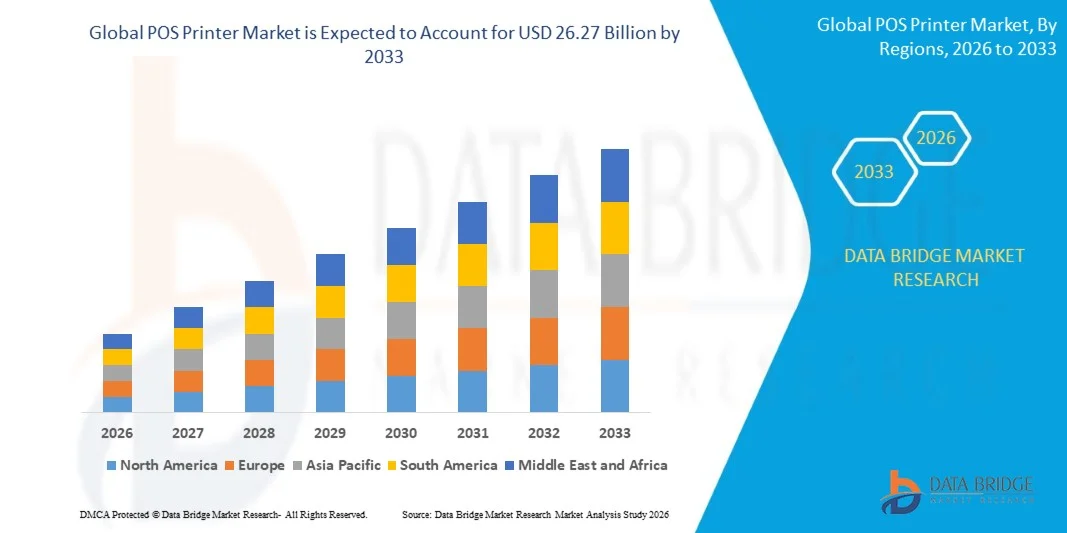
- As per Data Bridge Market Research Analysis the Global POS printer market size was valued at USD 15.17 billion in 2025 and is expected to reach USD 26.27 billion by 2033, at a CAGR of 7.10% during the forecast period
- The market growth is largely fuelled by the increasing adoption of digital payment solutions and the rising demand for efficient transaction processing across retail, hospitality, and healthcare sectors
- Technological advancements, such as mobile POS printers and cloud-based connectivity, are enhancing operational efficiency and driving market expansion
Market Size & Forecast
- Global Market Value (2025): USD 15.17 Billion
- Expected Market Value (2033): USD 26.27 Billion
- Forecast CAGR (2026–2033): 7.10%
What are the Major Takeaways of POS Printer Market ?
- The POS printer market is witnessing significant growth due to the rising preference for faster, reliable, and accurate printing solutions in retail, restaurant, and healthcare industries
- Increasing deployment of contactless payment and mobile payment technologies is driving demand for advanced thermal and mobile printers
- North America dominated the global POS printer market with the largest revenue share of 38.7% in 2025, driven by increasing adoption of retail automation, hospitality solutions, and efficient transaction systems
- Asia-Pacific region is expected to witness the highest growth rate in the global POS printer market, driven by rapid urbanization, rising disposable incomes, expansion of retail and hospitality infrastructure, and increasing adoption of mobile, wireless, and cloud-based POS printing solutions across emerging economies
- The Thermal Printers segment held the largest market revenue share in 2025, driven by its high-speed printing, low maintenance, and widespread adoption in retail and hospitality environments. Thermal printers are favored for their reliability in printing receipts and labels quickly, making them the preferred choice for high-volume transaction settings. In addition, their quiet operation and long-lasting print heads enhance efficiency in busy retail counters. The segment is further supported by innovations in energy-efficient models and wireless-enabled devices that simplify integration
Report Scope and POS Printer Market Segmentation
|
Attributes |
POS Printer Key Market Insights |
|
Segments Covered |
|
|
Countries Covered |
North America
Europe
Asia-Pacific
Middle East and Africa
South America
|
|
Key Market Players |
|
|
Market Opportunities |
|
|
Value Added Data Infosets |
In addition to the insights on market scenarios such as market value, growth rate, segmentation, geographical coverage, and major players, the market reports curated by the Data Bridge Market Research also include in-depth expert analysis, geographically represented company-wise production and capacity, network layouts of distributors and partners, detailed and updated price trend analysis and deficit analysis of supply chain and demand. |
What is the Key Trend in POS Printer Market ?
“Rising Adoption of Mobile and Cloud-Based Solutions”
• The increasing reliance on digital payment systems and mobile point-of-sale (POS) solutions is significantly shaping the POS printer market, as businesses seek efficient, reliable, and fast printing options for receipts, tickets, and labels. Thermal and impact printers are gaining traction due to their ability to deliver high-speed, low-maintenance performance, encouraging adoption across retail, hospitality, and logistics sectors
• Growing e-commerce, quick-service restaurants, and retail expansion are accelerating demand for POS printers that integrate seamlessly with cloud-based systems and mobile devices. Businesses are actively seeking printers that support multiple connectivity options such as USB, Bluetooth, and Wi-Fi, allowing for real-time transaction processing and inventory management
• Increasing emphasis on automation, customer experience, and operational efficiency is influencing purchasing decisions, with manufacturers providing compact, energy-efficient, and durable printing solutions. These factors are helping brands differentiate services in competitive markets while building trust through consistent and accurate receipt management
• For instance, in 2024, Epson in Japan and Star Micronics in the U.S. expanded their product portfolios by launching advanced cloud-ready POS printers with wireless and mobile connectivity features. These products were designed to improve transaction speed, reduce downtime, and enhance customer satisfaction across retail and foodservice operations
• While demand for POS printers is growing, market expansion relies on continuous R&D, cost-effective production, and compatibility with evolving POS software platforms. Manufacturers are also focusing on improving energy efficiency, reliability, and multi-platform integration to meet global demand and ensure long-term adoption
POS Printer Market Dynamics
Driver
“Rising Adoption Of Digital Payment And Mobile POS Solutions”
• The growing shift toward cashless transactions and mobile point-of-sale systems is a key driver for the POS printer market. Businesses are increasingly replacing legacy printers with modern thermal and impact printers to enhance transaction speed, reduce errors, and improve operational efficiency
• Expansion of retail, hospitality, and logistics industries is fueling demand for high-performance POS printers that offer seamless integration with cloud-based applications, inventory management systems, and mobile devices. This trend supports operational efficiency and improves customer service experiences
• Manufacturers are investing in product innovation, offering compact, multi-functional, and wireless-enabled POS printers that cater to the needs of small and large businesses. This is supported by growing consumer expectations for faster service, digital receipts, and personalized experiences
• For instance, in 2023, NCR in the U.S. and Epson in Japan reported increased deployment of mobile and cloud-integrated POS printers in retail and foodservice outlets, driven by higher adoption of contactless payments and mobile ordering systems
• Although rising digital payment trends support growth, wider adoption depends on cost optimization, device reliability, and multi-platform compatibility. Investment in scalable production, software integration, and energy-efficient designs will be critical for maintaining competitive advantage
Restraint/Challenge
“High Initial Cost And Software Compatibility Issues”
• The relatively high initial cost of advanced POS printers compared to legacy systems remains a key challenge, limiting adoption among small businesses. In addition, integration with various POS software platforms can be complex, affecting seamless deployment
• Uneven awareness and technical expertise among end-users, particularly in developing markets, restrict adoption of advanced POS printing solutions. Limited understanding of cloud integration and mobile compatibility can slow market penetration
• Supply chain and distribution challenges also impact market growth, as printers require timely delivery, proper installation, and regular maintenance. Logistical complexities and support infrastructure requirements can increase operational costs
• For instance, in 2024, distributors in Southeast Asia supplying POS printers to retail and hospitality businesses reported slower uptake due to high device costs and compatibility issues with existing software platforms. Training and maintenance requirements were additional barriers
• Overcoming these challenges will require cost-efficient production, expanded distribution networks, and focused educational initiatives for businesses. Collaboration with software providers, retailers, and service partners can help unlock the long-term growth potential of the global POS printer market
POS Printer Market Scope
The market is segmented on the basis of type, design, connectivity, output type, and end use.
• By Type
On the basis of type, the global POS printer market is segmented into Thermal Printers, Impact/Dot Matrix Printers, and Inkjet Printers. The Thermal Printers segment held the largest market revenue share in 2025, driven by its high-speed printing, low maintenance, and widespread adoption in retail and hospitality environments. Thermal printers are favored for their reliability in printing receipts and labels quickly, making them the preferred choice for high-volume transaction settings. In addition, their quiet operation and long-lasting print heads enhance efficiency in busy retail counters. The segment is further supported by innovations in energy-efficient models and wireless-enabled devices that simplify integration.
The Impact/Dot Matrix Printers segment is expected to witness the fastest growth rate from 2026 to 2033, driven by their durability and ability to print multi-copy documents. These printers remain essential in environments requiring carbon copies or rugged operations, such as warehouses and logistics. They are particularly suited for invoicing, receipts, and shipping documentation where multiple copies are needed. The segment also benefits from improvements in speed and connectivity, which reduce operational bottlenecks. Overall, their cost-effectiveness and resilience make them attractive for industrial applications.
• By Design
On the basis of design, the POS printer market is segmented into Desktop POS Printers, Mobile POS Printers, and Kiosk POS Printers. Desktop POS Printers held the largest market share in 2025 due to their compact size, easy integration with POS systems, and suitability for counter-based operations in retail and restaurant settings. These printers provide high reliability for daily transactions and support a wide range of printing materials such as receipts, tickets, and labels. Desktop models also offer compatibility with legacy POS systems, reducing installation costs. In addition, their ability to handle high-volume printing makes them ideal for supermarkets and chain stores.
Mobile POS Printers are projected to grow at the fastest CAGR from 2026 to 2033, fueled by the increasing adoption of mobile and contactless payment solutions. These portable printers provide flexibility for on-the-go billing and delivery services, especially in hospitality and field-service sectors. They support wireless connectivity such as Bluetooth and Wi-Fi, allowing seamless integration with smartphones and tablets. Mobile POS printers are also designed for rugged environments, with battery-powered operation supporting extended use. This makes them highly suitable for restaurants, delivery services, and outdoor events.
• By Connectivity
On the basis of connectivity, the POS printer market is segmented into Wired and Wireless. Wired POS Printers dominated the market in 2025, supported by stable connections, minimal interference, and integration with existing POS terminals. They provide reliable high-speed printing and are less prone to network disruptions, which is critical for large retail operations. Wired models also require minimal maintenance and offer secure data transmission, making them suitable for high-traffic areas. Their continued dominance is supported by legacy infrastructure in many established businesses.
Wireless POS Printers is expected to grow at the highest CAGR during 2026–2033, driven by advancements in Bluetooth and Wi-Fi technologies. Wireless printers enable flexible placement, mobility, and seamless integration with mobile POS systems, making them increasingly attractive for modern retail and hospitality applications. They facilitate quick deployment without complex wiring, reducing setup time and installation costs. Wireless printers also support remote monitoring and maintenance, enhancing operational efficiency. The rising trend of cloud-based POS systems further drives demand for wireless printing solutions.
• By Output Type
On the basis of output type, the market is segmented into Receipt Printers, Label Printers, Ticket Printers, and Multi‑functional Printers. Receipt Printers held the largest share in 2025, owing to their essential role in retail and restaurant billing processes and their efficiency in handling high transaction volumes. They are compatible with various POS systems and support fast, high-quality printing for customer receipts. Receipt printers are also increasingly integrated with digital payment systems, enhancing speed at checkout counters. Their reliability and low operational costs ensure continued demand across multiple sectors.
Label Printers are anticipated to register the fastest growth from 2026 to 2033, propelled by the rising demand for product labeling, shipping labels, and inventory management in e-commerce and warehouse operations. These printers provide accurate, high-resolution printing that improves brand visibility and regulatory compliance. Label printers also support versatile media formats, including adhesive labels and tags, making them ideal for logistics and retail applications. In addition, automated labeling solutions integrated with inventory software are boosting their adoption in modern warehouses.
• By End Use
On the basis of end use, the POS printer market is segmented into Restaurant, Hospitality, Healthcare, Retail, Warehouse, Entertainment, and Others. The Retail segment accounted for the largest market revenue in 2025, driven by the increasing number of retail outlets, supermarkets, and convenience stores globally. Retailers rely on POS printers for quick billing, inventory management, and customer service efficiency. The segment is further supported by the growth of omni-channel retailing and the integration of POS systems with loyalty programs. The demand for modern, fast, and reliable POS printing solutions continues to rise in retail environments.
The Hospitality segment is expected to grow at the highest CAGR during 2026–2033, supported by the rising adoption of digital billing, online ordering, and contactless payment systems in hotels, cafes, and restaurants. POS printers in this segment provide quick receipt generation, order tracking, and kitchen communication. Mobile and wireless printers enhance service efficiency and improve customer experience by allowing staff to process orders at the table or during delivery. In addition, innovations such as cloud-connected printing and integration with hotel management systems are further driving market expansion.
POS Printer Market Regional Analysis
• North America dominated the global POS printer market with the largest revenue share of 38.7% in 2025, driven by increasing adoption of retail automation, hospitality solutions, and efficient transaction systems
• Businesses and consumers in the region highly value the speed, reliability, and integration capabilities of POS printers with existing POS systems and inventory management software
• This widespread adoption is further supported by high technology penetration, strong retail infrastructure, and the growing demand for mobile and contactless payment solutions, establishing POS printers as a critical component for both retail and hospitality operations
U.S. POS Printer Market Insight
The U.S. POS printer market captured the largest revenue share in 2025 within North America, fueled by the rapid adoption of digital payment systems and modern retail technology. Retailers and restaurants are increasingly investing in high-speed receipt and label printers to enhance operational efficiency and customer experience. The demand for mobile POS printers and wireless connectivity, combined with integration with cloud-based and app-driven platforms, is further driving market growth. Moreover, the growing trend of e-commerce fulfillment centers and automated warehouses contributes to the rising need for label and ticket printing solutions.
Europe POS Printer Market Insight
The Europe POS printer market is expected to witness the fastest growth rate from 2026 to 2033, primarily driven by expanding retail chains, hospitality modernization, and government initiatives promoting digital payments. The demand for advanced printing solutions in retail, restaurants, and logistics is increasing, supported by the region’s emphasis on energy efficiency and eco-friendly operations. European businesses are adopting mobile and wireless POS printers to enhance transaction speed and reduce operational bottlenecks. The market is witnessing growth in multi-functional and kiosk printing solutions, especially in urban and commercial centers.
U.K. POS Printer Market Insight
The U.K. POS printer market is expected to witness the fastest growth rate from 2026 to 2033, driven by the increasing adoption of smart retail solutions and the growing demand for fast, secure, and reliable transaction systems. Businesses are focusing on mobile and wireless POS printing for restaurants, retail stores, and entertainment venues to improve efficiency and customer experience. The rise of e-commerce and omni-channel retail strategies, combined with the use of label and ticket printers for delivery and event management, continues to stimulate market expansion. Advanced integration with cloud-based POS platforms is also supporting growth.
Germany POS Printer Market Insight
The Germany POS printer market is expected to witness the fastest growth rate from 2026 to 2033, fueled by the adoption of innovative printing technologies and automated retail solutions. German retailers and hospitality providers are investing in energy-efficient and high-speed printers, with a focus on reliable multi-functional devices for receipts, labels, and tickets. Integration with inventory management and IoT-enabled POS systems is becoming increasingly common. The market benefits from Germany’s strong industrial base, advanced infrastructure, and focus on sustainability and digital transformation in retail and logistics.
Asia-Pacific POS Printer Market Insight
The Asia-Pacific POS printer market is expected to witness the fastest growth rate from 2026 to 2033, driven by rapid urbanization, rising retail and hospitality sectors, and increasing disposable incomes in countries such as China, Japan, and India. The region’s expanding adoption of smart retail, e-commerce, and automated logistics is boosting the demand for thermal, label, and mobile printers. Government initiatives supporting digital payment infrastructure and smart city projects are further enhancing market growth. Moreover, APAC is emerging as a manufacturing hub for POS printer components, making devices more affordable and accessible to a wider consumer base.
Japan POS Printer Market Insight
The Japan POS printer market is expected to witness the fastest growth rate from 2026 to 2033, owing to the country’s high-tech culture, advanced retail environment, and preference for efficiency in transaction processing. Japanese businesses increasingly adopt mobile and wireless POS printers to support restaurants, retail outlets, and logistics operations. The integration of POS printers with cloud-based systems, inventory management, and IoT-enabled devices is fueling demand. Furthermore, Japan’s aging population is driving the adoption of easy-to-use and highly reliable printing solutions across commercial and service sectors.
China POS Printer Market Insight
The China POS printer market accounted for the largest market revenue share in Asia-Pacific in 2025, attributed to rapid urbanization, a growing middle class, and high adoption of digital payments. The country is one of the largest markets for POS devices, with significant demand from retail chains, restaurants, e-commerce fulfillment centers, and warehouses. The push towards smart retail, automation, and smart city initiatives, along with cost-effective local manufacturing, is propelling market growth. Moreover, the increasing use of label, receipt, and ticket printers in commercial and industrial applications further strengthens market expansion.
POS Printer Market Share
The POS Printer industry is primarily led by well-established companies, including:
- Bixolon (South Korea)
- Citizen Systems (Japan)
- Epson Corporation (Japan)
- Honeywell International Inc. (U.S.)
- HP Development Company (U.S.)
- Mitsubishi Electric Corporation (Japan)
- NGX Technologies (U.S.)
- Posiflex Technology, Inc. (Taiwan)
- Seiko Instruments Inc. (Japan)
- Sewoo Tech (S. Korea)
- Shenzhen Xprinter Technology Co., Ltd. (China)
- Star Micronics Co., Ltd. (Japan)
- Toshiba Tec Corporation (Japan)
- TSC Auto ID Technology Co., Ltd. (Taiwan)
- Zebra Technologies Corporation (U.S.)
Latest Developments in Global POS Printer Market
- In November 2024, TSC Auto ID Technology completed the acquisition of enterprise mobility specialist Bluebird Inc. This strategic move is aimed at expanding TSC’s global presence and strengthening its portfolio in the auto-ID and POS printing market. The integration allows both companies to leverage combined expertise in mobility, barcode, and printing solutions, enhancing service offerings for retail, logistics, and industrial sectors. The acquisition is expected to accelerate market growth by providing comprehensive, end-to-end solutions, increasing competitiveness in global markets. It also supports TSC’s efforts to innovate in cloud-connected and integrated POS systems
- In February 2025, BIXOLON launched the SRP-380plus 3-inch POS printer, featuring print speeds up to 500 mm/sec and resolution options of 180 or 203 dpi. Designed for high-demand retail and hospitality environments, it offers advanced graphic control, a 70 million-line MCBF, and a 3 million-cut auto cutter, ensuring durability and reliability. The printer improves operational efficiency by reducing downtime and maintenance needs, making it suitable for high-volume transaction environments. Its robust performance and reliability reinforce BIXOLON’s presence in the global POS printer market, particularly in Asia-Pacific and North America
- In January 2025, Epson Corporation introduced the TM-T20IV thermal receipt printer, built for easy integration with both PC-POS and mPOS systems. The compact printer combines speed, reliability, and affordability, enhancing operational flexibility in retail and hospitality settings. Its design allows businesses to deploy it in a variety of environments, from small cafés to large retail chains, supporting seamless transaction processes. The TM-T20IV strengthens Epson’s portfolio of efficient, cost-effective printing solutions, helping the company maintain a competitive edge in the global POS printer market
- In June 2024, Star Micronics launched its TSP143IIIU USB and Ethernet POS printer, focusing on cloud and mobile POS compatibility. The printer supports remote management and easy setup for businesses adopting digital payment and mPOS solutions. Its high-speed printing and energy-efficient design reduce operational costs while ensuring reliable performance. This launch reinforces Star Micronics’ position in the North American and European markets and accelerates the adoption of cloud-enabled POS printing solutions across SMBs and enterprise clients
- In September 2023, Zebra Technologies Corporation released the ZD620 thermal label printer, optimized for high-volume retail and warehouse operations. It offers improved print quality, faster processing, and enhanced connectivity options, including USB, Ethernet, and wireless interfaces. The printer streamlines labeling, ticketing, and inventory management, reducing operational bottlenecks in complex supply chains. This development strengthens Zebra’s market leadership in the industrial and retail sectors, while driving growth in automated logistics and smart warehouse solutions
- In April 2022, Honeywell International Inc. unveiled its RP4 series of desktop POS printers, designed for small to medium-sized retail and hospitality businesses. The RP4 series combines high-speed printing, reliability, and easy integration with existing POS systems, enabling businesses to enhance checkout efficiency. Its compact design and energy-saving features cater to both cost-conscious and technology-focused clients. This product line expansion helped Honeywell strengthen its footprint in global POS printer markets, particularly across North America, Europe, and APAC regions

- Interactive Data Analysis Dashboard
- Company Analysis Dashboard for high growth potential opportunities
- Research Analyst Access for customization & queries
- Competitor Analysis with Interactive dashboard
- Latest News, Updates & Trend analysis
- Harness the Power of Benchmark Analysis for Comprehensive Competitor Tracking
Global Pos Printer Market, Supply Chain Analysis and Ecosystem Framework
To support market growth and help clients navigate the impact of geopolitical shifts, DBMR has integrated in-depth supply chain analysis into its Global Pos Printer Market research reports. This addition empowers clients to respond effectively to global changes affecting their industries. The supply chain analysis section includes detailed insights such as Global Pos Printer Market consumption and production by country, price trend analysis, the impact of tariffs and geopolitical developments, and import and export trends by country and HSN code. It also highlights major suppliers with data on production capacity and company profiles, as well as key importers and exporters. In addition to research, DBMR offers specialized supply chain consulting services backed by over a decade of experience, providing solutions like supplier discovery, supplier risk assessment, price trend analysis, impact evaluation of inflation and trade route changes, and comprehensive market trend analysis.
Data collection and base year analysis are done using data collection modules with large sample sizes. The stage includes obtaining market information or related data through various sources and strategies. It includes examining and planning all the data acquired from the past in advance. It likewise envelops the examination of information inconsistencies seen across different information sources. The market data is analysed and estimated using market statistical and coherent models. Also, market share analysis and key trend analysis are the major success factors in the market report. To know more, please request an analyst call or drop down your inquiry.
The key research methodology used by DBMR research team is data triangulation which involves data mining, analysis of the impact of data variables on the market and primary (industry expert) validation. Data models include Vendor Positioning Grid, Market Time Line Analysis, Market Overview and Guide, Company Positioning Grid, Patent Analysis, Pricing Analysis, Company Market Share Analysis, Standards of Measurement, Global versus Regional and Vendor Share Analysis. To know more about the research methodology, drop in an inquiry to speak to our industry experts.
Data Bridge Market Research is a leader in advanced formative research. We take pride in servicing our existing and new customers with data and analysis that match and suits their goal. The report can be customized to include price trend analysis of target brands understanding the market for additional countries (ask for the list of countries), clinical trial results data, literature review, refurbished market and product base analysis. Market analysis of target competitors can be analyzed from technology-based analysis to market portfolio strategies. We can add as many competitors that you require data about in the format and data style you are looking for. Our team of analysts can also provide you data in crude raw excel files pivot tables (Fact book) or can assist you in creating presentations from the data sets available in the report.













