


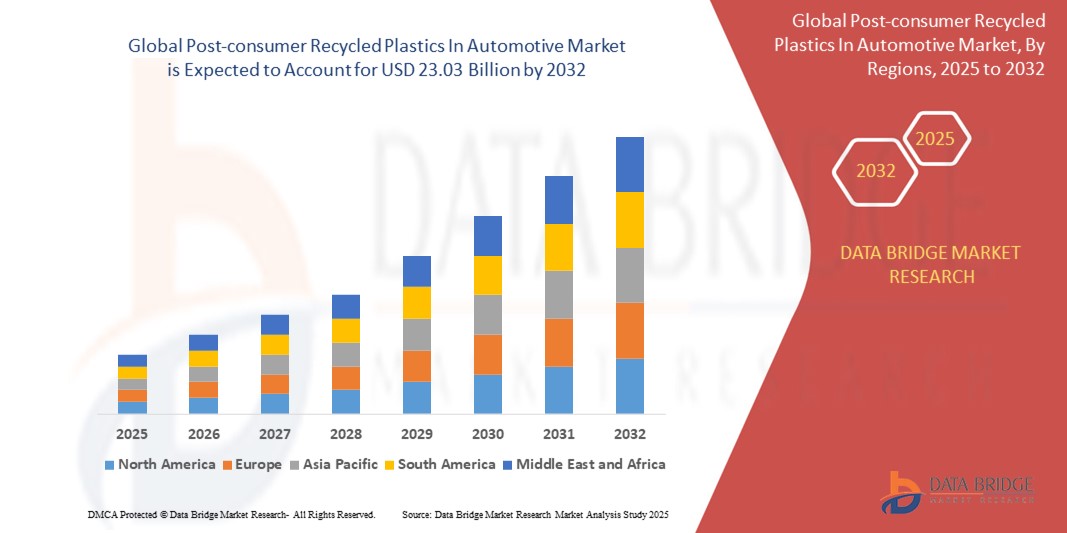
Post-consumer Recycled Plastics In Automotive Market Size
- The global post-consumer recycled plastics in automotive market size was valued at USD 13.608 billion in 2024 and is expected to reach USD 23.03 billion by 2032, at a CAGR of 6.80% during the forecast period
- This growth is driven by factors such as rising demand for sustainable materials, stringent government regulations on plastic waste, and the cost-effectiveness of recycled plastics compared to virgin materials
Post-consumer Recycled Plastics In Automotive Market Analysis
- Post-consumer recycled plastics are essential materials in the automotive industry, playing a crucial role in reducing waste and improving the sustainability of vehicle manufacturing
- The post-consumer recycled plastics in automotive market is experiencing significant growth, driven by the rising demand for eco-friendly materials, stricter environmental regulations, and advancements in recycling technologies. Increasing consumer preference for sustainable vehicles, along with the automotive industry's focus on lightweighting and cost-effective production, is further fueling market expansion
- Asia-Pacific is expected to dominate the post-consumer recycled plastics in automotive market with a share of 44.86%, driven by the increasing automotive production, rising focus on sustainability, and growing regulatory support for the adoption of recycled materials in vehicle manufacturing.
- North America is expected to be the fastest growing region in the post-consumer recycled plastics in automotive market during the forecast period due to rising environmental awareness, stringent regulations on plastic waste, and increased integration of recycled materials in vehicle interiors and structural components
- Interior components segment is expected to dominate the market with a market share of 61.42% due to high utilization of recycled plastics in manufacturing dashboards, seat panels, door trims, and other interior parts, driven by increasing demand for lightweight, durable, and sustainable materials to enhance vehicle efficiency and comply with environmental regulations
Report Scope and Post-consumer Recycled Plastics In Automotive Market Segmentation
|
Attributes |
Post-consumer Recycled Plastics In Automotive Key Market Insights |
|
Segments Covered |
|
|
Countries Covered |
North America
Europe
Asia-Pacific
Middle East and Africa
South America
|
|
Key Market Players |
|
|
Market Opportunities |
|
|
Value Added Data Infosets |
In addition to the insights on market scenarios such as market value, growth rate, segmentation, geographical coverage, and major players, the market reports curated by the Data Bridge Market Research also include import export analysis, production capacity overview, production consumption analysis, price trend analysis, climate change scenario, supply chain analysis, value chain analysis, raw material/consumables overview, vendor selection criteria, PESTLE Analysis, Porter Analysis, and regulatory framework. |
Post-consumer Recycled Plastics In Automotive Market Trends
“Rising Adoption of Recycled Plastics in Vehicle Interiors”
- One prominent trend in the global post-consumer recycled plastics in automotive market is the rising adoption of recycled plastics in vehicle interiors
- This trend is driven by the growing environmental awareness, regulatory pressures for sustainable manufacturing, and consumer demand for eco-friendly vehicles
- For instance, automakers such as Ford, BMW, and Toyota are integrating recycled plastics into components such as dashboards, seat panels, and door trims to reduce their carbon footprint and improve vehicle sustainability
- The demand for recycled plastics in vehicle interiors is gaining traction in developed regions such as North America and Europe and also in emerging markets, where rising environmental consciousness and regulatory frameworks are pushing for greener automotive solutions.
- As sustainability becomes a core focus of the automotive industry, the use of recycled plastics in vehicle interiors is expected to remain a key trend, shaping the market's growth in the coming years
Post-consumer Recycled Plastics In Automotive Market Dynamics
Driver
“Rising Environmental Regulations”
- Rising environmental regulations are a significant driver for the post-consumer recycled plastics in automotive market, as governments around the world impose stricter rules to reduce plastic waste and promote sustainable manufacturing practices
- This shift is gaining momentum globally, with increased emphasis on reducing carbon footprints and promoting the use of recycled materials in vehicle production
- As the automotive industry adapts to these regulations, there is a growing focus on integrating recycled plastics into various vehicle components, especially in interior and exterior parts, to meet sustainability goals and regulatory standards
- Automakers are actively working to innovate and find solutions that help them comply with environmental regulations while maintaining vehicle performance and safety standards
- Furthermore, the demand for eco-friendly solutions in automotive production is amplified by consumer preferences for greener, more sustainable vehicles, pushing companies to adopt recycled materials in their manufacturing processes
For instance,
- BMW and Ford are incorporating post-consumer recycled plastics into their vehicle models to meet both regulatory requirements and consumer demand for sustainable products.
- Volkswagen has committed to increasing the use of recycled materials in vehicle interiors as part of its broader sustainability initiatives
- As environmental regulations continue to tighten globally, the push for recycled plastics in automotive manufacturing will remain a key driver of market growth
Opportunity
“Rising Demand for Plastic Waste Management in Emerging Economies”
- The growing demand for plastic waste management in emerging economies presents a significant opportunity for the post-consumer recycled plastics in automotive market, offering recycling companies and automakers new avenues to source sustainable materials for vehicle production
- Industry players are capitalizing on this trend by establishing recycling infrastructure and forging partnerships with local governments to process plastic waste, which can be used in manufacturing automotive components
- This opportunity aligns with the broader shift toward sustainability and circular economy practices in these regions, as rising environmental awareness and stricter waste management regulations drive the need for more efficient plastic recycling systems
For instance,
- Tata Motors and Mahindra & Mahindra are collaborating with recycling firms in India to integrate post-consumer recycled plastics into their vehicle production lines
- Volkswagen has partnered with waste management companies in emerging markets to secure a steady supply of recycled plastics for use in interior and exterior vehicle parts
- As plastic waste management continues to improve, particularly in regions with growing urbanization and rising consumer awareness, the post-consumer recycled plastics in automotive market is poised to benefit from increased recycling capabilities, a steady supply of sustainable materials, and reduced manufacturing costs
Restraint/Challenge
“Inconsistent Quality and Contamination of Recycled Plastics”
- The inconsistent quality and contamination of recycled plastics presents a significant challenge for the post-consumer recycled plastics in automotive market, as automakers face increasing pressure to ensure the materials meet stringent safety, durability, and performance standards
- Recycled plastics often suffer from impurities or degradation, making it difficult to match the quality and strength of virgin plastics for critical automotive components
- Developing high-quality, contamination-free recycled plastics that meet the complex requirements of automotive manufacturing involves advanced sorting, purification, and processing technologies, all of which require significant R&D investments and time
For instance,
- Companies such as BMW and Ford are investing in state-of-the-art recycling technologies to improve the quality of recycled plastics, but continue to face hurdles in maintaining the desired material properties for use in vehicle production
- Without scalable solutions that guarantee high-quality recycled plastics, automakers may struggle to meet sustainability targets while maintaining vehicle safety and performance standards
Post-consumer Recycled Plastics In Automotive Market Scope
The market is segmented on the basis of polymer type and application.
|
Segmentation |
Sub-Segmentation |
|
By Polymer Type |
|
|
By Application |
|
In 2025, the interior components is projected to dominate the market with a largest share in application segment
The interior components segment is expected to dominate the post-consumer recycled plastics in automotive market with the largest share of 61.42% in 2025 due to high utilization of recycled plastics in manufacturing dashboards, seat panels, door trims, and other interior parts, driven by increasing demand for lightweight, durable, and sustainable materials to enhance vehicle efficiency and comply with environmental regulations.
The polypropylene (PP) is expected to account for the largest share during the forecast period in polymer type segment
In 2025, the polypropylene (PP) segment is expected to dominate the market with the largest market share of 44.28% due to its wide availability, cost-effectiveness, and favorable mechanical properties such as high impact resistance, flexibility, and thermal stability. These characteristics make PP highly suitable for manufacturing a broad range of automotive components, including bumpers, dashboards, door panels, and battery cases. In addition, its ease of recycling and compatibility with various processing techniques further contribute to its extensive use in post-consumer recycled plastic applications within the automotive sector.
Post-consumer Recycled Plastics In Automotive Market Regional Analysis
“Asia-Pacific Holds the Largest Share in the Post-consumer recycled plastics In automotive Market”
- Asia-Pacific dominates the post-consumer recycled plastics in automotive market with a share of 44.86%, driven by the increasing automotive production, rising focus on sustainability, and growing regulatory support for the adoption of recycled materials in vehicle manufacturing
- China holds a significant share due to its robust automotive industry, expanding plastic recycling infrastructure, and strong government initiatives promoting circular economy practices
- Regional dominance is further supported by cost-effective manufacturing, high plastic consumption rates, and the presence of several global and local automotive and plastic recycling companies
- With continuous innovation in material processing, growing demand for lightweight and eco-friendly automotive components, and favorable policy frameworks, Asia-Pacific is expected to maintain its leading position in the post-consumer recycled plastics in automotive market through 2032
“North America is Projected to Register the Highest CAGR in the Post-consumer recycled plastics In automotive Market”
- North America is expected to witness the highest growth rate in post-consumer recycled plastics in automotive market, driven by rising environmental awareness, stringent regulations on plastic waste, and increased integration of recycled materials in vehicle interiors and structural components
- U.S. holds a significant share due to its strong automotive production base, advanced recycling technologies, and consumer demand for sustainable and fuel-efficient vehicles
- Market growth in the region is further accelerated by growing investments in sustainable automotive materials, collaborations between automakers and recyclers, and policy support for green manufacturing
- With increasing demand for eco-friendly mobility solutions, rapid advancements in plastic recycling techniques, and rising consumer preference for sustainable products, North America is poised to emerge as the fastest-growing region in the global post-consumer recycled plastics in automotive market during the forecast period
Post-consumer Recycled Plastics In Automotive Market Share
The market competitive landscape provides details by competitor. Details included are company overview, company financials, revenue generated, market potential, investment in research and development, new market initiatives, global presence, production sites and facilities, production capacities, company strengths and weaknesses, product launch, product width and breadth, application dominance. The above data points provided are only related to the companies' focus related to market.
The Major Market Leaders Operating in the Market Are:
- BASF (Germany)
- SABIC (Saudi Arabia)
- Evonik Industries AG (Germany)
- Sumitomo Chemical Co., Ltd. (Japan)
- Arkema (France)
- LyondellBasell Industries N.V. (Netherlands)
- Celanese Corporation (U.S.)
- Eastman Chemical Company (U.S.)
- Chevron Phillips Chemical Company (U.S.)
- SUEZ SA (France)
- Exxon Mobil Corporation (U.S.)
- Covestro AG (Germany)
Latest Developments in Global Post-consumer Recycled Plastics In Automotive Market
- In November 2024, Covestro partnered with Chinese plastics recycling company Ausell to enhance the recycling of plastics from end-of-life vehicles. Their collaboration focuses on converting discarded automotive headlamps into high-quality post-consumer recycled (PCR) polycarbonates for use in new automotive applications. Both companies are committed to driving the circular transformation of the automotive industry and creating a strong market for recycled automotive plastics, particularly in China
- In August 2024, Novares, a global manufacturer of automotive plastic parts, took a significant step toward sustainability by incorporating post-consumer recycled (PCR) plastics into vehicle interior components. The company is using Terluran ECO GP-22 MR50, a mechanically recycled PCR ABS containing 50% recycled content, produced by INEOS Styrolution. This material preserves the properties of virgin ABS, such as excellent impact resistance and heat distortion resistance, making it an ideal drop-in replacement for various interior components, including door trims, dashboards, and seat parts

- Interactive Data Analysis Dashboard
- Company Analysis Dashboard for high growth potential opportunities
- Research Analyst Access for customization & queries
- Competitor Analysis with Interactive dashboard
- Latest News, Updates & Trend analysis
- Harness the Power of Benchmark Analysis for Comprehensive Competitor Tracking
Global Post Consumer Recycled Plastics In Automotive Market, Supply Chain Analysis and Ecosystem Framework
To support market growth and help clients navigate the impact of geopolitical shifts, DBMR has integrated in-depth supply chain analysis into its Global Post Consumer Recycled Plastics In Automotive Market research reports. This addition empowers clients to respond effectively to global changes affecting their industries. The supply chain analysis section includes detailed insights such as Global Post Consumer Recycled Plastics In Automotive Market consumption and production by country, price trend analysis, the impact of tariffs and geopolitical developments, and import and export trends by country and HSN code. It also highlights major suppliers with data on production capacity and company profiles, as well as key importers and exporters. In addition to research, DBMR offers specialized supply chain consulting services backed by over a decade of experience, providing solutions like supplier discovery, supplier risk assessment, price trend analysis, impact evaluation of inflation and trade route changes, and comprehensive market trend analysis.
Data collection and base year analysis are done using data collection modules with large sample sizes. The stage includes obtaining market information or related data through various sources and strategies. It includes examining and planning all the data acquired from the past in advance. It likewise envelops the examination of information inconsistencies seen across different information sources. The market data is analysed and estimated using market statistical and coherent models. Also, market share analysis and key trend analysis are the major success factors in the market report. To know more, please request an analyst call or drop down your inquiry.
The key research methodology used by DBMR research team is data triangulation which involves data mining, analysis of the impact of data variables on the market and primary (industry expert) validation. Data models include Vendor Positioning Grid, Market Time Line Analysis, Market Overview and Guide, Company Positioning Grid, Patent Analysis, Pricing Analysis, Company Market Share Analysis, Standards of Measurement, Global versus Regional and Vendor Share Analysis. To know more about the research methodology, drop in an inquiry to speak to our industry experts.
Data Bridge Market Research is a leader in advanced formative research. We take pride in servicing our existing and new customers with data and analysis that match and suits their goal. The report can be customized to include price trend analysis of target brands understanding the market for additional countries (ask for the list of countries), clinical trial results data, literature review, refurbished market and product base analysis. Market analysis of target competitors can be analyzed from technology-based analysis to market portfolio strategies. We can add as many competitors that you require data about in the format and data style you are looking for. Our team of analysts can also provide you data in crude raw excel files pivot tables (Fact book) or can assist you in creating presentations from the data sets available in the report.













