What is the Post-Harvest Grain Aeration Systems Market Size and Growth Rate?
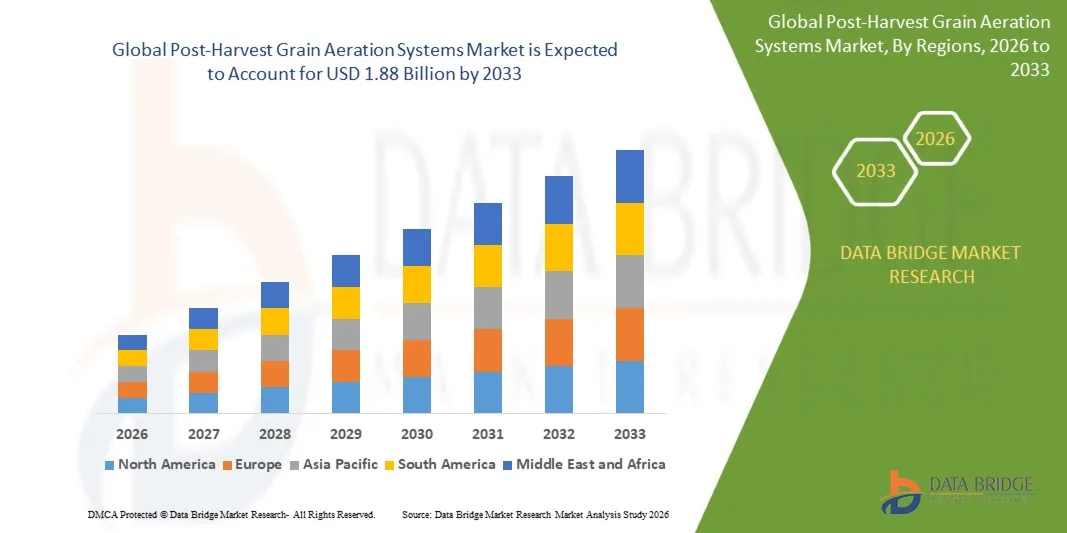
- As per Data Bridge Market Research analysis, the post-harvest grain aeration systems market was valued at USD 1.10 billion in 2025 and is projected to reach USD 1.88 billion by 2033, growing at a CAGR of 6.90% from 2026 to 2033.
- The market is experiencing consistent growth driven by rising demand for grain quality preservation, increasing adoption of advanced grain storage infrastructure, and expanding applications of aeration technologies across commercial grain elevators, agricultural facilities, and food supply chains.
- The increasing need to minimize post-harvest grain losses, prevent mold and insect infestations, and maintain consistent grain quality is encouraging farmers, grain storage operators, and agricultural cooperatives to invest in efficient aeration systems. Mechanical fans, automated temperature monitoring, and humidity-based controls are supporting better storage management by regulating grain temperatures, reducing moisture migration, and extending safe storage periods.
Market Size & Forecast
- Global Market Value (2025): USD 1.10 Billion
- Expected Market Value (2033): USD 1.88 Billion
- Forecast CAGR (2026–2033): 6.90%
- Leading Region in 2025: North America
- Fastest Growing Region: Asia Pacific
What are the Major Takeaways of the Post-Harvest Grain Aeration Systems Market?
- North America dominated the post-harvest grain aeration systems market with the largest revenue share of 33.89% in 2025, supported by advanced grain storage infrastructure and large-scale agricultural production.
- Asia-Pacific is expected to be the fastest-growing region at a CAGR of 6.9% from 2026 to 2033, fueled by expanding grain storage capacity, government investments in post-harvest infrastructure, and increasing demand across China and India.
- The fixed aeration systems segment led the market with a 40% share in 2025, driven by its extensive use in permanent grain storage infrastructure, including commercial silos, grain elevators, and on-farm storage bins
- Portable aeration systems are the fastest-growing system type, projected to register a CAGR of 7.0%, reflecting the surge in demand for flexible and cost-effective grain preservation solutions.
- The aeration fans and blowers segment dominated the component category with a 44.89% revenue share in 2025, led by their essential role in generating the airflow required for grain cooling and preservation.
- Corn accounted for 30% of the market share in 2025, preferred by its extensive use in animal feed, food processing, and industrial applications
- The soybean segment is the fastest-growing grain type category, with a CAGR of 7.5%, driven by demand from livestock feed, food processing, and vegetable oil production.
Report Scope and Post-Harvest Grain Aeration Systems Market Segmentation
|
Attributes |
Post-Harvest Grain Aeration Systems Key Market Insights |
|
Segments Covered |
|
|
Countries Covered |
North America
Europe
Asia-Pacific
Middle East and Africa
South America
|
|
Key Market Players |
|
|
Market Opportunities |
|
|
Value Added Data Infosets |
In addition to the insights on market scenarios such as market value, growth rate, segmentation, geographical coverage, and major players, the market reports curated by the Data Bridge Market Research also include import export analysis, production capacity overview, production consumption analysis, price trend analysis, climate change scenario, supply chain analysis, value chain analysis, raw material/consumables overview, vendor selection criteria, PESTLE Analysis, Porter Analysis, and regulatory framework. |
What is the Key Trend in the Post-Harvest Grain Aeration Systems Market?
- Grain storage operators are increasingly adopting automated aeration systems to regulate grain temperature, control moisture migration, and maintain quality while reducing spoilage risks during extended storage periods.
- For instance, in February 2025, SafeGrain introduced its Flat Storage Sensor, integrating carbon dioxide, moisture, and temperature monitoring in a floor-embedded design, with coverage of up to 4,200 square feet and options for automated fan control.
- Real-time monitoring enables operators to identify temperature hotspots, detect changing storage conditions, and schedule aeration more efficiently.
- Agricultural technology providers are integrating smart controllers, remote monitoring, and sensor-based automation to improve grain preservation and operational efficiency across commercial storage facilities.
- For instance, in March 2025, Wavcor International launched its Manhole Aeration system, designed for installation in hopper-bottom grain bins within minutes and compatible with its Airblast fan and most other fan brands.
- As grain storage operators increasingly prioritize quality preservation, energy efficiency, and proactive storage management, demand for automated and retrofit-compatible aeration technologies is expected to increase, strengthening the role of intelligent grain storage solutions.
What are the Key Drivers of the Post-Harvest Grain Aeration Systems Market?
- The growing need to reduce post-harvest grain losses and maintain stored grain quality has increased demand for aeration systems that control temperature, limit moisture migration, and reduce conditions favorable to insects and fungi.
- For instance, in March 2024, researchers published a study in Scientific Reports on sensor-based monitoring of corn during transportation and storage. The system tracked temperature, relative humidity, and carbon dioxide, using machine-learning models to predict grain quality changes and dry matter losses.
- Rising grain production and expanding commercial storage infrastructure are encouraging agricultural producers, cooperatives, and grain-handling companies to invest in improved storage and ventilation technologies.
- Government initiatives supporting modern grain storage, moisture monitoring, and post-harvest infrastructure are further encouraging the adoption of technologically advanced grain management systems.
- For instance, in February 2024, India's Ministry of Electronics and Information Technology announced the transfer of the SAFEETY Smart Food Grain Storage System technology, developed by SAMEER, to Paras Defence and Space Technologies for manufacturing and supply. The system incorporates RFID traceability, online weight and moisture measurement, and radio-frequency-based moisture removal, with a handling capacity of approximately 28 tonnes in 40 minutes.
- As food security priorities and investments in modern grain storage continue to expand, aeration systems are expected to remain important for maintaining grain quality, minimizing storage deterioration, and improving post-harvest handling efficiency.
What Factors are Challenging the Growth of the Post-Harvest Grain Aeration Systems Market?
- Advanced grain aeration systems require upfront investment in fans, perforated floors, ductwork, temperature sensors, automated controllers, and installation, increasing the cost of upgrading existing storage facilities.
- For instance, in September 2022, a study published in Agricultural Sciences examined grain storage technology adoption among 306 smallholder farmers in Northern Uganda. The study found that 37.8% of farmers aware of hermetic storage technologies identified high costs as a barrier, while 50.2% cited limited local availability.
- These investment requirements can limit adoption among smallholder farmers, small grain warehouses, and agricultural operators in emerging economies with restricted access to financing and modern storage infrastructure.
- In addition, aeration performance depends on grain moisture, ambient temperature, airflow resistance, and appropriate operating schedules, requiring technical knowledge and regular monitoring to avoid inefficient operation.
- For instance, in November 2024, a study published in the Brazilian Journal of Agricultural and Environmental Engineering assessed the energy efficiency of aeration in stored sunflower grains using machine-learning models. The research examined how operating conditions and temperature changes affect aeration efficiency, highlighting the need for better monitoring and optimization to control electricity consumption and operating costs.
- The high initial costs, infrastructure limitations, and need for technically appropriate operation continue to challenge adoption, particularly among smaller agricultural businesses, potentially slowing the penetration of advanced aeration systems in price-sensitive markets.
How is the Post-Harvest Grain Aeration Systems Market Segmented?
The post-harvest grain aeration systems market is segmented on the basis of system type, component, grain type, and end user.
- By System Type
On the basis of system type, the post-harvest grain aeration systems market is segmented into fixed aeration systems, portable aeration systems, natural draft aeration systems, mechanical pressure aeration systems, and negative pressure suction aeration systems. The fixed aeration systems segment is estimated to dominate the market with 40% share in 2025, owing to its extensive use in permanent grain storage infrastructure, including commercial silos, grain elevators, and on-farm storage bins. These systems provide consistent airflow throughout stored grain and help maintain suitable temperatures during prolonged storage periods. Their integration with perforated floors, ducts, and high-capacity fans supports effective grain cooling across large storage volumes. Fixed installations are particularly suitable for agricultural facilities that handle substantial quantities of grain during seasonal harvests. Their compatibility with temperature sensors and automated controllers further enhances storage management.
The portable aeration systems segment is projected to register the fastest growth at CAGR of 7.0% from 2026 to 2033, driven by demand for flexible and cost-effective grain preservation solutions. These systems can be moved between storage bins and facilities, making them suitable for farms with multiple storage locations. Portable units also help farmers introduce mechanical aeration without investing in extensive permanent ductwork or perforated-floor installations. Their flexibility is valuable during harvest periods when grain volumes and storage requirements change rapidly. Improvements in fan efficiency and ease of installation are further supporting adoption. Growing interest in affordable grain preservation technologies among small and medium-sized agricultural producers is expected to create additional demand.
- By Component
On the basis of component, the post-harvest grain aeration systems market is segmented into aeration fans and blowers, aeration ducts and perforated floors, aeration controllers, temperature and humidity sensors, airflow monitoring devices, and other accessories. The aeration fans and blowers segment dominated the broader grain aeration systems market with a 44.89% share in 2025, owing to their essential role in generating the airflow required for grain cooling and preservation. These components are fundamental to both fixed and portable aeration installations across farms, silos, and commercial grain storage facilities. Their capacity to circulate air through grain masses helps reduce temperature variations and the risk of localized spoilage. Demand is supported by the construction of new storage facilities and the replacement of aging fan equipment. Their compatibility with different storage designs makes them widely applicable across agricultural operations.
The temperature and humidity sensors segment is projected to register the fastest growth at CAGR of 8.0% from 2026 to 2033, supported by increasing adoption of data-driven grain storage management. These sensors help operators monitor storage conditions and identify temperature changes that may indicate moisture migration or deterioration. Integration with automated controllers allows aeration cycles to be adjusted according to grain conditions and ambient weather. Remote monitoring can also reduce the need for frequent manual inspections of large storage facilities. Improvements in wireless connectivity and sensor technology are making continuous monitoring more accessible. The growing emphasis on energy-efficient aeration and proactive grain quality management is expected to support demand for these components.
- By Grain Type
On the basis of grain type, the post-harvest grain aeration systems market is segmented into wheat, corn, rice, barley, soybean, and other grains. The corn segment is estimated to dominate the market with 30% share in 2025, supported by its extensive use in animal feed, food processing, and industrial applications. Corn is stored in large quantities across agricultural production regions, creating a need for effective temperature management throughout the storage cycle. Aeration helps manage heat accumulation and temperature differences within grain bins, reducing conditions associated with spoilage. The segment benefits from demand across commercial grain elevators, feed manufacturers, and agricultural producers. Large-scale storage operations also require reliable airflow to maintain grain quality between harvest and distribution.
The soybean segment is projected to register the fastest growth at CAGR of 7.5% from 2026 to 2033, driven by demand from livestock feed, food processing, and vegetable oil production. Soybeans require appropriate storage conditions to preserve quality and minimize deterioration before processing. Aeration systems help control grain temperatures and manage storage conditions as ambient weather changes. Increasing investment in modern grain handling and storage infrastructure is creating opportunities for improved aeration technologies in soybean-producing regions. Export-oriented supply chains also place greater emphasis on maintaining consistent grain quality during storage. These factors are expected to support demand for aeration equipment in soybean storage facilities.
- By End User
On the basis of end user, the post-harvest grain aeration systems market is segmented into farmers and agricultural producers, commercial grain storage operators, agricultural cooperatives, grain processing companies, food and beverage manufacturers, government grain storage agencies, and seed producers and distributors. The commercial grain storage operators segment is estimated to dominate the market with 35% share in 2025, supported by the large volumes of grain handled by commercial silos, grain elevators, and bulk storage terminals. These operators require reliable aeration systems to maintain grain quality across extended storage periods and high-capacity facilities. Mechanical fans, airflow distribution systems, and temperature monitoring equipment are essential for managing grain stored before transportation, processing, or export. Commercial facilities also benefit from automated controls that improve operating consistency across multiple storage units. Growing investment in bulk grain handling infrastructure is supporting demand for high-capacity aeration equipment.
The farmers and agricultural producers segment is projected to register the fastest growth at CAGR of 7.2% from 2026 to 2033, driven by increasing awareness of post-harvest losses and the importance of appropriate grain storage conditions. Farmers are increasingly seeking practical aeration solutions to preserve harvested crops and improve their flexibility in deciding when to sell grain. Portable fans and retrofit-compatible systems can help producers upgrade existing storage bins without constructing entirely new facilities. Access to affordable equipment and simpler monitoring technologies can further support adoption among small and medium-sized farms. Government programs aimed at improving post-harvest infrastructure may also encourage investment in grain preservation equipment. These factors are expected to support demand for farm-level aeration solutions.
Which Region Holds the Largest Share of the Post-Harvest Grain Aeration Systems Market?
- North America dominated the post-harvest grain aeration systems market with the largest revenue share of 33.89% in 2025, supported by advanced grain storage infrastructure and large-scale agricultural production.
- The region also benefits from extensive commercial grain elevator networks, advanced on-farm storage facilities, and increasing demand for automated temperature monitoring and energy-efficient aeration equipment. Strong investment in grain quality preservation, storage modernization, and post-harvest loss reduction continues to reinforce North America's leadership in the global market.
U.S. Post-Harvest Grain Aeration Systems Market Insight
The U.S. post-harvest grain aeration systems market is witnessing steady growth due to rising investments in modern grain storage infrastructure, increasing demand for grain quality preservation, and growing adoption of automated aeration technologies. The country’s large-scale corn, wheat, and soybean production, along with extensive commercial grain elevator networks, is driving demand across farms, storage facilities, and grain processing operations. In addition, growing emphasis on reducing post-harvest losses, improving storage efficiency, and maintaining grain quality is accelerating the adoption of advanced aeration systems.
Asia-Pacific Post-Harvest Grain Aeration Systems Market Insight
The Asia-Pacific post-harvest grain aeration systems market is expected to witness rapid growth, driven by increasing grain production, expanding agricultural infrastructure, and rising investments in modern storage facilities across countries such as China, India, and Australia. Growing awareness regarding post-harvest losses, increasing demand for food security, and adoption of efficient grain preservation technologies are supporting regional market expansion. In addition, government initiatives to modernize grain storage facilities and improve agricultural supply chains are accelerating the adoption of mechanical aeration and automated monitoring systems.
Japan Post-Harvest Grain Aeration Systems Market Insight
The Japan post-harvest grain aeration systems market is witnessing consistent growth due to increasing emphasis on grain quality preservation, efficient storage management, and modernization of agricultural infrastructure. Rice producers, agricultural cooperatives, and commercial storage operators are increasingly adopting aeration and temperature monitoring technologies to maintain grain quality during storage. Moreover, the country's focus on agricultural automation, labor efficiency, and advanced storage management solutions is further contributing to the adoption of modern grain aeration systems.
China Post-Harvest Grain Aeration Systems Market Insight
The China post-harvest grain aeration systems market is growing rapidly, driven by large-scale grain production, increasing investments in grain storage infrastructure, and rising government focus on food security. Growing adoption of mechanical ventilation, automated temperature monitoring, and moisture management technologies across commercial silos and grain storage facilities is supporting market demand. In addition, increasing efforts to reduce post-harvest losses, modernize grain handling operations, and strengthen agricultural supply chains are positioning China as an important market for advanced grain aeration technologies.
U.K. Post-Harvest Grain Aeration Systems Market Insight
The U.K. post-harvest grain aeration systems market is experiencing steady growth, supported by demand for efficient grain storage, improved quality management, and reduced post-harvest losses. Farmers, grain merchants, and commercial storage operators are increasingly utilizing aeration systems to regulate grain temperatures and maintain suitable storage conditions for wheat, barley, and other crops. Furthermore, the integration of automated controls, temperature sensors, and energy-efficient fans is improving storage management and operational efficiency, supporting the adoption of modern aeration technologies across the U.K. agricultural sector.
Germany Post-Harvest Grain Aeration Systems Market Insight
The Germany post-harvest grain aeration systems market is expanding steadily due to the country's established agricultural sector, advanced grain handling infrastructure, and increasing emphasis on sustainable storage practices. Grain producers, agricultural cooperatives, and commercial storage operators are increasingly utilizing aeration equipment to manage temperature variations, preserve grain quality, and minimize spoilage during storage. Continuous advancements in sensor-based monitoring, automated fan controls, and energy-efficient ventilation technologies, along with growing attention to resource efficiency and food supply chain resilience, are further supporting market growth in Germany.
Which are the Top Companies in Post-Harvest Grain Aeration Systems Market?
The post-harvest grain aeration systems industry is primarily led by well-established companies, including:
- Sukup Manufacturing Co. (U.S.)
- Meridian Manufacturing Inc. (Canada)
- Kotzur Pty Ltd (Australia)
- Agridry (Australia)
- Smallaire Pty Ltd (Australia)
- Keho Systems Ltd. (Canada)
- Grain Guard (Canada)
- SafeGrain, Inc. (U.S.)
- Wavcor International Inc. (Canada)
- All Size Perforating Ltd. (Canada)
- Mathews Company (U.S.)
- Shivvers Manufacturing, Inc. (U.S.)
- Sioux Steel Company (U.S.)
- Superior Grain Equipment (U.S.)
- Alvan Blanch Development Co. Ltd. (U.K.)
- Symaga S.A. (Spain)
- Silos Córdoba S.L. (Spain)
- Pratley Manufacturing (South Africa)
- BDC Systems Ltd. (U.K.)
What are Latest Developments in Post-Harvest Grain Aeration Systems Market?
- In March 2025, Wavcor International announced the launch of its Manhole Aeration System, designed to add aeration to existing hopper-bottom grain bins without requiring major structural modifications. The perforated cylinder fits through the existing manhole and works with Wavcor’s Airblast fan or compatible fans from other manufacturers. The system offers farmers a practical way to improve airflow, preserve grain quality, and reduce the cost of upgrading existing storage infrastructure.
- In September 2024, iGRAIN introduced its Aeration Control Module, designed to automate grain temperature and moisture management in storage facilities. The system integrates with iGRAIN’s Dashboard Manager, Smart App, and PLC/SCADA systems, using sensor data on grain temperature, moisture, carbon dioxide, and weather conditions to optimize aeration. Its equilibrium moisture concentration-based control approach aims to improve grain preservation while reducing unnecessary fan operation and energy consumption.
- In March 2024, SafeGrain announced a new range of grain monitoring and automation products, including fan automation technology, all-in-one sensor cables, digital temperature sensor cables, and a Dashboard Manager with a Smart App. These solutions enable operators to monitor temperature, moisture, and carbon dioxide levels while accessing storage data remotely. The product launch highlights the industry's shift toward automated aeration management and real-time monitoring to improve grain quality and storage efficiency
- In July 2022, GSI introduced its GrainVue grain management system, enabling farmers to monitor grain storage remotely and automate aeration fan operation. The system uses digital cables to track grain temperature and moisture and can activate fans when conditions are suitable for cooling or drying. Cloud connectivity, mobile access, automated alerts, and weather-based controls help operators manage multiple grain bins while reducing unnecessary fan operation.
- In August 2021, researchers Jingyun Liu and Ping Li published a study in Sensors describing a new experimental platform for stored-grain aeration research with real-time data acquisition and control. The platform used sensors and coordinated control loops to monitor and regulate inlet-air temperature and humidity, enabling more precise experimentation under different aeration conditions. The development supports research into intelligent aeration control and improved grain storage management.

- Interactive Data Analysis Dashboard
- Company Analysis Dashboard for high growth potential opportunities
- Research Analyst Access for customization & queries
- Competitor Analysis with Interactive dashboard
- Latest News, Updates & Trend analysis
- Harness the Power of Benchmark Analysis for Comprehensive Competitor Tracking
Data collection and base year analysis are done using data collection modules with large sample sizes. The stage includes obtaining market information or related data through various sources and strategies. It includes examining and planning all the data acquired from the past in advance. It likewise envelops the examination of information inconsistencies seen across different information sources. The market data is analysed and estimated using market statistical and coherent models. Also, market share analysis and key trend analysis are the major success factors in the market report. To know more, please request an analyst call or drop down your inquiry.
The key research methodology used by DBMR research team is data triangulation which involves data mining, analysis of the impact of data variables on the market and primary (industry expert) validation. Data models include Vendor Positioning Grid, Market Time Line Analysis, Market Overview and Guide, Company Positioning Grid, Patent Analysis, Pricing Analysis, Company Market Share Analysis, Standards of Measurement, Global versus Regional and Vendor Share Analysis. To know more about the research methodology, drop in an inquiry to speak to our industry experts.
Data Bridge Market Research is a leader in advanced formative research. We take pride in servicing our existing and new customers with data and analysis that match and suits their goal. The report can be customized to include price trend analysis of target brands understanding the market for additional countries (ask for the list of countries), clinical trial results data, literature review, refurbished market and product base analysis. Market analysis of target competitors can be analyzed from technology-based analysis to market portfolio strategies. We can add as many competitors that you require data about in the format and data style you are looking for. Our team of analysts can also provide you data in crude raw excel files pivot tables (Fact book) or can assist you in creating presentations from the data sets available in the report.