What is the Post-Harvest Treatment Market Size and Growth Rate?
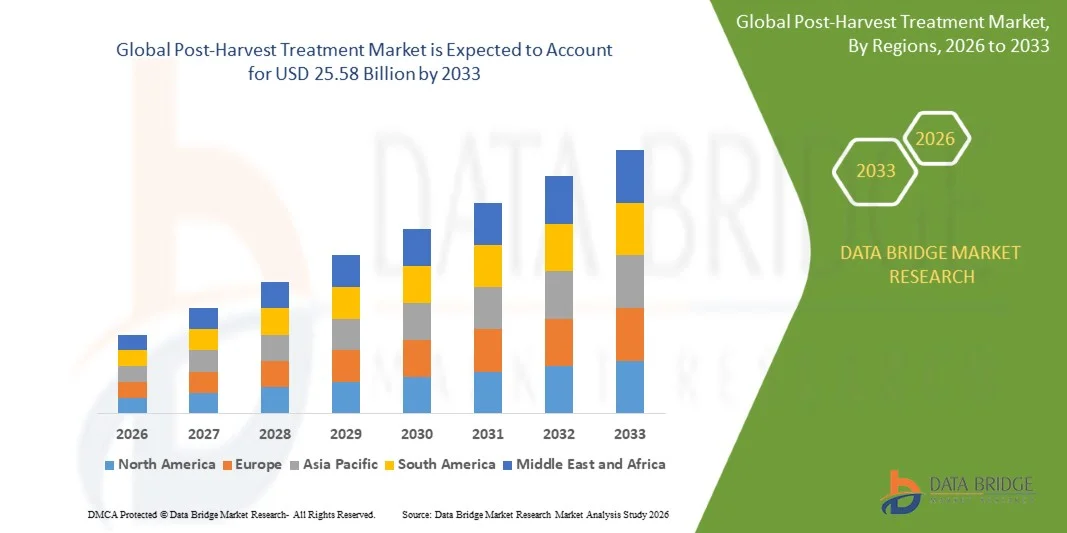
- As per Data Bridge Market Research analysis, the post-harvest treatment market was valued at USD 14.23 billion in 2025 and is projected to reach USD 25.58 billion by 2033, growing at a CAGR of 7.20% from 2026 to 2033.
- The market is experiencing consistent growth driven by rising concerns over food loss and waste, growing demand for fresh and high-quality produce, and the expansion of global trade in perishable agricultural commodities.
- The increasing volume of cross-border fresh produce trade, combined with stricter food safety and quality regulations, is compelling growers, packhouses, and exporters to adopt advanced post-harvest treatment solutions. Bio-based coatings and digital quality-monitoring platforms are increasingly complementing traditional chemical treatments in many markets, offering extended shelf life, reduced spoilage, and improved traceability across the supply chain.
Market Size & Forecast
- Global Market Value (2025): USD 14.23 Billion
- Expected Market Value (2033): USD 25.58 Billion
- Forecast CAGR (2026–2033): 7.20%
- Leading Region in 2025: Asia-Pacific
- Fastest Growing Region: North America
What are the Major Takeaways of the Post-Harvest Treatment Market?
- Asia-Pacific dominated the global post-harvest treatment market with the largest revenue share of 40.30% in 2025, supported by large-scale fruit and vegetable production, expanding cold storage infrastructure, and rising export activity across China, India, and Southeast Asia.
- North America is expected to be the fastest-growing region at a CAGR of 8.1% from 2026 to 2033, fueled by rising adoption of digital quality-monitoring platforms, growing consolidation among post-harvest solution providers, and increasing focus on reducing food loss across the fresh produce supply chain.
- The synthetic segment led the market by origin with a 62.70% share in 2025, driven by established efficacy, strong commercial adoption, and well-developed application protocols across packhouses and storage facilities.
- The natural/bio-based segment is the fastest-growing origin category, projected to register a CAGR of 8.4%, reflecting rising demand for plant-based coatings and residue-free treatments among fresh produce exporters.
- The fruits & vegetables segment dominated the application category with a 46.70% revenue share in 2025, led by extensive treatment adoption across citrus, pome fruits, and high-value perishable produce categories.
- The ethylene blockers & absorbers segment led the product category with a 31.30% share in 2025, owing to their critical role in slowing ripening and extending shelf life across climacteric fruit varieties.
Report Scope and Post-Harvest Treatment Market Segmentation
|
Attributes |
Post-Harvest Treatment Key Market Insights |
|
Segments Covered |
|
|
Countries Covered |
North America
Europe
Asia-Pacific
Middle East and Africa
South America
|
|
Key Market Players |
|
|
Market Opportunities |
|
|
Value Added Data Infosets |
|
What is the Key Trend in the Post-Harvest Treatment Market?
- Fresh produce companies are increasingly adopting digital quality-monitoring ecosystems that integrate orchard analytics, imaging, and real-time inspection data to improve post-harvest decision-making across the supply chain.
- Non-destructive quality analysis tools allow packhouses to assess fruit condition without damaging produce, improving sorting accuracy and reducing waste before storage and shipment.
- For instance, in November 2025, AgroFresh Solutions announced partnerships with Aerobotics and Neolithics to expand its FreshCloud™ digital ecosystem, integrating advanced orchard analytics and imaging to enhance post-harvest quality management.
- As exporters and packhouses continue to prioritize traceability, shelf-life extension, and sustainability, the integration of digital monitoring and AI-based inspection platforms is expected to accelerate, reinforcing technology-enabled post-harvest treatment as a core enabler of global fresh produce trade.
What are the Key Drivers of the Post-Harvest Treatment Market?
- The rapid growth of global fresh produce exports has significantly increased demand for post-harvest treatments capable of preserving quality, appearance, and safety of fruits and vegetables across extended supply chains.
- For instance, in March 2025, AgroFresh Solutions launched VitaFresh™ Botanicals, a plant-based coating solution designed to extend freshness and reduce food waste in citrus and avocados.
- Post-harvest solution providers are consolidating their portfolios and expanding regional service capabilities to meet growing demand from growers, packhouses, and exporters across key fruit-growing regions.
- For instance, in December 2024, Decco Worldwide Post-Harvest, Inc. expanded its service portfolio in Latin America by introducing a new line of bio-based fungicides targeting banana and mango exports.
- With the global agricultural trade increasingly relying on reliable freshness protection to meet quality standards and reduce spoilage, post-harvest treatments will remain indispensable for both conventional and organic fresh produce supply chains.
Which Factors are Challenging the Growth of the Post-Harvest Treatment Market?
- Post-harvest treatment adoption requires significant investment in cold storage infrastructure, application equipment, and regulatory compliance testing across multiple export destinations.
- Stringent residue limits and differing regulatory frameworks across regions, particularly in Europe, continue to raise compliance costs and limit market entry for smaller post-harvest solution providers.
- For instance, in March 2024, AgroFresh Solutions acquired Pace International, LLC from Valent BioSciences, a Sumitomo Chemical group company, reflecting the substantial capital investment required to build the global reach, technical services, and product portfolio needed to compete at scale in the post-harvest solutions industry.
- The high capital investment and recurring compliance costs associated with advanced post-harvest treatment systems continue to restrict adoption, particularly among smallholder growers and cost-sensitive markets. This cost barrier slows market penetration in price-sensitive and emerging regions, limiting the widespread deployment of advanced post-harvest technologies despite growing demand.
How is the Post-Harvest Treatment Market Segmented?
The post-harvest treatment market is segmented on the basis of product, origin, form, application, treatment method, crop type, mode of application, end user, distribution channel and technology integration.
- By Product
On the basis of product, the global post-harvest treatment market is segmented into coatings & waxes, fungicides, cleaners, sanitizers & disinfectants, ethylene blockers & absorbers, and others. The ethylene blockers & absorbers segment dominated the market with a 31.30% share in 2025, owing to their critical role in slowing the ripening process and extending shelf life across climacteric fruits such as bananas, apples, and avocados. These products deliver reliable freshness protection across long-distance shipping routes, making them the preferred choice for exporters and packhouses.
The coatings & waxes segment is projected to register the fastest growth from 2026 to 2033, driven by rising demand for plant-based and edible coatings that improve appearance, reduce moisture loss, and align with clean-label consumer preferences.
- By Origin
On the basis of origin, the global post-harvest treatment market is segmented into synthetic and natural/bio-based. The synthetic segment led the market with a 62.70% share in 2025, supported by established efficacy, cost-effectiveness, and well-developed application protocols across citrus, pome fruits, potatoes, onions, and other high-volume produce categories.
The natural/bio-based segment is expected to experience the fastest growth at a CAGR of 8.4% from 2026 to 2033, driven by rising consumer demand for residue-free produce and increasing regulatory support for sustainable, plant-based freshness solutions.
- By Form
On the basis of form, the global post-harvest treatment market is segmented into liquid and powder. The liquid segment dominated the market with a share of 78.20% in 2025 due to its widespread adoption in commercial fruit and vegetable handling operations, increasing demand for uniform application, and strong compatibility with existing packhouse systems. additionally, rising focus on dilution flexibility, ease of automation, and reduced application time further supports the strong adoption of liquid post-harvest treatment solutions.
The powder segment is anticipated to witness the fastest CAGR of 6.3% from 2026 to 2033, driven by this growth is fueled by the increasing reliance on dry formulations for selected storage treatments requiring longer product stability. post-harvest solution providers, packhouses, and storage facility operators are adopting powder-based treatments to conduct cost-effective, stable, and easy-to-handle storage protection. additionally, the integration of powder treatments into root crop and tuber storage protocols is enhancing the efficiency of powder-based post-harvest solutions, further driving segment growth.
- By Application
On the basis of application, the global post-harvest treatment market is segmented into fruits & vegetables, cereals & grains, flowers & ornamentals, and root crops & tubers. The fruits & vegetables segment led the market with a 46.70% share in 2025, supported by extensive treatment adoption across citrus, pome fruits, and high-value perishable produce categories requiring shelf-life extension and quality preservation.
The flowers & ornamentals segment is expected to experience the fastest growth from 2026 to 2033, driven by rising demand for specialized bio-treatments that prolong vase life and maintain aesthetic appeal, particularly across the floral export industry in the Netherlands and Colombia.
- By Treatment Method
On the basis of treatment method, the global post-harvest treatment market is segmented into chemical treatment, physical/thermal treatment, biological treatment, and controlled atmosphere storage. The chemical treatment segment dominated the market with a share of 58.30% in 2025 due to its critical role in providing broad-spectrum protection against fungal decay, microbial contamination, and physiological disorders during storage and transport. high adoption is driven by the increasing need for cost-effective, scalable freshness protection across high-volume produce categories. additionally, growing investment by post-harvest solution providers to improve efficacy, regulatory compliance, and application precision is reinforcing the leading position of this segment in the market.
The biological treatment segment is expected to witness the fastest CAGR from 2026 to 2033, this growth is driven by increasing demand for biocontrol-based freshness solutions that reduce reliance on synthetic fungicides. advanced biological formulations, including beneficial microorganisms and plant-derived compounds, are improving disease control while meeting residue-free market requirements. additionally, the adoption of these treatments among premium and export-oriented growers is further accelerating market expansion.
- By Crop Type
On the basis of crop type, the global post-harvest treatment market is segmented into citrus fruits, pome fruits, tropical fruits, vegetables, and grains & pulses. The citrus fruits segment dominated the market with the largest share in 2025 due to extensive global citrus trade requiring reliable fungicide, coating, and cleaning treatments to meet international quality and safety standards.
The tropical fruits segment is expected to witness the fastest CAGR from 2026 to 2033, driven by rising export volumes of bananas, mangoes, and avocados from Latin America, Africa, and Southeast Asia requiring specialized ripening control and freshness protection solutions.
- By Mode of Application
On the basis of mode of application, the global post-harvest treatment market is segmented into spray application, dip/immersion treatment, fumigation, and coating application. The dip/immersion treatment segment dominated the market with the largest share in 2025 due to its widespread use in high-throughput packhouse operations requiring uniform, full-surface treatment coverage for large produce volumes. the widespread presence of automated dip-line systems facilitates faster processing and reinforces this segment's leading market position.
The coating application segment is expected to witness the fastest CAGR from 2026 to 2033, driven by this growth is primarily driven by the increasing adoption of edible and plant-based coatings applied through precision spray and electrostatic systems, offering improved uniformity and reduced product waste.
- By End User
On the basis of end user, the global post-harvest treatment market is segmented into packhouses & cold storage facilities, growers & farms, food processing companies, and exporters & distributors. The packhouses & cold storage facilities segment dominated the market with the largest share in 2025 due to their central role in applying, monitoring, and validating post-harvest treatments prior to storage and distribution. additionally, established relationships between packhouse operators and post-harvest solution providers are reinforcing the dominance of this segment.
The exporters & distributors segment is expected to witness the fastest CAGR from 2026 to 2033, driven by rising demand for treatments that ensure compliance with destination-market quality and residue standards amid expanding global fresh produce trade.
- By Distribution Channel
On the basis of distribution channel, the global post-harvest treatment market is segmented into direct sales, distributors & agri-input dealers, and online/digital platforms. The direct sales segment dominated the market with the largest share in 2025 due to its critical role in enabling post-harvest solution providers to deliver technical support, application training, and customized treatment protocols directly to large growers and packhouses. the widespread presence of long-term supply agreements facilitates faster adoption and reinforces this segment's leading market position.
The online/digital platforms segment is expected to witness the fastest CAGR from 2026 to 2033, driven by this growth is primarily driven by the increasing digitization of agri-input procurement and rising adoption of e-commerce channels among small and mid-sized growers.
- By Technology Integration
On the basis of technology integration, the global post-harvest treatment market is segmented into digital monitoring & analytics, IoT-enabled storage systems, AI-based quality inspection, and traditional/manual systems. The traditional/manual systems segment dominated the market with the largest share in 2025 due to widespread continued reliance on established application protocols across smallholder and mid-sized packhouse operations globally.
The AI-based quality inspection segment is expected to witness the fastest CAGR from 2026 to 2033, driven by this growth is driven by the increasing adoption of non-destructive scanning and imaging technologies that enable real-time quality assessment, making post-harvest quality management more efficient and valuable for next-generation packhouse operations.
Which Region Holds the Largest Share of the Post-Harvest Treatment Market?
- Asia-Pacific dominated the post-harvest treatment market and accounted for the largest revenue share of 40.30% in 2025, supported by large-scale fruit and vegetable production, expanding cold storage and packhouse infrastructure, and rising export activity across China, India, and Southeast Asia.
- The region also benefits from growing government support for reducing post-harvest food loss, expanding Tier-1 and Tier-2 supplier networks, and increasing adoption of both synthetic and bio-based freshness treatments. Rising investment in digital quality-monitoring infrastructure continues to strengthen Asia-Pacific's leadership position in the global market.
China Post-Harvest Treatment Market Insight
The China post-harvest treatment market is experiencing steady growth, supported by the country's large fruit and vegetable production base, expanding cold chain infrastructure, and increasing adoption of coatings, fungicides, and ethylene management technologies. Rising investments in packhouse automation and growing demand for export-quality produce are contributing to market growth. Furthermore, integration of digital quality monitoring is improving treatment consistency, positioning China as a key growth market in the post-harvest treatment industry.
India Post-Harvest Treatment Market Insight
The India post-harvest treatment market is expanding steadily due to the country's growing horticulture sector, rising fruit and vegetable production, and increasing adoption of next-generation freshness protection technologies. Growers, packhouses, and exporters are increasingly investing in coatings, fungicides, and cold storage-linked treatment protocols to meet rising domestic and export demand. Continuous government support for reducing post-harvest losses is further driving market growth in India.
North America Post-Harvest Treatment Market Insight
The North America post-harvest treatment market is expected to witness the fastest growth globally, driven by rising consolidation among post-harvest solution providers, increasing adoption of digital quality-monitoring platforms, and growing focus on reducing food loss across the fresh produce supply chain. Growing awareness regarding sustainable, bio-based treatments, rising adoption of AI-enabled inspection technologies, and increasing demand for scalable, export-ready freshness solutions are supporting regional market expansion. Additionally, the growing presence of leading post-harvest solution providers and packhouse technology developers is accelerating investment across the region.
U.S. Post-Harvest Treatment Market Insight
The U.S. post-harvest treatment market is witnessing consistent growth due to rising investments in advanced freshness protection technologies, expanding adoption of plant-based coatings, and continued consolidation among leading post-harvest solution providers. Growers, packhouses, and exporters are increasingly adopting digital monitoring and non-destructive inspection tools for quality validation and shelf-life extension. Moreover, increasing integration of biocontrol solutions and the country's focus on reducing food waste are further contributing to market growth.
Mexico Post-Harvest Treatment Market Insight
The Mexico post-harvest treatment market is growing steadily, driven by expanding fresh produce export operations, rising adoption of cold storage and coating technologies, and increasing government focus on agricultural trade development. Growing adoption of bio-based fungicides and coatings across avocado, citrus, and berry export operations is significantly boosting market demand. In addition, rising investment from global post-harvest solution providers and increasing integration into North American fresh produce supply chains are positioning Mexico as a key growth market for post-harvest treatment globally.
Which are the Top Companies in the Post-Harvest Treatment Market?
The post-harvest treatment industry is primarily led by well-established companies, including:
- AgroFresh Solutions, Inc. (U.S.)
- Pace International, LLC (U.S.)
- Decco Worldwide Post-Harvest, Inc. (U.S.)
- JBT Corporation (U.S.)
- Xeda International S.A.S. (France)
- Syngenta AG (Switzerland)
- FMC Corporation (U.S.)
- Nufarm Limited (Australia)
- Bayer AG (Germany)
- Citrosol S.A. (Spain)
- Fomesa Fruitech S.L. (Spain)
- Futureco Bioscience S.A. (Spain)
- Corteva Agriscience (U.S.)
- BASF SE (Germany)
- Hazel Technologies, Inc. (U.S.)
- Lytone Enterprise, Inc. (Taiwan)
- Colin Campbell Chemicals Pty Ltd. (Australia)
- Sufresca Ltd. (Israel)
- Ceradis B.V. (Netherlands)
- Jingold S.p.A. (Italy)
- Valent BioSciences LLC (U.S.)
- Biotalys NV (Belgium)
- Symbiotech Research Pvt. Ltd. (India)
- Post Harvest Solution Ltd. (U.K.)
What are Latest Developments in the Post-Harvest Treatment Market?
- In November 2025, AgroFresh Solutions announced partnerships with Aerobotics and Neolithics to expand its FreshCloud™ digital ecosystem, integrating advanced orchard analytics and imaging to enhance post-harvest quality management.
- In May 2025, Biotalys announced a strategic collaboration with AgroFresh Solutions to develop and commercialize biocontrol solutions for post-harvest protection, targeting improved disease control and shelf-life extension for fresh produce.
- In March 2025, AgroFresh Solutions launched VitaFresh™ Botanicals, a plant-based coating solution designed to extend freshness and reduce food waste in citrus and avocados.
- In February 2025, AgroFresh Solutions introduced a non-destructive fruit quality analysis scanner integrated with FreshCloud™ Inspection, enabling real-time quality monitoring and improved post-harvest decision-making across produce supply chains.
- In December 2024, Decco Worldwide Post-Harvest, Inc. expanded its service portfolio in Latin America by introducing a new line of bio-based fungicides targeting banana and mango exports.
- In March 2024, AgroFresh Solutions, Inc. acquired Pace International, LLC from Valent BioSciences, a Sumitomo Chemical Co., Ltd. group company, strengthening AgroFresh's presence in key fruit-growing regions across North and South America.

- Interactive Data Analysis Dashboard
- Company Analysis Dashboard for high growth potential opportunities
- Research Analyst Access for customization & queries
- Competitor Analysis with Interactive dashboard
- Latest News, Updates & Trend analysis
- Harness the Power of Benchmark Analysis for Comprehensive Competitor Tracking
Data collection and base year analysis are done using data collection modules with large sample sizes. The stage includes obtaining market information or related data through various sources and strategies. It includes examining and planning all the data acquired from the past in advance. It likewise envelops the examination of information inconsistencies seen across different information sources. The market data is analysed and estimated using market statistical and coherent models. Also, market share analysis and key trend analysis are the major success factors in the market report. To know more, please request an analyst call or drop down your inquiry.
The key research methodology used by DBMR research team is data triangulation which involves data mining, analysis of the impact of data variables on the market and primary (industry expert) validation. Data models include Vendor Positioning Grid, Market Time Line Analysis, Market Overview and Guide, Company Positioning Grid, Patent Analysis, Pricing Analysis, Company Market Share Analysis, Standards of Measurement, Global versus Regional and Vendor Share Analysis. To know more about the research methodology, drop in an inquiry to speak to our industry experts.
Data Bridge Market Research is a leader in advanced formative research. We take pride in servicing our existing and new customers with data and analysis that match and suits their goal. The report can be customized to include price trend analysis of target brands understanding the market for additional countries (ask for the list of countries), clinical trial results data, literature review, refurbished market and product base analysis. Market analysis of target competitors can be analyzed from technology-based analysis to market portfolio strategies. We can add as many competitors that you require data about in the format and data style you are looking for. Our team of analysts can also provide you data in crude raw excel files pivot tables (Fact book) or can assist you in creating presentations from the data sets available in the report.