


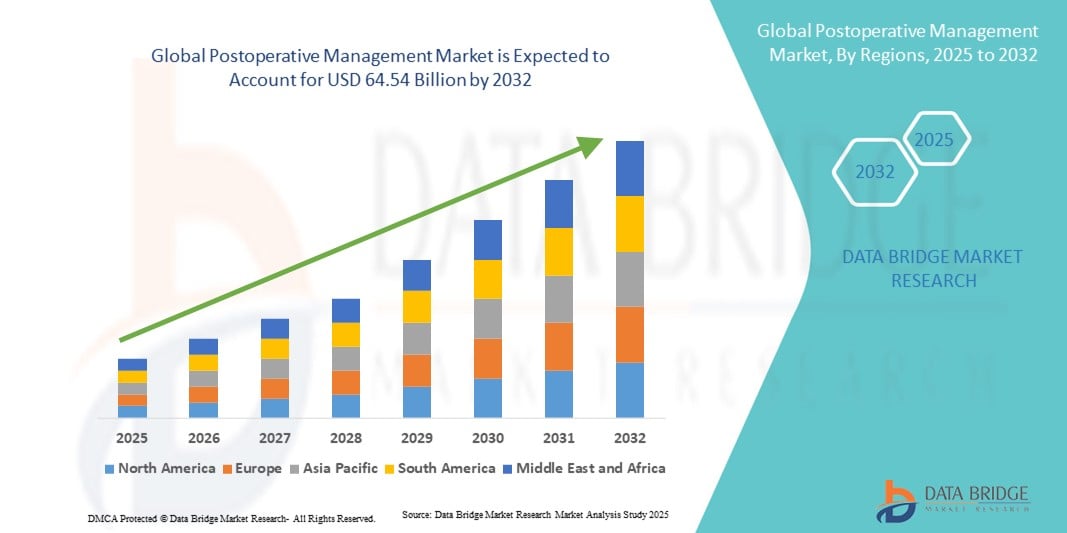
Postoperative Management Market Size
- The global postoperative management market size was valued at USD 40.01 billion in 2024 and is expected to reach USD 64.54 billion by 2032, at a CAGR of 6.16% during the forecast period
- The market growth is primarily driven by the rising prevalence of surgical procedures, increasing demand for enhanced patient recovery, and growing adoption of advanced postoperative monitoring and care solutions in hospitals and outpatient settings
- In addition, the emphasis on reducing post-surgical complications, improving patient outcomes, and integrating digital health technologies such as remote monitoring and automated pain management systems is propelling the adoption of postoperative management solutions, thereby significantly contributing to market expansion
Postoperative Management Market Analysis
- Postoperative management, encompassing patient monitoring, pain control, wound care, and rehabilitation after surgical procedures, is increasingly recognized as a critical component of healthcare delivery due to its role in reducing complications, enhancing recovery, and improving patient outcomes
- The rising demand for postoperative management solutions is primarily driven by the growing number of surgical procedures, increasing focus on patient-centered care, and integration of digital health technologies such as remote monitoring, automated pain management, and telehealth-enabled follow-ups
- North America dominated the postoperative management market with the largest revenue share of 39% in 2024, supported by advanced healthcare infrastructure, high adoption of digital health solutions, and a strong presence of key market players, with the U.S. witnessing significant deployment of smart postoperative monitoring systems in hospitals and ambulatory surgical centers
- Asia-Pacific is expected to be the fastest growing region in the postoperative management market during the forecast period due to expanding healthcare infrastructure, increasing healthcare expenditure, and rising awareness of advanced postoperative care solutions
- Pain segment dominated the postoperative management market with a market share of 42.8% in 2024, driven by the critical need to control postoperative pain, reduce complications, and improve patient satisfaction and recovery outcomes
Report Scope and Postoperative Management Market Segmentation
|
Attributes |
Postoperative Management Key Market Insights |
|
Segments Covered |
|
|
Countries Covered |
North America
Europe
Asia-Pacific
Middle East and Africa
South America
|
|
Key Market Players |
|
|
Market Opportunities |
|
|
Value Added Data Infosets |
In addition to the insights on market scenarios such as market value, growth rate, segmentation, geographical coverage, and major players, the market reports curated by the Data Bridge Market Research also include in-depth expert analysis, pricing analysis, brand share analysis, consumer survey, demography analysis, supply chain analysis, value chain analysis, raw material/consumables overview, vendor selection criteria, PESTLE Analysis, Porter Analysis, and regulatory framework. |
Postoperative Management Market Trends
Integration of Digital Health and AI-Enabled Monitoring
- A major trend in the global postoperative management market is the growing integration of digital health technologies and AI-driven monitoring systems, enabling continuous patient tracking, predictive alerts, and personalized care plans
- For instance, AI-enabled remote monitoring platforms can analyze vital signs and pain levels in real time, alerting healthcare providers to potential complications such as hemorrhage or hypoxia before they escalate. Similarly, some wearable devices allow patients to report pain or mobility status directly to care teams, facilitating timely interventions
- AI integration in postoperative management supports predictive analytics, allowing clinicians to anticipate post-surgical complications, optimize pain management regimens, and improve discharge planning. For instance, platforms such as VitalConnect and Medtronic’s remote monitoring tools use AI to detect abnormal trends in patient data, ensuring proactive care
- The seamless integration of postoperative management systems with hospital electronic health records (EHR) enables centralized control over patient care, from medication administration and wound monitoring to rehabilitation tracking, creating a more coordinated and efficient care pathway
- This trend toward intelligent, interconnected, and patient-centric postoperative management is reshaping expectations for recovery outcomes. Consequently, companies are increasingly developing AI-enabled platforms capable of remote monitoring, personalized care recommendations, and automated alerts to improve patient safety and satisfaction
- The demand for postoperative management solutions leveraging digital health and AI is growing rapidly as hospitals, outpatient centers, and home care services prioritize efficiency, early complication detection, and optimized patient recovery
Postoperative Management Market Dynamics
Driver
Rising Surgical Procedures and Focus on Patient-Centered Recovery
- The increasing volume of surgical procedures globally, along with heightened awareness of postoperative complications, is driving demand for advanced postoperative management solutions
- For instance, in 2024, major hospitals in North America and Europe expanded the use of AI-enabled remote monitoring and pain management systems to enhance recovery outcomes and reduce readmissions. Such initiatives are expected to continue fueling market growth
- Postoperative management solutions enable continuous monitoring of vital signs, pain levels, and wound healing, improving patient safety and satisfaction while reducing healthcare costs associated with complications
- Growing emphasis on patient-centered care, faster recovery, and reduced hospital stays is making digital and integrated postoperative management solutions essential for hospitals, surgical centers, and home care providers
- The adoption of mobile apps, wearable devices, and telehealth platforms to remotely manage pain, mobility, and recovery metrics further enhances the convenience and effectiveness of postoperative care
Restraint/Challenge
Data Privacy Concerns and High Implementation Costs
- Concerns regarding patient data privacy and cybersecurity present a significant challenge to the broader adoption of AI-enabled postoperative management systems, as these solutions often collect sensitive health information
- High-profile cases of healthcare data breaches, for instance, the 2023 ransomware attack on a U.S. hospital network that compromised patient monitoring data, have made some hospitals and patients cautious about implementing connected monitoring systems
- Companies such as Medtronic and Philips emphasize secure encryption, HIPAA compliance, and robust authentication protocols to mitigate these concerns
- In addition, the relatively high cost of advanced digital monitoring platforms, wearable devices, and AI-driven postoperative solutions can be a barrier for smaller hospitals, outpatient centers, and budget-conscious healthcare providers, particularly in developing regions
- While prices are gradually decreasing and scalable solutions are emerging, the perceived premium for integrated digital postoperative management solutions can hinder rapid adoption
- Addressing these challenges through enhanced cybersecurity, regulatory compliance, staff training, and cost-effective solutions will be critical for sustaining growth in the postoperative management market
Postoperative Management Market Scope
The market is segmented on the basis of indication, product type, application, and distribution channel.
- By Indication
On the basis of indication, the postoperative management market is segmented into airway obstruction, hypoxia, hemorrhage, hypotension, hypertension, pain, shivering, hypothermia, vomiting, aspiration, and residual narcosis. The pain segment dominated the market with the largest revenue share of 42.8% in 2024, as effective pain management is critical to patient recovery and overall satisfaction. Hospitals and surgical centers prioritize pain control to reduce post-surgical complications, minimize hospital stay durations, and enhance patient comfort. Opioids, NSAIDs, and multimodal therapy are widely used, reinforcing this segment’s strong market position. Patient-reported outcomes and regulatory focus on pain management protocols further drive the dominance of this segment. Moreover, innovations in patient-controlled analgesia (PCA) systems and digital monitoring are enhancing the effectiveness and adoption of pain management solutions.
Hypoxia is expected to witness the fastest growth from 2025 to 2032 due to the increasing need for advanced respiratory monitoring after surgery. Rising incidence of anesthesia-related complications and respiratory distress post-surgery necessitates continuous oxygen monitoring. Hospitals are adopting AI-enabled monitoring devices that detect drops in oxygen saturation and alert healthcare providers in real time. The growing emphasis on preventing life-threatening postoperative events, particularly in critical care and cardiac surgery units, is accelerating the adoption of hypoxia-focused management solutions. In addition, increasing awareness among patients and caregivers about respiratory complications is further propelling growth in this segment.
- By Product Type
On the basis of product type, the postoperative management market is segmented into opioids (fentanyl, morphine, meperidine), NSAIDs (paracetamol, ibuprofen, ketorolac tromethamine, celecoxib, etoricoxib, rofecoxib), glucocorticoids, local anesthetics, antidepressants, and others. The opioids segment dominated the market in 2024, driven by their widespread use in managing moderate-to-severe postoperative pain. Fentanyl and morphine are preferred for rapid onset and strong analgesic effects, particularly in oncology, orthopedic, and cardiovascular surgeries. Hospitals rely on opioids for immediate post-surgical pain relief, making them a core part of recovery protocols. Despite concerns about dependency, their clinical efficacy ensures continued high demand. Patient-controlled analgesia systems and hospital-based pain management programs further solidify opioids’ dominant position. Regulatory oversight and protocol-driven administration also maintain their widespread use in inpatient settings.
NSAIDs are projected to register the fastest growth from 2025 to 2032 due to increasing adoption of multimodal pain management strategies. These drugs provide effective pain relief while minimizing opioid dependence and related side effects. Growing awareness of enhanced recovery after surgery (ERAS) protocols is promoting NSAIDs for postoperative care. Drugs such as ibuprofen, ketorolac, and celecoxib are increasingly used in both inpatient and outpatient settings. Technological advancements in formulation, such as extended-release or combination therapies, further drive growth in this segment. Patients and clinicians are increasingly opting for NSAIDs for safer long-term pain management post-surgery.
- By Application
On the basis of application, the postoperative management market is segmented into cancer pain, arthritic pain, neuropathic pain, musculoskeletal pain, migraine, fibromyalgia, and others. Musculoskeletal pain dominated the market in 2024, driven by the high volume of orthopedic, joint replacement, and fracture-related surgeries globally. Postoperative management of musculoskeletal pain is critical to restoring mobility, reducing complications, and shortening recovery periods. Hospitals and rehabilitation centers prioritize targeted pain relief to enhance patient outcomes and improve satisfaction scores. Pharmacological interventions, combined with physiotherapy and digital monitoring, reinforce the importance of this segment. Aging populations and rising orthopedic surgical volumes further support dominance in revenue share. Hospitals increasingly integrate musculoskeletal pain management into broader enhanced recovery programs, driving consistent demand.
Neuropathic pain is expected to be the fastest growing segment from 2025 to 2032 due to the rising number of nerve-related surgeries in oncology, neurology, and spinal procedures. This type of pain often requires specialized medications such as antidepressants and anticonvulsants, making its management more complex. The adoption of personalized therapy plans, combined with digital monitoring of patient responses, supports segment growth. Growing awareness of post-surgical nerve complications is prompting clinicians to adopt proactive pain control strategies. Advances in targeted therapies and patient-centric recovery programs further accelerate the expansion of this segment.
- By Distribution Channel
On the basis of distribution channel, the postoperative management market is segmented into hospital pharmacies, retail pharmacies and drug stores, and e-commerce. Hospital pharmacies dominated the market in 2024 as most postoperative drugs are initially dispensed and monitored within inpatient settings. Hospitals provide controlled administration of opioids, NSAIDs, and other critical medications, ensuring compliance with safety and regulatory standards. The high concentration of surgical patients in hospitals ensures sustained demand for this channel. Hospital pharmacies also support integrated digital monitoring of drug administration, enhancing patient safety and outcomes. Their ability to manage high-volume dispensing and provide specialized counseling consolidates their dominant position. Partnerships with pharmaceutical companies for bulk supply and protocol-driven administration further strengthen this channel.
E-commerce is expected to witness the fastest growth from 2025 to 2032, fueled by the shift toward home-based postoperative care and outpatient recovery. Patients increasingly prefer online pharmacies for convenience, easy access to medications, and home delivery options. Digital platforms also offer cost advantages, subscription services, and wider product availability. Integration with telehealth and mobile apps allows patients to monitor prescriptions and receive reminders, enhancing adherence. Urbanization, rising internet penetration, and changing patient behavior toward self-managed recovery are driving rapid adoption. E-commerce is also enabling remote patient access in regions with limited physical pharmacy infrastructure, accelerating growth further.
Postoperative Management Market Regional Analysis
- North America dominated the postoperative management market with the largest revenue share of 39% in 2024, supported by advanced healthcare infrastructure, high adoption of digital health solutions, and a strong presence of key market players
- Hospitals and surgical centers in the region prioritize postoperative care to improve recovery outcomes, reduce complications, and enhance patient satisfaction, leading to widespread implementation of digital and AI-enabled monitoring systems
- This dominance is further supported by advanced healthcare infrastructure, high healthcare expenditure, and strong regulatory frameworks that encourage the adoption of innovative postoperative management technologies
U.S. Postoperative Management Market Insight
The U.S. postoperative management market captured the largest revenue share of 82% in 2024 within North America, driven by the high volume of surgical procedures and the increasing adoption of advanced patient monitoring and pain management solutions. Hospitals and outpatient centers are prioritizing digital and AI-enabled systems to improve recovery outcomes, reduce complications, and enhance patient satisfaction. The growing preference for remote monitoring, patient-controlled analgesia, and telehealth-enabled postoperative care is further propelling market growth. Moreover, robust healthcare infrastructure, high expenditure on healthcare technology, and strong focus on patient-centered care continue to support market expansion.
Europe Postoperative Management Market Insight
The Europe postoperative management market is projected to expand at a substantial CAGR during the forecast period, primarily driven by the rising number of surgical procedures and stringent regulatory guidelines emphasizing patient safety and effective postoperative care. Increasing urbanization and the growing adoption of connected healthcare devices are fostering market growth. European healthcare providers are increasingly implementing digital monitoring, automated pain management, and remote follow-up systems. The demand is strong across hospitals, surgical centers, and home care applications, with advanced postoperative solutions being incorporated into both new and existing healthcare setups.
U.K. Postoperative Management Market Insight
The U.K. postoperative management market is anticipated to grow at a noteworthy CAGR during the forecast period, fueled by the rising trend of home-based recovery programs and outpatient surgical procedures. Concerns about postoperative complications, patient safety, and improving recovery times are encouraging healthcare providers to adopt advanced monitoring and pain management solutions. The U.K.’s robust healthcare infrastructure, combined with increasing integration of telehealth platforms and digital devices, is expected to sustain market growth. In addition, patient awareness and preference for technologically advanced recovery solutions are driving adoption in both hospital and home care settings.
Germany Postoperative Management Market Insight
The Germany postoperative management market is expected to expand at a considerable CAGR during the forecast period, supported by strong healthcare infrastructure and the emphasis on innovation in clinical care. Growing awareness of postoperative complications and the need for continuous patient monitoring are encouraging hospitals to adopt AI-enabled systems and digital health platforms. Integration of postoperative management solutions with hospital information systems is increasing efficiency, patient safety, and recovery outcomes. Demand is growing across hospitals, surgical centers, and rehabilitation facilities, particularly for solutions that provide real-time monitoring and predictive analytics for high-risk patients.
Asia-Pacific Postoperative Management Market Insight
The Asia-Pacific postoperative management market is poised to grow at the fastest CAGR of 25% during the forecast period of 2025 to 2032, driven by increasing surgical volumes, rising healthcare expenditure, and growing awareness of advanced postoperative care. Countries such as China, Japan, and India are witnessing rapid adoption of remote monitoring, AI-enabled patient care, and telehealth solutions. The region’s expanding healthcare infrastructure, coupled with government initiatives promoting digital health and smart hospitals, is accelerating market growth. Affordability, accessibility, and rising patient awareness about improved recovery outcomes are also contributing to the rapid adoption of postoperative management solutions.
Japan Postoperative Management Market Insight
The Japan postoperative management market is gaining momentum due to the country’s advanced healthcare infrastructure, high-tech adoption, and aging population, which demands enhanced postoperative care. Hospitals and outpatient centers are increasingly implementing AI-based monitoring and digital pain management systems to improve recovery outcomes and reduce readmissions. Integration with IoT devices for remote monitoring, along with patient-centered care initiatives, is driving adoption. The growing number of minimally invasive and outpatient surgeries further supports market growth across residential, hospital, and rehabilitation settings.
India Postoperative Management Market Insight
The India postoperative management market accounted for the largest revenue share in Asia-Pacific in 2024, attributed to rapid urbanization, expanding healthcare infrastructure, and rising surgical procedures. Increasing awareness of postoperative complications and the adoption of digital health technologies, including telehealth and remote monitoring, are driving market growth. The government’s push toward smart hospitals and affordable healthcare solutions is further propelling adoption. Hospitals, surgical centers, and home care providers are increasingly implementing advanced pain management, wound care, and monitoring solutions. The growing middle class, improving healthcare access, and a strong domestic manufacturing base for medical devices support market expansion in India.
Postoperative Management Market Share
The postoperative management industry is primarily led by well-established companies, including:
- AbbVie Inc (U.S.)
- Johnson & Johnson and its affiliates (U.S.)
- Pfizer Inc (U.S.)
- AstraZeneca (U.K.)
- Merck & Co., Inc. (U.S.)
- Fresenius SE & Co. KGaA (Germany)
- Baxter (U.S.)
- Deltex Medical Group (U.K.)
- Carenet Health (U.S.)
- XENCO MEDICAL (U.S.)
- SeamlessMD. (Canada)
- Qventus (U.S.)
- Pip Care (U.S.)
- FluidAI Medical (U.S.)
- Spirecut (U.S.)
- Bedal International (U.S.)
- CircuCare (U.S.)
- AkknaTe (U.S.)
- MD Biomedical AB (Sweden)
- Buddy Healthcare Ltd Oy. (Finland)
What are the Recent Developments in Global Postoperative Management Market?
- In August 2025, Medbridge introduced "Surgical Pathways," a digital musculoskeletal and movement-based medicine platform designed to streamline postoperative rehabilitation. This initiative aims to enhance patient recovery through evidence-based protocols and remote monitoring, integrating physical therapy with surgical recovery processes
- In June 2025, Universal Health Services (UHS) partnered with Hippocratic AI to deploy generative AI agents that assist clinicians in conducting post-discharge follow-up calls. Initially launched in two UHS subsidiaries, this program aims to improve patient engagement and reduce readmission rates through automated, personalized outreach
- In May 2025, OYE Therapeutics Inc. announced a research collaboration with Purdue University to evaluate the safety and efficacy of a novel intravenous caffeine formulation aimed at accelerating recovery from general anesthesia. This partnership seeks to enhance postoperative recovery times and improve patient outcomes
- In January 2025, Qventus unveiled its Perioperative Care Coordination (PCC) solution, which utilizes AI assistants to support pre-admission testing nurses. The system aids in tracking patient records, coordinating phone calls, and identifying relevant risks and clearances, thereby reducing administrative burdens and optimizing patient care
- In January 2025, SeamlessMD launched a new Follow-Up Module designed to streamline postoperative care by enabling secure, direct communication between care teams and patients. This tool allows for one-way or two-way messaging, facilitating quicker responses to patient concerns and reducing the need for phone calls. Early adopters have reported significant time savings and improved patient outcomes

- Interactive Data Analysis Dashboard
- Company Analysis Dashboard for high growth potential opportunities
- Research Analyst Access for customization & queries
- Competitor Analysis with Interactive dashboard
- Latest News, Updates & Trend analysis
- Harness the Power of Benchmark Analysis for Comprehensive Competitor Tracking
Data collection and base year analysis are done using data collection modules with large sample sizes. The stage includes obtaining market information or related data through various sources and strategies. It includes examining and planning all the data acquired from the past in advance. It likewise envelops the examination of information inconsistencies seen across different information sources. The market data is analysed and estimated using market statistical and coherent models. Also, market share analysis and key trend analysis are the major success factors in the market report. To know more, please request an analyst call or drop down your inquiry.
The key research methodology used by DBMR research team is data triangulation which involves data mining, analysis of the impact of data variables on the market and primary (industry expert) validation. Data models include Vendor Positioning Grid, Market Time Line Analysis, Market Overview and Guide, Company Positioning Grid, Patent Analysis, Pricing Analysis, Company Market Share Analysis, Standards of Measurement, Global versus Regional and Vendor Share Analysis. To know more about the research methodology, drop in an inquiry to speak to our industry experts.
Data Bridge Market Research is a leader in advanced formative research. We take pride in servicing our existing and new customers with data and analysis that match and suits their goal. The report can be customized to include price trend analysis of target brands understanding the market for additional countries (ask for the list of countries), clinical trial results data, literature review, refurbished market and product base analysis. Market analysis of target competitors can be analyzed from technology-based analysis to market portfolio strategies. We can add as many competitors that you require data about in the format and data style you are looking for. Our team of analysts can also provide you data in crude raw excel files pivot tables (Fact book) or can assist you in creating presentations from the data sets available in the report.













