What is the Potash Solubilizing and Mobilizing Market Size and Growth Rate?
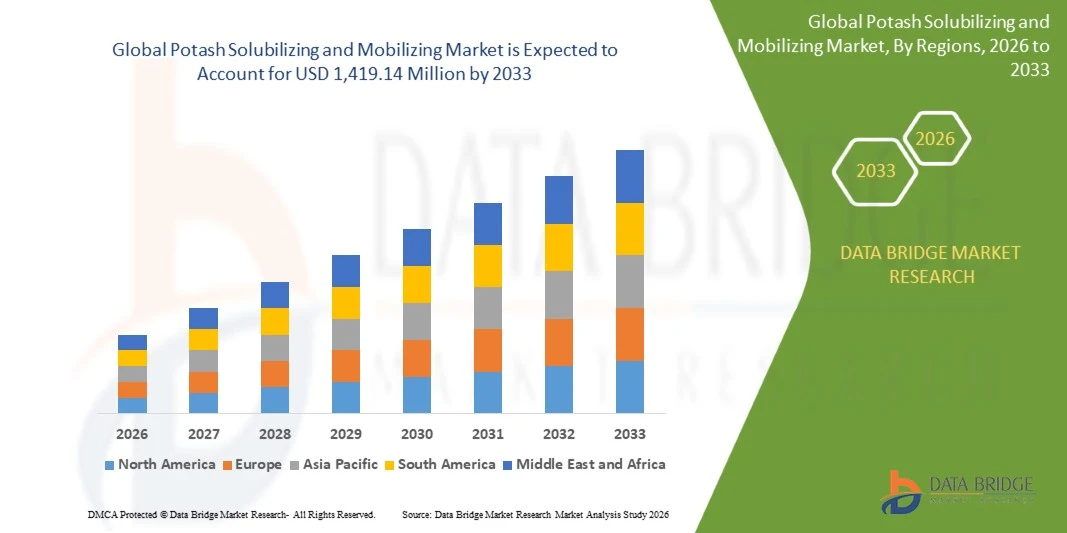
- As per Data Bridge Market Research analysis, the potash solubilizing and mobilizing market was valued at USD 585.60 million in 2025 and is projected to reach USD 1,419.14 million by 2033, growing at a CAGR of 11.7% from 2026 to 2033.
- The market is experiencing consistent growth driven by rising demand for sustainable agricultural inputs, increasing adoption of microbial biofertilizers, and growing emphasis on improving soil fertility and potassium availability. Potash-solubilizing and mobilizing microorganisms help release potassium from insoluble mineral forms, supporting nutrient uptake and more efficient crop production.
- The increasing need to improve agricultural productivity, maintain soil health, and optimize fertilizer use is encouraging farmers to adopt biological nutrient-management solutions. Potassium-solubilizing microorganisms are gaining attention as a complement to conventional fertilizers because they help mobilize soil-bound potassium, improve nutrient availability in the root zone, and support sustainable crop production while reducing dependence on exclusively chemical-based nutrient-management practices
Market Size & Forecast
- Global Market Value (2025): USD 585.60 Million
- Expected Market Value (2033): USD 1,419.14 Million
- Forecast CAGR (2026–2033): 11.7%
- Leading Region in 2025: North America
- Fastest Growing Region: Asia Pacific
What are the Major Takeaways of the Potash Solubilizing and Mobilizing Market?
- North America dominated the potash solubilizing and mobilizing market with the largest revenue share of 33.5% in 2025, supported by advanced agricultural practices, established biological crop-input industries, and increasing adoption of sustainable farming solutions
- Asia-Pacific is expected to be the fastest-growing region at a CAGR of 14% from 2026 to 2033, fueled by extensive agricultural activity and growing adoption of biofertilizers in India and China.
- The cereals and grains segment led the market with a 38.5% share in 2025, driven by extensive cultivation of rice, wheat, maize, and other staple crops that require adequate potassium for growth and yield development.
- Fruits and vegetables are the fastest-growing crop type, projected to register a CAGR of 12.4%, reflecting the surge in demand for high-quality horticultural produce and improved nutrient-management practices.
- The soil treatment segment dominated the mode of application category with a 42.5% revenue share in 2025, led by direct application of microbial formulations to agricultural soils to improve potassium availability.
- Carrier-based biofertilizer accounted for 56.5% of the market share in 2025, preferred by the established use of solid microbial formulations in agricultural nutrient management.
- The azospirillum is the fastest-growing microorganism category, with a CAGR of 13.5%, driven by its established use in plant-growth-promoting microbial products.
Report Scope and Potash Solubilizing and Mobilizing Market Segmentation
|
Attributes |
Potash Solubilizing and Mobilizing Key Market Insights |
|
Segments Covered |
|
|
Countries Covered |
North America
Europe
Asia-Pacific
Middle East and Africa
South America
|
|
Key Market Players |
|
|
Market Opportunities |
|
|
Value Added Data Infosets |
In addition to the insights on market scenarios such as market value, growth rate, segmentation, geographical coverage, and major players, the market reports curated by the Data Bridge Market Research also include import export analysis, production capacity overview, production consumption analysis, price trend analysis, climate change scenario, supply chain analysis, value chain analysis, raw material/consumables overview, vendor selection criteria, PESTLE Analysis, Porter Analysis, and regulatory framework. |
What is the Key Trend in the Potash Solubilizing and Mobilizing Market?
- Agricultural input manufacturers are increasingly developing microbial formulations that improve potassium availability by solubilizing insoluble mineral compounds, supporting nutrient-use efficiency and sustainable crop production.
- For instance, in June 2025, researchers published a study in BMC Plant Biology identifying highly efficient potassium-solubilizing bacterial strains that increased potassium release from feldspar by up to 55.1% under laboratory conditions, highlighting advances in microbial formulations for improving nutrient availability and crop growth.
- Microbial formulations are being designed to mobilize soil-bound potassium and improve nutrient uptake, helping crops access nutrients that may otherwise remain unavailable in the soil.
- Agricultural biotechnology researchers are investigating microbial combinations that solubilize multiple soil minerals, creating potential for broader nutrient-management applications across different crops.
- For instance, in November 2025, researchers at Can Tho University in Vietnam demonstrated that liquid potassium-solubilizing purple nonsulfur bacteria increased available soil potassium and improved hybrid maize yields from 11.1 to 12.2–12.6 tonnes per hectare, highlighting the potential of microbial solutions to improve potassium mobilization and fertilizer-use efficiency.
- As farmers and agricultural input companies increasingly prioritize soil fertility and efficient nutrient utilization, advances in microbial strains and formulations are expected to strengthen the role of potash-solubilizing and mobilizing products in sustainable crop nutrition.
What are the Key Drivers of the Potash Solubilizing and Mobilizing Market?
- The growing demand for sustainable crop nutrition and improved fertilizer-use efficiency has increased interest in potassium-solubilizing microorganisms that release soil-bound potassium and support crop growth.
- For instance, in October 2024, the Indian Journal of Agricultural Sciences published research on integrating potassium-solubilizing bacteria with potassium fertilization in pearl millet, reporting yield improvements of 26.7% and 24% across two growing seasons compared with the control, highlighting the potential of microbial biofertilizers to improve crop productivity and potassium-use efficiency.
- Farmers and agricultural input manufacturers are increasingly exploring microbial biofertilizers to complement conventional fertilizers, improve nutrient uptake, and maintain soil productivity across diverse cropping systems.
- For instance, in August 2023, Frontiers in Microbiology published research demonstrating that potassium-solubilizing bacterial consortia improved potassium uptake and salt tolerance in rice grown under saline-sodic conditions, increasing the root potassium-to-sodium ratio by 200% at 40 mM salinity in the Shaheen rice variety, highlighting the potential of microbial inoculants to improve nutrient uptake under soil stress.
- With increasing emphasis on sustainable agriculture and biological nutrient management, potash-solubilizing and mobilizing products are gaining attention as complementary inputs for improving potassium availability and supporting long-term soil fertility.
What Factors are Challenging the Growth of the Potash Solubilizing and Mobilizing Market?
- Microbial biofertilizers face formulation and storage challenges because beneficial microorganisms must remain viable and effective throughout manufacturing, transportation, storage, and field application.
- For instance, in September 2024, the Journal of Sustainable Agriculture and Environment published a review identifying inconsistent field performance, short shelf life, high manufacturing costs, and inadequate formulation technologies as major barriers to microbial biofertilizer commercialization, highlighting challenges that can restrict the adoption of potash-solubilizing and mobilizing products.
- These limitations can reduce product consistency and farmer confidence, particularly when microbial performance varies across soil types, climatic conditions, and agricultural practices.
- Maintaining viable microbial populations requires suitable carrier materials, quality-control procedures, and storage conditions, increasing production complexity and potentially raising costs for manufacturers.
- For instance, in May 2021, IOP Conference Series: Earth and Environmental Science published research on potassium-solubilizing rhizobacteria formulated with potassium feldspar and organic carrier materials, finding that microbial viability varied substantially by formulation, demonstrating the technical challenges of maintaining product stability and shelf life during storage.
- These technical and commercial barriers continue to challenge the widespread adoption of potash-solubilizing and mobilizing products, particularly where farmers have limited awareness of microbial inputs or require consistent results across different growing environments.
How is the Potash Solubilizing and Mobilizing Market Segmented?
The potash solubilizing and mobilizing market is segmented on the basis of crop type, mode of application, form, and microorganism.
- By Crop Type
On the basis of crop type, the potash solubilizing and mobilizing market is segmented into cereals and grains, pulses and oilseeds, fruits and vegetables, and others. The cereals and grains segment dominated the market with an estimated 38.5% share in 2025, owing to extensive cultivation of rice, wheat, maize, and other staple crops that require adequate potassium for growth and yield development. Potassium-solubilizing microorganisms help release soil-bound potassium into plant-available forms, supporting nutrient uptake and crop productivity. Increasing demand for food production and efficient fertilizer utilization is encouraging farmers to explore microbial biofertilizers. These products can complement conventional potassium fertilizers and support soil fertility management. Large cultivated areas under cereal crops further contribute to demand for microbial nutrient solutions.
The fruits and vegetables segment is projected to register the fastest growth at an estimated CAGR of 12.4% from 2026 to 2033, supported by increasing demand for high-quality horticultural produce and improved nutrient-management practices. Potassium plays an important role in fruit development, sugar accumulation, water regulation, and produce quality. Potassium-solubilizing microorganisms can improve potassium availability around plant roots and support nutrient absorption. Expanding greenhouse cultivation, protected farming, and commercial horticulture is creating opportunities for specialized microbial formulations. Increasing consumer demand for quality produce is encouraging growers to adopt more efficient nutrient-management strategies. The integration of microbial products with fertigation and other modern farming practices may further support segment growth.
- By Mode of Application
On the basis of mode of application, the potash solubilizing and mobilizing market is segmented into soil treatment, seed treatment, and others. The soil treatment segment dominated the market with an estimated 42.5% share in 2025, driven by the direct application of microbial formulations to agricultural soils to improve potassium availability. These products support the conversion of insoluble potassium compounds into forms that plant roots can absorb. Soil application allows microorganisms to establish themselves in the root zone, where they can interact with soil minerals and plant roots. Farmers can incorporate microbial products into existing soil preparation and fertilizer application practices. Growing interest in improving soil fertility and nutrient-use efficiency is supporting this application method.
The seed treatment segment is projected to register the fastest growth at an estimated CAGR of 12.8% from 2026 to 2033, supported by increasing interest in targeted microbial delivery and early-stage crop establishment. Seed treatment allows beneficial microorganisms to be applied directly to seeds before planting, positioning them near emerging roots. This approach can support early root development and improve access to soil nutrients, including potassium. The relatively small quantity of product required per seed can make the application method attractive for commercial farming operations. Increasing adoption of biological seed treatments and integrated crop management practices is also supporting interest in this segment. Improvements in microbial coating technologies and formulation stability may further encourage adoption.
- By Form
On the basis of form, the potash solubilizing and mobilizing market is segmented into carrier-based biofertilizer and liquid formulations. The carrier-based biofertilizer segment dominated the market with an estimated 56.5% share in 2025, supported by the established use of solid microbial formulations in agricultural nutrient management. These products use suitable carrier materials to support microbial survival and facilitate handling, storage, and application. Carrier-based formulations can be incorporated into soil or applied through established agricultural practices, depending on product specifications. Their compatibility with conventional farming operations makes them accessible to a broad range of growers. Established manufacturing processes and distribution channels also support their availability in agricultural markets.
The liquid segment is projected to register the fastest growth at an estimated CAGR of 13.1% from 2026 to 2033, driven by ease of application, convenient mixing, and compatibility with modern agricultural practices. Liquid microbial formulations can be applied through suitable spraying, soil-drenching, and fertigation systems when product specifications permit. They can support uniform distribution of beneficial microorganisms across treated areas. Growing adoption of precision agriculture and mechanized crop management is creating opportunities for liquid biological inputs. Improvements in stabilizers, formulation technologies, and packaging are helping manufacturers address microbial viability challenges. Demand for convenient application methods among commercial growers may further support this segment. Nevertheless, shelf life and storage requirements vary according to the microorganisms and formulation used.
- By Microorganism
On the basis of microorganism, the potash solubilizing and mobilizing market is segmented into Rhizobium, Azotobacter, Azospirillum, cyanobacteria, and phosphate-solubilizing microorganisms. The Azotobacter segment dominated the market with an estimated 27.5% share in 2025, supported by the established use of free-living beneficial bacteria in biological nutrient management. Certain strains contribute to plant growth through nitrogen fixation and the production of growth-promoting substances, while selected strains may also contribute to potassium mobilization. Their potential use in integrated microbial formulations makes them relevant to sustainable agriculture. Interest in reducing reliance on exclusively chemical-based nutrient inputs is supporting research into multifunctional microorganisms. Product performance depends on the strain, formulation, crop, and soil conditions.
The Azospirillum segment is projected to register the fastest growth at an estimated CAGR of 13.5% from 2026 to 2033, supported by its established use in plant-growth-promoting microbial products. Certain Azospirillum strains can promote root development and improve nutrient acquisition, potentially supporting the uptake of potassium and other nutrients. Their use in biological crop-input formulations is attracting attention among growers seeking to improve fertilizer-use efficiency. Research into microbial consortia is also creating opportunities to combine complementary plant-growth-promoting functions. Integration with existing fertilizer programs may help improve crop nutrient management when strains are compatible with the application system. However, the ability to solubilize or mobilize potassium varies by strain and should not be assumed for every Azospirillum product.
Which Region Holds the Largest Share of the Potash Solubilizing and Mobilizing Market?
- North America dominated the potash solubilizing and mobilizing market with the largest revenue share of 33.5% in 2025, supported by advanced agricultural practices, established biological crop-input industries, and increasing adoption of sustainable farming solutions
- The region also benefits from advancements in agricultural biotechnology, expanding precision farming practices, and growing interest in improving potassium availability and fertilizer-use efficiency. Increasing focus on sustainable crop production, soil fertility enhancement, and environmentally responsible farming practices continues to support North America's position in the global market.
U.S. Potash Solubilizing and Mobilizing Market Insight
The U.S. potash solubilizing and mobilizing market is witnessing steady growth due to rising demand for efficient potassium fertilizers, sustainable agricultural practices, and improved nutrient-use efficiency. The country’s advanced agricultural sector, along with increasing adoption of microbial biofertilizers and precision farming technologies, is driving demand across commercial farming and horticultural applications. In addition, growing emphasis on soil health, reducing dependence on conventional chemical fertilizers, and improving crop productivity is accelerating the adoption of potash-solubilizing and mobilizing solutions.
Asia-Pacific Potash Solubilizing and Mobilizing Market Insight
The Asia-Pacific potash solubilizing and mobilizing market is expected to witness rapid growth, driven by expanding agricultural production, increasing awareness of soil fertility management, and rising investments in sustainable farming practices across countries such as China, India, and Japan. Growing awareness regarding microbial fertilizers, rising demand for cost-effective crop nutrition solutions, and increasing government support for biofertilizers are supporting regional market expansion. In addition, the growing adoption of organic farming and integrated nutrient management practices is accelerating the use of potash-solubilizing and mobilizing products across agricultural sectors.
Japan Potash Solubilizing and Mobilizing Market Insight
The Japan potash solubilizing and mobilizing market is witnessing consistent growth due to rising investments in sustainable agriculture, advanced crop nutrition technologies, and soil fertility improvement initiatives. Farmers, agricultural cooperatives, and research institutions are increasingly exploring microbial biofertilizers to improve potassium availability, enhance nutrient absorption, and support crop productivity. Moreover, increasing interest in environmentally friendly agricultural inputs and the country's focus on resource-efficient farming practices are further contributing to market growth.
China Potash Solubilizing and Mobilizing Market Insight
The China potash solubilizing and mobilizing market is growing rapidly, driven by increasing demand for agricultural productivity, declining soil fertility in cultivated areas, and rising government focus on sustainable fertilizer use. Growing adoption of microbial fertilizers and biological soil amendments across commercial farming and horticultural applications is supporting market demand. In addition, rising investments in agricultural biotechnology, increasing awareness of balanced nutrient management, and efforts to improve fertilizer-use efficiency are positioning China as an important growth market for potash-solubilizing and mobilizing solutions.
U.K. Potash Solubilizing and Mobilizing Market Insight
The U.K. potash solubilizing and mobilizing market is experiencing steady growth, supported by rising adoption of sustainable agricultural inputs, soil health management practices, and biological crop nutrition solutions. Increasing interest in reducing reliance on conventional fertilizers and improving nutrient availability in agricultural soils is contributing to market growth. Furthermore, advancements in microbial formulations and growing emphasis on regenerative farming and environmentally responsible agricultural practices are supporting the adoption of potash-solubilizing and mobilizing products across the U.K. agricultural sector.
Germany Potash Solubilizing and Mobilizing Market Insight
The Germany potash solubilizing and mobilizing market is expanding steadily due to the country's strong agricultural research capabilities, increasing focus on sustainable crop production, and growing adoption of biological fertilizer technologies. Farmers, agricultural input suppliers, and research institutions are increasingly exploring microbial solutions to improve potassium availability, enhance soil fertility, and support efficient nutrient management. Continuous advancements in agricultural biotechnology, growing interest in reducing fertilizer-related environmental impacts, and strong emphasis on sustainable farming practices are further driving market growth in Germany.
Which are the Top Companies in Potash Solubilizing and Mobilizing Market?
The potash solubilizing and mobilizing industry is primarily led by well-established companies, including:
- T. Stanes and Company Limited (India)
- KAN BIOSYS PRIVATE LIMITED (India)
- Varsha Bioscience and Technology India Pvt. Ltd. (India)
- Biotech International Limited (India)
- Gujarat State Fertilizers & Chemicals Limited (India)
- Coromandel International Limited (India)
- National Fertilizers Limited (India)
- Rashtriya Chemicals and Fertilizers Limited (India)
- UPL Limited (India)
- SOM Phytopharma India Limited (India)
- Biostadt India Limited (India)
- Sikko Industries Limited (India)
- Lallemand Inc. (Canada)
- Koppert B.V. (Netherlands)
- Mapleton Agri Biotech Pty Ltd (Australia)
- Rizobacter Argentina S.A. (Argentina)
- Futureco Bioscience S.A. (Spain)
- Kiwa Bio-Tech Products Group Corporation (U.S.)
- BioWorks, Inc. (U.S.)
- Novonesis A/S (Denmark)
What are Latest Developments in Potash Solubilizing and Mobilizing Market?
- In April 2025, researchers published a study on mica-based potassium-mobilizing bacterial biofertilizers, investigating the potential of potassium-bearing minerals such as muscovite and biotite as alternative nutrient sources. The research evaluated bacterial strains for their ability to release potassium from these minerals and support tomato plant growth. This development highlights ongoing efforts to improve the use of naturally occurring mineral resources through microbial technologies and advance sustainable potassium nutrition in agriculture.
- In August 2024, researchers published a study on phosphorus-, potassium-, and silicon-solubilizing bacteria in Chemical and Biological Technologies in Agriculture. The researchers isolated six bacterial strains from forest soils and investigated their ability to mobilize essential nutrients from soil minerals. The study demonstrated the potential of these microorganisms to improve nutrient availability and promote rice seedling growth, highlighting opportunities for developing multifunctional microbial biofertilizers that support soil fertility and more efficient crop nutrition
- In October 2023, Bionema Group launched RootVita, a biostimulant product designed for agricultural, horticultural, forestry, and turf applications. The formulation combines biofertilizers, plant growth-promoting rhizobacteria, essential nutrients, prebiotics, and vitamins. Its functions include potash mobilization, phosphorus and silica solubilization, and micronutrient assimilation, helping plants access nutrients and improve resilience to environmental stress. The launch highlighted the growing integration of microbial technologies into sustainable crop nutrition solutions.
- In July 2023, the Indian Council of Agricultural Research (ICAR) highlighted the development of potassium-solubilizing biofertilizers under its Soil Biodiversity–Biofertilizers research program. The initiative included improved microbial strains, longer-shelf-life liquid formulations, and biofertilizer consortia designed for different crops and soil types. These developments support the conversion of less-available soil potassium into forms accessible to plants and strengthen efforts to improve nutrient-use efficiency and promote sustainable agricultural practices.
- In April 2022, researchers published a study on isolating potassium-solubilizing bacteria and developing liquid microbial fertilizer from food-processing wastewater in Biochemical Engineering Journal. The research identified efficient potassium-solubilizing bacterial strains and investigated the use of food wastewater as a medium for producing microbial fertilizer. The resulting formulation improved available soil potassium and supported the growth of pakchoi plants. This development demonstrated the potential to combine microbial fertilizer production with waste valorization and resource-efficient agricultural nutrient management
- Interactive Data Analysis Dashboard
- Company Analysis Dashboard for high growth potential opportunities
- Research Analyst Access for customization & queries
- Competitor Analysis with Interactive dashboard
- Latest News, Updates & Trend analysis
- Harness the Power of Benchmark Analysis for Comprehensive Competitor Tracking
Data collection and base year analysis are done using data collection modules with large sample sizes. The stage includes obtaining market information or related data through various sources and strategies. It includes examining and planning all the data acquired from the past in advance. It likewise envelops the examination of information inconsistencies seen across different information sources. The market data is analysed and estimated using market statistical and coherent models. Also, market share analysis and key trend analysis are the major success factors in the market report. To know more, please request an analyst call or drop down your inquiry.
The key research methodology used by DBMR research team is data triangulation which involves data mining, analysis of the impact of data variables on the market and primary (industry expert) validation. Data models include Vendor Positioning Grid, Market Time Line Analysis, Market Overview and Guide, Company Positioning Grid, Patent Analysis, Pricing Analysis, Company Market Share Analysis, Standards of Measurement, Global versus Regional and Vendor Share Analysis. To know more about the research methodology, drop in an inquiry to speak to our industry experts.
Data Bridge Market Research is a leader in advanced formative research. We take pride in servicing our existing and new customers with data and analysis that match and suits their goal. The report can be customized to include price trend analysis of target brands understanding the market for additional countries (ask for the list of countries), clinical trial results data, literature review, refurbished market and product base analysis. Market analysis of target competitors can be analyzed from technology-based analysis to market portfolio strategies. We can add as many competitors that you require data about in the format and data style you are looking for. Our team of analysts can also provide you data in crude raw excel files pivot tables (Fact book) or can assist you in creating presentations from the data sets available in the report.