What is the Potassium Nitrate Foliar Fertilizer Market Size and Growth Rate?
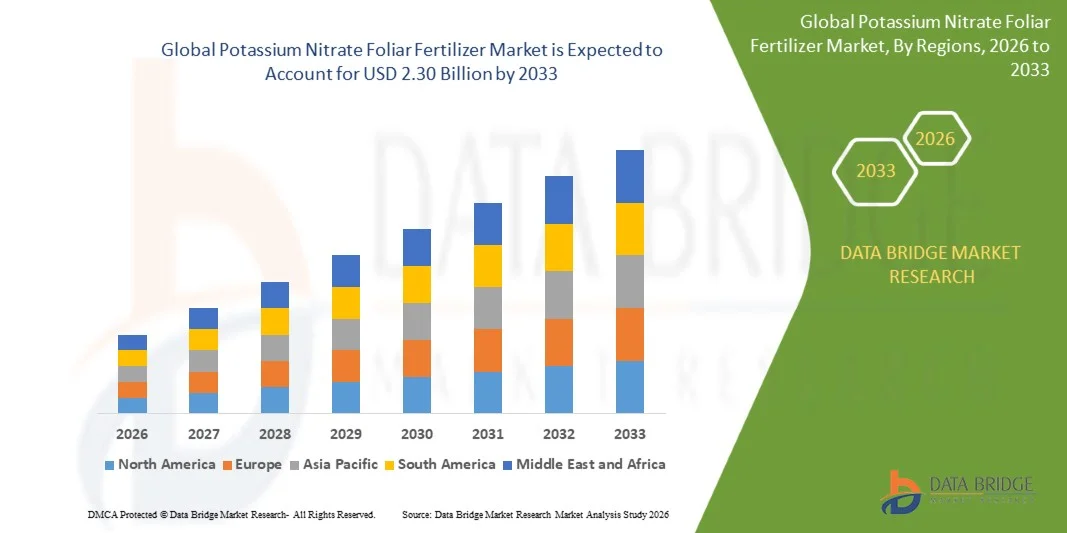
- As per Data Bridge Market Research analysis, the potassium nitrate foliar fertilizer market was valued at USD 1.48 billion in 2025 and is projected to reach USD 2.30 billion by 2033, growing at a CAGR of 5.70% from 2026 to 2033.
- The market is experiencing consistent growth driven by increasing demand for efficient crop nutrition, rising adoption of foliar application techniques, and the growing use of potassium nitrate for improving crop growth, yield, fruit quality, and nutrient uptake.
- The increasing focus on precision agriculture and sustainable farming practices, combined with the need for efficient nutrient management, is encouraging farmers to adopt potassium nitrate foliar fertilizers across agricultural and horticultural crops. The increasing focus on crop productivity and efficient nutrient management, combined with the demonstrated benefits of foliar potassium nitrate application across different crops, is supporting market adoption. Research studies have also evaluated foliar potassium nitrate applications for improving growth and yield in crops including rice and sunflower.
Market Size & Forecast
- Global Market Value (2025): USD 1.48 Billion
- Expected Market Value (2033): USD 2.30 Billion
- Forecast CAGR (2026–2033): 5.70%
- Leading Region in 2025: Asia Pacific
- Fastest Growing Region: North Ameica
What are the Major Takeaways of the Potassium Nitrate Foliar Fertilizer Market?
- Asia-Pacific dominated the potassium nitrate foliar fertilizer market with a 33.78% revenue share in 2025, supported by expanding agricultural production, rising food demand, government initiatives, and increasing adoption of advanced fertilization methods.
- North America is expected to be the fastest-growing region at a CAGR of 5.0% from 2026 to 2033, fueled by increasing adoption of precision agriculture, advanced nutrient management practices, specialty fertilizers, and growing demand for efficient crop nutrition solutions.
- The liquid segment led the market with a 43% share in 2025, driven by its ease of application, rapid nutrient uptake, and compatibility with modern spraying equipment.
- Powder is the fastest-growing product type, projected to register a CAGR of 6.0%, reflecting the surge in storage stability, ease of transportation, cost-effectiveness, and flexible dosing.
- The cereals & grains segment dominated the application category with a 38% revenue share in 2025, led by the extensive cultivation of rice, wheat, maize, and other staple crops
- Field crops accounted for 52% of the market share in 2025, preferred by the extensive cultivation of cereals, grains, oilseeds, pulses, and other agricultural crops.
- The horticultural crops segment is the fastest-growing crop type category, with a CAGR of 6.4%, driven by expanding fruit and vegetable production and increasing demand for specialized crop nutrition.
Report Scope and Potassium Nitrate Foliar Fertilizer Market Segmentation
|
Attributes |
Potassium Nitrate Foliar Fertilizer Key Market Insights |
|
Segments Covered |
|
|
Countries Covered |
North America
Europe
Asia-Pacific
Middle East and Africa
South America
|
|
Key Market Players |
|
|
Market Opportunities |
|
|
Value Added Data Infosets |
In addition to the insights on market scenarios such as market value, growth rate, segmentation, geographical coverage, and major players, the market reports curated by the Data Bridge Market Research also include import export analysis, production capacity overview, production consumption analysis, price trend analysis, climate change scenario, supply chain analysis, value chain analysis, raw material/consumables overview, vendor selection criteria, PESTLE Analysis, Porter Analysis, and regulatory framework. |
What is the Key Trend in the Potassium Nitrate Foliar Fertilizer Market?
- Farmers are increasingly adopting foliar potassium nitrate application as a targeted nutrient-management practice to improve crop yield, grain filling, fruit quality, and nutrient uptake while supplying nitrogen and potassium directly through plant foliage.
- For instance, in December 2021, a study published in the Agricultural Research Journal found that foliar application of 1.5% potassium nitrate at the boot stage increased rice grain yield by 3.2–4.1 q/ha across different genotypes and improved net returns by USD 50.5–85.7/ha, supporting the growing use of crop-stage-specific foliar nutrition.
- Research is increasingly focusing on crop-stage-specific foliar application, with potassium nitrate concentrations and application timing being evaluated to maximize nutrient utilization and yield performance.
- Fruit and horticultural producers are also using foliar potassium nitrate to target fruit size, yield, soluble solids, and overall crop quality, expanding its use beyond conventional field crops.
- For instance, in June 2021, research published in Plants found that potassium nitrate was the most effective potassium source among the tested foliar treatments for improving ‘Canino’ apricot fruit yield and preharvest quality, while also maintaining postharvest quality during cold storage; the study covered the 2019 and 2020 growing seasons
- As growers increasingly prioritize precision nutrient delivery, crop-specific fertilization, and improved nutrient-use efficiency, the adoption of potassium nitrate foliar fertilizers is expected to expand across cereals, fruits, vegetables, and other high-value crops.
What are the Key Drivers of the Potassium Nitrate Foliar Fertilizer Market?
- The growing requirement for higher crop productivity and efficient nutrient management is increasing demand for foliar potassium nitrate, which provides plants with readily available nitrogen and potassium during critical growth stages.
- For instance, in March 2023, research published in Frontiers in Plant Science found that potassium nitrate application, combined with salicylic acid, improved grain yield and yield-related traits in advanced wheat genotypes, supporting the use of potassium nutrition to enhance crop productivity.
- Increasing cultivation of high-value fruits and vegetables is further supporting demand for potassium nitrate foliar fertilizers because potassium plays an important role in fruit development, quality, and yield formation.
- For instance, in February 2024, research published in the Journal of Soil Science and Plant Nutrition evaluated potassium nitrate as a foliar potassium source in potassium-deficient lemon trees across 2021 and 2022 seasons, demonstrating the potential of foliar K nutrition to improve nutrient uptake and yield in fruit crops.
- The expanding application of foliar nutrition across different crops, combined with research demonstrating improvements in yield, grain filling, fruit quality, and farm returns, is strengthening the commercial potential of potassium nitrate-based foliar fertilizers.
Which Factors are Challenging the Growth of the Potassium Nitrate Foliar Fertilizer Market?
- Incorrect concentration, application timing, and crop-specific requirements can limit the effectiveness of potassium nitrate foliar fertilizers, making accurate application practices essential for achieving consistent crop responses.
- For instance, in December 2022, a study published in the International Journal of Farm Sciences evaluated 1% and 2% KNO₃ foliar sprays on fig under different application schedules, demonstrating the need to optimize concentration and timing to achieve consistent nutrient responses
- Dependence on appropriate crop growth stages and environmental conditions can create variability in foliar fertilizer performance, particularly when farmers lack access to technical guidance on concentration, timing, and application methods.
- For instance, in December 2022, research published in the Journal of Plant Nutrition evaluated foliar potassium nitrate on lettuce under salinity stress, highlighting that foliar KNO₃ performance depends on crop and environmental stress conditions and requires appropriate treatment levels for effective results.
- The need for precise application rates, crop-specific recommendations, and suitable application timing can therefore slow adoption among growers with limited technical knowledge, while inconsistent application practices may reduce the expected productivity and economic benefits of potassium nitrate foliar fertilization.
How is the Potassium Nitrate Foliar Fertilizer Market Segmented?
The potassium nitrate foliar fertilizer market is segmented on the basis of product type, application, crop type, and distribution channel.
- By Product Type
On the basis of product type, the potassium nitrate foliar fertilizer market is segmented into liquid, powder, and granular. The liquid segment dominated the market with 43% share in 2025, owing to its ease of application, rapid nutrient uptake, and compatibility with modern spraying equipment. Liquid formulations are particularly suitable for high-value crops and precision agriculture applications where uniform coverage and immediate nutrient availability are important. They are also widely applicable in protected cultivation systems, including greenhouses, where controlled nutrient delivery is required. Their compatibility with mechanized spraying systems further supports commercial agricultural adoption. Increasing emphasis on efficient nutrient delivery is strengthening demand for liquid formulations.
The powder segment is projected to register the fastest growth at 6.0% CAGR from 2026 to 2033, supported by storage stability, ease of transportation, cost-effectiveness, and flexible dosing. Powdered potassium nitrate can be dissolved before application, allowing farmers to adjust concentrations according to crop requirements. The formulation is suitable for large-scale commercial farming operations where transportation and storage efficiency are important. Improved powder formulation technologies are also enhancing solubility and dispersion characteristics. Smallholder farmers can benefit from flexible dosing and compatibility with different application methods. Increasing precision in foliar nutrient application is creating additional opportunities for powdered products
- By Application
On the basis of application, the potassium nitrate foliar fertilizer market is segmented into cereals & grains, fruits & vegetables, oilseeds & pulses, turf & ornamentals, and others. The cereals & grains segment dominated the market with 38% share in 2025, supported by the extensive cultivation of rice, wheat, maize, and other staple crops. Potassium nitrate supplies both nitrogen and potassium, which are important nutrients during critical crop-development stages. Research has demonstrated positive effects of foliar KNO₃ application on grain yield and yield-related characteristics in rice. Large cultivated areas and increasing pressure to improve cereal productivity provide a substantial addressable market. Farmers are increasingly using foliar nutrition as a supplementary strategy alongside soil fertilization. The large-scale production of cereals and grains therefore continues to support the segment's leading position
The fruits & vegetables segment is projected to witness the fastest growth at 6.3% CAGR from 2026 to 2033, driven by increasing demand for high-value crops and quality-oriented nutrient management. Potassium is important for fruit development, crop quality, size, and yield formation. Foliar potassium nitrate allows growers to deliver potassium during specific stages of crop development. Research on apricot has shown that potassium nitrate can improve fruit yield and preharvest quality parameters. Growing commercial horticulture and protected cultivation are creating additional demand for specialized foliar fertilizers. The higher economic value of fruits and vegetables also encourages growers to invest in targeted nutrient-management practices. Consequently, increasing emphasis on crop quality and productivity is expected to accelerate adoption in this segment
- By Crop Type
On the basis of crop type, the potassium nitrate foliar fertilizer market is segmented into field crops, horticultural crops, plantation crops, and others. The field crops segment dominated the market with. 52% share in 2025, owing to the extensive cultivation of cereals, grains, oilseeds, pulses, and other agricultural crops. Field crops provide a large application base for potassium nitrate because of their extensive cultivated acreage. Foliar KNO₃ is increasingly evaluated as a supplementary nutrient source for improving productivity and yield attributes. Research in rice and wheat has demonstrated the potential benefits of foliar potassium nitrate under field conditions. The need to improve nutrient-use efficiency is encouraging growers to adopt supplementary foliar applications. Increasing agricultural productivity requirements and the scale of field-crop production are therefore supporting the segment's dominance.
The horticultural crops segment is projected to witness the fastest growth at 6.4% CAGR from 2026 to 2033, supported by expanding fruit and vegetable production and increasing demand for specialized crop nutrition. Horticultural crops have relatively high economic value, increasing growers' focus on yield and quality optimization. Potassium nitrate foliar application can provide potassium during critical stages of fruit development and crop maturation. Research has evaluated foliar potassium nitrate in fruits including apricot and guava for yield and quality improvement. Protected cultivation and greenhouse production are also creating demand for precise nutrient-delivery solutions. Increasing consumer demand for high-quality fruits and vegetables is further encouraging intensive crop-management practices.
- By Distribution Channel
On the basis of distribution channel, the potassium nitrate foliar fertilizer market is segmented into online and offline. The offline segment dominated the market with 76% share in 2025, supported by established agricultural distributors, retailers, cooperatives, and direct manufacturer sales. Agricultural input retailers remain an important source of fertilizers for commercial farmers and smallholders. Offline channels also provide farmers with access to product recommendations and application guidance. Established distributor networks allow manufacturers to reach major agricultural regions efficiently. Direct sales are particularly relevant for large commercial farms and institutional agricultural buyers. The continued importance of physical agricultural-input stores therefore supports the offline segment's leading position.
The online segment is projected to register the fastest growth at 8.0% CAGR from 2026 to 2033, supported by increasing e-commerce penetration and digitalization across agricultural supply chains. Online platforms provide growers with access to a wider range of specialized fertilizer products. Farmers can compare product specifications, formulations, prices, and supplier information before purchasing. Digital distribution can also improve access to specialty fertilizers in regions where physical agricultural retailers have limited product availability. Increasing smartphone and internet penetration is facilitating online agricultural-input procurement. Direct-to-farmer digital sales models are further expanding the reach of fertilizer manufacturers and distributors.
Which Region Holds the Largest Share of the Potassium Nitrate Foliar Fertilizer Market?
- Asia-Pacific dominated the potassium nitrate foliar fertilizer market with a 33.78% revenue share in 2025, supported by expanding agricultural production, rising food demand, government initiatives, and increasing adoption of advanced fertilization methods.
- The region also benefits from rapid agricultural modernization, increasing adoption of precision agriculture, and growing awareness of efficient nutrient management, particularly across China, India, and Southeast Asia. Agriculture remains a major end-use for potassium nitrate in the region. Increasing demand for fertilizers to enhance crop yields and quality, together with investments in agricultural infrastructure and research, continues to strengthen Asia-Pacific's leadership in the global market.
Japan Potassium Nitrate Foliar Fertilizer Market Insight
The Japan potassium nitrate foliar fertilizer market is supported by the country’s focus on improving agricultural productivity, efficient nutrient management, and technology-oriented farming practices. The application of foliar fertilizers provides growers with a supplementary method of delivering nutrients during specific crop-development stages. Japan’s high-value horticultural production provides opportunities for specialized potassium nutrition aimed at improving crop quality and productivity. Research internationally has demonstrated that appropriately timed foliar potassium application can increase potassium concentrations in plant tissues and influence fruit-quality characteristics. The growing importance of high-value crops and precision-oriented agricultural practices supports opportunities for potassium nitrate foliar fertilizer applications.
China Potassium Nitrate Foliar Fertilizer Market Insight
The China potassium nitrate foliar fertilizer market is growing due to its extensive agricultural production, increasing focus on crop productivity, and adoption of advanced fertilization methods. China is identified as one of the countries at the forefront of Asia-Pacific’s potassium nitrate foliar fertilizer market growth. The country’s large cultivated area creates substantial demand potential for fertilizers designed to improve nutrient availability and crop performance. Foliar potassium nitrate provides nitrogen and potassium simultaneously and can be applied during critical crop-development stages. Research on rice has demonstrated that foliar KNO₃ can increase filled grains, spikelet fertility, grain yield, and economic returns, supporting the broader agricultural rationale for its adoption.
North America Potassium Nitrate Foliar Fertilizer Market Insight
The North America potassium nitrate foliar fertilizer market is expected to witness the fastest growth, supported by advanced farming technologies, increasing adoption of precision agriculture, and growing demand for high-value crops. The region has established commercial use of potassium nitrate fertilizers, with the United States representing a major country market and Canada also showing strong growth potential. A North American potash nitrate fertilizer study specifically tracks foliar application across the United States, Canada, and the rest of North America. The region also benefits from increasing emphasis on efficient nutrient delivery and precision fertilizer application. In the United States, USDA Agricultural Research Service field research in South Texas evaluated potassium nitrate and other potassium sources on muskmelon and found that foliar potassium treatments increased plant-tissue potassium concentrations and, in one season, generally produced higher yields than untreated plots.
U.S. Potassium Nitrate Foliar Fertilizer Market Insight
The U.S. potassium nitrate foliar fertilizer market is witnessing growth due to increasing adoption of precision nutrient management, high-value crop production, and advanced agricultural practices. The country’s developed agricultural sector and emphasis on improving crop productivity are supporting demand for foliar potassium applications. Research from the U.S. Department of Agriculture has demonstrated that foliar potassium nutrition can increase potassium concentrations in plant tissues and improve fruit-quality parameters when appropriately timed. Increasing demand for efficient nutrient management and specialized fertilizers continues to support opportunities for potassium nitrate foliar applications in U.S. agriculture.
U.K. Potassium Nitrate Foliar Fertilizer Market Insight
The U.K. potassium nitrate foliar fertilizer market is supported by increasing emphasis on efficient nutrient management, crop productivity, and sustainable agricultural practices. Foliar fertilization provides growers with an additional approach for supplying nutrients when soil availability or crop demand creates a requirement for supplementary applications. Potassium is particularly important for crop development and quality, while potassium nitrate also provides a source of nitrogen. Research has shown that foliar potassium nutrition can improve plant tissue potassium concentrations and selected crop-quality parameters when applications are carefully timed. These factors create opportunities for technically targeted potassium nitrate foliar applications in U.K. agriculture.
Germany Potassium Nitrate Foliar Fertilizer Market Insight
The Germany potassium nitrate foliar fertilizer market is expanding steadily, supported by advanced agricultural practices, precision nutrient management, and increasing emphasis on efficient fertilizer use. The country’s technologically advanced agricultural sector provides opportunities for specialized foliar nutrition products that can complement conventional soil fertilization. Potassium nitrate can supply both potassium and nitrogen through foliar application during specific crop-development stages. Research has demonstrated that foliar potassium nutrition can increase plant tissue potassium concentrations and improve selected crop-quality characteristics, providing a scientific basis for targeted foliar nutrient management. Continued adoption of precision agriculture and efficient nutrient-management practices is expected to support demand for specialized foliar fertilizers in Germany.
Which are the Top Companies in Potassium Nitrate Foliar Fertilizer Market?
The potassium nitrate foliar fertilizer industry is primarily led by well-established companies, including:
- SQM. (Chile)
- Yara International ASA (Norway)
- ICL Group Ltd. (Israel)
- Haifa Negev technologies LTD (Israel)
- K+S Aktiengesellschaft (Germany)
- EuroChem Group (Switzerland)
- Coromandel International Ltd (India)
- Gujarat State Fertilizers & Chemicals Limited (India)
- Rashtriya Chemicals and Fertilizers Limited (India)
- National Fertilizers Limited (India)
- KEMAPCO (Jordan)
- Arab Potash Company (Jordan)
- Migao Corporation (Canada)
- Yunnan Yuntianhua Co., Ltd. (China)
- Jiangxi Tengda Industrial Co., Ltd. (China)
- Qingdao Runfeng Chemical Co., Ltd. (China)
- Shandong Kingenta Ecological Engineering Group Co., Ltd. (China)
- The Mosaic Company (U.S.)
- Nutrien Ltd. (Canada)
What are Latest Developments in Potassium Nitrate Foliar Fertilizer Market?
- In October 2024, ICL highlighted its collaboration with Haldor Topsoe to optimize potassium nitrate supply and distribution, supporting more efficient agricultural nutrient operations. ICL also reported its partnership with Zhejiang AMP International to expand the development and distribution of water-soluble fertilizers and Polysulphate products in China. These collaborations strengthen ICL’s specialty-fertilizer supply network and its ability to provide water-soluble nutrient solutions to agricultural markets.
- In April 2024, Haifa Group announced a collaboration with India-based DEEPAK Group to expand its activities in India and improve innovation and sustainability in plant nutrition and agriculture. The agreement, brings together Haifa’s specialty-fertilizer expertise and DEEPAK/Mahadan Agrtech’s agricultural capabilities, supporting the development and distribution of advanced plant-nutrition solutions in the Indian market. Haifa’s portfolio includes potassium nitrate fertilizers, making the collaboration relevant to the broader potassium nitrate foliar-fertilizer ecosystem.
- In November 2023, SQM inaugurated a hydroponic agricultural project in Iquique, Chile, involving more than 1,200 hydroponic lettuce plants, with potassium nitrate serving as an essential specialty fertilizer for the project. SQM described the initiative as an opportunity to provide participants with training in high-tech agriculture and highlighted hydroponics as an important part of modern farming. The development demonstrates the practical application of potassium nitrate in controlled-environment agriculture and hydroponic production.
- In June 2023, ICL launched a new line of water-soluble foliar and fertigation fertilizers under its Nova brand in North America. The portfolio included Nova FINISH, Nova PULSE, Nova ELEVATE, and Nova FLOW, designed to help growers address nutrient deficiencies, plant stress, and crop-specific nutritional requirements. Nova FINISH is a high-potassium foliar and fertigation product, while Nova FLOW provides NPK, magnesium, sulfur, and boron for late-season and reproductive-stage crop nutrition. The launch expanded ICL’s portfolio of water-soluble foliar and fertigation solutions for growers in the U.S. and strengthened the availability of specialized foliar nutrition products.
- In October 2021, ICL expanded its potassium nitrate supply arrangement with Haldor Topsoe, announcing that it expected to increase its sourcing of NOP (potassium nitrate) from Haldor Topsoe and begin marketing the additional product during the first quarter of 2022. The expanded arrangement was intended to integrate Topsoe material into ICL’s global specialty-fertilizer supply offerings while maintaining ICL’s other potassium nitrate supplier relationships

- Interactive Data Analysis Dashboard
- Company Analysis Dashboard for high growth potential opportunities
- Research Analyst Access for customization & queries
- Competitor Analysis with Interactive dashboard
- Latest News, Updates & Trend analysis
- Harness the Power of Benchmark Analysis for Comprehensive Competitor Tracking
Data collection and base year analysis are done using data collection modules with large sample sizes. The stage includes obtaining market information or related data through various sources and strategies. It includes examining and planning all the data acquired from the past in advance. It likewise envelops the examination of information inconsistencies seen across different information sources. The market data is analysed and estimated using market statistical and coherent models. Also, market share analysis and key trend analysis are the major success factors in the market report. To know more, please request an analyst call or drop down your inquiry.
The key research methodology used by DBMR research team is data triangulation which involves data mining, analysis of the impact of data variables on the market and primary (industry expert) validation. Data models include Vendor Positioning Grid, Market Time Line Analysis, Market Overview and Guide, Company Positioning Grid, Patent Analysis, Pricing Analysis, Company Market Share Analysis, Standards of Measurement, Global versus Regional and Vendor Share Analysis. To know more about the research methodology, drop in an inquiry to speak to our industry experts.
Data Bridge Market Research is a leader in advanced formative research. We take pride in servicing our existing and new customers with data and analysis that match and suits their goal. The report can be customized to include price trend analysis of target brands understanding the market for additional countries (ask for the list of countries), clinical trial results data, literature review, refurbished market and product base analysis. Market analysis of target competitors can be analyzed from technology-based analysis to market portfolio strategies. We can add as many competitors that you require data about in the format and data style you are looking for. Our team of analysts can also provide you data in crude raw excel files pivot tables (Fact book) or can assist you in creating presentations from the data sets available in the report.