What is the Potassium Sulfate Fertilizer Market Size and Growth Rate?
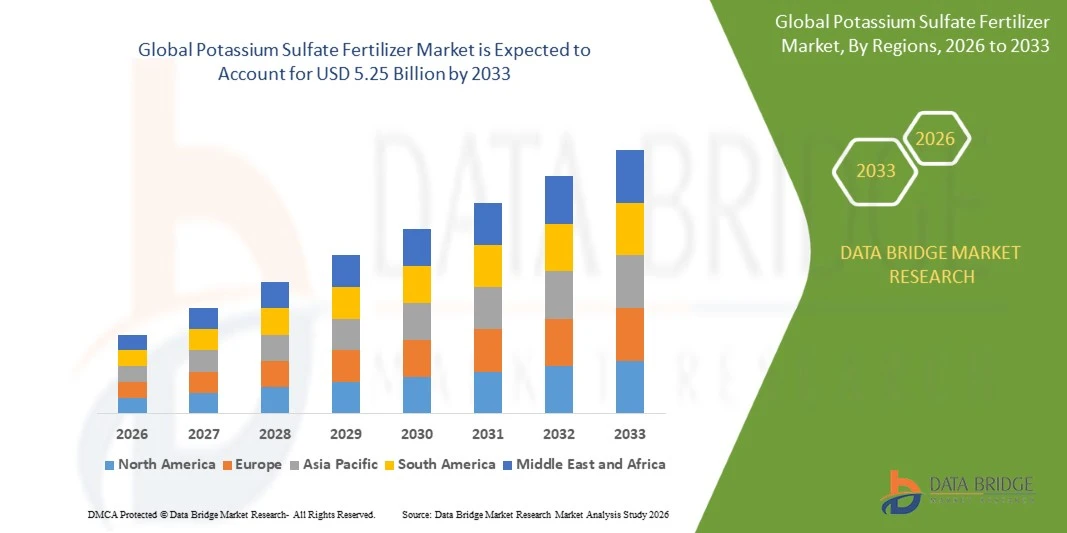
- As per Data Bridge Market Research analysis, the potassium sulfate fertilizer market was valued at USD 3.64 billion in 2025 and is projected to reach USD 5.25 billion by 2033, growing at a CAGR of 4.70% from 2026 to 2033.
- The market is experiencing consistent growth driven by rising demand for chloride-free fertilizers, increasing adoption of high-efficiency agricultural inputs, and expanding cultivation of high-value crops such as fruits, vegetables, and nuts.
- The growing emphasis on improving crop quality, optimizing nutrient management, and enhancing agricultural productivity is encouraging farmers to adopt potassium sulfate fertilizers. Increasing demand for potassium and sulfur nutrients, particularly in chloride-sensitive crops, along with the expansion of fertigation and precision farming practices, is supporting market growth across global agricultural markets.
Market Size & Forecast
- Global Market Value (2025): USD 3.64 Billion
- Expected Market Value (2033): USD 5.25 Billion
- Forecast CAGR (2026–2033): 4.70%
- Leading Region in 2025: North America
- Fastest Growing Region: Asia Pacific
What are the Major Takeaways of the Potassium Sulfate Fertilizer Market?
- North America dominated the potassium sulfate fertilizer market with the largest revenue share of 32.5% in 2025, supported by advanced agricultural practices, high adoption of specialty fertilizers, and strong demand for high-quality crop production.
- Asia-Pacific is expected to be the fastest-growing region at a CAGR of 5.4% from 2026 to 2033, fueled by expanding agricultural activities, increasing demand for high-value crops, and rising adoption of modern fertilizer application practices in China, India, and Japan.
- The standard potassium sulfate (SOP) segment led the market with a 45% share in 2025, driven by its widespread use as a chloride-free source of potassium and sulfur in agricultural production.
- Water-soluble SOP are the fastest-growing product type, projected to register a CAGR of 5.8%, reflecting the surge in adoption of precision agriculture, fertigation, and greenhouse cultivation.
- The granular segment dominated the form category with a 55% revenue share in 2025, led by its suitability for conventional agricultural practices and large-scale fertilizer application
- Fruits accounted for 30% of the market share in 2025, preferred by the need for balanced potassium nutrition in commercial fruit production.
- The vegetables segment is the fastest-growing crop type category, with a CAGR of 5.6%, driven by rising demand for fresh produce and increasing investment in intensive horticultural farming.
Report Scope and Potassium Sulfate Fertilizer Market Segmentation
|
Attributes |
Potassium Sulfate Fertilizer Key Market Insights |
|
Segments Covered |
|
|
Countries Covered |
North America
Europe
Asia-Pacific
Middle East and Africa
South America
|
|
Key Market Players |
|
|
Market Opportunities |
|
|
Value Added Data Infosets |
In addition to the insights on market scenarios such as market value, growth rate, segmentation, geographical coverage, and major players, the market reports curated by the Data Bridge Market Research also include import export analysis, production capacity overview, production consumption analysis, price trend analysis, climate change scenario, supply chain analysis, value chain analysis, raw material/consumables overview, vendor selection criteria, PESTLE Analysis, Porter Analysis, and regulatory framework. |
What is the Key Trend in the Potassium Sulfate Fertilizer Market?
- The increasing adoption of specialty fertilizers and precision nutrient management is shaping the potassium sulfate fertilizer market, as farmers seek to improve crop quality, enhance nutrient-use efficiency, and reduce chloride exposure in sensitive crops.
- For instance, in May 2026, Fertilizer International, published by CRU, reported that global water-soluble fertilizer demand increased by 12% year over year to 6.0 million tonnes in 2024, while water-soluble potassium sulfate consumption reached approximately 0.9 million tonnes.
- The growing use of fertigation and controlled-environment agriculture is supporting demand for water-soluble potassium sulfate, particularly in greenhouse vegetables, fruits, and other high-value crops.
- For instance, in June 2024, Van Iperen International and Cinis Fertilizer inaugurated the GreenSwitch Potassium factory in Sweden to produce potassium sulfate using industrial waste products through a circular production model.
- As growers increasingly prioritize crop quality, efficient nutrient delivery, and sustainable fertilizer use, potassium sulfate is expected to remain an important specialty fertilizer for high-value and chloride-sensitive crops.
What are the Key Drivers of the Potassium Sulfate Fertilizer Market?
- The rising demand for high-quality agricultural produce is increasing the use of potassium sulfate fertilizers, particularly for fruits, vegetables, and other chloride-sensitive crops that require balanced potassium and sulfur nutrition.
- For instance, in February 2023, the U.S. Department of Agriculture published a technical evaluation explaining that potassium sulfate is preferred over potassium chloride for chloride-sensitive crops, including fruits, tobacco, and flowers, because it supplies potassium without adding chloride
- The expansion of commercial horticulture, greenhouse farming, and modern irrigation systems is encouraging farmers to adopt potassium sulfate products that support targeted nutrient delivery and improved crop management.
- For instance, in August 2026, the University of Georgia Extension published research evaluating potassium sources for pepper production, examining potassium sulfate as an alternative to potassium chloride due to differences in salt-related risks and fertilizer costs.
- As agricultural producers focus on improving crop productivity, meeting specialized nutrient requirements, and maintaining produce quality, demand for potassium sulfate fertilizers is expected to remain supported across commercial farming systems.
What Factors are Challenging the Growth of the Potassium Sulfate Fertilizer Market?
- Potassium sulfate fertilizers can be more expensive than conventional potassium chloride fertilizers, increasing input costs for farmers operating with limited agricultural budgets.
- For instance, in February 2024, Procurement Resource reported that potassium sulfate prices in China were declining amid abundant supply and weak downstream demand, with lower potassium chloride raw-material costs also contributing to the price movement.
- These higher costs can restrict adoption among small-scale farmers and price-sensitive agricultural markets, particularly where access to specialty fertilizers and modern nutrient-management systems remains limited.
- Fluctuations in raw-material prices, international trade conditions, transportation expenses, and fertilizer availability can increase procurement uncertainty for manufacturers, distributors, and agricultural buyers.
- For instance, in September 2025, the U.S. Department of Agriculture’s Economic Research Service reported that global fertilizer production, trade, and prices are affected by supply-chain conditions and international market dynamics. These factors can increase procurement uncertainty for potassium sulfate manufacturers that rely on potash feedstocks and associated raw materials
- The combination of higher fertilizer costs, dependence on reliable supply chains, and limited affordability among smaller farms continues to challenge wider potassium sulfate adoption, particularly in price-sensitive agricultural markets.
How is the Potassium Sulfate Fertilizer Market Segmented?
The potassium sulfate fertilizer market is segmented on the basis of product type, form, crop type, and end user.
- By Product Type
On the basis of product type, the potassium sulfate fertilizer market is segmented into standard potassium sulfate (SOP), granular SOP, and water-soluble SOP. The standard potassium sulfate (SOP) segment dominated the market with an estimated 45% share in 2025, owing to its widespread use as a chloride-free source of potassium and sulfur in agricultural production. It is particularly suitable for chloride-sensitive crops that require carefully managed nutrient inputs. Farmers use standard SOP to support crop development, improve produce quality, and address potassium deficiencies. Its compatibility with conventional fertilizer application practices supports demand across diverse farming systems. The product is also valued for supplying two essential plant nutrients in a single fertilizer.
The water-soluble SOP segment is projected to register the fastest growth at an estimated CAGR of 5.8% from 2026 to 2033, driven by increasing adoption of precision agriculture, fertigation, and greenhouse cultivation. Its high solubility enables nutrient delivery through drip irrigation and other suitable irrigation systems. This allows growers to apply potassium and sulfur more precisely according to crop requirements. Water-soluble SOP is particularly relevant for high-value fruits, vegetables, and horticultural crops. Increasing investment in controlled-environment agriculture is further supporting its use. The growing emphasis on water and fertilizer efficiency is encouraging farmers to adopt soluble nutrient formulations. These factors are expected to strengthen demand for water-soluble SOP during the forecast period.
- By Form
On the basis of form, the potassium sulfate fertilizer market is segmented into granular, powdered, and liquid. The granular segment dominated the market with an estimated 55% share in 2025, owing to its suitability for conventional agricultural practices and large-scale fertilizer application. Granular potassium sulfate is relatively convenient to handle, transport, store, and distribute across agricultural supply chains. Its physical characteristics support broadcasting, soil incorporation, and blending with compatible fertilizers. Commercial farms often prefer granular formulations because they can be applied using conventional fertilizer spreaders. The segment also benefits from established distribution networks serving agricultural retailers and wholesalers.
The liquid segment is projected to register the fastest growth at an estimated CAGR of 5.5% from 2026 to 2033, supported by increasing interest in precision nutrient delivery and modern irrigation-based farming. Liquid fertilizer formulations can be incorporated into suitable fertigation programs, allowing growers to manage nutrient application according to crop needs. Their use can support timely nutrient delivery during important stages of plant development. The expansion of greenhouse cultivation and intensive horticultural production is creating additional demand for specialized liquid nutrient products. Farmers are increasingly seeking application methods that improve operational efficiency and reduce unnecessary fertilizer use. Advancements in irrigation equipment and nutrient management systems are supporting this transition. However, adoption depends on formulation compatibility, solubility, and local agronomic requirements.
- By Crop Type
On the basis of crop type, the potassium sulfate fertilizer market is segmented into fruits, vegetables, cereals and grains, oilseeds and pulses, and turf and ornamentals. The fruits segment dominated the market with an estimated 30% share in 2025, driven by the need for balanced potassium nutrition in commercial fruit production. Potassium plays an important role in fruit development, sugar accumulation, water regulation, and overall crop quality. Potassium sulfate is particularly suitable for fruit crops sensitive to chloride or grown under conditions requiring careful chloride management. Growers use it in orchards and vineyards as part of crop-specific fertilization programs. Increasing demand for premium-quality fruits is encouraging producers to focus on effective nutrient management.
The vegetables segment is projected to register the fastest growth at an estimated CAGR of 5.6% from 2026 to 2033, driven by rising demand for fresh produce and increasing investment in intensive horticultural farming. Vegetable crops often require carefully balanced nutrient programs to support vegetative growth, fruit development, and marketable yield. Potassium sulfate provides potassium and sulfur without adding chloride, making it suitable for crops where chloride sensitivity is a concern. Its use is relevant to selected crops such as potatoes, tomatoes, peppers, and greenhouse vegetables, depending on soil conditions and agronomic requirements. Expanding protected cultivation and drip irrigation systems is creating demand for specialized fertilizer formulations. Rising consumer demand for high-quality vegetables is further encouraging improved nutrient management. These developments are expected to support growth in this segment.
- By End User
On the basis of end user, the potassium sulfate fertilizer market is segmented into commercial farming, horticulture, greenhouse, and household. The commercial farming segment dominated the market with an estimated 50% share in 2025, owing to the large fertilizer requirements of farms producing crops for domestic and international markets. Commercial growers use potassium sulfate to address potassium and sulfur requirements across selected field crops and high-value agricultural production. The fertilizer's low chloride content makes it suitable for farming systems where chloride management is important. Large-scale farms can incorporate it into established fertilizer application and soil management programs. Established agricultural distributors and bulk procurement arrangements further support its use.
The greenhouse segment is projected to register the fastest growth at an estimated CAGR of 6.0% from 2026 to 2033, supported by the expansion of protected cultivation and precision nutrient management. Greenhouse growers frequently rely on controlled irrigation and carefully formulated nutrient solutions to maintain consistent crop growth. Water-soluble potassium sulfate can provide potassium and sulfur through suitable fertigation systems when formulation compatibility and water quality requirements are met. Its application is relevant to high-value crops such as tomatoes, peppers, cucumbers, and selected ornamental plants. Growing investment in year-round cultivation is increasing the need for precise fertilizer management. Advances in irrigation automation and crop monitoring are further supporting specialized nutrient delivery. These factors are expected to encourage greater adoption of potassium sulfate fertilizers in greenhouse production.
Which Region Holds the Largest Share of the Potassium Sulfate Fertilizer Market?
- North America dominated the potassium sulfate fertilizer market with the largest revenue share of 32.5% in 2025, supported by advanced agricultural practices, high adoption of specialty fertilizers, and strong demand for high-quality crop production.
- The region also benefits from established agricultural supply chains, increasing cultivation of high-value crops, and growing demand for chloride-free fertilizers in crop production. Increasing emphasis on improving crop quality, optimizing fertilizer application, and enhancing agricultural productivity continues to strengthen North America's position in the global market
U.S. Potassium Sulfate Fertilizer Market Insight
The U.S. potassium sulfate fertilizer market is witnessing steady growth due to rising demand for specialty fertilizers, increasing cultivation of high-value crops, and growing emphasis on efficient nutrient management. The country’s advanced agricultural sector, along with widespread adoption of modern farming practices and precision agriculture technologies, is driving demand for potassium sulfate across commercial farming and horticultural applications. In addition, increasing focus on improving crop quality, managing chloride-sensitive crops, and optimizing fertilizer use is supporting market expansion.
Asia-Pacific Potassium Sulfate Fertilizer Market Insight
The Asia-Pacific potassium sulfate fertilizer market is expected to witness rapid growth, driven by expanding agricultural activities, increasing food demand, and rising investments in modern farming practices across countries such as China, India, and Japan. Growing cultivation of fruits and vegetables, increasing adoption of fertigation systems, and rising awareness of balanced crop nutrition are supporting regional market expansion. Additionally, the growing use of specialty fertilizers and increasing emphasis on improving agricultural productivity are accelerating potassium sulfate adoption across commercial farming and horticultural sectors.
Japan Potassium Sulfate Fertilizer Market Insight
The Japan potassium sulfate fertilizer market is witnessing consistent growth due to increasing demand for high-quality agricultural produce, advanced horticultural practices, and efficient nutrient management. Farmers and greenhouse operators are adopting potassium sulfate to supply essential potassium and sulfur nutrients, particularly for selected high-value and chloride-sensitive crops. Moreover, increasing integration of precision agriculture, controlled-environment cultivation, and modern irrigation technologies is supporting demand for specialized fertilizer formulations and contributing to market growth.
China Potassium Sulfate Fertilizer Market Insight
The China potassium sulfate fertilizer market is growing steadily, driven by extensive agricultural production, increasing demand for specialty fertilizers, and rising focus on improving crop quality and nutrient-use efficiency. Growing cultivation of fruits, vegetables, and other high-value crops is supporting demand for potassium sulfate across commercial farming and horticultural applications. In addition, increasing adoption of modern irrigation systems, greenhouse cultivation, and precision nutrient management is contributing to market development and strengthening China's role in the global potassium sulfate fertilizer industry.
U.K. Potassium Sulfate Fertilizer Market Insight
The U.K. potassium sulfate fertilizer market is experiencing steady growth, supported by demand for specialized crop nutrition, expanding horticultural production, and increasing emphasis on efficient fertilizer application. Farmers and commercial growers are using potassium sulfate for selected crops that require potassium and sulfur while limiting chloride exposure. Furthermore, growing interest in precision agriculture, protected cultivation, and sustainable nutrient management is encouraging the use of specialty fertilizers, supporting adoption across commercial farming and horticultural applications.
Germany Potassium Sulfate Fertilizer Market Insight
The Germany potassium sulfate fertilizer market is expanding steadily due to the country's established agricultural sector, strong horticultural production, and increasing emphasis on efficient nutrient management. Farmers are adopting potassium sulfate to support crop nutrition and meet the requirements of selected high-value and chloride-sensitive crops. Continuous advancements in precision farming, fertigation, and controlled-environment agriculture, along with growing interest in sustainable fertilizer practices, are further supporting market demand in Germany.
Which are the Top Companies in Potassium Sulfate Fertilizer Market?
The potassium sulfate fertilizer industry is primarily led by well-established companies, including:
- K+S Aktiengesellschaft (Germany)
- Tessenderlo Group NV (Belgium)
- Sociedad Química y Minera de Chile S.A. (Chile)
- Compass Minerals International, Inc. (U.S.)
- Cinis Fertilizer AB (Sweden)
- KSM inc. (Canada)
- Haifa Negev technologies LTD (Israel)
- Van Iperen International B.V. (Netherlands)
- DCM Shriram Limited (India)
- ICL Group Ltd. (Israel)
- Yara International ASA (Norway)
- EuroChem Group AG (Switzerland)
- Nutrien Ltd. (Canada)
- The Mosaic Company (U.S.)
- Coromandel International Limited (India)
- Paradeep Phosphates Limited (India)
- Gujarat State Fertilizers & Chemicals Limited (India)
- Deepak Fertilisers and Petrochemicals Corporation Limited (India)
- Aries Agro Limited (India)
- Sev.en Global Investments a.s. (Czech Republic)
What are Latest Developments in Potassium Sulfate Fertilizer Market?
- In July 2025, Upcycle Minerals announced the launch of its Brine to Potassium Sulfate Fertilizer with Carbon Capture project in Saskatchewan, Canada. The company engaged Stantec Consulting to conduct preliminary engineering assessments for the proposed production facility. The project aims to develop a domestic source of potassium sulfate and support fertilizer supply in North America.
- In July 2024, SO4, a subsidiary of Sev.en Global Investments, announced the successful production of its first potassium sulfate at the Lake Way facility in Western Australia. The milestone demonstrated progress toward commercial operation following investments in plant-process improvements and new flotation equipment. The development supported efforts to establish a domestic source of specialty potassium fertilizer in Australia.
- In June 2024, Cinis Fertilizer officially inaugurated its first potassium sulfate production facility in Örnsköldsvik, Sweden. The facility uses industrial waste products as inputs in a circular production process designed to manufacture potassium sulfate with a lower carbon footprint. The development marked a significant step toward more resource-efficient specialty fertilizer production.
- In February 2024, DCM Shriram Bio Enchem commenced commercial production at its sulphate of potash plant at the Hariawan sugar facility in Uttar Pradesh, India. The plant uses technology developed by CSIR–Central Salt and Marine Chemicals Research Institute to recover potassium-based fertilizers from distillery spent-wash ash. The initiative supports domestic fertilizer production through the utilization of industrial by-products.
- In June 2022, K+S announced that it had signed a letter of intent with Cinis Fertilizer to cooperate in the synthetic production of potassium sulfate in Scandinavia. Under the proposed arrangement, K+S would supply potassium chloride feedstock, while it could purchase potassium sulfate produced by Cinis. The collaboration aimed to expand specialty fertilizer availability and develop a production process using industrial residues and renewable energy.
- Interactive Data Analysis Dashboard
- Company Analysis Dashboard for high growth potential opportunities
- Research Analyst Access for customization & queries
- Competitor Analysis with Interactive dashboard
- Latest News, Updates & Trend analysis
- Harness the Power of Benchmark Analysis for Comprehensive Competitor Tracking
Data collection and base year analysis are done using data collection modules with large sample sizes. The stage includes obtaining market information or related data through various sources and strategies. It includes examining and planning all the data acquired from the past in advance. It likewise envelops the examination of information inconsistencies seen across different information sources. The market data is analysed and estimated using market statistical and coherent models. Also, market share analysis and key trend analysis are the major success factors in the market report. To know more, please request an analyst call or drop down your inquiry.
The key research methodology used by DBMR research team is data triangulation which involves data mining, analysis of the impact of data variables on the market and primary (industry expert) validation. Data models include Vendor Positioning Grid, Market Time Line Analysis, Market Overview and Guide, Company Positioning Grid, Patent Analysis, Pricing Analysis, Company Market Share Analysis, Standards of Measurement, Global versus Regional and Vendor Share Analysis. To know more about the research methodology, drop in an inquiry to speak to our industry experts.
Data Bridge Market Research is a leader in advanced formative research. We take pride in servicing our existing and new customers with data and analysis that match and suits their goal. The report can be customized to include price trend analysis of target brands understanding the market for additional countries (ask for the list of countries), clinical trial results data, literature review, refurbished market and product base analysis. Market analysis of target competitors can be analyzed from technology-based analysis to market portfolio strategies. We can add as many competitors that you require data about in the format and data style you are looking for. Our team of analysts can also provide you data in crude raw excel files pivot tables (Fact book) or can assist you in creating presentations from the data sets available in the report.