


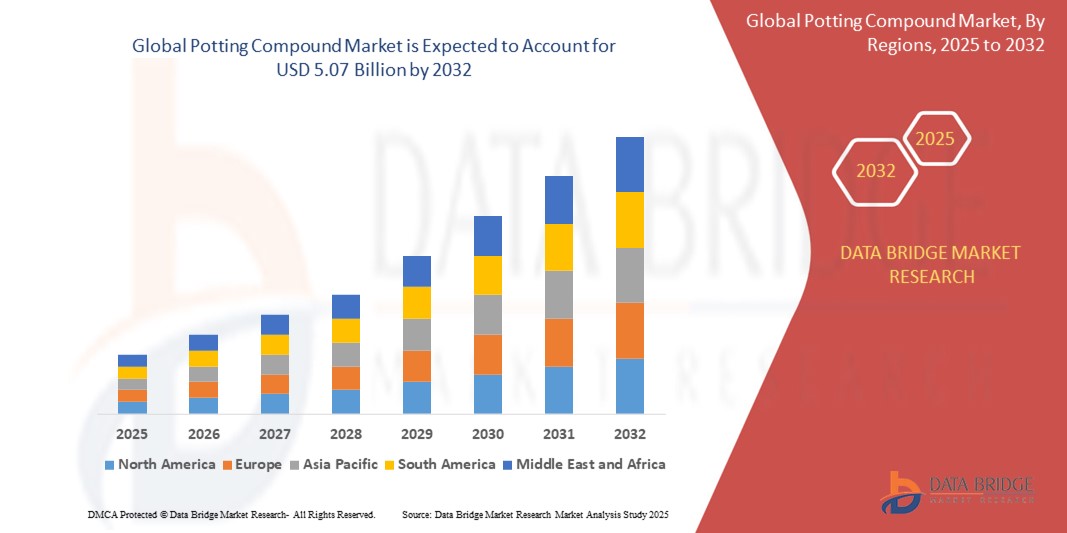
What is the Global Potting Compound Market Size and Growth Rate?
- The global potting compound market size was valued at USD 3.76 billion in 2024 and is expected to reach USD 5.07 billion by 2032, at a CAGR of 3.80% during the forecast period
- Market expansion is primarily driven by the increasing use of potting materials in electronic applications to protect sensitive components from moisture, dust, chemicals, and mechanical damage
- In addition, rapid advancements in electric vehicles, consumer electronics, renewable energy, and industrial automation are significantly contributing to the steady rise in potting compound demand worldwide
What are the Major Takeaways of Potting Compound Market?
- Potting Compounds are essential for encapsulation, insulation, and protection of electronic components, widely used across industries such as electronics, automotive, aerospace, and energy to enhance product durability and reliability
- The market is being accelerated by trends such as miniaturization of electronic devices, increased automation, and thermal management needs in high-performance applications
- Growth is also being fueled by rising demand for environmentally friendly and thermally conductive potting materials, especially in EVs, power modules, and smart electronic devices, ensuring long-term stability and protection
- Asia-Pacific dominated the potting compound market with the largest revenue share of 42.3% in 2024, driven by rapid industrialization, expanding electronics manufacturing, and increasing demand from automotive and renewable energy sectors
- North America is projected to be the fastest-growing region, with a CAGR of 3.7% from 2024 to 2030, fueled by advancements in electronics, automotive, and renewable energy sectors. The region's growth is supported by increasing investments in electric vehicles, rising demand for consumer electronics, and the expansion of renewable energy projects
- The Epoxy segment dominated the market with the largest revenue share of 47.5% in 2024, driven by its excellent mechanical strength, chemical resistance, and electrical insulation properties
Report Scope and Potting Compound Market Segmentation
|
Attributes |
Potting Compound Key Market Insights |
|
Segments Covered |
|
|
Countries Covered |
North America
Europe
Asia-Pacific
Middle East and Africa
South America
|
|
Key Market Players |
|
|
Market Opportunities |
|
|
Value Added Data Infosets |
In addition to the insights on market scenarios such as market value, growth rate, segmentation, geographical coverage, and major players, the market reports curated by the Data Bridge Market Research also include in-depth expert analysis, pricing analysis, brand share analysis, consumer survey, demography analysis, supply chain analysis, value chain analysis, raw material/consumables overview, vendor selection criteria, PESTLE Analysis, Porter Analysis, and regulatory framework. |
What is the Key Trend in the Potting Compound Market?
“High Demand for Miniaturization and High Thermal Performance”
- A prominent trend shaping the potting compound market is the increasing demand for miniaturized electronic components and high thermal conductivity compounds in consumer electronics, automotive electronics, and industrial control systems
- Manufacturers are innovating low-viscosity, thermally conductive potting compounds that ensure effective heat dissipation and protect sensitive microelectronic parts from harsh environmental conditions
- For instance, Henkel offers Loctite SI 5972, a thermally conductive potting compound ideal for compact electronic circuits requiring both flexibility and high heat transfer
- With rapid advances in power electronics and the growing popularity of electric vehicles (EVs), there is a rising need for lightweight yet robust potting materials to handle higher voltages and temperatures
- This trend is also evident in renewable energy systems, where potting compounds are used in solar inverters and wind turbine control units to enhance durability and insulation
- As industries continue to move towards smaller, faster, and hotter electronics, demand for next-generation potting compounds that combine electrical insulation, thermal management, and space-saving benefits is projected to accelerate
What are the Key Drivers of Potting Compound Maret?
- The increased production of consumer electronics and automotive electronics, combined with rising demand for protection against moisture, chemicals, and vibration, are key growth drivers for the potting compound market
- For instance, in February 2024, 3M Electronics launched a new line of high-performance polyurethane potting compounds designed for EV batteries and onboard charging systems
- The proliferation of smart devices, connected cars, and industrial automation systems has intensified the need for durable encapsulation materials to extend the lifecycle of PCBs and sensitive electrical components
- Furthermore, the transition toward renewable energy and electrification of transportation has boosted demand for potting compounds in solar panels, battery packs, and charging stations
- The market is also driven by regulatory compliance requirements for safety and performance in high-voltage applications, prompting manufacturers to adopt advanced potting materials with high dielectric strength and flame retardancy
- As industries continue to digitize and rely on complex electronics, potting compounds serve a critical role in device reliability, acting as a shield against physical and electrical damage
Which Factor is challenging the Growth of the Potting Compound Market?
- A key challenge in the potting compound market is the difficulty in reworking and repairing potted components once the compound has cured, limiting flexibility for electronics manufacturers
- For instance, repair and replacement of encapsulated circuits can result in entire unit discard, increasing production costs and material waste especially problematic in industries that rely on rapid prototyping or low-volume customization
- Moreover, regulatory and environmental concerns related to the use of certain epoxy resins and solvents—especially in Europe and North America can constrain market growth
- Another hurdle is the complex application process and need for precise dispensing equipment, which may deter small and medium-sized enterprises (SMEs) from adopting potting solutions
- The high-performance potting compounds that offer thermal conductivity and chemical resistance also come with elevated costs, potentially limiting their adoption in cost-sensitive markets or consumer products
- Overcoming these challenges will require innovation in reworkable formulations, compliance with evolving environmental standards, and the development of cost-effective potting technologies that balance performance with sustainability
How is the Potting Compound Market Segmented?
The market is segmented on the basis of resin type, function, curing techniques, application, and end-user.
By Resin Type
On the basis of resin type, the potting compound market is segmented into Epoxy, Polyurethane, Silicone, Polyester, Polyamide, Polyolefin, and Acrylics. The Epoxy segment dominated the market with the largest revenue share of 47.5% in 2024, driven by its excellent mechanical strength, chemical resistance, and electrical insulation properties. Epoxy resins are widely preferred in electronics and automotive applications due to their strong adhesion and durability under harsh conditions. The demand for epoxy potting compounds is further supported by their versatility and compatibility with various curing techniques.
The Silicone segment is expected to witness the fastest CAGR from 2025 to 2032, fueled by its superior thermal stability, flexibility, and resistance to moisture, making it ideal for high-temperature and sensitive electronic applications.
By Application
On the basis of application, the market is segmented into Electrical and Electronics. The Electrical and Electronics segment accounted for the largest market revenue share of 62.3% in 2024, due to the increasing need for protection and insulation of delicate electronic components and circuits in consumer devices, automotive electronics, and industrial equipment.
By Curing Techniques
On the basis of curing techniques, the potting compound market is segmented into UV Curing, Thermal Curing, and Room Temperature Curing. The Thermal Curing segment dominated the market with a revenue share of 53.8% in 2024, favored for its reliable curing process and suitability for large-scale industrial applications requiring consistent performance and strong bonding.
The UV Curing segment is projected to register the fastest growth rate over the forecast period, attributed to its rapid curing times and energy efficiency, especially in applications demanding quick turnaround and precision.
By Function
On the basis of function, the market is segmented into Corrosion Resistance and Insulation. The Insulation segment held the largest revenue share of 58.7% in 2024, owing to the critical role of potting compounds in electrically isolating sensitive components and preventing short circuits in electronic assemblies.
The Corrosion Resistance segment is expected to grow rapidly, driven by increasing demand in harsh environmental conditions such as automotive and marine applications where chemical and moisture resistance is essential.
By End-Users
On the basis of end-users, the potting compound market is segmented into Electronics, Transportation, Energy and Power, Industrial, and Others. The Electronics segment dominated the market with the largest revenue share of 55.9% in 2024, propelled by the booming consumer electronics sector and the rising use of potting compounds in smartphones, computers, and other smart devices.
The Transportation segment is anticipated to exhibit the fastest CAGR during the forecast period, driven by the growing adoption of electric vehicles and advanced automotive electronics requiring enhanced protection and thermal management.
Which Region Holds the Largest Share of the Potting Compound Market?
- Asia-Pacific dominated the potting compound market with the largest revenue share of 42.3% in 2024, driven by rapid industrialization, expanding electronics manufacturing, and increasing demand from automotive and renewable energy sectors
- Countries like China, India, and Japan are major contributors, owing to their robust electronics and automotive industries, and supportive government initiatives promoting domestic manufacturing
- The region's dominance is further bolstered by the presence of key market players and the availability of raw materials, facilitating cost-effective production and supply chain efficiencies
China Potting Compound Market Insight
China held the largest market share in the Asia-Pacific potting compound market in 2024, attributed to its status as a global manufacturing hub for electronics and automotive components. The country's focus on electric vehicles and renewable energy projects further amplifies the demand for potting compounds to ensure component reliability and longevity.
India Potting Compound Market Insight
India is experiencing significant growth in the potting compound market, driven by government initiatives like "Make in India" and the expansion of its electronics manufacturing sector. The increasing adoption of electric vehicles and renewable energy solutions also contributes to the rising demand for potting compounds in the country.
Japan Potting Compound Market Insight
Japan's potting compound market is characterized by advanced technological developments and a strong focus on quality and reliability. The country's well-established electronics and automotive industries, coupled with continuous R&D investments, support the steady demand for high-performance potting compounds.
Which Region is the Fastest Growing Region in the Potting Compound Market?
North America is projected to be the fastest-growing region, with a CAGR of 3.7% from 2024 to 2030, fueled by advancements in electronics, automotive, and renewable energy sectors. The region's growth is supported by increasing investments in electric vehicles, rising demand for consumer electronics, and the expansion of renewable energy projects, all of which require reliable potting solutions for component protection. Additionally, stringent regulations regarding electronic component safety and performance standards drive the adoption of high-quality potting compounds in the region.
U.S. Potting Compound Market Insight
The U.S. accounted for the largest revenue share in the North American potting compound market in 2024, driven by its leading position in technological innovation and manufacturing. The country's emphasis on electric vehicles, renewable energy, and advanced electronics continues to propel the demand for potting compounds.
Canada Potting Compound Market Insight
Canada's potting compound market is witnessing growth due to the expansion of its renewable energy sector and increasing adoption of electric vehicles. Government incentives and a focus on sustainable technologies contribute to the rising demand for potting solutions in various applications.
Mexico Potting Compound Market Insight
Mexico is emerging as a key player in the potting compound market, supported by its growing electronics manufacturing industry and strategic location for exports. The country's participation in global supply chains and investments in automotive and electronics sectors drive the demand for potting compounds.
Which are the Top Companies in Potting Compound Market?
The potting compound industry is primarily led by well-established companies, including:
- ELANTAS GmbH (Germany)
- Henkel AG & Co. KGaA (Germany)
- Master Bond Inc. (U.S.)
- Dymax Corporation (U.S.)
- Electrolube (U.K.)
- CHT Germany GmbH (Germany)
- EFI Polymers (U.S.)
- INTERTRONICS (U.K.)
- MG Chemicals (Canada)
- Dow (U.S.)
- H.B. Fuller Company (U.S.)
- 3M (U.S.)
- Aremco (U.S.)
- Hitachi Chemical Co., Ltd. (Japan)
- Wacker Chemie AG (Germany)
- Huntsman International LLC (U.S.)
- Parker Hannifin Corp (U.S.)
- RBC Industries Inc (U.S.)
What are the Recent Developments in Global Potting Compound Market?
- In February 2024, PPG expanded its aerospace product portfolio by introducing PPG PR-2940 and PPG PR-2936 adhesives, with PPG PR-2940 ESPA being a lightweight potting compound specifically engineered to reinforce and fill honeycomb structures in aircraft. The solution supports OEMs and MROs in fabricating essential internal components such as wings, galleys, lavatories, and overhead bins. This launch underscores PPG’s commitment to providing advanced, application-specific solutions to the aerospace industry
- In February 2024, Kerafol and X2F announced a partnership aimed at enhancing thermal management solutions for electronic potting compound devices by combining Kerafol’s thermally conductive materials with X2F’s controlled-viscosity molding technology. This collaboration targets the electronics industry’s growing demand for high-performance thermal management systems. The move marks a significant step toward developing next-gen potting solutions for complex electronics
- In May 2023, Henkel AG introduced three new potting products for the automotive sector, including Loctite AA 5832 (polyacrylate-based), Loctite SI 305 (silicone-based), and the two-component Loctite PE 8086 AB, designed to offer both physical protection and thermal control. These sealants integrate easily into automated manufacturing and are highly compatible with automotive materials. The launch strengthens Henkel’s position in automotive-grade potting and encapsulation technologies
- In May 2021, Dymax and HZO formed a strategic alliance to address increasing demand for protective coatings across IoT, edge computing, and rugged electronic devices. This collaboration focuses on safeguarding mission-critical technologies—such as autonomous vehicles, wearables, and smart meters—through advanced protective potting and coating materials. This partnership reflects an industry-wide shift toward comprehensive protection for next-generation electronics
- In February 2021, Panacol introduced Vitralit UD 8052 F, a high-strength adhesive designed specifically for piezo actuators and sensors, offering exceptional tear resistance ideal for bonding ceramics and plastics. This adhesive ensures long-term durability in sensitive electronic applications. This product innovation highlights Panacol’s focus on performance-driven bonding solutions in precision electronics

- Interactive Data Analysis Dashboard
- Company Analysis Dashboard for high growth potential opportunities
- Research Analyst Access for customization & queries
- Competitor Analysis with Interactive dashboard
- Latest News, Updates & Trend analysis
- Harness the Power of Benchmark Analysis for Comprehensive Competitor Tracking
Global Potting Compound Market, Supply Chain Analysis and Ecosystem Framework
To support market growth and help clients navigate the impact of geopolitical shifts, DBMR has integrated in-depth supply chain analysis into its Global Potting Compound Market research reports. This addition empowers clients to respond effectively to global changes affecting their industries. The supply chain analysis section includes detailed insights such as Global Potting Compound Market consumption and production by country, price trend analysis, the impact of tariffs and geopolitical developments, and import and export trends by country and HSN code. It also highlights major suppliers with data on production capacity and company profiles, as well as key importers and exporters. In addition to research, DBMR offers specialized supply chain consulting services backed by over a decade of experience, providing solutions like supplier discovery, supplier risk assessment, price trend analysis, impact evaluation of inflation and trade route changes, and comprehensive market trend analysis.
Data collection and base year analysis are done using data collection modules with large sample sizes. The stage includes obtaining market information or related data through various sources and strategies. It includes examining and planning all the data acquired from the past in advance. It likewise envelops the examination of information inconsistencies seen across different information sources. The market data is analysed and estimated using market statistical and coherent models. Also, market share analysis and key trend analysis are the major success factors in the market report. To know more, please request an analyst call or drop down your inquiry.
The key research methodology used by DBMR research team is data triangulation which involves data mining, analysis of the impact of data variables on the market and primary (industry expert) validation. Data models include Vendor Positioning Grid, Market Time Line Analysis, Market Overview and Guide, Company Positioning Grid, Patent Analysis, Pricing Analysis, Company Market Share Analysis, Standards of Measurement, Global versus Regional and Vendor Share Analysis. To know more about the research methodology, drop in an inquiry to speak to our industry experts.
Data Bridge Market Research is a leader in advanced formative research. We take pride in servicing our existing and new customers with data and analysis that match and suits their goal. The report can be customized to include price trend analysis of target brands understanding the market for additional countries (ask for the list of countries), clinical trial results data, literature review, refurbished market and product base analysis. Market analysis of target competitors can be analyzed from technology-based analysis to market portfolio strategies. We can add as many competitors that you require data about in the format and data style you are looking for. Our team of analysts can also provide you data in crude raw excel files pivot tables (Fact book) or can assist you in creating presentations from the data sets available in the report.













