What is the Poultry Feed Anticoccidials Market Size and Growth Rate?
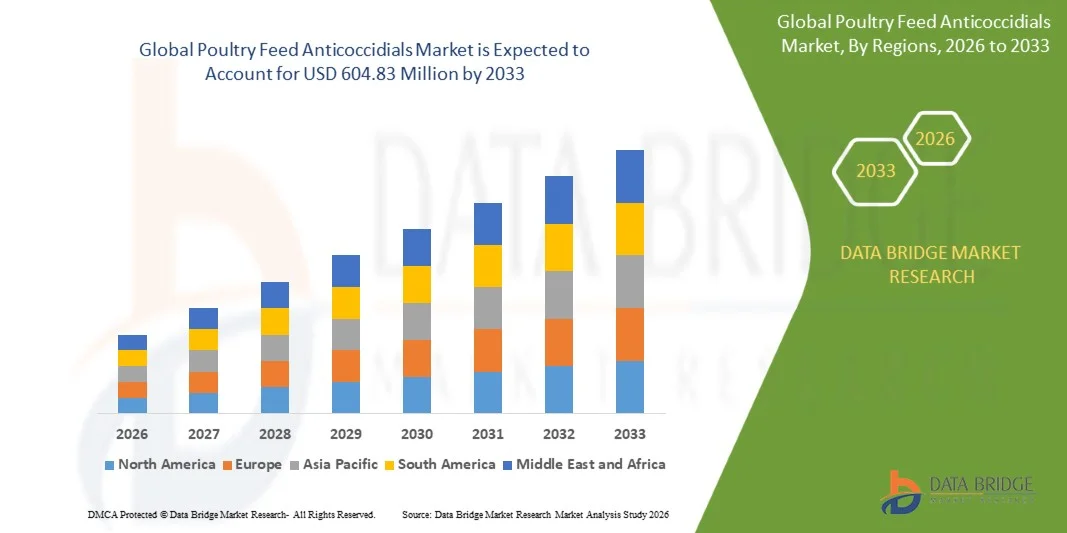
- As per Data Bridge Market Research analysis, the poultry feed anticoccidials market was valued at USD 428.58 million in 2025 and is projected to reach USD 604.83 million by 2033, growing at a CAGR of 4.40% from 2026 to 2033.
- The market is experiencing consistent growth driven by rising global poultry production, increasing prevalence of coccidiosis, growing demand for effective disease-prevention solutions, and expanding adoption of anticoccidial feed additives across commercial poultry farms.
- The increasing emphasis on poultry health, feed efficiency, and food safety, combined with the expansion of intensive poultry farming, is encouraging producers to adopt effective anticoccidial solutions. Ionophore, chemical-derivative, and natural anticoccidials are increasingly incorporated into poultry feed programs to control coccidiosis, improve flock performance, and address concerns related to disease resistance and sustainable poultry production.
Market Size & Forecast
- Global Market Value (2025): USD 428.58 Million
- Expected Market Value (2033): USD 604.83 Million
- Forecast CAGR (2026–2033): 4.40%
- Leading Region in 2025: North America
- Fastest Growing Region: Asia Pacific
What are the Major Takeaways of the Poultry Feed Anticoccidials Market?
- North America dominated the poultry feed anticoccidials market with the largest revenue share of 38% in 2025, supported by large-scale commercial poultry production, stringent feed-safety regulations, and widespread adoption of coccidiosis prevention programs.
- Asia-Pacific is expected to be the fastest-growing region at a CAGR of 6.8% from 2026 to 2033, fueled by expanding poultry production, rising animal-protein consumption, increasing commercial feed manufacturing, and modernization of poultry farming operations.
- The chemical segment led the market with a 77% share in 2025, driven by the established use of synthetic anticoccidial compounds in commercial poultry production.
- Natural are the fastest-growing source type, projected to register a CAGR of 8.4%, reflecting the surge in interest in natural approaches to poultry health management.
- The broilers segment dominated the livestock category with a 65% revenue share in 2025, led by the extensive scale of commercial broiler production and the importance of coccidiosis prevention in rapidly growing birds
- Dry accounted for 74% of the market share in 2025, preferred by its compatibility with established commercial feed-manufacturing processes
- The chemical derivative anticoccidials segment is the fastest-growing drug type category, with a CAGR of 6.5%, driven by increasing demand for diversified coccidiosis-control strategies
Report Scope and Poultry Feed Anticoccidials Market Segmentation
|
Attributes |
Poultry Feed Anticoccidials Key Market Insights |
|
Segments Covered |
|
|
Countries Covered |
North America
Europe
Asia-Pacific
Middle East and Africa
South America
|
|
Key Market Players |
|
|
Market Opportunities |
|
|
Value Added Data Infosets |
In addition to the insights on market scenarios such as market value, growth rate, segmentation, geographical coverage, and major players, the market reports curated by the Data Bridge Market Research also include import export analysis, production capacity overview, production consumption analysis, price trend analysis, climate change scenario, supply chain analysis, value chain analysis, raw material/consumables overview, vendor selection criteria, PESTLE Analysis, Porter Analysis, and regulatory framework. |
What is the Key Trend in the Poultry Feed Anticoccidials Market?
- Natural and phytogenic anticoccidials are gaining attention as poultry producers seek alternatives to conventional coccidiostats, particularly amid resistance concerns and growing demand for residue-conscious poultry production and feed programs worldwide.
- For instance, in March 2025, Animals published a study evaluating a phytogenic supplement containing alkaloids and flavonoids in 256 broiler chickens experimentally challenged with Eimeria spp.; the supplement reduced fecal oocyst counts by 61.3% compared with the challenged control, highlighting growing interest in plant-based alternatives to conventional anticoccidials
- Feed manufacturers are increasingly exploring combinations of essential oils, botanicals, probiotics, and immune-supporting ingredients to improve gut health while supporting coccidiosis control and reducing dependence on conventional anticoccidial programs globally.
- For instance, in April 2024, Livestock Science published a field study evaluating Citrus aurantium peel essential oil and Yucca schidigera saponins in broilers experiencing coccidiosis; both natural ingredients reduced coccidia shedding and intestinal lesions while improving broiler growth performance, supporting the development of natural anticoccidial solutions.
- Growing interest in natural feed additives is encouraging research into standardized phytogenic formulations that deliver consistent anticoccidial activity, strengthen intestinal integrity, and fit integrated poultry health-management programs globally and commercially.
What are the Key Drivers of the Poultry Feed Anticoccidials Market?
- The rising poultry production and intensive farming are increasing exposure to Eimeria, encouraging producers to use anticoccidials routinely to protect flock health, maintain feed efficiency, and reduce disease-related production losses worldwide.
- For instance, in March 2025, Elanco highlighted that coccidiosis is a leading health challenge in broiler production and that it causes intestinal damage, reduced weight gain, and poorer feed efficiency
- Growing concerns about drug resistance are encouraging integrated anticoccidial programs combining rotation, vaccination, feed additives, and management practices to maintain effectiveness while reducing prolonged exposure to compounds across poultry operations.
- For instance, in May 2025, Huvepharma announced the launch of Monimax in Southeast Asia, combining monensin and nicarbazin, with the company reporting performance improvements including daily weight gain and feed conversion in trials.
- Continued investment in poultry health, biosecurity, and feed efficiency is expected to sustain demand for anticoccidials as producers prioritize preventive disease management across commercial broiler and layer operations globally.
Which Factors are Challenging the Growth of the Poultry Feed Anticoccidials Market?
- Anticoccidial resistance among Eimeria populations is challenging market growth because prolonged exposure to conventional compounds can reduce treatment effectiveness, requiring rotation, combination strategies, monitoring, and alternative control approaches in production.
- For instance, in December 2024, Veterinary Research published research identifying a specific mutation associated with reduced susceptibility of Eimeria tenella to salinomycin, highlighting the biological mechanisms behind anticoccidial resistance.
- Regulatory restrictions and consumer preference for reduced chemical inputs can complicate product development, registration, residue management, and commercialization of conventional anticoccidial products across major poultry-producing markets worldwide today and regionally.
- For instance, in September 2026, the UK Advisory Committee on Animal Feedingstuffs reviewed evidence concerning ionophore coccidiostats, including potential links between narasin exposure and transferable antimicrobial-resistance determinants, demonstrating the growing regulatory attention surrounding these feed additives.
- Variable performance of natural alternatives remains another challenge because differences in plant composition, dosage, standardization, field conditions, and Eimeria strains can make efficacy difficult to reproduce consistently across farms and regions.
How is the Poultry Feed Anticoccidials Market Segmented?
The poultry feed anticoccidials market is segmented on the basis of source, livestock, form, drug type, mode of consumption, and type.
- By Source
On the basis of source, the poultry feed anticoccidials market is segmented into chemical and natural. The chemical segment dominated the market with an 77% share in 2025, owing to the established use of synthetic anticoccidial compounds in commercial poultry production. Chemical anticoccidials are widely incorporated into poultry feed for preventing and controlling coccidiosis. Their established efficacy and availability across commercial veterinary products support widespread adoption. They are used across intensive broiler, layer, and breeder production systems. Established dosing practices and compatibility with feed manufacturing further strengthen their utilization. The availability of multiple chemical active ingredients also allows producers to develop structured coccidiosis-control programs.
The natural segment is projected to register the fastest growth at 8.4% CAGR from 2026 to 2033, driven by increasing interest in natural approaches to poultry health management. Natural anticoccidial solutions include plant extracts, phytogenic compounds, essential oils, and other bioactive ingredients. Poultry producers are increasingly exploring these products as complementary or alternative approaches to conventional anticoccidials. Growing consumer interest in naturally produced poultry products is supporting demand for such solutions. Increasing attention to antimicrobial resistance is also encouraging research into non-conventional disease-management approaches. Improvements in formulation technologies are enhancing the consistency and application of natural feed additives.
- By Livestock
On the basis of livestock, the poultry feed anticoccidials market is segmented into breeders, broilers, and layers. The broilers segment dominated the market with 65% share in 2025, owing to the extensive scale of commercial broiler production and the importance of coccidiosis prevention in rapidly growing birds. Broilers are particularly vulnerable to productivity losses associated with intestinal disease. Coccidiosis can negatively affect growth performance and feed utilization, increasing the importance of preventive disease-management programs. Anticoccidials are therefore widely incorporated into commercial broiler feeding programs. Large flock sizes and intensive production systems further increase demand for effective coccidiosis control. The expansion of poultry-meat production is also supporting consumption of anticoccidial products.
The layers segment is projected to register the fastest growth at 6.5% CAGR from 2026 to 2033, supported by increasing emphasis on maintaining flock health throughout extended egg-production cycles. Effective intestinal-health management is important for maintaining productivity in commercial layer operations. Producers are increasingly implementing preventive health programs to minimize disease-related production losses. Expansion of commercial egg production is generating additional demand for poultry health and feed-additive solutions. Improvements in feed formulation are also supporting more targeted disease-management practices. Increasing adoption of integrated flock-health programs is creating additional opportunities for anticoccidial products.
- By Form
On the basis of form, the poultry feed anticoccidials market is segmented into dry and liquid. The dry segment dominated the market with 74% share in 2025, owing to its compatibility with established commercial feed-manufacturing processes. Dry anticoccidials can be incorporated into premixes and complete poultry feeds using conventional feed-milling systems. Their ease of handling, storage, and transportation supports use across large-scale poultry operations. Dry formulations can also be distributed consistently through appropriately manufactured feed. Established feed-industry infrastructure further facilitates their widespread application. The availability of numerous dry anticoccidial products through animal-health and feed-additive suppliers supports adoption
The liquid segment is projected to register the fastest growth at 7.0% CAGR from 2026 to 2033, driven by demand for flexible administration and increasing modernization of poultry production systems. Liquid formulations can provide producers with additional flexibility in delivering anticoccidial products. They can be incorporated into suitable farm-based delivery systems where controlled administration is required. Advances in formulation technologies are improving product handling and stability. Increasing automation in commercial poultry facilities is also supporting more precise administration practices. Liquid products can complement feed-based disease-management programs in selected production environments.
- By Drug Type
On the basis of drug type, the poultry feed anticoccidials market is segmented into antibiotic anticoccidials, chemical derivative anticoccidials, and ionophore anticoccidials. The ionophore anticoccidials segment dominated the market with 59% share in 2025, owing to their long-established application in commercial poultry production. Ionophore anticoccidials include widely used compounds such as monensin, narasin, lasalocid, and salinomycin. These products have extensive application in the prevention and control of coccidiosis caused by Eimeria species. Their established performance and familiarity among poultry producers support continued utilization. Ionophores are also commonly incorporated into structured rotation and shuttle programs. Their compatibility with commercial feed systems further supports widespread adoption.
The chemical derivative anticoccidials segment is projected to register the fastest growth at 6.5% CAGR from 2026 to 2033, supported by increasing demand for diversified coccidiosis-control strategies. Chemical derivatives provide poultry producers with alternatives to ionophore-based products. Compounds such as diclazuril and nicarbazin are used in poultry coccidiosis-management programs. Producers can incorporate different active ingredients into rotation or shuttle strategies to diversify disease-control approaches. Growing attention to anticoccidial effectiveness is supporting demand for products with different mechanisms of action. Continued development of combination and targeted formulations is further supporting this segment.
- By Mode of Consumption
On the basis of mode of consumption, the poultry feed anticoccidials market is segmented into injection and oral. The oral segment dominated the market with 85% share in 2025, owing to its suitability for large-scale poultry production. Oral administration allows anticoccidial products to be delivered across large flocks without individually handling birds. This makes the approach particularly suitable for commercial broiler, layer, and breeder operations. Feed-based administration can be integrated into established poultry nutrition programs. It also reduces labor requirements compared with individual administration methods. The widespread use of medicated and supplemented feed systems further supports oral consumption.
The injection segment is projected to register the fastest growth at 4.5% CAGR from 2026 to 2033, supported by demand for targeted administration in specialized poultry-health applications. Injection-based delivery can provide direct administration where individual treatment is required. It can be useful in controlled veterinary settings and selected situations where rapid administration is necessary. Improvements in veterinary delivery equipment are supporting greater precision in administration. Increasing focus on targeted poultry health management is also creating demand for specialized delivery approaches. Although its application remains more limited than oral administration, specialized veterinary practices can support gradual adoption.
- By Type
On the basis of type, the poultry feed anticoccidials market is segmented into diclazuril, dinitro-o-toluamide (DOT), lasalocid, monensin, narasin, nicarbazin, salinomycin, and other types. The salinomycin segment dominated the market with 40% share in 2025, supported by its established use as an ionophore anticoccidial in commercial poultry production. Salinomycin is widely used for the prevention and control of coccidiosis in poultry. Its long-standing commercial application provides producers with an established disease-management option. The compound is active against important Eimeria species affecting poultry. Its compatibility with feed-based administration further supports its use in intensive production systems. Established knowledge regarding its application and incorporation into poultry-feed programs strengthens demand.
The diclazuril segment is projected to register the fastest growth at 6.8% CAGR from 2026 to 2033, driven by increasing demand for chemical anticoccidial alternatives and diversified coccidiosis-control programs. Diclazuril provides producers with a non-ionophore option for managing coccidial infections. Its application can support rotation strategies involving different anticoccidial compounds. Increasing attention to maintaining the effectiveness of coccidiosis-control programs is encouraging the use of diversified active ingredients. Diclazuril is also available in established veterinary formulations for poultry production. Growing demand for effective chemical alternatives is supporting its use across commercial poultry operations.
Which Region Holds the Largest Share of the Poultry Feed Anticoccidials Market?
- North America dominated the poultry feed anticoccidials market with the largest revenue share of 38% in 2025, supported by large-scale commercial poultry production, stringent feed-safety regulations, and widespread adoption of coccidiosis prevention programs.
- The region also benefits from intensive broiler and layer farming, well-developed veterinary services, and increasing emphasis on coccidiosis prevention and flock productivity. Strong presence of animal-health companies, advanced feed-management practices, and continued investment in poultry health technologies further strengthen North America's leading position in the global market.
U.S. Poultry Feed Anticoccidials Market Insight
The U.S. poultry feed anticoccidials market is witnessing steady growth due to large-scale commercial poultry production, strong demand for poultry meat and eggs, and increasing emphasis on coccidiosis prevention. The country’s well-established feed manufacturing infrastructure, along with widespread adoption of preventive flock-health programs, is driving demand for anticoccidial products across broiler, layer, and breeder operations. In addition, increasing focus on feed efficiency, flock productivity, and effective disease management is accelerating the adoption of anticoccidials across commercial poultry farms.
Asia-Pacific Poultry Feed Anticoccidials Market Insight
The Asia-Pacific poultry feed anticoccidials market is expected to witness rapid growth, driven by expanding poultry production, rising consumption of animal protein, and increasing investments in commercial poultry farming across countries such as China, India, and Japan. Growing adoption of intensive farming practices, modern feed manufacturing technologies, and preventive animal-health programs is supporting regional market expansion. In addition, increasing awareness regarding coccidiosis management and the growing presence of organized poultry producers are accelerating anticoccidial adoption across the region.
Japan Poultry Feed Anticoccidials Market Insight
The Japan poultry feed anticoccidials market is witnessing consistent growth due to rising emphasis on poultry health management, food safety, and efficient commercial production. Poultry producers are increasingly adopting preventive health programs and feed-based disease-management solutions to maintain flock productivity and control coccidiosis. Moreover, increasing use of advanced feed formulations, improved veterinary practices, and the country’s focus on maintaining high standards of poultry production are further contributing to market growth.
China Poultry Feed Anticoccidials Market Insight
The China poultry feed anticoccidials market is growing rapidly, driven by expanding commercial poultry production, rising demand for poultry products, and increasing adoption of intensive farming systems. Growing utilization of modern feed technologies and preventive flock-health programs is significantly boosting demand for anticoccidial products across commercial poultry operations. In addition, rising investments in poultry production infrastructure, increasing awareness regarding coccidiosis prevention, and the modernization of animal-health practices are supporting China's position as a major market for poultry feed anticoccidials.
U.K. Poultry Feed Anticoccidials Market Insight
The U.K. poultry feed anticoccidials market is experiencing steady growth, supported by established poultry production, increasing emphasis on animal health, and growing adoption of structured coccidiosis-control programs. Increasing investments in advanced feed management and disease-prevention practices are contributing to market growth. Furthermore, growing attention to antimicrobial stewardship, feed efficiency, and alternative approaches to poultry health management is encouraging producers to optimize anticoccidial use and supporting continued development of the U.K. poultry feed anticoccidials market.
Germany Poultry Feed Anticoccidials Market Insight
The Germany poultry feed anticoccidials market is expanding steadily due to the country’s established poultry farming industry, advanced feed manufacturing capabilities, and increasing focus on animal health management. Poultry producers and feed manufacturers are increasingly utilizing anticoccidial solutions as part of preventive flock-health programs to control coccidiosis and maintain production efficiency. Continuous advancements in feed formulation, veterinary practices, and alternative disease-management approaches, along with strong emphasis on food safety and sustainable poultry production, are further driving market growth in Germany.
Which are the Top Companies in Poultry Feed Anticoccidials Market?
The poultry feed anticoccidials industry is primarily led by well-established companies, including:
- Elanco Animal Health (U.S.)
- Zoetis Inc. (U.S.)
- Merck & Co., Inc. (U.S.)
- Boehringer Ingelheim (Germany)
- Huvepharma EOOD (Bulgaria)
- Phibro Animal Health Corporation (U.S.)
- Virbac (France)
- CEVA SANTE ANIMALE (France)
- Impextraco NV (Belgium)
- Kemin Industries, Inc. (U.S.)
- Amlan International (U.S.)
- Vetoquinol (France)
- ADISSEO (France)
- dsm-firmenich (Switzerland)
- EW Nutrition (Germany)
- ANIMINE (France)
- NOVUS INTERNATIONAL, INC. (U.S.)
- Alltech (U.S.)
- Jefo (Canada)
- Vetagro S.p.A. (Italy)
What are Latest Developments in Poultry Feed Anticoccidials Market?
- In May 2025, Huvepharma announced the launch of Monimax in Southeast Asia, expanding availability of its microgranulated anticoccidial combination of monensin and nicarbazin across markets including Malaysia, Indonesia, the Philippines, Thailand, and Vietnam. The product was developed to provide synergistic coccidiosis control while supporting poultry performance and feed efficiency. The launch reflects continued development of combination anticoccidial solutions for commercial poultry production.
- In January 2024, Boehringer Ingelheim announced the launch of VAXXILIVE Cocci 3, a poultry coccidiosis vaccine previously known as Hatchpak Cocci III. The product provides a biological alternative to in-feed anticoccidial drugs and contains three genetically stable precocious Eimeria strains targeting important species affecting broilers. The launch expanded the range of biological tools available for coccidiosis prevention and management in poultry production.
- In February 2023, Amlan International’s Phylox received the 2023 IPPE New Product Showcase “Best of the Best” in Live Production award, recognizing the product as an innovative natural, non-pharmaceutical solution for coccidiosis management. Phylox uses a blend of bioactive phytochemicals designed to target Eimeria species and provide an alternative to conventional anticoccidial drugs. The recognition highlighted the development of natural solutions for poultry producers seeking alternatives for no-antibiotic-ever production programs.
- In April 2022, Amlan International launched Phylox Feed, a natural alternative to anticoccidial drugs and vaccines, along with NeutraPath, for poultry and livestock producers. Phylox Feed was developed to support intestinal health and production performance in systems where conventional in-feed antibiotics and anticoccidial drugs are being reduced or removed. The launch demonstrated growing development of natural feed-based approaches to coccidiosis management.
- In May 2021, Elanco launched ZoaShield in the U.S., providing poultry producers with a flexible zoalene-based option for coccidiosis control. The product was positioned as an anticoccidial solution suitable for different poultry operations and was particularly relevant to producers managing No Antibiotics Ever flocks. The launch expanded Elanco’s poultry-health offering for maintaining effective coccidiosis-control programs.

- Interactive Data Analysis Dashboard
- Company Analysis Dashboard for high growth potential opportunities
- Research Analyst Access for customization & queries
- Competitor Analysis with Interactive dashboard
- Latest News, Updates & Trend analysis
- Harness the Power of Benchmark Analysis for Comprehensive Competitor Tracking
Data collection and base year analysis are done using data collection modules with large sample sizes. The stage includes obtaining market information or related data through various sources and strategies. It includes examining and planning all the data acquired from the past in advance. It likewise envelops the examination of information inconsistencies seen across different information sources. The market data is analysed and estimated using market statistical and coherent models. Also, market share analysis and key trend analysis are the major success factors in the market report. To know more, please request an analyst call or drop down your inquiry.
The key research methodology used by DBMR research team is data triangulation which involves data mining, analysis of the impact of data variables on the market and primary (industry expert) validation. Data models include Vendor Positioning Grid, Market Time Line Analysis, Market Overview and Guide, Company Positioning Grid, Patent Analysis, Pricing Analysis, Company Market Share Analysis, Standards of Measurement, Global versus Regional and Vendor Share Analysis. To know more about the research methodology, drop in an inquiry to speak to our industry experts.
Data Bridge Market Research is a leader in advanced formative research. We take pride in servicing our existing and new customers with data and analysis that match and suits their goal. The report can be customized to include price trend analysis of target brands understanding the market for additional countries (ask for the list of countries), clinical trial results data, literature review, refurbished market and product base analysis. Market analysis of target competitors can be analyzed from technology-based analysis to market portfolio strategies. We can add as many competitors that you require data about in the format and data style you are looking for. Our team of analysts can also provide you data in crude raw excel files pivot tables (Fact book) or can assist you in creating presentations from the data sets available in the report.